


Gaming stocks offer investors the opportunity to participate in the business of video games, digital platforms, and mobile applications. Through additional content, in-game purchases, and subscriptions, companies can generate revenue beyond the sale of a game.
At the same time, the industry is associated with particular risks. This article shows you which business models lie behind gaming stocks and what you should look for when selecting companies in this sector.

The most important facts in brief:
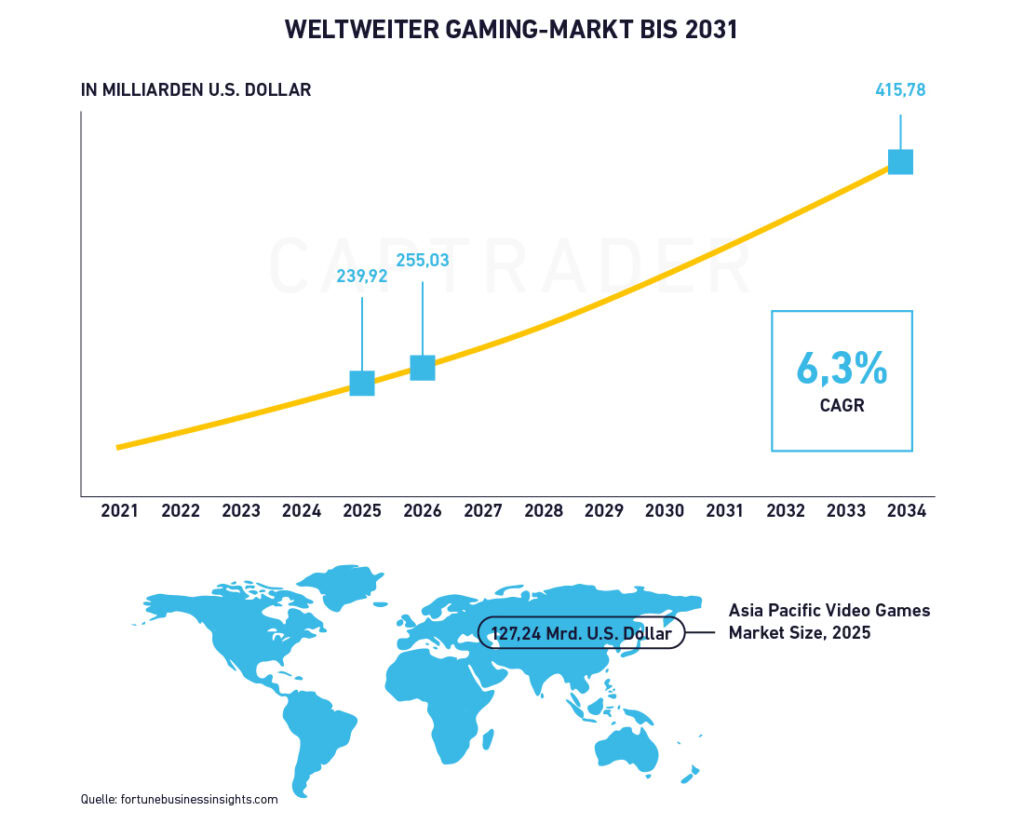
- The video game market is expected to grow from $255 billion in 2026 to nearly $416 billion by 2034.
- Market forecasts for cloud gaming and video game subscriptions are considered particularly promising.
- In addition to strong brands, factors that count for gaming stocks include development costs, the dependence on individual titles, and regulatory requirements.
What are gaming stocks?
Gaming stocks include developer studios and publishers, as well as operators of digital distribution platforms, console manufacturers, and providers of software for game development.
The business models differ significantly depending on the focus: While a publisher may depend on successful releases, a platform operator earns money from a wide variety of games offered.
For investors, gaming stocks can be divided into several categories:
- Game developers and publishersThese companies develop their own titles or finance and market games from other studios. Revenue potential arises from the sale of new games, expansions, and additional content. However, high development costs and unpredictable sales results can significantly affect results.
- Providers of online gamesThey operate games that are continuously updated after release. Revenue can come from in-game purchases, additional content, or subscriptions. The key is whether it is possible to keep players engaged in the long term without the costs of new content eating into the economic success.
- Developers of Mobile GamesTheir focus is on games for smartphones and tablets. Often, they combine free downloads with in-game purchases or advertising. For investors, the expenses for acquiring new users and the revenue per player are particularly relevant.
- Console manufacturers and platform operatorsThese companies sell gaming devices or operate digital stores and subscription services. They can benefit from both their own game offerings and purchases within their ecosystem. The demand for hardware and the attractiveness of exclusive titles noticeably influence their business development.
- Providers of development softwareThey provide game engines and other tools that studios use to create and operate games. Their business is therefore not solely dependent on the success of a single title. However, it is important whether developers use the software on a permanent basis and how much they pay for it.
Many large gaming companies combine several of these areas. They develop their own games, distribute them through their own platforms, and generate additional revenue after the launch of sales.
Such a breakdown can reduce the dependence on individual publications, but it does not eliminate the competitive pressure or the risk of costly failures. Therefore, anyone evaluating gaming stocks should not only pay attention to well-known game titles, but also to the revenue sources and cost structure of the respective company.


The market potential of gaming stocks and in 2026
The global video game market provides gaming stocks with a broad base of growth. Forecasts estimate the volume at $255.03 billion in 2026 and expect an increase to $415.78 billion by 2034. This corresponds to an average annual growth rate of 6.3 %%.
What is crucial for investors is not only how many games are sold, but also how companies can reach and engage their users over the long term.
The following presents two promising growth factors in the video game industry in detail.
Future prospects for gaming subscriptions
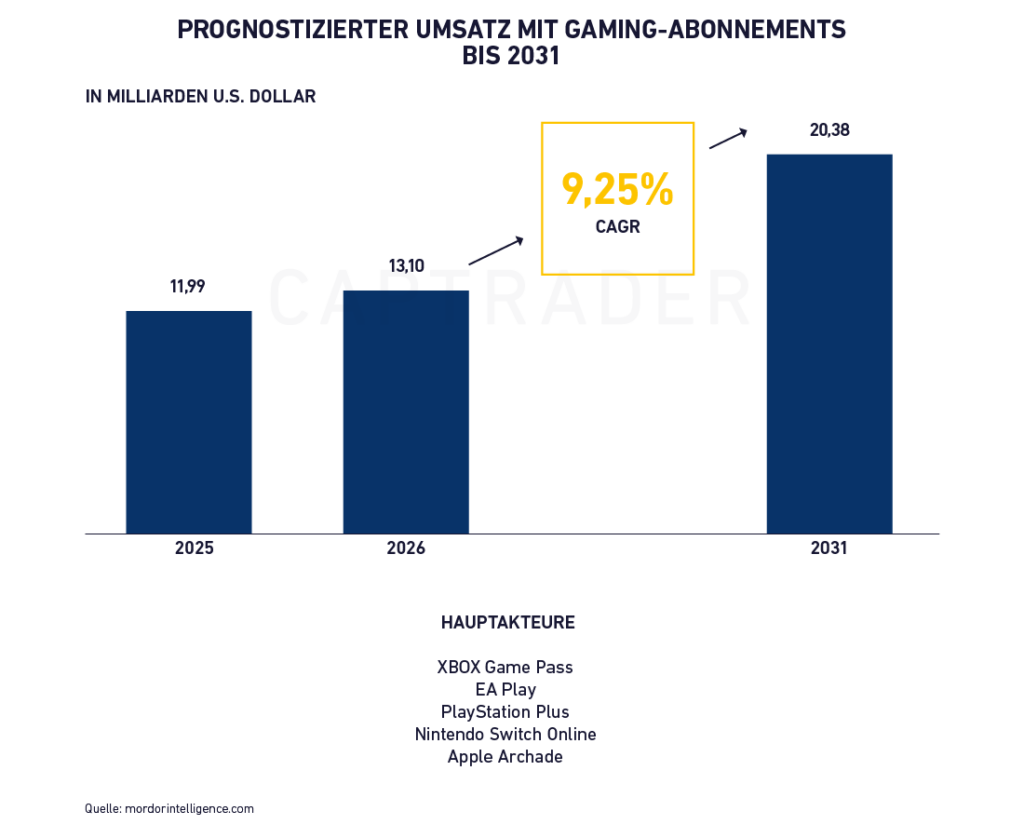
The global market for subscription-based gaming is expected to reach nearly $12 billion in 2025 and grow from $13.1 billion in 2026 to $20.38 billion by 2031. This represents an average annual growth rate of 9.25 %%.
An important driver of growth is access to extensive game libraries for a regular fee. In addition, new games are available as part of the subscription service on the day of release. Cross-platform accounts also allow users to switch between consoles, PCs, and mobile devices without losing their game progress.
Additional incentives are promised by family plans that bundle multiple users under one tariff, as well as gaming offers combined with mobile phone contracts.
Geographically, North America is the largest market for gaming subscriptions. However, the strongest growth is expected in the Asia-Pacific region, where high smartphone usage and the bundling of gaming services with mobile phone plans are driving demand.
Growth market for cloud gaming
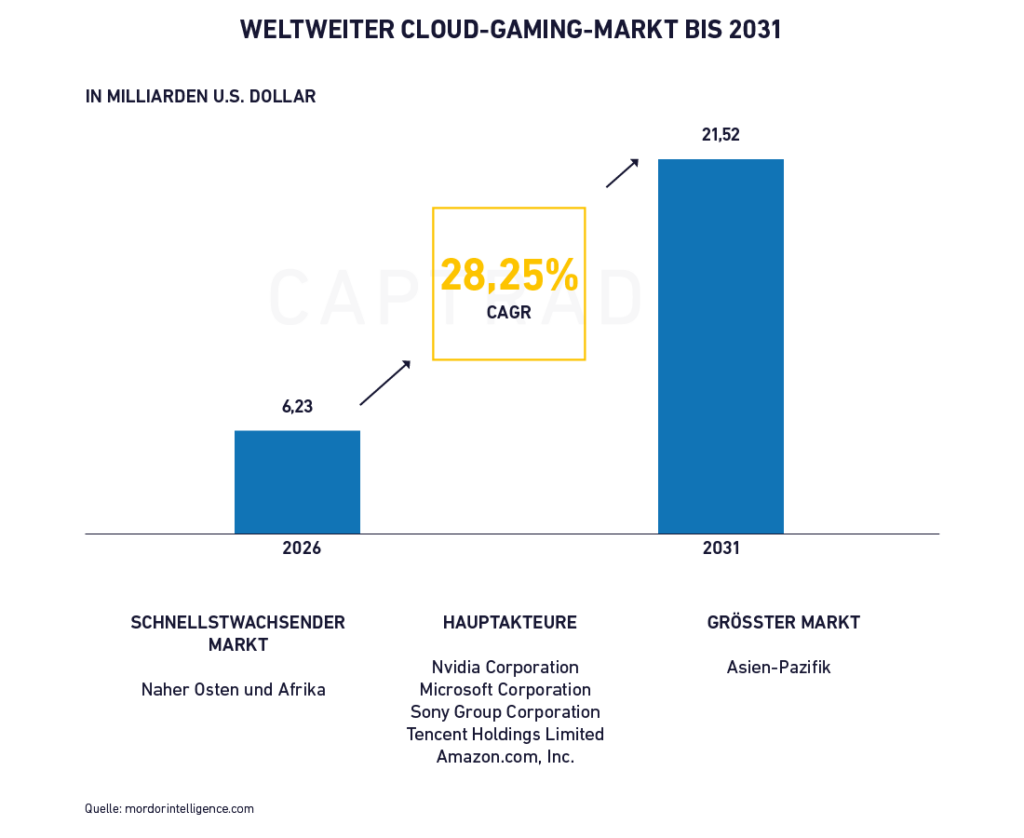
The global cloud gaming market is expected to grow from $6.23 billion in 2026 to $21.62 billion by 2031. This corresponds to an average annual growth rate of 28.25 %%. The forecast refers to revenue from the streaming of games, not the entire video game market.
An important driver of growth is the expansion of faster mobile networks and regional data centers. This allows games to be run on remote servers and streamed to smartphones, tablets, and smart TVs without requiring users to have a powerful console or gaming PC.
In addition, subscriptions, game offerings in mobile tariff plans, and a wider selection of titles available via streaming promote distribution. For providers, this opens up additional opportunities to attract new users and generate recurring revenue.
In terms of content, the market primarily encompasses the direct streaming of games as well as models that combine streaming with locally stored game data. Use takes place via various devices and is primarily funded through subscriptions, but also through usage-based and advertising-funded offerings.
Regionally, Asia-Pacific is the largest market, while the Middle East and Africa are expected to see the strongest growth. However, high costs for computing power, license fees, and an inadequate internet connection can slow down development. Therefore, it is important for investors: A growing cloud gaming market does not automatically mean increasing profits for every gaming stock.
Investing in gaming: The best video game stocks
The following overview presents selected publicly traded companies from the gaming industry. It includes notable companies. Blue chip stocks and provides you, as an investor, with initial guidance in your search for video game stocks.
Which stock is suitable for an investment depends, in addition to the business model, on the valuation and the individual risk profile.
| Company | ISIN | Country | Market capitalization in US dollars¹ |
| Microsoft Corporation | US5949181045 | USA | 3.833 billion |
| Tencent Holdings Limited | KYG875721634 | China | 501 billion |
| Sony Group Corporation | JP3435000009 | Japan | 138 billion |
| NetEase, Inc. | KYG6427A1022 | China | 74 billion |
| Sea Limited | US81141R1005 | Singapore | 61 billion |
| Nintendo Co., Ltd. | JP3756600007 | Japan | 59 billion |
| Electronic Arts Inc. | US2855121099 | USA | 53 billion |
| Take-Two Interactive Software, Inc. | US8740541094 | USA | 38 billion |
| Roblox Corporation | US7710491033 | USA | 33 billion |
| Aristocrat Leisure Limited | AU000000ALL7 | Australia | 25 billion |
To make a targeted investment in gaming stocks, you need a broker. At CapTrader, you can open an account and trade shares directly on more than 170 international stock exchanges. The trading fees are particularly low: for US stocks, you pay 1 cent per share, but at least 2.00 US dollars per order.


1. Take-Two Interactive Software
Iconic brands and long-standing franchises form the foundation of the success of Take-Two Interactive Software, Inc. (ISIN: US8740541094). The US publisher generates revenue through console and PC titles, in-game purchases, and mobile games.
Blockbusters like Grand Theft Auto, Red Dead Redemption and NBA 2K attract millions of players over the years. Through Rockstar Games, 2K and Zynga, the company generates ongoing revenue not only through one-time sales but also through live services.
For the gaming industry, the upcoming release of Grand Theft Auto VI (GTA 6) marks a historic turning point. As one of the most financially successful media launches ever, the title has the potential not only to massively boost Take-Two’s revenue but also to catalyze the entire hardware and video game market.
| Tax year | estimated revenue (in million USD)¹ | Change from previous year¹ |
| 2026 | 6.721 | 19,00 % |
| 2027 | 8.510 | 26,62 % |
| 2028 | 9.255 | 8,76 % |
2. Tencent Holdings Limited
Many successful online games rely on users returning year after year. This is exactly what a large part of Tencent's gaming business (ISIN: KYG875721634) is built on. China stock It earns both titles for the domestic market and games that are published internationally.
Brands like Honor of Kings, Delta Force and VALORANT show how Tencent actively keeps existing player communities engaged with new content. Outside of China, the company is also present with its own offerings and games of its subsidiaries. This not only generates revenue at the launch of a title, but also during its continued use.
For investors, the separation of the business divisions is important: In addition to gaming, Tencent operates social platforms, advertising, and financial services. These areas can also influence the stock price, just as a game's success can. In the gaming segment, developments in China and international business should be considered separately.
| Tax year | estimated revenue (in million USD)¹ | Change from previous year¹ |
| 2026 | 123.046 | 9,88 % |
| 2027 | 134.797 | 9,55 % |
| 2028 | 148.013 | 9,80 % |
3. Sony Group Corporation
Selling a PlayStation is only the beginning of the customer relationship for Sony (ISIN: JP3435000009). The company remains involved in its platform even after the hardware purchase, through the PlayStation Store, network services, and new games.
The company's own studios provide titles for the PlayStation platform. At the same time, external developers benefit from the existing user base when they release their games there. Sony thus combines the role of a console manufacturer with that of a platform operator and game publisher.
The Sony stock, however, does not depend solely on the PlayStation. Music, film, and image sensors are also part of the group. Anyone interested in Sony as a gaming stock should therefore take into account both the activities on the gaming platform and the development of the other business segments.
| Tax year | estimated revenue (in million USD)¹ | Change from previous year¹ |
| 2026 | 79.335 | −3,69 % |
| 2027 | 81.859 | 3,18 % |
| 2028 | 81.466 | −0,48 % |
CapTrader can do that:
At CapTrader, trading fees are extremely low: You can trade Japanese stocks starting at 0.10 % of the order volume, with a minimum of 500 JPY per order.
4. Roblox Corporation
At Roblox (ISIN: US7710491033), the focus is not on individual games but on a platform where users can discover and create their own gaming worlds. The content comes largely from independent developers. This means that the offering is not only growing through the work of their own studios.
Roblox primarily earns money through the virtual currency Robux, which users spend on digital items and experiences. A portion of this revenue goes to the developers. The more attractive content they create, the more likely players will return and spend money on the platform again.
| Tax year | estimated revenue (in million USD)¹ | Change from previous year¹ |
| 2026 | 6.904 | 1,7 % |
| 2027 | 7.777 | 12,64 % |
| 2028 | 9.107 | 17,1 % |
5. Nintendo
Nintendo (ISIN: JP3756600007) connects its own gaming consoles with exclusive brands such as Mario and Zelda. The company from Kyoto has evolved from a card game manufacturer into a provider of hardware, games and digital services.
The competitive advantage of the Japanese stock It focuses less on maximum computing power than on characters, game worlds, and a coordinated offering for different age groups.
With Nintendo Switch Online, digital game sales, merchandising, and media collaborations, Nintendo is opening up additional revenue streams. However, its core business remains dependent on the success of new consoles and games.
| Tax year | estimated revenue (in million USD)¹ | Change from previous year¹ |
| 2026 | 14.715 | 98,56 % |
| 2027 | 14.833 | 0,80 % |
| 2028 | 16.315 | 9,99 % |
Risk factors in video game stocks: A practical analysis for investors
Growth forecasts for the video game market, gaming subscriptions, and cloud gaming are not a guarantee of increased profits for individual companies.
Game publishers, console manufacturers, and platform operators carry different risks. Therefore, to make an informed assessment of gaming stocks, you should primarily examine how a company develops games, engages users, and generates revenue.
1. High development costs and difficult to plan success
A complexly produced game requires years of capital investment before it is determined whether it meets player expectations. Rising development costs and longer production times increase the pressure on large studios. For publishers, the outcome of a single important title can have a noticeable impact on business development.
- Moved PublicationsA later start of sales shifts expected revenues and extends the time until refinancing.
- Disappointing Sales figuresIf an expensive game falls short of expectations, the development costs are difficult to offset.
- Competition at Playing timeSuccessful online games and platforms keep users engaged for a long time. New titles must not only compete with other new releases but also with already established games.
Therefore, for investors, in addition to the publication calendar, it is important to consider how broad the game portfolio is and how dependent a company is on a few brands.
2. Player commitment and ongoing costs
Subscriptions, online games, and in-game purchases can generate recurring revenue after launch. However, providers must continuously maintain their services for this to happen. New content, server operations, and user acquisition all incur costs, even if a game no longer grows strongly.
- Emigration from PlayersWhen users lose interest, revenue from additional content and subscriptions often also declines.
- Costs for new content: An extensive game catalog or regular updates make offers attractive, but they do have an impact on profitability.
- Uncertain Payment readinessMany players use free or low-cost games. High user numbers alone therefore do not tell much about how much revenue an operator actually generates.
Especially for platform companies like Roblox, it is worth taking a look at the user activity and the revenue generated. In the case of subscription services, it also depends on whether the value of the game offering justifies the costs for content and operation.
3. Regulation and dependence on platforms
Gaming companies must take youth protection, data privacy, and consumer protection into account. Digital game currencies and in-game purchases are particularly important focus areas: The European Commission, among other things, demands transparent pricing and fair treatment of underage users. For online platforms, the safety of young users also plays an important role.
- Requirements for in-game purchasesChanges in the presentation of prices or in the sale of virtual currencies can affect existing revenue models.
- Youth protection and moderationPlatforms with user-generated content need procedures to limit problematic content and contacts.
- Fees for digital storesAnyone who distributes games through other app stores must take their terms and conditions into account. Changes in fees or payment methods can affect the margin.
Not every risk affects every gaming stock equally. A publisher is more dependent on the success of new games, while for a platform operator user engagement, moderation, and distribution conditions are more important. It is these differences that you should compare before investing based on the respective business model.
CapTrader can do that:
At CapTrader, the trading fees are extremely low: you can trade US shares from as little as $ 0.01 per share (order minimum $ 2.00) and German shares from as little as 0.1 % of the order volume (order minimum €2.00), options from €2.00, futures from €1.00, ETFs from €2.00 and much more!


Conclusion: Investing in video games: Are gaming stocks worth it?
According to the projected forecasts, the outlook for the gaming industry is promising. The market for gaming subscriptions is expected to grow from $13.1 billion in 2026 to $20.38 billion by 2031. For cloud gaming, an increase from $6.23 to $21.62 billion is expected over the same period.
This creates opportunities for recurring revenue and closer customer relationships for companies. However, high costs for games, licenses, and technical infrastructure can reduce profits. Therefore, it is crucial to choose providers that can retain players in the long term and operate their offerings profitably.
Before investing in gaming stocks, you should conduct your own research and carefully analyze the business model, valuation, and risks of each company.
If you also want to invest in other industries, you can do so with a Aktiensparplan completely automated actions. In addition to gaming stocks, for example, AI shares, Silver stocks, Automotive stocks, Gold Stocks, Bank stocks and more likely to be the case.
List of sources:
(1) Source: Marketscreener from 20.09.26
