


For many investors, bank stocks represent an exciting way to participate in the success of an entire economy. However, hardly any sector reacts as sensitively to interest rates, economic conditions, and regulation. Those who invest in bank stocks seek not only attractive dividend yields but also security and long-term prospects for their assets.
But which bank stocks are robustly positioned, and what risks should be considered? In this post, you'll learn what investors should know about bank stocks before investing.

The most important facts in brief:
- Bank stocks are considered attractive in 2026, primarily due to stable profits and high dividend yields.
- Interest rate developments, AI integration, and regulation are crucial drivers of profitability through 2030.
- Potential risks include interest rate declines, rising regulatory costs, cyber attacks, and growing commercial real estate loan defaults.
Bank stocks.
Bank stocks are shares in financial institutions that offer financial services such as lending, deposit management, payment transactions, or asset management. Investors are thus investing in the heartbeat of the economy, as banks play a central role in financing companies, private individuals, and governments.
The banking sector encompasses various business models: traditional commercial banks, investment banks, regional banks, and fintech companies setting new standards with digital solutions. The profitability of banks is heavily dependent on interest rates, economic conditions, and regulation. These factors noticeably influence the price of bank stocks.
Classification by business model:
- Commercial banksFocus on private and corporate clients, revenue from interest and commission business.
- Investment bankSpecializing in capital markets transactions, mergers and acquisitions.
- Regional and Direct BanksCustomer proximity, often lower cost structure, growing online share.
While interest rate hikes generally improve bank profits, recessions or tighter capital requirements can strain profitability. Therefore, bank stocks are considered cyclical investments that tend to benefit disproportionately during growth phases, but can come under pressure during downturns.
For those who wish to familiarize themselves with stock market basics, our guide on Aktien für Anfänger an introduction.


European Banks After the Boom: What Investors Should Know Now
In recent years, European bank stocks have staged an impressive rally, significantly outperforming many broad stock indices. Following this strong phase, investors are now less focused on the next stock market rocket and more on whether the sector can continue to serve as a building block for stable returns.
Banks are still benefiting from the cost optimization initiated earlier and overall solid credit quality, but at the same time they face new challenges from falling key interest rates and weakening dynamics in fee and commission business.
Many stocks continue to pay high dividends. Especially in Europe, dividend growth rates for selected stocks are often over 10 % annually.
For investors, this means that the very biggest valuation fantasies may have been exhausted for now. Nevertheless, attractive dividend yields and sometimes moderate valuations continue to make bank stocks interesting. Especially as a supplement in a broadly diversified portfolio with a medium to long-term investment horizon.
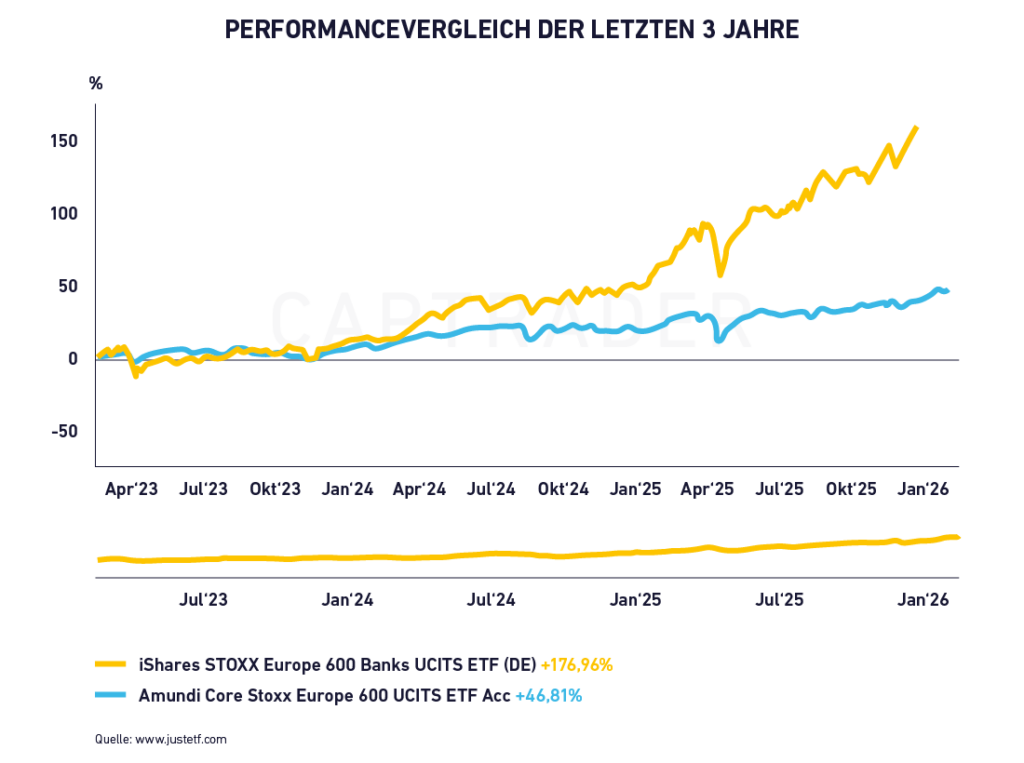
The Banking ETF (ISIN: DE000A0F5UJ7) has significantly outperformed the broadly diversified Europe ETF (ISIN: LU0908500753) over the last three years, with approx. +177 % compared to around +47 % return. At the same time, the Banking ETF shows significantly stronger fluctuations and drawdowns, while the Core-Europe ETF is much calmer and more broadly diversified.
Those who want to trade stock market fluctuations intraday should first familiarize themselves intensively with suitable Day trading strategies and a consistent Money Management to deal with.
Why European Bank Stocks Will Remain Exciting in 2026/27
Analysts Swiss major bank UBS and private bank Julius Baer expect European banks to increase their net interest income by a total of around 30 billion euros in 2026 and 2027. The drivers are a growing lending business, more stable margins, and improved interest rate risk management, which cushions the effects of falling key interest rates.
According to assessments, institutions such as HSBC, Deutsche Bank, Société Générale, Erste Group, and several Greek banks are expected to benefit particularly. These banks are currently still attractively valued and additionally entice investors with high dividends, share buybacks, and potential takeover speculation.
The Market Potential of Banking Stocks Until 2030
The market potential for bank stocks until 2030 will be significantly driven by increased operational efficiency and the development of new revenue streams. Analyses from McKinsey and Deloitte see the banking sector at a turning point: the transformation towards a technology-driven financial service provider could support valuation multiples (e.g., P/E ratio) in the long term.
- Profitability recovery: Sound McKinsey The global return on equity (ROE) could lie within a stable corridor of 10 % to 12 % by 2030. That would be a significant improvement compared to the early 2020s and would lift many banks sustainably above their cost of capital again.
- AI as an Efficiency DriverThe integration of artificial intelligence offers banks significant savings potential. A report by Morgan Stanley projects efficiency gains of up to 30 % through AI adoption and digitalization. However, this is linked to the elimination of around 200,000 jobs in the European banking sector by 2030. In parallel, it is estimated Juniper Research, that global spending by banks on generative AI will grow to approximately $85 billion by 2030 to scale personalized customer experiences and new business models.
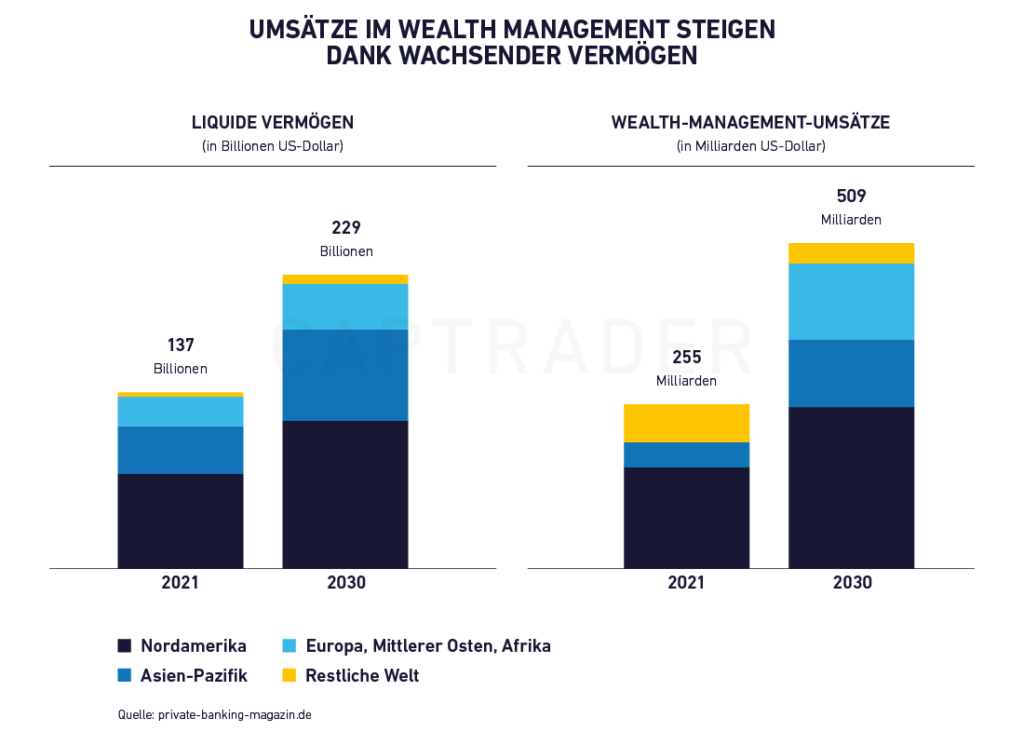
Alongside the banks' increasing profitability, a clear structural shift is also emerging. On the one hand, wealth management is growing dynamically: according to market analyses, global liquid assets are expected to rise to around 229 trillion US dollars by 2030, while revenues in wealth management are projected to climb to over 500 billion US dollars.
This development shows that banks are increasingly tapping into new revenue streams through technology-driven advice and data-based services.
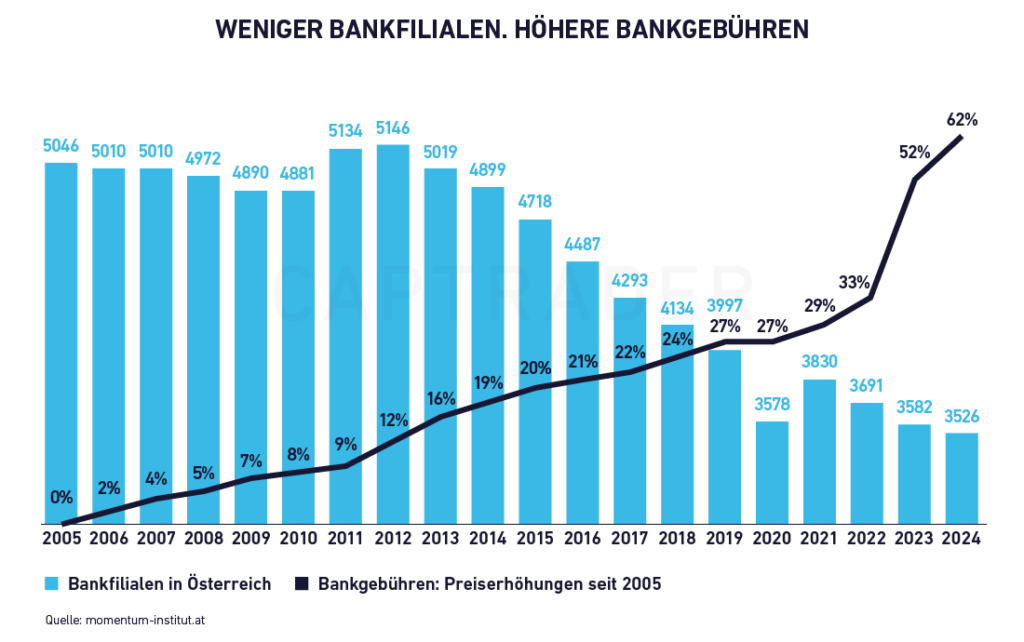
On the other hand, the traditional branch business is changing profoundly. In countries like Austria, the number of bank branches has significantly decreased since 2005, while bank fees have risen sharply in the same period.
This trend illustrates how banks are increasing their operational efficiency and streamlining cost structures through branch closures, digitalization, and fee adjustments. A key factor for rising margins in the coming decade.
Good to know:
The banking sector is likely to evolve into a more profitable, digitally integrated industry by 2030, driven by AI, efficiency gains, and rising returns on equity.


Risk factors for bank stocks
The banking sector is undergoing a phase of transformation, characterized by technological leaps and regulatory upheavals. While this presents long-term opportunities, the industry simultaneously faces a number of structural risks that can sustainably impact the profitability and valuation of bank stocks.
For investors, this means that the profitability of many institutions will increasingly depend on external conditions rather than operational excellence in the future.
1. Interest Rate and Margin Risk: The Tension Between Inflation and Growth
The shift in key interest rates since 2022 has provided banks with higher net interest margins in the short term. However, in the medium term, the risk of a „stagnation trap“ is increasing: if economic growth in the EU and the US remains weak, while central banks keep interest rates high to combat inflation, both credit demand and margins will come under pressure.
Such a constellation could lead to the following effects:
- Decline in credit volumes in the corporate client and real estate segments
- Increase in refinancing costs in interbank business
- Shrinking interest margins despite nominally high interest rates
The earnings situation of many European banks therefore remains heavily dependent on monetary policy decisions and the timing of their turning point.
2. Credit Risks and Asset Quality: The Shadow of Long Booms
After years of expansive lending, the first cracks are appearing in loan portfolios. The number of non-performing loans (NPLs) is rising, particularly in the commercial real estate sector and among highly indebted companies.
A price decline in commercial properties or stagnating cash flows in interest-rate-sensitive industries such as logistics or construction could lead to new waves of write-downs.
Key Risk Aspects:
- Real estate exposureFalling asset values devalue loan collateral and increase risk premiums.
- Provision requirementEven moderate increases in non-performing loans (NPLs) force higher risk provisions, which weaken dividend capacity and the equity base.
- Sector concentrationBanks focused on real estate financing are structurally under greater pressure.
3. Regulatory Pressure
Regulatory change is one of the most persistent risks to the profitability of traditional institutions. The final implementation of Basel IV by 2030 will tighten capital requirements and limit scope for risk-weighted assets.
In parallel, administrative expenses are growing due to ESG regulation and intensified anti-money laundering (AML) controls.
Essential Consequences:
- Capital commitmentMore equity means lower distribution capacity and decreasing returns on equity.
- Cost burdenCompliance, IT, and reporting expenses are increasing, particularly due to EU-wide ESG disclosure requirements.
- Structural Competitive disadvantagesSmaller institutions bear these fixed costs more heavily, which should lead to consolidation in the European banking sector.
4. Cyber Resilience and Systemic Shocks
The complete digitization of banking has made cyber risk one of the sector's most critical threats. Attacks on payment infrastructures, identity theft, or data breaches can cause immediate financial damage and loss of reputation.
In addition, there is the danger of coordinated attacks in a geopolitical context, for example, on core systems of the European financial architecture.
Key challenges:
- Building robust emergency and restart strategies
- Investment in Real-Time Monitoring of Critical Systems
- Balance between data security and digital customer comfort experience
A single, large-scale incident could shake confidence in the entire banking system and cause capital market valuations of broad sectors to collapse.
An overview of the largest and best-known banking stocks
The largest and best-known American and European bank stocks offer investors attractive dividends, solid growth potential, and valuable portfolio diversification. Below you will find a clear table, sorted by market capitalization.
| Company | ISIN | Country | Market capitalization in US dollars | Dividend yield |
| JPMorgan Chase | US46625H1005 | USA | 825 billion | 1,80 % |
| Bank of America | US0605051046 | USA | 384 billion | 1,96 % |
| HSBC | GB0005405286 | UK | 302 billion | 4,75 % |
| Goldman Sachs | US38141G1040 | USA | 293 billion | 2,05 % |
| Wells Fargo | US9497461015 | USA | 280 billion | 1,82 % |
| Citigroup | US1729674242 | USA | 202 billion | 3,10 % |
| BNP Paribas | FR0000131104 | France | 119 billion | 6,39 % |
| German Bank | DE0005140008 | Germany | 75 billion | 2,05 % |
| Société Générale | FR0000130809 | France | 66 billion | 2,34 % |
Before you select individual shares, you first need a securities account. How to set up a securities account step by step Open an account, you can find out in CapTrader's detailed guide.
The Core-satellite strategy has proven to be an effective approach: it relies on a stable core of quality stocks, rounded out by high-growth "satellite" stocks. This strategy is versatile and works just as well with Konsumgüter-, Tourism- or Oil stocks.
From the largest and most reputable American and European bank stocks, five selected institutions stand out. Concise profiles of these institutions are presented below.
Bank of America
Bank of America, with a market capitalization of $384 billion, is among the leading US banks in consumer banking, serving millions of private clients. Through Merrill Lynch, it dominates wealth management with personalized investment solutions for all asset levels.
The diversified model, including Commercial Banking and Global Markets, ensures resilient earnings. Perfect for investors who value long-term customer relationships and solid US growth drivers.
| Tax year | estimated revenue (in millions USD) | Change compared to previous year |
| 2025 | 113.097 | 11,00 % |
| 2026 | 119.918 | 6,03 % |
| 2027 | 125.559 | 4,70 % |
Source: Marketscreener, 01/31/26
2. Wells Fargo
Wells Fargo is considered popular with a market capitalization of $280 billion. Blue chip share and shines in US retail banking, as well as in the mortgage and real estate sectors. Strong commercial lending generates stable revenue from the dynamic middle-market segment.
Following comprehensive restructuring, it stands for increased stability, cost efficiency, and capital repatriation. Ideal for high-dividend portfolios with a focus on the robust US housing and credit market.
| Tax year | estimated revenue (in millions USD) | Change compared to previous year |
| 2025 | 83.699 | 1,70 % |
| 2026 | 88.595 | 5,85 % |
| 2027 | 92.410 | 4,31 % |
3. JPMorgan Chase & Co.
JPMorgan Chase is the world's largest bank with a market capitalization of $825 billion and is the leader in U.S. retail banking. It reaches millions of customers through its dense branch network and leverages diversification into profitable investment banking.
As a comprehensive full-service bank, it covers wealth management and corporate finance globally. Its robust balance sheet ensures resilience in crises and makes it the cornerstone of passive portfolios.
| Tax year | estimated revenue (in millions USD) | Change compared to previous year |
| 2025 | 182.447 | 2,75 % |
| 2026 | 194.003 | 6,33 % |
| 2027 | 201.064 | 3,64 % |
4. BNP Paribas
BNP Paribas, with a market capitalization of $119 billion, masters the balance between retail and investment banking in Europe. Its dominant presence in France and the Eurozone guarantees reliable regional earnings.
Pioneering sustainability initiatives combined with digitalization accelerate sustainable growth. Optimal for EU-centric portfolios aiming to balance moderate risk with attractive returns.
| Tax year | estimated revenue (in millions USD) | Change compared to previous year |
| 2025 | 60.077 | 4,41 % |
| 2026 | 63.548 | 5,78 % |
| 2027 | 66.138 | 4,08 % |
5. Deutsche Bank
Deutsche Bank, with a market capitalization of USD 75 billion, leads investment banking in Germany with a focus on large deals. Wealth Management and DWS Asset Management complete the offering for wealthy private clients.
Through consistent cost reductions, it is strengthening its balance sheet and preparing for a return to dividends. DACH investors are optimally leveraging their deep regional expertise and long-term stability.
| Tax year | estimated revenue (in millions USD) | Change compared to previous year |
| 2025 | 37.822 | 6,66 % |
| 2026 | 38.963 | 3,02 % |
| 2027 | 40.525 | 4,01 % |
CapTrader can do that:
At CapTrader, the trading fees are extremely low: you can trade US shares from as little as $ 0.01 per share (order minimum $ 2.00) and German shares from as little as 0.1 % of the order volume (order minimum €2.00), options from €2.00, futures from €1.00, ETFs from €2.00 and much more!


Conclusion: Are bank stocks worth it in 2026?
Bank stocks remain a central component for investors focused on stability, dividends, and long-term value appreciation. Particularly solid institutions with a clear digital strategy, efficient cost management, and a strong asset management business are seen as beneficiaries in the coming years.
Between 2026 and 2030, the transformation of the banking sector will be the main focus. The use of artificial intelligence, automation, and digital platforms will increase efficiency and create new revenue streams. At the same time, higher interest rates, stable credit quality, and a growing wealth management business will ensure reliable income.
Despite increasing regulatory requirements, the risk-return ratio remains attractive.
