The NVIDIA share (ISIN: US67066G1040) is one of the biggest beneficiaries of the AI boom. The share price performance in recent years and months has been characterized in part by strong climbs, but also by significant price fluctuations and thus setbacks. But are there actually ways to generate additional income with existing shares in your portfolio without having to sell the shares directly?
The following article is about the so-called "Covered call strategy", which will be explained using the aforementioned share certificate from NVIDIA and may primarily appeal to investors looking to enter the options business.
Review and fundamental introduction
In the first part of the series, the "Cash-secured put strategy" was introduced. Building on this, the "covered call strategy" will now be explained using the NVIDIA share as an example.
According to NVIDIA, it is the leading provider of artificial intelligence (AI) technology. In addition to hardware components such as graphics chips, the company also produces software that enables AI applications.
Worth knowing: According to the industry portal "CompaniesMarketCap", NVIDIA, with a market capitalization of USD 4.329 trillion, is the most valuable company in the world (as at July 31, 2025), followed by Microsoft (USD 3.966 trillion) and Apple (USD 3.109 trillion).
NVIDIA
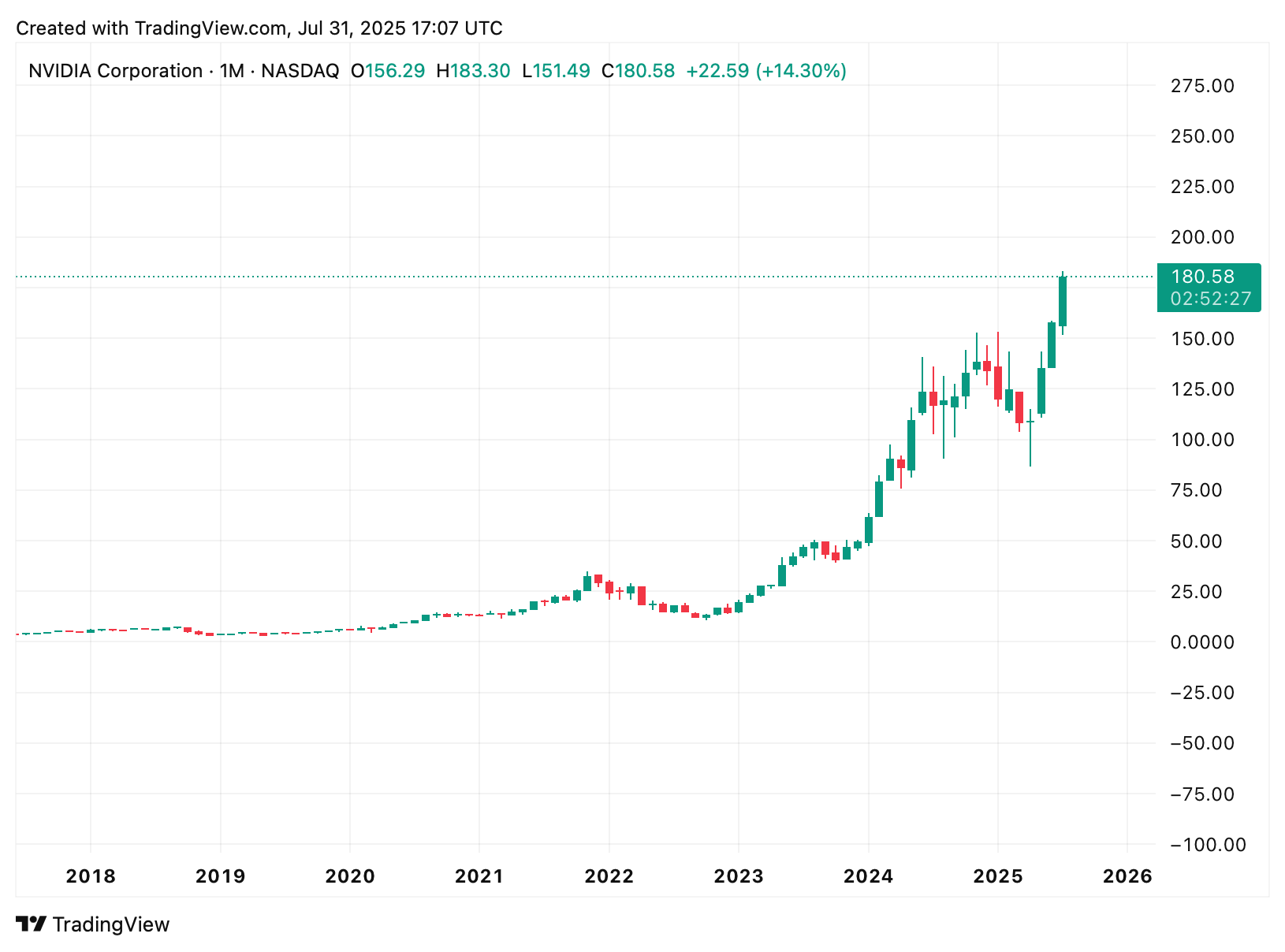
Source: TradingView
Introduction to the covered call strategy
A covered call is the sale of a call option on an underlying asset - in this example, the Nvidia share - which is already in the portfolio. In the covered call strategy, a call option is sold on an NVIDIA share, in this example, which the investor already owns. In return, there is the possibility that the seller will receive a premium. In return, however, the seller undertakes to sell the share at the Strike price if the buyer exercises the option.
The strategy may be suitable in a market environment consisting of sideways or slightly rising prices.
As the option premium collected is capped, the risk of the covered call is a fall in the price of the underlying asset. It should also be noted that the profit potential is capped. In this case, if the NVIDIA share price rises above the strike price of the call option, there is no opportunity to profit from the price performance.
NVIDIA share: Between trade dispute and monetary policy uncertainties
Despite the seemingly never-ending euphoria surrounding the artificial intelligence (AI) sector, it is important not to lose sight of macroeconomic uncertainty factors. The market environment continues to be characterized by a field of tension consisting of trade disputes and monetary policy uncertainties.
Recently, the world's two largest economies, the United States and China, were unable to agree on a possible extension of the soon-to-end trade pause, which runs until August 12, 2025, in their smouldering trade dispute. Even if there is always the possibility of an easing of tensions in the tariff conflict, developments in the trade dispute between the US and major economies are likely to remain a classic sword of Damocles hanging over investors' heads. The customs conflict could also have a particular impact on NVIDIA in the second half of the year and beyond.
Most recently, the United States had blocked deliveries of AI chips to the People's Republic for months. In mid-July 2025, NVIDIA CEO Jensen Huang said that the company would resume selling so-called H20 chips on the Chinese market after Washington and Beijing reached an agreement to ease mutual restrictions.
Investors should hope for interest rate cuts by the US Federal Reserve (Fed) in the second half of 2025
The monetary policy decisions of the US Federal Reserve could also be of increasing interest in the second half of 2025. As expected, the Federal Reserve (Fed) left the key interest rate unchanged for the fifth time in a row on July 30, 2025, which remains at a range of 4.25% to 4.50%. Should the Fed consider lowering interest rates at the three remaining scheduled meetings, this could tend to increase the attractiveness of interest-free and risky investments compared to fixed-interest securities and thus also play into the hands of NVIDIA shares.
Conclusion Covered call strategy: not a panacea, but possibly a useful tool
The covered call strategy can offer investors with existing shares an opportunity to generate additional income through premiums.
In view of a volatile market consisting of AI euphoria, possible export restrictions and geopolitical uncertainties, the covered call strategy could be exciting for investors. Despite the opportunities, investors should not ignore the existing risks. As the potential option premium is limited, the risk of a covered call is listed in a bearish development of the NVIDIA share. There is also a risk that potential price gains above the strike price will have to be foregone. All in all, the covered call strategy offers opportunities, but also has clear risks and restrictions that need to be taken into account. Investors should carefully weigh up the potential opportunities and, in particular, the potential losses.