


Many investors see agricultural stocks as an attractive option to benefit from the growth of the global agricultural market. This sector is gaining momentum particularly due to crop prices, demand for food, cultivation costs, and the market position of the companies.
As an investor, you should know that grain stocks are heavily influenced by price fluctuations in agricultural products, crop yields, weather conditions, and operational challenges. In this article, you will learn which agricultural stocks are currently stably positioned and what potentials and risks the sector holds.

The most important facts in brief:
- In 2026, leading agricultural stocks will benefit from the growing demand for agricultural technology and precision farming, as well as efficiency gains along the entire chain.
- Agricultural stocks provide you with direct access to the global food and agricultural commodity market and benefit from long-term trends such as population growth and rising caloric demand.
- At the same time, investors must keep key risks in mind: weather and climate risks, highly fluctuating input costs, political interventions (CAP, subsidies, environmental regulations), and ESG issues such as soil quality and water scarcity.
What are agricultural stocks and farming stocks?
Agricultural stocks and farming stocks comprise companies along the entire agricultural value chain. This includes firms that manage agricultural land, manufacture inputs, process agricultural commodities, or provide technologies for agriculture.
The sector remains relevant in the long term, as it secures the global food supply and benefits from megatrends such as population growth, rising demand, and limited resources. At the same time, agricultural stocks react to factors such as weather, commodity prices, energy costs, and geopolitical developments.
Agricultural stocks can be divided into several key areas that react differently to market cycles:
- food manufacturerCompanies that process agricultural raw materials into end products such as food, beverages, or consumer goods. They are at the end of the value chain and benefit from stable demand. At the same time, rising raw material prices can weigh on margins, while strong brands often allow for pricing power.
- fertilizer manufacturerThese companies produce essential plant nutrients such as nitrogen, phosphate, and potassium. They are a central lever for increasing agricultural yields. Their profits usually rise during phases of high agricultural prices, as farmers invest more heavily in yields. However, the business is cyclical and heavily dependent on energy prices.
- seed and agrochemical companyCompanies in this sector develop seeds, crop protection products, and innovative agricultural solutions. They benefit from the growing demand for efficient and high-yield agriculture. At the same time, regulatory issues and research costs play a major role.
- tractor and agricultural machinery manufacturerManufacturer of machinery such as tractors, combine harvesters, and precision agriculture technology. They benefit from investments in efficiency, automation, and smart farming. The business is cyclical, as farmers make major investments during boom periods.
- agricultural producersCompanies that engage in farming themselves and grow raw materials such as grain, corn, or soy. Their results depend directly on crop yields, weather conditions, and market prices, and are correspondingly volatile.
- Farmland and agricultural land investorsCompanies that own agricultural land and lease it out or farm it themselves. They benefit from rising land prices and stable rental income. This sector is often considered a defensive entry point into the agricultural sector.
- processing and agricultural trading companyThese companies store, transport, process, and trade agricultural commodities worldwide. They profit from trading volumes and price fluctuations and are a central component of global supply chains.
- Agricultural technology and servicesThis includes providers of software, data analysis, irrigation systems, and other solutions to increase efficiency. This sector is growing strongly due to trends such as digitization, automation, and sustainable agriculture.
- Exploration and project development companyCompanies that develop new cultivation areas or innovative agricultural projects. They offer high growth potential, but are associated with increased risk.
Some agricultural companies cover multiple stages of the value chain. This allows them to better balance fluctuations in submarkets and secure more stable revenues.


The market potential of agricultural stocks in 2026
The agricultural technology market is benefiting from several structural trends in agriculture. Rising demand for food, the growing shortage of skilled labor in the fields, and the pressure for more efficient, resource-conserving management are causing farmers worldwide to increasingly invest in modern machinery and automation.
This primarily benefits manufacturers of tractors, harvesting equipment, and digital solutions that increase productivity and lower operating costs.
The following graphic visualizes this development and illustrates the market potential of agricultural technology. It highlights key figures such as expected market growth, regional focuses, and leading providers that are particularly relevant for investors in agricultural stocks.
- The overall market for agricultural technology is projected to grow from $186.9 billion (2025) to $350.9 billion (2035), at a compound annual growth rate (CAGR) of 6.5 %.
- The tractor sector alone will reach a volume of 54.3 billion US dollars in 2025.
- Fully automated agricultural equipment will already account for about 37 % of the market share by 2025, which is a clear indication of the trend toward automation.
- Asia-Pacific is identified as the largest and fastest-growing market, with additional momentum from emerging economies such as China and India
- Market leaders such as John Deere and other top players collectively control over 30 % of the market share, underscoring the market power of established corporations.
These key figures illustrate that agricultural technology is not only a cyclical, but increasingly a structurally growing segment. For investors in agricultural stocks, this means an attractive environment in which established market leaders and specialized niche providers alike benefit from rising investments in modern agricultural machinery.
1. Population growth and food demand as a long-term tailwind
By 2050, the world population is projected to grow to around 9.7 billion people, which will significantly increase global food demand. USDA analyses show that worldwide production of crop calories (plant-based calories from agricultural crops) must increase significantly to meet this additional demand.
- World population: increase to approx. 9.7 billion people by 2050 (medium scenario).
- Crop calories: +47 % needed by 2050; in higher-emission scenarios, up to +61 %.
- According to the OECD-FAO, about 80 % of the additional crop output is due to higher yields, not to an increase in cultivated area.
- Key role for mechanization, agricultural technology, seeds, fertilizers, and digital solutions to realize these leaps in efficiency.
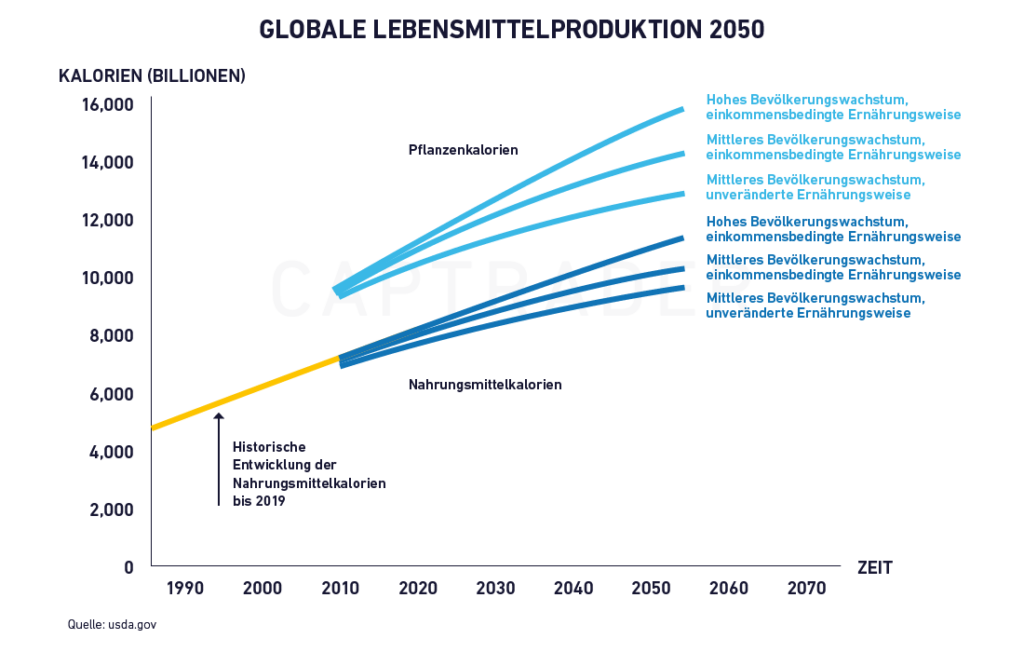
The graph shows that by 2050, global food production must increase by 47 to 61 %, depending on population growth. The difference between crop calories and food calories arises because about half of the harvest is used for animal feed, biofuels, and industrial purposes.
2. Agricultural stocks as a potential inflation hedge
Agricultural investments not only benefit from structural demand growth, but historically also offer a certain degree of protection against inflation. Since food covers basic needs, prices for grains, oilseeds, and other agricultural commodities often rise over time in line with the general price level, which can translate into higher revenues for agricultural producers and agribusinesses.
Studies on US farmland show that over decades, agricultural land returns have a positive correlation with inflation and have delivered real, inflation-adjusted yields. During periods of elevated inflation (such as the early 2020s), farmland values and lease incomes in many places rose faster than the Consumer Price Index.
- Long-term data from the NCREIF Farmland Index show that farmland has generated stable, positive total returns with comparatively low volatility since the early 1990s.
- During several periods of inflation (including the 1970s and the 2020s), farmland returns significantly exceeded the consumer price index, indicating effective protection against inflation.
- For investors, exchange-listed agricultural stocks (machinery manufacturers, fertilizer and seed companies, grain traders) as well as farmland vehicles can thus be a sensible addition to the portfolio to cushion purchasing power losses – even if this protection is not perfect every year.
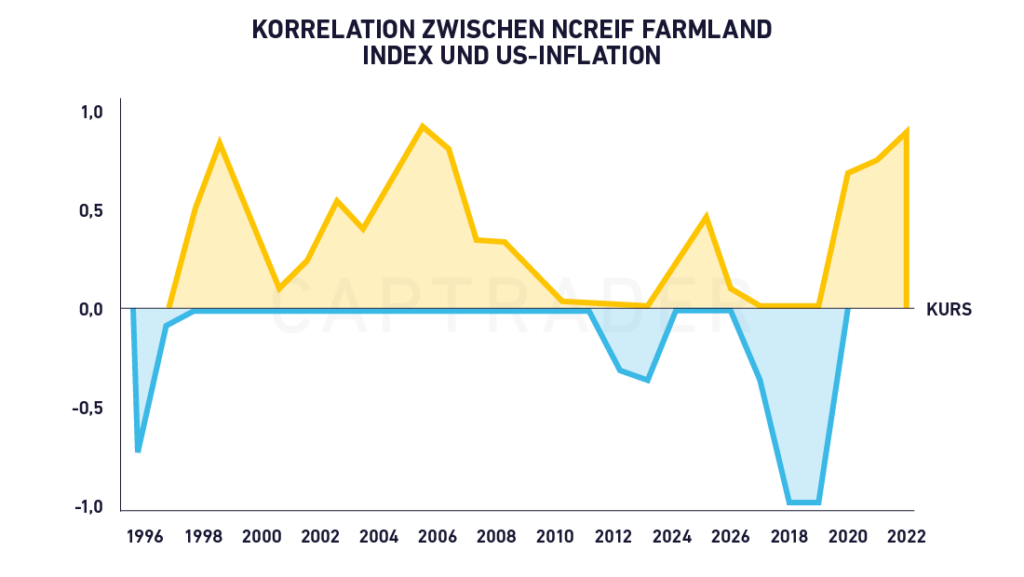
The chart shows the 5-year rolling correlation between the NCREIF Farmland Index and US inflation (CPI) from 1996 to 2022. Yellow areas represent a positive correlation (farmland returns and inflation rose together). The blue areas represent the rare phases when the two diverged.
The vast majority of the period is green, with particularly strong spikes in the early 2000s and from 2020 onward, when the correlation reached nearly +1.0, moving almost perfectly in tandem with inflation.
For investors in grain stocks, this is an important insight: when inflation rises, the prices of grain, fertilizer, and farmland generally rise as well. Companies along the entire agricultural value chain benefit from this and can thus act as a natural buffer against purchasing power losses in the portfolio.
The best agricultural stocks and farming stocks
The following overview presents a selection of the world's most significant publicly traded agricultural companies whose business models are closely linked to farming, crop production, and agricultural commodities.
The focus is primarily on corporations operating along the agricultural value chain—such as in cultivation, processing, trade, or agri-specific inputs like seeds and crop protection—that hold a noticeable share of the global agricultural market.
The order is based on current market capitalization (as of May 2026), allowing you to see at a glance which agricultural and grain stocks dominate the segment.
| Company | ISIN | Country | Market capitalization in US dollars¹ |
| Corteva Inc. | US22052L1044 | USA | 54 billion |
| Archer-Daniels-Midland | US0394831020 | USA | 37 billion |
| Nutrien Ltd. | CA67077M1086 | Canada | 33 billion |
| Bunge Global SA | CH1300646267 | USA | 24 billion |
| Tyson Foods Inc. | US9024941034 | USA | 24 billion |
| CF Industries | US1252691001 | USA | 18 billion |
| Yara International ASA | NO0005655850 | Norway | 15 billion |
| CNH Industrial N.V. | NL0010545661 | Netherlands | 14 billion |
| AGCO Corporation | US0010841023 | USA | 9 billion |
| Mosaic Company | US61945C1036 | USA | 7 billion |
To trade stocks, you need a brokerage account. With CapTrader, you can open an account and trade stocks directly on more than 170 international stock exchanges. The trading fees are particularly low: for US stocks, you pay 1 cent per share, with a minimum of 2.00 US dollars per order.


1. Corteva Inc.
As a pure-play stock, Corteva (ISIN: US22052L1044) focuses exclusively on the agricultural sector. Formed from the merger of the agricultural divisions of Dow, DuPont, and Pioneer, the US corporation now unites two powerful pillars under one roof.
On the one hand, the group develops highly resistant seed brands (such as Pioneer) for corn, soybeans, or sunflowers to ensure consistent crop yields even in extreme weather and pest infestations.
On the other hand, the portfolio includes a broad range of crop protection products against insects, weeds, and fungal diseases. Precise digital farm management systems round off the offering.
| Tax year | estimated revenue (in millions USD)¹ | Change compared to previous year¹ |
| 2025 | 17.401 | 2,92 % |
| 2026 | 18.257 | 4,92 % |
| 2027 | 18.892 | 3,48 % |
2. Archer-Daniels-Midland (ADM)
Looking at the interface between the farm and the supermarket shelf, one inevitably encounters Archer-Daniels-Midland (ISIN: US0394831020). Commonly referred to simply as ADM, this long-established company acts as a global backbone for logistics and processing in the agricultural industry.
Through a gigantic network of silos, cargo ships, and freight trains, the US corporation buys up harvests such as soy, corn, or wheat worldwide, transports them, and processes the raw materials into vegetable oils and proteins.
At the same time, the well-known Dividend aristocrat established as a supplier of refined ingredients: From starch and sweeteners to food flavorings and raw materials for biofuels, ADM serves a wide variety of industries.
| Tax year | estimated revenue (in millions USD)¹ | Change compared to previous year¹ |
| 2025 | 80.269 | -6,15 % |
| 2026 | 85.716 | 6,79 % |
| 2027 | 89.458 | 4,37 % |
CapTrader can do that:
At CapTrader, trading fees are extremely low: For German stocks, order fees amount to 0.10 % of the order volume, with a minimum of €2.00 per order.
Nutrien Ltd.
Emerging from the merger of heavyweights PotashCorp and Agrium, Nutrien Ltd. (ISIN: CA67077M1086) plays a key role in the global supply of nutrients today. The Canadian giant covers the entire chain from mining to direct distribution.
The foundation is formed by its own production: Nutrien is considered the world's largest potash producer and holds significant market shares in nitrogen and phosphate. However, instead of limiting itself purely to raw material mining, the group operates a dense network of branches for farmers.
Through these internal service centers, fertilizers, seeds, and crop protection products, along with digital cultivation advice, go directly to the agricultural businesses without any detours.
| Tax year | estimated revenue (in millions USD)¹ | Change compared to previous year¹ |
| 2025 | 25.949 | 3,73 % |
| 2026 | 27.736 | 6,89 % |
| 2027 | 27.030 | -2,55 % |
4. CF Industries
The specialization in yield-enhancing nitrogen fertilizer forms the core of CF Industries' (ISIN: US1252691001) business activities.
The US company produces ammonia and nitrogen-based compounds derived from it, which help agricultural businesses worldwide secure crop yields per hectare for major crops such as wheat, corn, or rapeseed.
In addition to its traditional agricultural business, the group is increasingly tapping into promising energy sectors. By utilizing its existing infrastructure to produce sustainable, low-emission ammonia, the company is positioning itself as a supplier for the decarbonization of industry and maritime transport.
| Tax year | estimated revenue (in millions USD)¹ | Change compared to previous year¹ |
| 2025 | 7.084 | 19,34 % |
| 2026 | 7.926 | 11,89 % |
| 2027 | 7.095 | -10,48 % |
5. Mosaic Company
Foundation and heavyweight of mineral extraction: The US-based Mosaic Company (ISIN: US61945C1036) has consistently focused its operational core on the two essential plant nutrients potassium and phosphate.
Through its in-house conveyor systems and mines, the company extracts potassium for crop immunity and water regulation, while the mined phosphate rock is processed into fertilizers for root development.
Distribution is handled by a dedicated global logistics division, which, in addition to raw materials, also offers specialized micronutrient mixtures for the targeted enrichment of depleted soils.
| Tax year | estimated revenue (in millions USD)¹ | Change compared to previous year¹ |
| 2025 | 12.052 | 8,36 % |
| 2026 | 13.250 | 9,94 % |
| 2027 | 12.902 | -2,63 % |
CapTrader can do that:
At CapTrader, the trading fees are extremely low: you can trade US shares from as little as $ 0.01 per share (order minimum $ 2.00) and German shares from as little as 0.1 % of the order volume (order minimum €2.00), options from €2.00, futures from €1.00, ETFs from €2.00 and much more!
Risk factors in agricultural stocks: A practical analysis for investors
Agricultural stocks offer you the opportunity to participate in the value creation surrounding food production, animal feed, and industrial agricultural commodities.
At the same time, they are heavily dependent on crop yields, climate risks, cost structures, and political regulation, meaning you should understand the specific risk drivers of this industry rather than just looking at crop prices or earnings estimates.
1. Yield and weather risks
Perhaps the central risks in agricultural stocks lie in the volatility of yields and crop prices. Yields depend heavily on weather, soil quality, variety selection, and crop protection, while climate change and extreme weather events such as droughts, heavy rain, or hail further amplify these fluctuations.
If regional crop failures occur, prices often rise, but individual producers can suffer massive volume losses. Particularly critical are:
- Long-lasting droughts and heatwaves
- Floods and heavy rain at harvest time
- Late frosts and storm events during sensitive growth phases
For the company analysis, it is worth looking at regional diversification, irrigation capacities, variety mix, insurance, and the use of instruments such as commodity futures or weather derivatives, with which companies actively manage harvest and price risks.
2. Cost and margin pressure in the agricultural sector
The profitability of agricultural businesses depends not only on crop prices, but also on the costs per hectare or per ton. In recent years, key cost drivers such as energy, fertilizers, pesticides, land leases, and wages have increased significantly, putting pressure on margins in many operations.
Important drivers for margin risks are:
- Price spikes for mineral fertilizers and diesel
- Rising machine and maintenance costs
- Higher lease prices for agricultural land
- Additional expenses due to environmental and fertilizer regulation
Empirical analyses show that margins in primary agricultural production are often significantly more volatile than in downstream stages such as processing or trade. Even moderate increases in input prices or falling producer prices can reverse the profit leverage.
For investors, therefore, cost structure, efficiency strategies, the use of technology, and the ability to enforce pricing are key audit points.
3. Politics, Subsidies and Trade Risks
Hardly any sector is as heavily influenced by politics and regulation as agriculture. Agricultural stocks therefore react sensitively to changes in EU agricultural policy, national subsidy programs, environmental regulations, and international trade rules.
Relevant political and regulatory risks include, among others:
- Reforms of the Common Agricultural Policy (CAP) and changing subsidy logic
- Stricter regulations on fertilization, crop protection, animal welfare, and land use
- Tariffs, export restrictions, or new trade agreements
- Delays or reductions in funding disbursements
Such interventions can shift business models, delay investment decisions, or make entire product segments less profitable.
For your analysis, you should therefore examine in which regions a company operates, how dependent it is on direct payments or subsidy programs, and how flexibly it can respond to regulatory changes.
4. Sustainability, soil quality, and ESG risks
Sustainability topics and ESG criteria are rapidly gaining importance in the agricultural sector. Soil, water, and biodiversity are central production factors whose degradation poses not only ecological but also massive economic risks.
Key ESG risk areas in agricultural stocks:
- Soil erosion, loss of humus, and declining soil fertility
- Water scarcity, overexploitation of groundwater and pollution
- Decline of pollinators and biodiversity
- Critical public perception of intensive agriculture
Studies show that soil degradation and erosion are already leading to rising operating costs and yield losses, for example due to a higher need for fertilizer or more complex management. In addition, banks and investors are paying increasing attention to ESG risks in the agricultural sector, which can influence financing conditions and valuation.
It remains important to keep an eye on sustainability reports, soil and water management, crop rotations, emission reduction targets, and transparency in dealing with environmental and social issues. Companies that invest early in regenerative practices and resource conservation can build more resilient business models and more stable returns in the long term.
Conclusion: Are agricultural stocks and grain stocks worth it in 2026?
Agricultural stocks and grain stocks could be an exciting addition to the portfolio in 2026 because they combine two strong drivers: structural growth from rising food demand through 2050 and the trend toward more efficient, technology-driven agriculture.
For investors, however, a rigorous selection is crucial: those who invest in agricultural stocks should not only look at growth and the narrative, but systematically examine yield and weather risks, cost and margin pressure, political framework conditions, and ESG risks.
Particularly attractive are equities with a solid balance sheet, a clear market position, access to high-growth regions, a resilient cost basis, and a comprehensible strategy for capitalizing on megatrends such as precision farming, automation, and sustainable fertilization.
Then agricultural stocks can offer both growth opportunities and a certain degree of long-term inflation protection in the portfolio.
If this post on agricultural stocks appeals to you, feel free to take a look at our other industry analyses on the topics of Gold stocks, silver stocks or water stocks.
List of sources:
(1) Source: Marketscreener from 05/09/26
