


Have you ever wondered how you can make your investment strategy more stable and predictable without sacrificing the chance of regular returns?
Preference shares, for example, are a lesser-known but particularly attractive form of investment. They combine the advantages of shares and fixed-interest securities and offer a higher degree of security and predictable income.
By the end of this article, you will not only understand how preference shares work, but also how they can be optimally integrated into your long-term investment strategy.

The most important in a nutshell
- Preference shares offer higher dividends but no voting rights.
- They are particularly suitable for security-oriented investors who are looking for regular income.
- Preference shareholders have priority for dividends and in the event of insolvency.
- Disadvantages: Limited price potential and high dependence on interest rate trends.
What are preference shares?
Preference shares, also known as "preferred shares", are a special form of shares that have a senior status to conventional ordinary shares, particularly when it comes to Dividends and the distribution of company assets in the event of insolvency.
The decisive difference between preferred and Ordinary shares This is because preference shareholders generally have no voting rights at a company's Annual General Meeting.
However, for many investors who focus more on the financial aspect of their investment, the lack of voting rights is less relevant because preferred shares offer other, more attractive features.


While dividend payments for ordinary shares depend on the company's annual profits and are variable, preference shares often offer fixed dividends, which are generally higher and, above all, more reliable.
This makes them particularly attractive for investors who rely on regular income or are looking for a more stable source of income, such as pensioners or security-conscious investors. Preferred shares can be seen as a kind of hybrid of shares and bonds, as they have the characteristics of both a share and a fixed-interest security.
Another key feature of preference shares is their lower volatility compared to ordinary shares. Preffered shares react less sensitively to fluctuations on the stock markets and are therefore more stable.
This is particularly advantageous in times of economic uncertainty, when investors tend to focus on security. In such phases, the advantages of preferred shares become apparent, as they offer not only price stability but also a more reliable dividend payment.
| Property | Preference shares | Ordinary shares |
| Voting rights | No voting rights | Voting rights at Annual General Meetings |
| Dividends | Higher, fixed dividends, preferential payout | Variable, depending on the company |
| Price potential | Lower volatility, limited growth potential | Higher volatility, greater growth potential |
| Rank in the event of insolvency | Priority over ordinary shareholders | Subordinated to preference shareholders |
| Dependence on interest rates | More susceptible to interest rate changes | Less vulnerable |
Why preference shares are attractive for security-conscious investors
Preferred shares are a particularly attractive form of investment for security-oriented investors who value stability and regular income above all. In contrast to ordinary shares, whose value can fluctuate considerably, preferred shares often offer a more stable price performance as they are less affected by speculative influences or short-term market developments.
This stability results in part from the structure of the preferred shares, which are more like a fixed income security. Investors who hold preferred shares can rely on regular dividends, regardless of the company's performance in a given year.
This makes preference shares particularly attractive for long-term investors who expect a stable income from their investments.
Another advantage of preferred shares is their preferential treatment in the event of company insolvency. Should financial difficulties arise, preference shareholders have priority in the payout of company assets compared to ordinary shareholders.
This offers additional security, especially in uncertain economic times.
Good to know:
Preference shares offer stable dividends and lower price volatility compared to ordinary shares, while they are given preferential treatment in the event of insolvency
Types of preference shares
Not all preferred shares are the same. There are different types, each offering different advantages and suitable for different investment strategies.
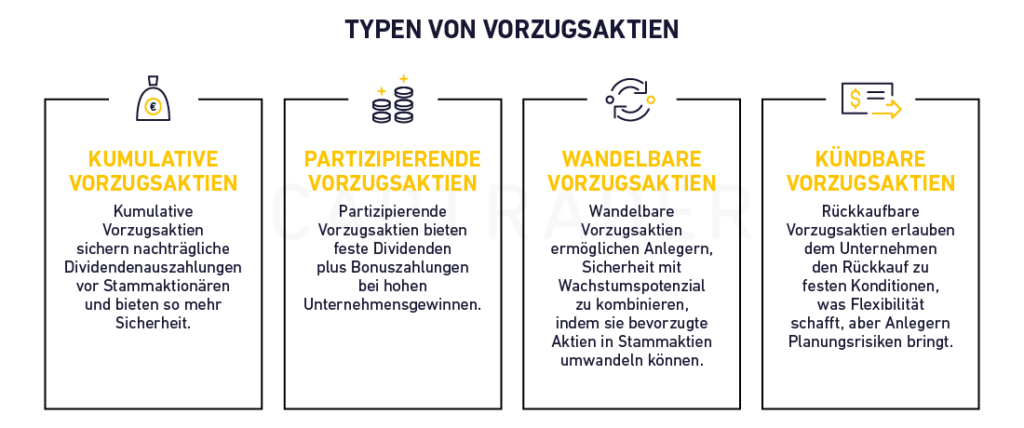
The most important types of preference shares are cumulative, participating, convertible and callable preffered shares. A detailed analysis of these variants is listed below:
- Cumulative preference sharesThese shares guarantee the investor that unpaid dividends from previous years will be paid in arrears before new dividends are distributed to ordinary shareholders. This type of preferred share therefore provides additional security for the investor, particularly in difficult economic times when companies may not be able to pay dividends. When the company recovers, the cumulative preferred shareholders receive their dividends due retroactively.
- Participating preference sharesThese shares offer the opportunity to participate in the company's extraordinary profits in addition to the fixed dividends. This means that as a holder of participating preference shares, you will receive a bonus dividend in addition to the fixed dividend if the company is particularly profitable. This type of preference share is suitable for investors who are looking for both a stable dividend and the chance of higher returns through company profits.
- Convertible preference sharesConvertible preference shares offer investors the opportunity to convert their preffered shares into ordinary shares at a fixed ratio. This type of preferred share is ideal for investors who want to benefit from the long-term positive performance of ordinary shares without taking the immediate risk of an ordinary share. Convertible preferred shares therefore combine security and growth potential by offering the investor the option to convert into ordinary shares in the event of a favorable share price performance.
- Redeemable preference sharesThis variant gives the company the right to buy back the preferred shares at a specific time and at a predetermined price. For the company, this offers the opportunity to adapt flexibly to changing financial conditions. For the investor, however, there is a risk that he may lose his shares at a time that does not suit his interests, which can make long-term planning more difficult.
Each of these types of preference shares offers specific benefits and risks, and investors should choose the one best suited to their needs and investment objectives.
Why preference shares are considered an alternative to bonds
Preference shares are often used as an alternative to Bonds viewed. But why is that? Both forms of investment offer fixed returns and are considered more stable than the more volatile ordinary shares.
The main similarities and differences between preferred shares and bonds lie in the type of income, price behavior and ranking in the event of insolvency.
Initially, both preferred shares and bonds offer a relatively reliable source of income. While bonds provide stable returns through fixed interest income, preferred shares often offer higher dividend yields.


In addition, dividends on preference shares have priority, which means that preference shareholders receive preferential payment in the event of insolvency or in times of economic difficulty.
Another advantage of preferred shares over bonds is the participation in the company's success. While bonds function purely as debt instruments and offer the investor a fixed interest rate without direct participation in the company's success, preferred shares offer a profit-related dividend and the potential for price gains, particularly in the case of convertible preferred shares.
This makes them attractive for investors who are looking for long-term increases in income, but at the same time want a certain degree of security and stability in their portfolio.
However, there are also differences. Compared to bonds, preference shares are riskier in times of crisis, as they are part of a company's equity and are only serviced after the bonds in the event of liquidation.
However, they are still senior to ordinary shareholders in the event of insolvency, which gives them a degree of security. Investors who want greater security and are happy with lower returns may be more likely to opt for bonds, while those who are willing to accept a little more risk for higher returns may prefer preferred shares.
| Property | Preference shares | Bonds |
| Yield | Higher dividends | Fixed interest income |
| Rank in the event of insolvency | Subordinated to bonds | Priority for insolvencies |
| Price fluctuations | Lower volatility than ordinary shares | Hardly any price fluctuations |
| Right to have a say | No voting rights | No voting rights |
| Growth potential | Moderate potential for price increases | No growth potential |
Examples of well-known preference shares
The following is a list of some well-known examples of preference shares that are characterized by their stability and dividend strength:
Volkswagen
Volkswagen is one of the largest car manufacturers in the world, known for brands such as Audi, Porsche and VW. At Volkswagen The two share classes differ primarily in terms of voting rights and dividend amounts.
While the Ordinary share (ISIN: DE0007664005) via a Voting rights which allows shareholders to participate in the decisions of the company, the Preference share (ISIN: DE0007664039) none Voting rights.
For the 2023 financial year, Volkswagen AG has proposed a dividend of 9.00 € per ordinary share and 9.06 € per preference share which corresponds to a payout ratio of 28 % corresponds.
Alphabet
Alphabet Inc., the parent company of Googleis a leading global technology company that operates in areas such as Search engines, digital Advertising, Cloud computing and artificial intelligence dominates the market. Its best-known products and services include Google Search, YouTube, Android and the Google Cloud Platform.
Alphabet has Three types of shares in circulationClass A (ordinary shares), Class B (non-publicly tradable shares) and Class C (preference shares).
The differences between the share classes are
- Class A shares (ISIN: US02079K3059)
These shares are publicly tradable and grant the shareholders one share each. Voting rights per share. They enable investors to participate in important company decisions at Annual General Meetings. - Class B shares (not publicly tradable)
These shares are held exclusively by the founders Larry Page, Sergey Brin and some insiders of the company. Each Class B share grants 10 voting rightsThis enables the founders to secure their control over the management of the company. These shares are Not tradable on the stock exchange and make Alphabet one of the few technology companies with such a strong concentration of power. - Class C shares (ISIN: US02079K1079)
Class C shares have No voting rightsbut are publicly tradable. They offer investors the opportunity to benefit from Alphabet's growth without influencing the company's decisions.
Sixt
Sixt SE is a leading international company in the area Mobility and offers a wide range of services such as Car rental, Leasing and Car sharing an.
With a presence in over 100 countries Sixt has made a name for itself as an innovative provider that responds to the growing demand for mobility services with flexible and digital solutions.
The company is benefiting from trends such as urbanization and the increasing use of mobility services instead of traditional car ownership.
The Ordinary share (ISIN: DE0007231326) grants the right to vote at the Annual General Meeting, while the Preference share (ISIN: DE0007231334) without voting rights.
Preference shares generally receive a slightly higher dividend. For the 2023 financial year, Sixt resolved to pay a dividend of 3.90 € per ordinary share and 3.92 € per preference share.
CapTrader can do that:
CapTrader is characterized by a transparent and cost-effective fee structure and the ability to invest on over 150 stock exchanges worldwide. There are no custody fees and US stocks can be traded for as little as $0.01 per share (minimum $2 on US exchanges). Options on US options exchanges cost $3.50 per contract. There are no hidden costs.
Conclusion: When are preference shares worthwhile for investors?
Preference shares offer an attractive opportunity to receive higher and more stable dividends, while at the same time reducing the risk compared to ordinary shares.
Preference shares can be a solid addition to a portfolio, especially for security-conscious investors who rely on regular income. They are less volatile and offer additional protection in the event of insolvency. However, the lack of voting rights and the lower price potential can be a disadvantage for some investors.
This type of share is particularly suitable for long-term investors who are dependent on a constant income without wanting to be actively involved in company management. If you are looking for a defensive investment strategy and value stable income, preferred shares are a sensible option.
