


Many investors view solar stocks as an attractive way to profit from the growth of the global solar market. This sector is gaining momentum, driven in particular by rising electricity prices, growing demand for renewable energies, falling production costs for photovoltaics, and the strong market position of the companies.
In this article, you will learn which solar stocks are currently stably positioned and what potentials and risks the sector holds. You will also discover the factors that strongly influence the value of solar stocks.

The most important facts in brief:
- Solar stocks will benefit in 2026 from a structural tailwind driven by climate targets, electrification, and the massive expansion of renewable energy.
- Solar PV is already the cheapest form of power generation in many places. Further falling levelized costs of electricity increase the long-term market potential
- At the same time, solar stocks are sensitive to interest rates and economic cycles, depend on politics and regulation, and are increasingly exposed to risks from grid bottlenecks, price volatility, and overcapacity.
What are solar stocks and photovoltaic stocks?
Solar stocks and photovoltaic stocks comprise shares of companies active in the solar energy value chain.
This includes, for example, companies that install solar systems, produce solar modules, develop new photovoltaic technologies, or generate and distribute solar power. They operate at the intersection of renewable energies, financing, and corporate investment.
Despite changing market conditions, the solar sector retains its relevance because it is not only essential for clean electricity production, but also serves as an asset class in times of economic uncertainty. Solar stocks are particularly suited for investors who want to benefit from rising electricity prices, favorable subsidy conditions, and the growing demand for renewable energies.
Solar stocks can be divided into different segments of the value chain. These areas react differently to electricity prices, production costs, and market sentiment.
- ProducersProducers are companies that operate solar systems, generate solar power, and resell the energy. Their profits correlate closely with electricity prices. When prices rise, their margins usually improve as well.
- development companyThese companies develop new solar projects and initiate pilot plants. They carry higher risks, but offer strong share price growth potential upon success.
- Processing and manufacturing companiesSuch companies manufacture, store, or process solar panels and photovoltaic components for sale or industrial purposes. Their revenues depend on the solar market as well as demand in target markets.
- Trading and service companyThis includes companies that trade, install, finance, or maintain solar systems. They take advantage of high market activity and growing demand for solar solutions, especially during volatile phases.
- Service providerService providers supply technology, software, and services for the solar industry, such as site assessments, installation machinery, maintenance, or specialized consulting. Their development follows producers' investments and thus indirectly the solar market.
Some solar companies cover multiple stages of the value chain. This allows them to better balance fluctuations in submarkets and secure more stable earnings.


The market potential of solar stocks and PV stocks in 2026
Solar stocks will benefit in 2026 from an environment in which climate policy, technological development, and energy demand are pointing in the same direction.
By 2030, significant growth in global renewable energy generation capacities is expected, with solar PV projected to contribute the largest share of the expansion. At the same time, new solar projects are already among the most cost-effective forms of electricity generation in many markets today.
Key drivers of the market potential are:
- rising electricity demand due to the electrification of transport, industry, and data centers
- significantly lower and continuing to fall levelized cost of electricity from solar PV
- additional demand for storage and system solutions due to growing solar shares in the grid
Altogether, this creates a structural growth area in which the earnings potential increases along the entire solar value chain: from module and component manufacturers to project developers and integrated solar and storage providers.
Structural demand growth driven by electrification and climate targets
Solar stocks are benefiting from a clear, forward-looking structural trend: according to IEA forecasts and analyses based on them, global deployment of renewable power plant capacity is set to nearly double by 2030, with solar PV making the largest contribution to this growth.
The background includes tightened climate targets, net-zero strategies, and the political will to replace fossil fuel power plants with low-CO₂ generation—especially with solar as one of the fastest and cheapest technologies for new construction.
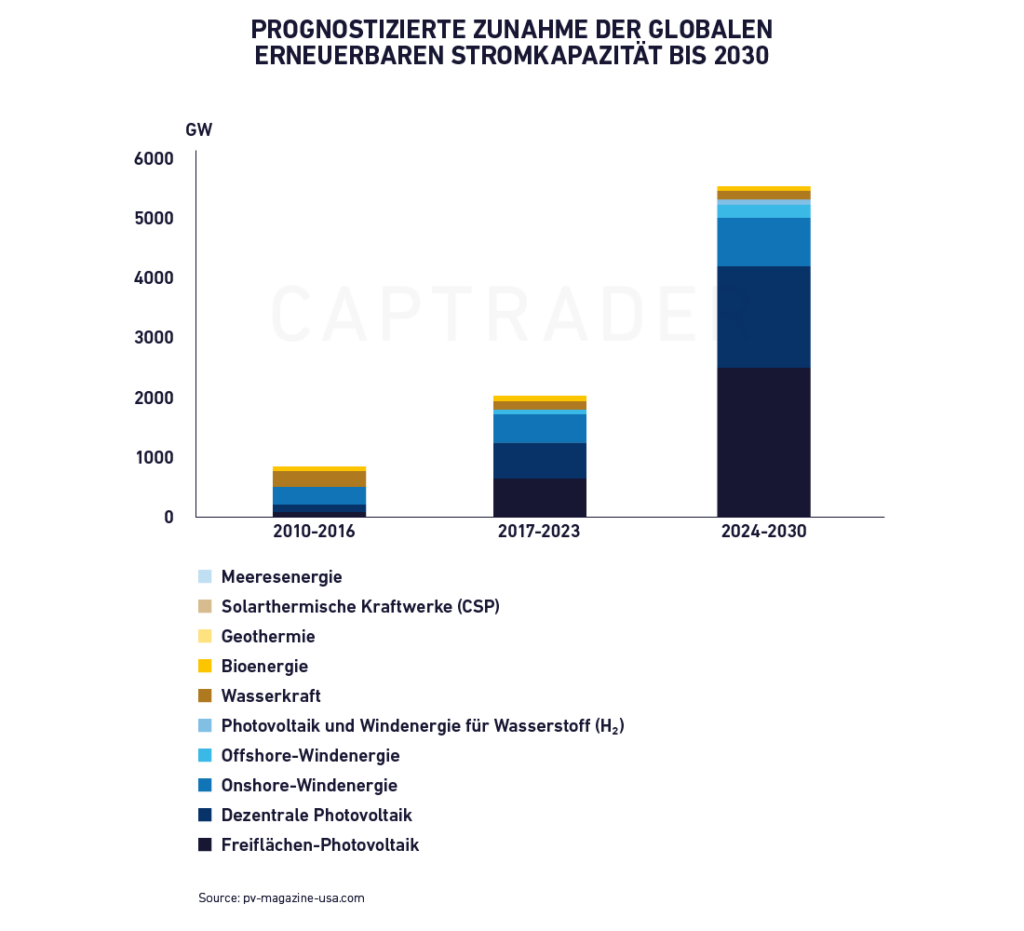
At the same time, energy consumption is shifting increasingly toward the electricity sector: e-mobility, heat pumps, the electrification of industry, and the rapidly growing power demand of data centers and AI applications are causing global electricity demand to grow significantly more dynamically than in the 2010s.
In most scenarios, this additional demand is expected to be met primarily by solar and wind power, which significantly increases the long-term project and revenue potential for companies along the solar value chain.
Falling levelised cost of electricity and growing competitiveness of solar PV
A central pillar of the market potential of solar stocks is that solar PV is not only one of the cheapest sources of electricity today, but is expected to become even cheaper.
Analyses show that the levelized cost of energy (LCOE) for solar PV has already fallen by about 80 to 90 % since 2010 and will continue to decline through the mid-2030s.
In many scenarios, the global average LCOE of utility-scale solar drops toward 20 to 30 US dollars per MWh by 2050, significantly below the projected costs of fossil alternatives.
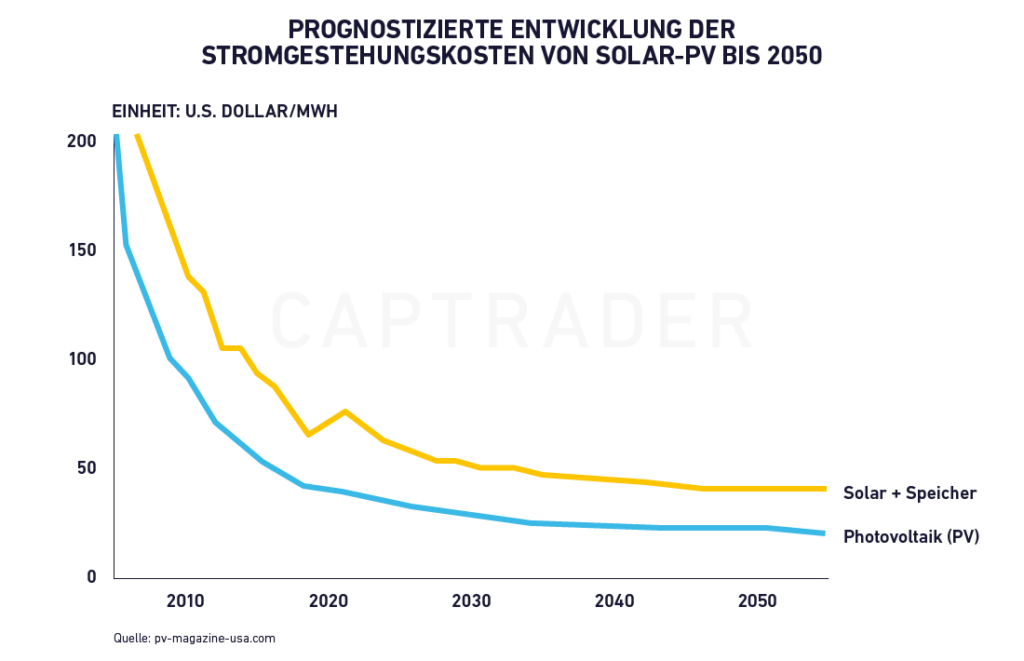
For investors, this means that solar projects will not only remain economically superior to coal and gas power plants in the long run, but are also expected to further expand their cost advantage. The cheaper solar power becomes, the more applications (power supply, hydrogen production, e-mobility, industrial heat) will become financially attractive, and the larger the addressable market for publicly traded solar companies will be.
Companies with economies of scale, efficient project development, and a strong capital structure can achieve above-average margins in this environment while growing strongly.
Additional tractive effort through storage, system services, and falling grid costs
With the growing share of solar power, the demand for storage and flexibility solutions is increasing significantly worldwide. Solar companies that combine photovoltaics with battery storage, energy management, and system services are thus benefiting from an additional market with its own independent growth dynamics.
Forecasts project the global solar and battery storage market to grow from its current volume in the low double-digit billions to well over 100 billion US dollars by the 2030s, driven by grid stability, self-consumption optimization, and regulatory requirements.
For solar stocks, this opens up the opportunity to generate recurring revenues beyond pure module and system sales through integrated „solar plus storage“ solutions. Business models that not only sell storage as additional hardware, but also integrate it into tariffs, virtual power plants, or grid service concepts, are particularly attractive.
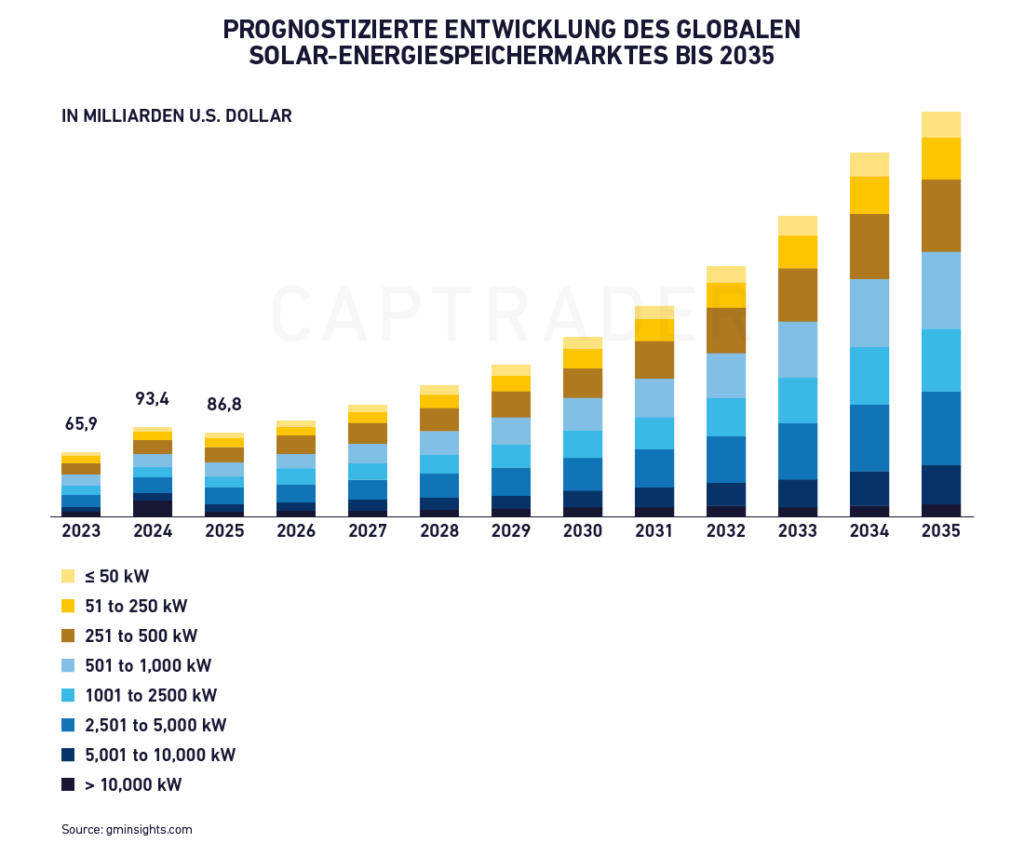
The depicted bars show a rapidly growing market volume in billions of US dollars, which underscores the increasing economic importance of storage solutions in the solar energy environment.
Risk Factors in Solar Stocks: A Practical Analysis for Investors
Solar stocks offer you the opportunity to profit from the global expansion of photovoltaics, energy transition programs, and the growing demand for clean electricity. At the same time, the sector is characterized by unique sources of risk that differ significantly from traditional industries.
In addition to general stock market risks, interest rate levels, overcapacities, politics, grid infrastructure, and technological dynamics play a central role, which you should consider in detail when analyzing individual solar stocks.
Interest rate, cyclicality, and margin risks in the solar sector
Solar companies are highly capital-intensive and therefore sensitive to changes in the interest rate environment and the economic cycle. During phases of rising interest rates, the financing costs for solar projects increase, which reduces present values and returns and can delay project pipelines.
At the same time, an oversupply of modules and components can lead to fierce price wars and margin pressure, as is currently visible in parts of the Chinese solar industry.
Key risk drivers in this area:
- Rising key interest rates and higher financing costs for PV projects
- Price drop due to overcapacity in modules, cells, and glass
- Cyclical demand weaknesses following phases of strong expansion
- High fixed-cost structures and operating leverage during a decline in sales
Current reports show that price competition and overcapacities have forced leading manufacturers into profit warnings and stock price declines.
For you as an investor, balance sheet quality, debt level, cost position, and pricing power are therefore key criteria to distinguish solar stocks with a robust business model from highly cyclical „price fighters.“.
Politics, regulation and market interventions
The solar sector is closely linked to political goals and support mechanisms. Feed-in tariffs, tender designs, tax incentives, and decarbonization programs can strongly influence demand and project profitability, but are regularly adjusted.
Positive measures can trigger growth phases, whereas abrupt cuts or uncertainty regarding future framework conditions can slow down investments.
Relevant political and regulatory risks for solar stocks:
- Adjustment or reduction of funding programs and feed-in tariffs
- Delayed approvals, bureaucratic hurdles, and changing auction rules
- Trade policies such as tariffs, anti-dumping measures, or rules of origin
- Changes in net-zero strategies, CO₂ prices, or energy planning
Reports on Europe show that while the EU has achieved its solar expansion target for 2025, the market has recently clouded over, driven in part by uncertainty regarding regulatory frameworks and concerns about grid expansion.
For your analysis, it is therefore important in which countries a company is active, how heavily it depends on certain subsidy regimes, and whether the business model remains viable even if political conditions change.
Grid bottlenecks, price risks, and project volatility
With an increasing share of solar energy, risks are shifting from the field and module toward the grid and market mechanics. In Europe and other regions, grid bottlenecks, long connection queues, and curtailment risks are increasing when grid expansion fails to keep pace with PV deployment. Solar parks are then unable to feed in at full capacity despite installed capacity, which reduces expected yields.
Key risks in this area:
- Grid bottlenecks and delays in grid connections
- Curtailment during periods of high generation
- Capture price risks and discounts compared to average prices
- Negative electricity prices and volatile spot markets
SolarPower Europe analyses and data platforms like the Solar Data Atlas show that curtailment rates and negative prices are increasing in some European markets, thereby affecting both short-term revenues and long-term PPA (Power Purchase Agreement) prices.
For investors, the structure of revenue sources thus becomes decisive: long-term PPAs with solid counterparties, geographic diversification, storage integration, and clever site selection can cushion grid and revenue risks and increase the predictability of cash flows.


The best solar stocks 2026
The following overview presents a selection of the world's most important publicly traded solar companies whose business models are closely linked to photovoltaics, solar power generation, and solar-specific system technology.
| Company | ISIN | Country | Market capitalization in US dollars¹ |
| NextEra Energy Inc. | US65339F1012 | USA | 181 billion |
| Sungrow Power Supply | CNE1000018M7 | China | 54 billion |
| First Solar Inc. | US3364331070 | USA | 33 billion |
| LONGi Green Energy | CNE100001FR6 | China | 16 billion |
| Enphase Energy Inc. | US29355A1079 | USA | 9 billion |
| Trina Solar Co. Ltd. | CNE100003ZR0 | China | 5 billion |
| SolarEdge Technologies | US83417M1045 | USA | 5 billion |
| JA Solar Technology | CNE100000SD1 | China | 4 billion |
| Sunrun Inc. | US86771W1053 | USA | 4 billion |
| Canadian Solar Inc. | CA1366351098 | Canada | 1 billion |
CapTrader can do that:
To be able to invest in solar stocks, a brokerage account is required. CapTrader allows you to easily Deposit opening and trading on more than 170 international exchanges. The trading fees are particularly low: For US stocks, you pay 1 cent per share, with a minimum of $2.00 per order.
1. NextEra Energy Inc.
NextEra Energy Inc. (ISIN: US65339F1012) is considered one of the world's most valuable utilities and a heavyweight among solar stocks, with a clear focus on wind, solar, and storage projects in North America.
Through Florida Power & Light, the company operates a large regulated utility business in Florida, while the NextEra Energy Resources segment develops and operates one of the largest portfolios of wind, solar, and battery storage facilities worldwide.
Instead of relying solely on a provider model, it combines Dividend aristocrat stable, regulated cash flows from the grid business with high-growth, long-term contracted earnings from large-scale renewable energy projects, positioning itself as a defensive growth stock in the solar and wind energy sector.
| Tax year | estimated revenue (in millions USD)¹ | Change compared to previous year¹ |
| 2025 | 27.412 | 10,74 % |
| 2026 | 31.518 | 14,98 % |
| 2027 | 34.575 | 9,7 % |
2. Sungrow Power Supply
Sungrow Power Supply (ISIN: CNE1000018M7) is one of the global leading providers of inverters and system technology for photovoltaics and energy storage, making it a key player in the worldwide solar infrastructure.
The Blue-chip stock has evolved from a pure inverter manufacturer into a broadly positioned provider focusing on photovoltaics, energy storage, power conversion, and new energy investments.
Instead of just supplying individual components, Sungrow offers complete system solutions ranging from PV inverters and storage hardware to project development and operational services, thereby benefiting directly from the global expansion of solar and storage projects.
| Tax year | estimated revenue (in millions USD)¹ | Change compared to previous year¹ |
| 2025 | 13.180 | 14,55 % |
| 2026 | 15.334 | 16,34 % |
| 2027 | 17.925 | 16,9 % |
CapTrader can do that:
At CapTrader, trading fees are extremely low: You can trade Chinese stocks starting at 50.00 CNH or a 0.20 % order fee.
3. First Solar Inc.
First Solar Inc. (ISIN: US3364331070) is one of the leading manufacturers of cadmium telluride thin-film solar modules and clearly focuses on utility-scale projects.
The company operates highly automated manufacturing facilities in the USA and India, among other locations, and supplies primarily large project developers and energy providers that build multi-megawatt solar parks.
Instead of competing in the mass market for standard silicon modules with dumping prices, First Solar relies on a technological lead, high yields under real operating conditions, robust supply chains in the US, and long-term supply contracts with major IPPs (Independent Power Producers), positioning the company as a premium player in the utility-scale solar park segment.
| Tax year | estimated revenue (in millions USD)¹ | Change compared to previous year¹ |
| 2025 | 5.219 | 24,09 % |
| 2026 | 5.093 | -2,42 % |
| 2027 | 5.909 | 16,01 % |
4. Canadian Solar Inc.
Canadian Solar Inc. (ISIN: CA1366351098) is one of the established global solar module manufacturers and is also active as a project developer and IPP in the utility-scale segment.
The company operates production facilities in Canada, China, and Vietnam, among other countries, and has a geographically diversified pipeline of solar and storage projects across multiple continents.
Canadian Solar thus combines the traditional module and system business with the development, sale, and, in some cases, long-term operation of solar parks, which opens up additional sources of revenue and ties the company more closely to recurring cash flows from power generation and long-term PPAs.
| Tax year | estimated revenue (in millions USD)¹ | Change compared to previous year¹ |
| 2025 | 5.595 | -6,65 % |
| 2026 | 6.237 | 11,48 % |
| 2027 | 7.844 | 25,76 % |
CapTrader can do that:
At CapTrader, trading fees are extremely low: you can trade Canadian stocks starting from just 1 cent per share or a minimum of 1 CAD.
5. LONGi Green Energy
LONGi Green Energy (ISIN: CNE100001FR6) is the world's largest manufacturer of monocrystalline silicon wafers and a leading producer of solar modules.
The company covers large parts of the PV value chain, from wafers and cells to modules and project development, and has built a dominant market position in the global PV market in recent years.
Rather than acting solely as a supplier, LONGi leverages its economies of scale, vertical integration, and technological R&D (research and development) to continuously reduce costs per watt while delivering high-performance products, thereby addressing both price wars and premium segments in the global solar market.
| Tax year | estimated revenue (in millions USD)¹ | Change compared to previous year¹ |
| 2025 | 10.397 | -14,82 % |
| 2026 | 10.992 | 5,72 % |
| 2027 | 12.716 | 15,68 % |
CapTrader can do that:
At CapTrader, the trading fees are extremely low: you can trade US shares from as little as $ 0.01 per share (order minimum $ 2.00) and German shares from as little as 0.1 % of the order volume (order minimum €2.00), options from €2.00, futures from €1.00, ETFs from €2.00 and much more!


Conclusion: Are solar stocks and PV stocks worth it in 2026?
Solar and photovoltaic stocks could benefit significantly in 2026 from the interplay of rising electricity demand, ambitious climate targets, and falling solar power costs. Solar PV is already considered one of the cheapest options for new generation capacity in many markets, while storage and system solutions open up additional growth and earnings potential.
Interest rate risks, overcapacities, regulatory changes regarding subsidies, and grid bottlenecks remain relevant stumbling blocks, but these risks could be partially mitigated through diversification across various business models and regions, as well as a focus on solid balance sheets and resilient project pipelines.
In a well-diversified portfolio, selected solar stocks could therefore be an interesting opportunity to benefit long-term from the global energy transition and the expansion of solar and storage technologies.
If you are interested in regular wealth accumulation with stocks, you can conveniently invest a fixed amount via a Aktiensparplan invest. This flexible concept is not only suitable for Dividend shares or Automotive stocks, but also for subject areas such as Crypto shares, Gold Stocks or AI shares.
List of sources:
(1) Source: Marketscreener from 05/30/2026
