


Energy stocks are at the center of megatrends such as decarbonization, electrification, renewable energies, and the digitalization of power grids. However, it is difficult for investors to assess which utility stocks are truly competitive in the long term and which energy stocks have already priced in too much of the future.
This guide clearly explains how the energy sector works, which energy company stocks have already achieved double-digit returns within a year, and what risks are associated with entering this industry.

The most important facts in brief
- Energy stocks directly bet on trends such as decarbonization, renewable energy, grid expansion, and electrification.
- The global electricity market is projected to grow to over $414 billion by 2032.
- The industry offers investors significant opportunities through growth potential, but also risks due to high capital intensity and dependence on political regulations.
What are energy stocks?
Energy stocks are investments in companies that generate, transmit, distribute, store electricity, or offer services related to energy supply.
This includes not only traditional energy producers but also grid operators and infrastructure companies, which form the backbone of the electricity supply by providing and maintaining power lines, substations, and storage facilities.
| Energy sector segment | Description |
| Integrated energy suppliers | Companies with generation, distribution, and network operation in one business model. |
| Network and Infrastructure Companies | Specialization in the construction, operation, and maintenance of transmission and distribution networks with regulated revenues. |
| Renewable Energy Developers | Planning, construction, and operation of large-scale facilities such as wind and solar farms. |
| Storage and System Integrators | Provision of storage solutions for grid stabilization and diversification. |
This diversity allows investors to choose between defensive dividend stocks and high-growth stocks, depending on their risk profile.
Well-known publicly traded energy utility stocks worldwide, each with different focuses within the energy sector ecosystem, include:
- NextEra Energy (US65339F1012)Globally leading renewable energy developer with a highly regulated U.S. network business.
- Southern Company (US8425871071)Major US utility with a focus on nuclear, gas, and growing renewable segments.
- Constellation EnergySpecialist in low-carbon power generation with a focus on nuclear and green energy.
- Vistra Corp (US92840W2044)Integrated US utility with a diversified fleet including storage and retail.
- American Electric Power (US0255371017)Established grid and producer operator with a massive investment program in transmission.
If you would first like to familiarize yourself with the basics of shares in general, our guide to Aktien für Anfänger an extensive introduction.


The market potential of energy stocks
Energy stocks have been back in the spotlight for many investors for several years. Depending on the business model and regional focus, energy utility stocks can offer both defensive stability and growth-oriented opportunities.
This brings questions such as: What role can energy sector stocks play in a portfolio? What are the key growth drivers and what risks should not be underestimated?
Four structural trends in the energy sector
The energy market is undergoing a fundamental transformation: moving away from a historically sluggish utility business with stable but slow-moving cash flows towards a highly politicized future sector characterized by megatrends such as digitalization, climate policy, and technological disruption.
Several long-term drivers are acting here simultaneously and often independently, making the energy sector one of the most resilient, yet also most complex, asset classes. This diversity not only creates growth opportunities for utility stocks worldwide but also spreads risks across various segments.
The central structural trends include, in particular, the following four mutually reinforcing developments:
Energy Transition and Decarbonization
Ambitious CO₂ reduction targets are being legally enshrined worldwide, such as net-zero by 2050 in the EU or similar plans in the USA and China. Fossil fuel generation is being gradually phased out, while renewable energies like wind, solar, and green hydrogen are being massively expanded.
Traditional energy providers therefore face the challenge of restructuring their portfolios, but often gain new stable revenue streams through long-term grid contracts and subsidies. New specialists in the field of offshore wind or power-to-X, on the other hand, are experiencing rapid growth, as states view these technologies as key to independence from fossil fuel imports.
2. Increasing electricity demand due to electrification and digitalization
The electrification of mobility (e-vehicles), heating (heat pumps), and industry is sustainably increasing electricity demand. Added to this is the explosive expansion of data centers and digital infrastructures.
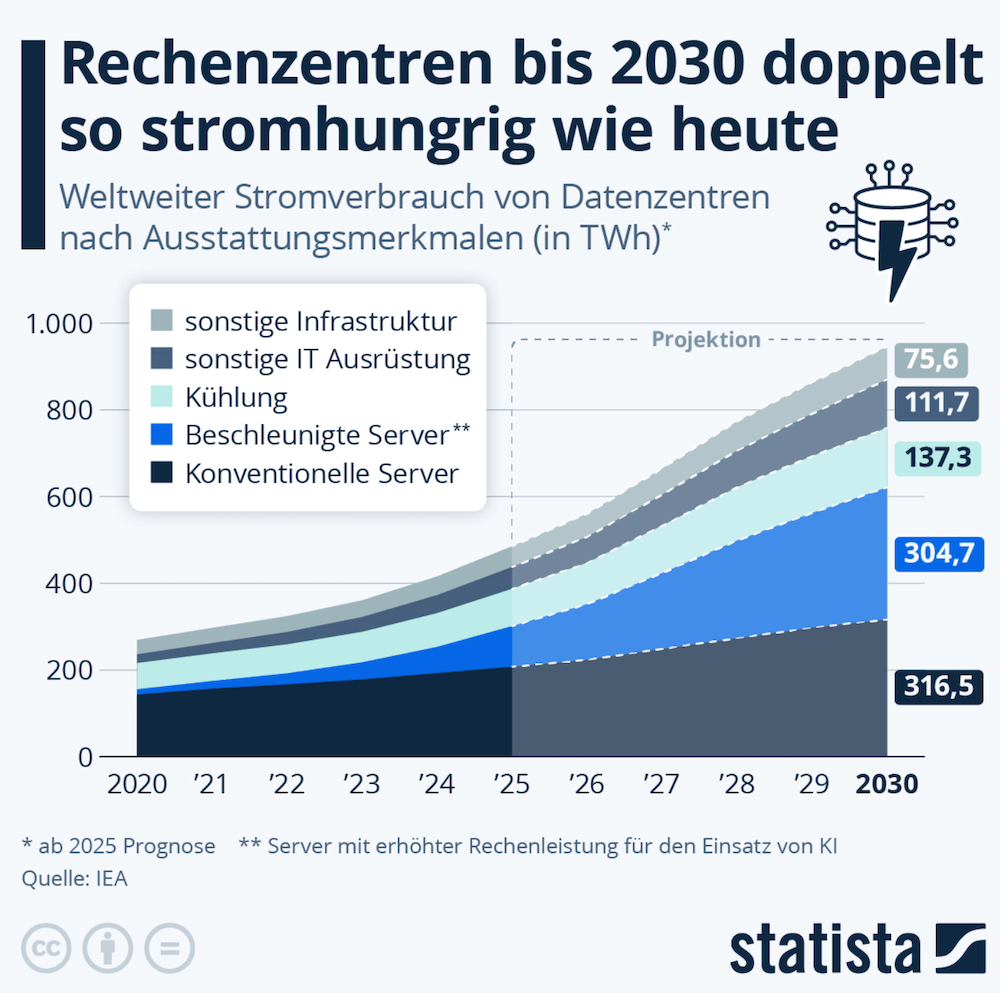
Particularly noteworthy here is the energy consumption of Artificial Intelligence (AI): a single AI training can require as much electricity as 100 US households in a year. By 2030, experts predict a global additional demand of up to 1,000 TWh from data centers alone. This is comparable to the total electricity consumption of Japan.
Electric vehicles are further accelerating this trend: By 2030, over 250 million EVs are expected to be on the road worldwide, creating a massive but flexible electricity demand for charging infrastructure and smart charging. Companies offering reliable generation, grid, and storage solutions will directly benefit from this demand explosion.
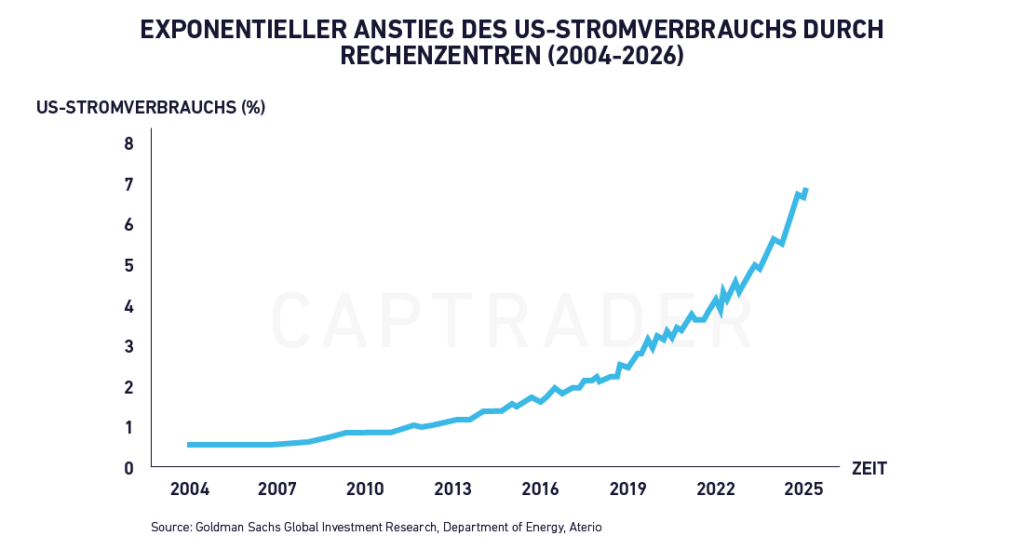
Zudem ist durch den KI-Boom ist der Anteil der Rechenzentren am US-Stromverbrauch ist von weniger als 1 % im Jahr 2004 auf circa 7 % Anfang 2026 gestiegen. Infolgedessen stehen Energieversorger vor großen Herausforderungen bei der Netzkapazität, während die Tech-Branche verstärkt auf erneuerbare Energien und Kernkraft setzt, um das weitere Wachstum zu sichern.
3. Investment wave in grids, storage and flexibility
As the share of volatile renewables (currently over 40% % in Europe) increases, grid expansion, battery storage, and demand response systems will become indispensable. Europe alone plans investments of 800 billion euros in transmission and distribution grids by 2030; globally, the storage market is expected to grow to 200 GWh of annual installations by 2030.
These revenue streams are largely independent of volatile wholesale electricity prices and form a natural buffer against market fluctuations. This creates a rare combination of growth potential and reliable predictability for investors.
4. Global Perspective
Europe emphasizes regulated, defensive models with a strong focus on grids and renewable energy, while North America remains more dynamic through unconventional gas and tech-driven demand. Asia, particularly China and India, is growing the fastest due to urbanization and industrialization, with electricity consumption rising 5 to 7 % annually.
Energy provider stocks worldwide cover this spectrum, allowing investors to strategically leverage regional differences, for example, through ETFs with global diversification.
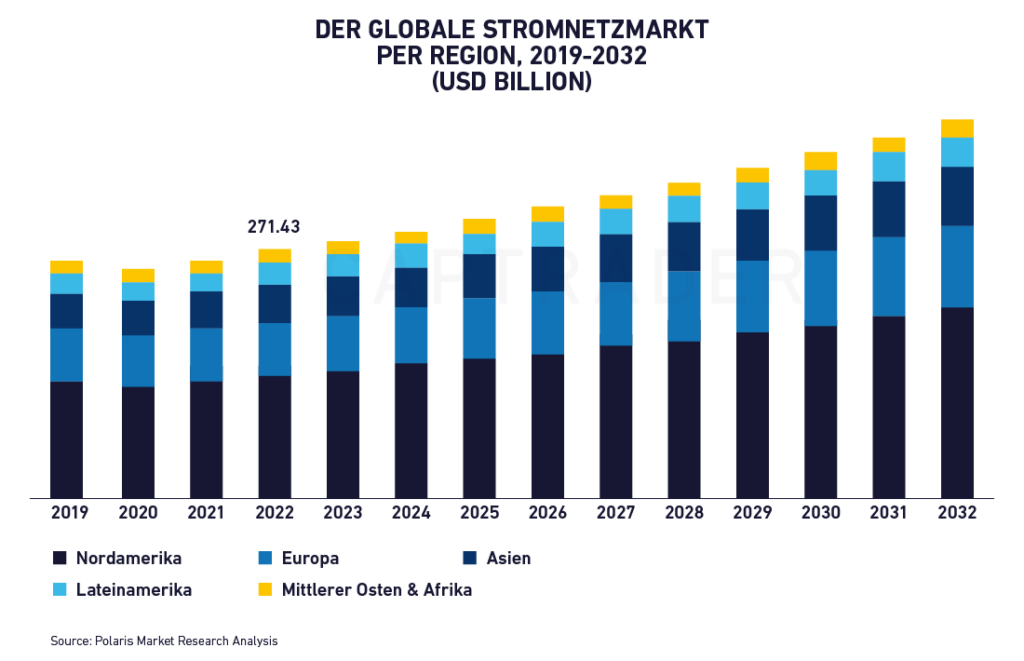
For you as an investor, this combination of trends means that energy stocks are drawing their potential from a broad spectrum of structural growth drivers, which are distributed across regions, technologies, and segments (generation, grids, storage).
In the long term, this has a stabilizing and diversifying effect on the portfolio, but it does not rule out short-term volatility due to political or technological uncertainties. The added value lies in conscious selection.
Those who understand these drivers can strategically focus on defensive stability (networks) or aggressive growth (AI/power demand) and thus achieve above-average returns with manageable risk.
Four key risk factors for energy stocks
Despite diverse growth opportunities and structural drivers, the energy sector remains a challenging investment area, by no means free of significant risks. The business models of many energy sector companies are particularly vulnerable due to their capital intensity and strong reliance on political decisions.
The four most important risks can be divided into four central categories, each having different effects on energy utility stocks worldwide:
Regulatory and political interventions
Energy companies operate in a highly regulated environment where tariffs, grid fees, subsidy schemes, and environmental regulations are determined by politicians and authorities. A sudden legislative initiative, such as special taxes on excess profits, price caps, or the abrupt halt of expansion of support systems, can significantly reduce profit margins within a few months.
In countries with election cycles or geopolitical tensions, such as energy dependence on Russia or China, this risk is further amplified, as short-term populism can disrupt long-term investment plans.
2. Volatility of energy and commodity prices
Many energy stocks, particularly integrated utilities with fossil fuel generation, are directly affected by fluctuations in gas, oil, coal, and wholesale electricity prices. While high prices can boost short-term earnings, subsequent drops due to mild weather, oversupply from LNG, or increased renewables lead to margin pressure.
Inadequate or failed hedging strategies exacerbate this. An example is the massive losses some utilities experienced during the 2022 energy crisis, when spot prices soared but long-term supply contracts were absent. Even green companies are not immune, as volatile electricity prices affect their project economics.
3. Project, Technology, and Investment Risks
The transformation of the energy system requires gigantic capital expenditures. Europe alone plans by 2030 over 1 billion Euros for grids, storage, and renewables. However, delays due to permitting issues, supply chain bottlenecks for turbines or batteries, or cost overruns of often 20 to 50 % over budget are noticeably impacting balance sheets.
Energy companies, in particular, will benefit from the investment project, as they will drive the expansion and maintenance of power grids and associated infrastructure. The funds provided will enable them to modernize existing capacities, implement innovative technologies, and thus ensure a long-term energy supply.
Technologically outdated projects, such as older offshore wind farms without repowering options or obsolete storage solutions, also diminish returns. Dependence on large-scale projects is particularly risky, as a single failure due to weather events or construction problems can cause the entire stock valuation to collapse.
4. Competition and Structural Change
The sector is becoming increasingly fragmented and disruptive. New technologies such as large-scale batteries, Power to X, smart grids, or decentralized prosumer models are shifting value creation away from traditional utility companies towards agile specialists or tech companies. Larger players are consolidating through acquisitions, while smaller providers are losing market access and funding.
Historically secure giants that are too late in adopting digitalization or storage technologies risk losing relevance, similar to telecom providers during the internet revolution. The competition for talent, patents, and partnerships with tech corporations for AI data centers further intensifies this pressure.
A considered approach to these risks creates a decisive information advantage over investors who primarily idolize energy stocks as safe utility providers with stable dividends. Those who analyze regulatory stability, hedging quality, project pipelines, and innovation capabilities can avoid misjudgments.
For example, defensive network operators with global diversification can be prioritized or high-growth but volatile renewable energy companies with clear risk management can be paired.


The largest energy stocks by market capitalization
This section focuses on leading energy provider stocks and energy conglomerates, ordered by their market capitalization and thus their significance in the capital market.
| Company | ISIN | Country | Market capitalization in US dollars | Dividend yield |
| GE Vernova | US36828A1016 | USA | 213 | 0,15 % |
| Reliance Industries | INE002A01018 | India | 212 | 0,39 % |
| NextEra Energy | US65339F1012 | USA | 196 | 2,73 % |
| Iberdrola | ES0144580Y14 | Spain | 156 | 3,77 % |
| Enel | IT0003128367 | Italy | 115 | 5,15 % |
| Southern Company | US8425871071 | USA | 107 | 3,37 % |
Before you select individual shares, you first need a securities account. How to set up a securities account step by step Open an account, you can find out in CapTrader's detailed guide.
1. Reliance Industries
Reliance Industries is the largest Blue chip share on the list. This is India's largest conglomerate with a focus on “New Energy” and oil, as well as a key player in Asia's energy transition.
- business modelDiversified energy group with oil/gas, refining, petrochemicals, and a growing New Energy segment including solar, hydrogen, and batteries.
- Core customersGlobal energy consumers, industry, data centers, and emerging EVs in India/Asia.
- USPVertical integration from upstream to downstream plus massive investments in green energy (e.g., 10 GW solar by 2030).
Reliance supports customers from raw material extraction through refining and chemicals to forward-looking new energy solutions such as green hydrogen and storage technologies.
As an energy stock, the company offers a direct play on the energy transition in India and Asia, as well as the shift from fossil fuels to renewable energy. The stock presents opportunities through scaling and diversification, but also risks due to capital intensity and geopolitical dependencies.
| Tax year | Estimated revenue (in millions) | Change compared to previous year |
| 2025 | 9,646,930 INR / 106,020 USD | +7,06 % |
| 2026 | 10,062,715 INR / 110,590 USD | +4,31 % |
| 2027 | 10,882,398 INR / 119,598 USD | +8,15 % |
Good to know:
Upstream and Downstream describe the entire value chain in the energy industry, from exploration/extraction of raw materials (Upstream) through transportation/processing (Midstream) to refining and end-customer sales (Downstream).
2. NextEra Energy
NextEra Energy is the world's largest producer of wind and solar energy and operates a leading energy company focused on renewable energy in North America.
- business modelOperator of regulated utilities (Florida Power & Light) and renewable energy projects (NextEra Energy Resources), including the development, construction, and operation of wind, solar, and storage facilities.
- Core customersUtilities, large customers such as tech companies and industry (e.g., data centers), as well as 6 million private customers in Florida.
- USPCost efficiency through economies of scale, co-located solar-storage, and long-term PPAs for stable cash flows.
NextEra Energy is investing heavily in solar-plus-storage and transmission to meet growing US electricity demand and drive decarbonization. For investors, the company offers stable growth through regulated revenue and global demand for clean energy, with risks from regulation and weather dependency.
| Tax year | Estimated Revenue (in millions of US dollars) | Change compared to previous year |
| 2025 | 27.412 | +10,74 % |
| 2026 | 31.215 | +13,87 % |
| 2027 | 34.152 | +9,41 % |
3. Iberdrola
Iberdrola is a global energy leader focused on renewable energies, networks, and energy services in Europe, the USA, and Latin America.
- business modelGeneration from wind, solar, and hydro, regulated grid operation, and marketing of electricity and gas to millions of customers.
- Core customersPrivate customers, commercial and industrial buyers, governments, and energy distributors in Spain, the UK, the USA, and Brazil.
- USPEnd-to-End solutions for Net-Zero with smart grid infrastructure, storage, and digital monitoring.
Iberdrola is investing heavily in offshore wind, smart grids, and storage to scale decarbonization. For investors, the company combines stable regulated revenues with growth in renewables, taking into account regulatory and geopolitical risks.
| Tax year | Estimated revenue (in millions) | Change compared to previous year |
| 2025 | 46,977 € / 55,372 US Dollars | +5,00 % |
| 2026 | 48,012 € / 56,592 US Dollars | +2,2 % |
| 2027 | 50,381 € / 59,384 US Dollars | +4,93 % |
4. Enel
Enel is a global energy company with a focus on renewable energy, grids, and sustainable energy services in over 30 countries on four continents.
- business modelIntegrated value chain from power generation (wind, solar, hydro), transport/distribution via 1.87 million km of networks to end customer supply with electricity, gas, and services.
- Core customersApprox. 80 million end-users worldwide, including private, commercial, and industrial customers in Europe and Latin America, as well as large-volume buyers.
- USPDigital Transformation with Smart Grids, Enel X for E-Mobility, Demand Response, and Integrated Net-Zero Solutions.
Enel is investing heavily in Renewables, Grids, and Digital to lead the energy transition. For investors, it offers growth through diversification and stable grid revenues, with risks from regulation and competition.
| Tax year | Estimated revenue (in millions) | Change compared to previous year |
| 2025 | 81,855 € / 96,482 US dollars | +3,68 % |
| 2026 | 81,551 € / 96,124 US dollars | -0,37 % |
| 2027 | 82,667 € / 97,440 US dollars | +1,37 % |
5. Southern Company
Southern Company is a leading U.S. energy provider headquartered in Atlanta, supplying electricity and gas to 9 million customers in seven Southern states.
- business modelVertically integrated utilities (Alabama Power, Georgia Power, etc.) for generation (nuclear, gas, renewables), transmission/distribution, and wholesale sales, as well as gas supply.
- Core customers: 9 million private, commercial, and industrial customers in the southeastern USA, as well as wholesale customers such as municipalities and cooperatives.
- USPPlatform approach with demand response, smart grid, e-mobility, and a balanced portfolio of baseload and renewables.
Southern Company is investing in nuclear, renewables, storage, and digital grids to secure demand growth and resilience. For investors, it offers stable dividends and regulated earnings with risks from capital intensity and regulation.
| Tax year | Estimated revenue (in millions) | Change compared to previous year |
| 2025 | 29.553 | +10,59 % |
| 2026 | 30.586 | +3,49 % |
| 2027 | 32.111 | +4,99 % |
Performance of the Top 10 Energy Stocks
Below you will find a detailed overview of the most important players. To show you the most profitable investment trends, we have sorted the list according to their market efficiency.
Here are the top 10 performers in energy stocks, ranked by their year-to-date performance. The strongest share price growth is a robust +122 % within one year.
| Rank | Company | Course (approx.) | 1 year | Focus |
| 1 | Fluence Energy | 15,97 $ | +112,4 % | Battery Storage & Software |
| 2 | RWE | 52,60 € | +74,3 % | Mix (Wind, Solar, Gas) |
| 3 | NRG Energy | 179,18 $ | +54,3 % | Energy Sales & Generation |
| 4 | Ormat Technologies | 115,26 $ | +50,8 % | Geothermal Energy (Worldwide) |
| 5 | Iberdrola | 20,17 € | +46,6 % | Grids & Renewables (Spain) |
| 6 | Enel | 9,83 € | +41,8 % | Network Infrastructure & Retail |
| 7 | National Grid | 15,80 € | +35,0 % | Power & Gas Grids (UK/USA) |
| 8 | NextEra Energy | 79,84 $ | +18,7 % | Wind & Solar Market Leader |
| 9 | Vistra Corp | 167,80 $ | +4,8 % | Nuclear Power & Natural Gas (USA) |
| 10 | Constellation Energy | 296,50 $ | -2,7 % | Largest Nuclear Power Plant Operator (USA) |
An established method is the Core-satellite strategyStable quality stocks form the core here, supplemented by high-growth stocks as satellites. It can be found not only in energy stocks, but also in Banks-, Oil- or Consumer Goods Shares use.
CapTrader can do that:
To invest in the best energy stocks, you first need a securities account with access to major international stock exchanges. At CapTrader, trading fees are extremely low: you can trade US stocks starting from $ $0.01 per share (order minimum $ $2.00) and German stocks starting from 0.1 % of the order volume (order minimum €2.00), options from €2.00, futures from €1.00, ETFs from €2.00, and much more!


Conclusion: Is it worth investing in energy stocks?
Energy stocks offer attractive long-term opportunities through megatrends such as decarbonization, increasing electricity demand, and grid expansion.
Despite risks like a change in political direction and price volatility, stable regulated revenues and growth drivers provide diversification in a portfolio, making energy stocks ideal for defensive and growth-oriented investors.
With global market potential exceeding $414 billion by 2032, targeted investments are worthwhile, supplemented by an account with CapTrader to benefit from low fees.
