


"Buy cheap, sell high" can also work with interest rates! At the Carry trade traders borrow capital at a favorable interest rate in order to subsequently deploy it with a higher return. In a simplified form, carry trades are one of the most popular forex strategies!

The most important in a nutshell
- In a carry trade, a trader raises capital at favorable conditions and thus generates higher profits
- Traders use this approach in forex trading to trade currencies with low interest rates against those with high interest rates
- Risks arise, among other things, from changes in interest rates or exchange rates
Carry trade definition and examples
The term carry trade describes a financial transaction with a very simple basic concept:
- Traders first raise capital on the financial market and have to pay interest on it (interest expense). They therefore choose a currency with low interest rates.
- You then invest this money in products with higher interest rates (interest income).
- The interest rate difference represents your profit.

Such a Carry trade is successful if the income is greater than the costs of the business. In the opposite case, there is a loss or failure.
It is an extremely versatile strategy, as traders can use the cheaply borrowed money in different ways. These include, for example
- Fixed-interest products such as call money or fixed-term deposits
- Dividendenstarke Aktien or other investments that offer profit participation
- Long, medium or Short-term bonds
- And much more!
Good to know:
The term carry trade does not include situations in which traders use the borrowed capital for active trading. For example, those who use the money as Day trading starting capital uses, Swing trading strategies exercises or with it Trade options does not operate a carry trade! This is much more about Debt capital trading!
However, this form of carry trade is very costly: Investors have to take out loans in other countries, exchange currencies and then invest in interest-bearing products. In practice, it is mainly institutional market participants such as funds and banks, as well as investors with large assets, who take this route.
For private traders, there is often a simpler option in forex trading.
CapTrader can do that:
With 28 currencies available in over 100 currency pairs, CapTrader is the ideal broker for carry trades and all other forex strategies! You benefit from maximum liquidity, tight spreads and excellent trading conditions.
How do interest rate differences arise?
Modern financial market theories assume that carry trades should not actually be possible. Similar to arbitrage trading, the interest rate differentials are a Inefficiency of the market.
In a perfect market environment, the discrepancies should not exist, as market participants would immediately open large positions in search of profit. This demand would quickly close any divergences.
The fact that carry trades are effective trading strategies shows that the interconnectedness of the financial markets is not complete. They arise from regional differences that create unique economic situations. They are the basis for the attractive interest rate differentials that forex traders take advantage of.
There are numerous reasons for the deviations. If we look at some of the countries whose currencies are typically used for carry trades, it quickly becomes clear how this comes about:
- Japanonce the country with the highest per capita income of all G7 countries and the second largest economy in the world, experienced a decades-long phase of economic contraction and permanent deflation. This only ended in 2024 and was characterized by extremely low and even negative interest rates. The Japanese yen was the most popular base currency for carry trades for many years.
- Australia on the other hand, has enjoyed impressive growth since the 1990s, supported by the mining industry, among others. With 26 years without a recession, it set a global record that only ended in 2020. This is accompanied by high interest rates (with the exception of a two-year Covid phase) of recently over 4 %, which make the Australian dollar ideal as a counter currency for carry trades.

- The United States of America form the world's largest economy, accounting for over a quarter of the global economy alone. This has been accompanied by phases of intensive growth, but also by particularly dramatic crises. Accordingly, the interest rate in recent years has been a rollercoaster ride: Since the turn of the millennium, there have been three phases of interest rates above 5 %, three phases with interest rates below 1 % and quite a few other, smaller changes. These extreme differences have always made the US dollar interesting for carry trades, both as a base currency and as a counter currency.
- European Union: Since the 2008 financial crisis, the key interest rate in the European Union has been close to the zero percent mark. It was only after the Covid crisis had been overcome that there was an increase, climbing to just over 4 %. The euro therefore not only offers interesting opportunities for carry trades; like the US dollar, it is also valued by forex traders due to its relative stability.

Practical significance in Forex trading
The concept of the carry trade is mainly used in forex trading, where it is known as the "Currency carry trades" are called. They are so popular there that the meaning has shifted: Today, the term carry trade actually always refers to this forex variant.
Merchants can borrow capital in a low-interest currency and exchange it for a means of payment with a higher interest rate. The actual Investing in a financial product is no longer necessaryas the mere holding of the position already requires a remuneration: the rollover rate
Rollover rate: How to profit from currency carry trades
Forex positions are closed daily at 11:00 am German time (5:00 pm EST) and the same position is opened for the next trading day. This process runs automatically and is referred to as "Tomorrow Next", "Tom-next" or "Rolling".
If traders hold a currency pair with different interest rates, they are charged the interest rate difference at that time. This is referred to as the "rollover rate". It can be positive or negative and thus result in profits or losses.
The interest rates of the base and counter currencies are decisive.
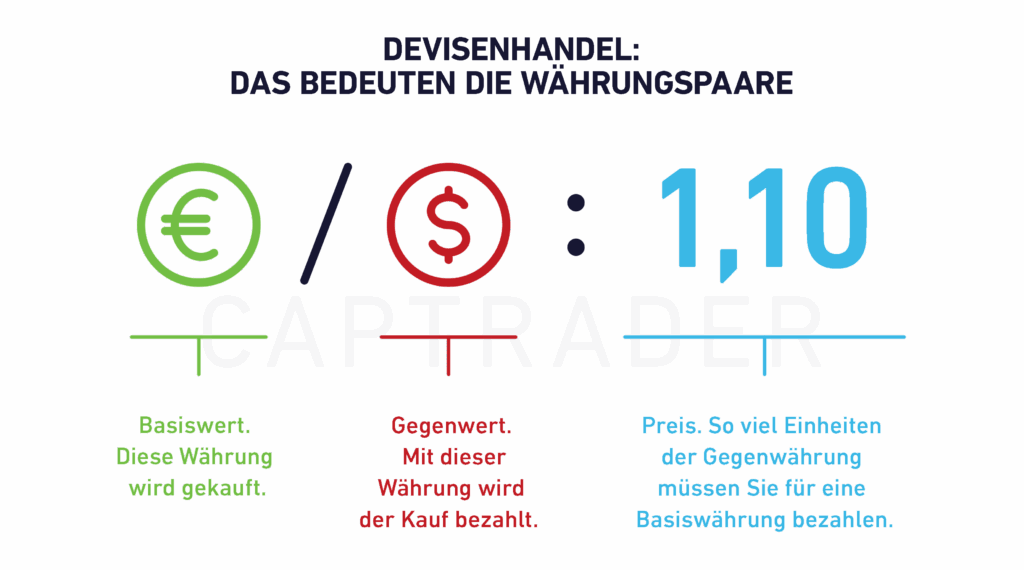
- If the base currency has a lower interest rate than the counter currency, a profit is made. This is a positive carry trade. The broker credits the trader with the interest rate difference on a pro rata basis.
- If, on the other hand, the base currency has a higher interest rate than the counter currency, the trader incurs a loss when rolling between two days. The broker deducts these costs accordingly and there is a negative carry trade.
The rollover rate is calculated from the interest rate difference between the two currencies. As this is only the pro rata interest for one day, the result must be divided by 365 days. The respective exchange rate also plays a role in the result, resulting in the following formula:

R Base currency: Interest rate of the base currency
R Counter currency: Interest rate of the counter currency
U = exchange rate
Example of carry trades
To conclude a carry trade with a positive result, traders must hold a currency pair with a suitable interest rate differential: The base currency should have the lowest possible interest rate, while the counter currency should have the highest possible interest rate.
For a long time, the Japanese yen was a popular currency for raising capital cheaply: The Japanese key interest rate has hovered around zero points since 2000 and only rose slightly again in 2024! In this environment, market participants were able to borrow money extremely cheaply.

A classic carry trade therefore looks like this, for example:
- A market participant borrows Japanese yen at a low interest rate (short position). He only pays 0.5 % interest p.a. for this.
- At the same time, he buys Australian dollars (long position), as he receives a high interest rate of 4 %.
- The interest rate differential for this position is 3.5 % per year
- The YEN:AUD exchange rate in our example is 0.011
This results in:
R Rollover = (0.5 - 4) / 365 × 0.011 = 0.871 %
If everything goes according to plan, the retailer in our example can therefore rely on a Return of 0.871 % in just one trading day. Transaction costs must be deducted from the result. If margin trading was used (trading with leverage), the result can be multiplied.
Risks of carry trades
Carry trades offer enormous profit potential and are therefore hugely popular strategies in forex trading! However, as is usual in the financial world, there are also No return without risk.
A carry trade is subject to two typical dangers:
1. changes in interest rates
A successful carry trade requires a base currency with a low interest rate and a counter currency with a higher interest rate. Should the Interest rates of one or both currencies develop unfavorablyis a Reduced return or even a loss is possible!
This means for the base currency:
- Rising interest rates = negative, as it now costs more to borrow money here.
- Falling interest rates = positive, as the cost of lending money is now falling.
The following applies to the counter currency:
- Rising interest rates = positive, as an investor receives a higher return.
- Falling interest rates = negative, as it is now less profitable to hold this currency.
To put it simply: The greater the gap between the interest rates of the two currencies, the more lucrative the carry trade. A smaller distance, on the other hand, makes this strategy less profitable.
A look at the historical interest rate development in Japan and Australia shows that changes in the popular currency pair were quite frequent. They were mainly driven by Australia's active interest rate policy, while Japan maintained a steady -0.1 % for many years.

Changes in interest rates can have a massive impact on a carry tradeFortunately, they occur comparatively rarely and are almost always announced by the responsible institutions.
2. exchange rate changes
Calculations of the return on a carry trade are always based on the assumption of a constant exchange rate. Should the However, if the exchange rate between the base currency and the counter currency changes, this also influences the possible profits of such a position!
If the price of the counter currency rises, traders can also enjoy a book profit (in addition to the interest gains from the carry trade). The same naturally also applies if the base currency falls in value.
In addition to this gain in value, the rollover rate also improves. We now receive a better return if the currency pair is held overnight.
Conversely, there is a loss in value if the base currency increases in value or the counter currency decreases. Not only does the price of the currency pair held decrease, but the rollover interest rate is also reduced.
In our example yen - Australian dollar this means:
- YEN/AUD exchange rate rises = we make an additional profit and receive a higher rollover rate.
- YEN/AUD exchange rate falls = we make an additional loss and our rollover rate falls.
CapTrader can do that:
With the constant threat of exchange rate changes, the last thing forex traders need is additional costs and mark-ups. At CapTrader, you can trade foreign currencies for as little as €3.75 per transaction! This is how we ensure that your profits end up where they should: in your pocket!
Additional risks due to use of leverage
An important reason for the enormous popularity of forex trading is the Possibility to act with high leverage. This allows profits, but also losses, to be multiplied. However, due to the potential risks involved, it is Trading for beginners rather to avoid.
In order to achieve leverage, a trader borrows additional capital from his broker. He must repay the amount once the transaction has been completed. In the meantime, however, he can wager significantly more money and may keep any winnings.
However, if losses are incurred, the trader must limit them or bear them himself. If a transaction is too negative and the broker's loan is at risk, it can lead to the Margin Call come: The broker pulls the ripcord and asks the trader to close the position, reduce it or bring in additional money.
There are serious risks associated with carry trades:
- Interest rate risk of the base currency
- Interest rate risk of the counter currency
- Exchange rate risk between the two currencies
Such a business can quickly develop contrary to our expectations and result in losses. This result is reinforced by a lever. We would therefore like to emphasize once again that persons who use the Learn to trade should initially only act with very small levers or without any leverage at all.
It is also advisable to first CapTrader Paper Trading Account to use. Here you can try out carry trades in a safe environment under real conditions.


Carry trading in practice
If you would like to use carry trading, you can Different possibilities with their own advantages and disadvantages. Which option is right for you depends on your previous experience, the capital available and your risk profile, among other things.
1. currency carry trades
Probably the simplest variant Currency carry trades. Thereby hold a currency pair overnightto obtain the rollover rate. If the interest rate of the base currency is lower than the interest rate of the counter currency, this rollover rate will be positive. You make a profit!
Only a few steps are required for implementation:
- Open an account with a broker such as CapTrader, which offers forex trading.
- Pay in capital
- Select and buy a suitable currency pair
- Alternatively: Also a Short sale of the currencies is possible
- If you hold a currency pair with an interest rate differential overnight, the rollover rate will be credited to you (or deducted if the interest rate is unfavorable)
| Advantages | Disadvantages |
| Advantageous interest rate changes can generate additional profits | Risk of loss due to unfavorable changes in interest rates |
| Advantageous exchange rate changes can generate additional profits | Risk of loss due to unfavorable changes in exchange rates |
| Leverage possible to increase profits | Profit (without leverage) rather low |
| You will receive the payment even if the exchange rates do not change |
2. carry trade financial products
One Financial products such as ETFs or funds offer particularly easy access to carry trades. Different providers pursue a carry trading strategy, often with different focuses.
Investing is particularly easy: all you have to do is create a Open an account and select the right investment product. Before doing so, however, you should review the strategy used and previous successes to ensure that the respective product matches your expectations.
| Advantages | Disadvantages |
| No effort for you, as carry trades are executed automatically or by fund managers | Additional costs |
| Particularly easy access via your broker | Low transparency |
| Often better performance than a lay trader can expect | Low chance of outperformance / a professional trader can earn significantly more with carry trades |
Conclusion: The carry trade is a popular forex strategy - and not without reason!
With a carry trade, traders use Interest rate differences between individual currenciesYou borrow capital in one low-interest currency and invest it in another with a higher return.
The maximum profit is the interest rate differentialless transaction costs. But the effort involved is also enormous! Much simpler and extremely popular is the so-called. Currency carry trade. Traders simply hold a currency pair with different interest rates.
A portion of the interest is credited to them daily. This approach is widespread in forex trading. In combination with leverage, it can generate attractive profits.
However, all carry trades are subject to also various risksBoth interest rate changes and fluctuating exchange rates can jeopardize our returns! Traders must therefore not only take short-term Trading signals but also keep an eye on the long-term forecasts for individual currencies.
