Your Broker for worldwide trading

What is a pip in trading? Explanation and application

The Pip represents the smallest possible movement of a currency in Forex trading represent. However, depending on the extent to which you trade, even such a tiny price change can have a significant impact. We explain how a pip works, what value it has and what significance it has for traders. 

A simple outline of a document with horizontal lines and a yellow magnifying glass in front of it, symbolizing the document check or search.

The most important in a nutshell

  • A pip ("percentage in point") is the smallest price change that a currency can make.
  • Pips indicate the movement of a currency. Together with the amount invested (lot), the profit or loss of a trade can be calculated. 
  • We show you how you can use pips in practical trading and what they are good for

Pip Trading: Definition

Trading is all about price changes. Whether you are day trading with Operating shares, Trade options or want to build up a long-term equity portfolio: The price changes decide whether you have been successful. 

This is also the case when trading foreign currencies, i.e. forex trading. In this area, however, even the smallest changes are important! Even a hundredth of a percent can make a huge difference here, because traders are invested with very large amounts (or are involved in very large positions). 

The smallest measurable price change is referred to as a "pip", which stands for "point in percentage". 

  • For many currencies, such as the US dollar or the euro, one pip corresponds to 0.01 %, i.e. one hundredth of a percent.  
  • When trading other currencies, such as the Japanese yen, there are other values. Here, one pip corresponds to 0.1 %. 
  • Larger price jumps are also indicated in pip (for example: price increase of the euro by 150 pip = increase of 1.5 %). 
  • Although percentages are possible, they are rather unusual in Forex trading. 

CapTrader can do that:

Forex trading is a lucrative trading field that offers you a number of advantages (e.g. round-the-clock trading). Unfortunately, foreign currencies are not available with most brokers! However, CapTrader gives you access to these attractive assets with a huge selection of over 100 currency pairs!

Lots, pips, currency pairs: important terms explained

To better understand the meaning and use of pips in trading, it is helpful to know other important terms: 

1. Base and quote currency

In forex trading, currencies are traded in pairs: One is bought and paid for with another currency. The unit that is purchased is called the base currency, while the means of payment is the quote currency. 
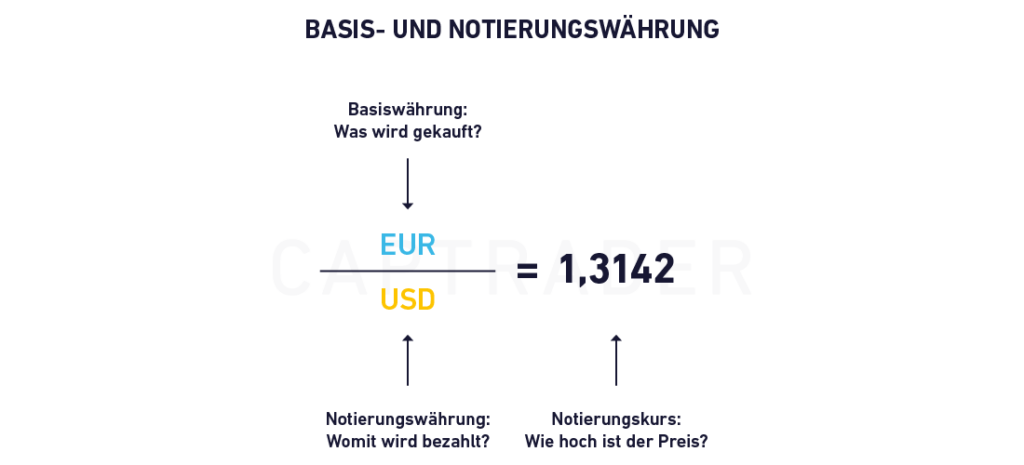
Exchange rate chart: 1 EUR corresponds to 1.3142 USD. The base currency is EUR, the quote currency is USD. Knowledge of pip trading helps to better analyze these exchange rate fluctuations.

The price is usually quoted to 4 decimal places (exception: Japanese yen). A change to the fourth decimal place corresponds to one pip. 

Advertisement for CapTrader with a view of Europe from space at night, a list of trading advantages and a yellow button labeled "Open account".

2. Plumb bob

Another key term to consider in the context of forex trading and pips is the lot. It describes the quantity of a currency that is traded, i.e. the size of a trade. 

Currency pairs are traded in predetermined amounts, which means that traders cannot simply open any position size, but have to choose the right one for them from a range of lots. 

The following are available: 

Lot designationScope
Standard100,000 units 
Mini10,000 units
Micro1,000 units
Nano100 units

The price of a lot is made up of the volume multiplied by the price of the currency.

Example: 

You want to buy a standard lot of US dollars and pay for it in euros. The dollar exchange rate at the time of trading is € 0.95. The purchase price is therefore € 95,000

Text with a formula: "LOT PRICE = lot size X currency rate" with "lot size" in blue and "currency rate" in orange, important for mastering pip trading.

Such an investment would expose you to considerable risks - not to mention the enormous capital requirement. 

However, you do not have to pay the full amount of €95,000 to purchase the lot! A broker like CapTrader offers you the option of margin trading. You only provide part of the money, the so-called margin. Your broker lends you the rest. 

This not only reduces your capital requirement, but also creates a leverage effect: both your potential profits and any losses multiply depending on how much capital you have borrowed. 

Regardless of how you purchased a nano, micro, mini or standard lot: After the purchase, the price of your US dollars may change. These changes are measured in pips and relate to a single currency unit. 

If the price of your US dollar rises by 5 pips in our example, this corresponds to a change of 0.0005 $. Multiplied by the lot size of 100,000 $, this results in a profit of 50 $. 

Good to know:

With CapTrader you can also Short sale on currencies and thus profit from falling prices!

Pipette and micro-pip

In the context of forex trading, you will occasionally come across the You may come across the terms pipette or micro-pip. This does not refer to the laboratory device for measuring liquids! A pipette is an even smaller unit of measurement for price changes that some brokers offer. 

  • This is a price change to the fifth decimal place
  • Ten pipettes make one pipette
  • It corresponds to 0.00001 monetary units (exception: Japanese yen). When trading in euros, this would correspond to 0.001 or one tenth of a cent. 

These particularly small movements can play an important role when trading larger lots. However, if you are betting on micro, mini or nano, you will naturally have less interest in these mini movements. 

Also with the Scalping pipettes are of particular interest. With this fast type of trading, traders are only invested for a few seconds or minutes and close positions after small profits. 

Those who use this strategy often only aim for gains of a few pips. In this case, it may make sense to place a stop-loss order a few pips apart. 

CapTrader can do that:

With CapTrader you get all Forex toolsthat are necessary for successful trading at a professional level. In addition to top-class trading software, this also includes the display of pipettes for particularly accurate calculations. 

Importance of pips in trading

Anyone who has already invested in products such as shares and now wants to invest in Forex Learn to trade will initially be surprised by the concept of pips. Why is the percentage figure, as is usual for other assets, not sufficient here?

The simple answer would be: Because currencies are recorded to the fourth decimal place when trading. A term like Pip is simply simpler and easier to grasp than the exact percentage ("one hundredth of a percent"). 

However, this does not quite do justice to the importance of the Pip: Forex trading involves trading very large quantities of the respective currency. Positions here often have a value of up to €100,000! A single pip may "only" correspond to a hundredth of a cent, but for an investment of €100,000 this adds up to the equivalent of €10.

Jumps of several pips, which are not uncommon in Forex trading, can immediately mean larger profits or losses. 

Good to know:

The sizes of currency trading mentioned here can be daunting, especially for newcomers; however, there are also significantly smaller positions and alternatives such as currency ETFs or options trading. Forex is therefore also Trading for beginners suitable. 

Risk management through pips

Pips have many more practical uses in trading than just measuring price movements: They are also a important instrument for sensible risk and Money management

Traders place take-profit, stop-loss and other types of orders to secure their profits and avoid major losses. The orders are created at intervals at the current price and trigger a sale when a predefined value is reached. 

The central question that concerns all retailers is: 

  • How large should the distance in pips be between the current price and the respective order? 

The answer depends largely on the strategy chosen: 

Strategy How many pips profit per trade?Stop-loss distance
Scalping - numerous trades with short terms and small profitsTraders aim for small profits of 5 to 10 pips per tradeVery close, often between 2 and 4 pips per trade
Day trading (intraday) - positions remain open for a maximum of one trading dayA popular destination is a Day trading profit per day in the amount of 50 pips per trade Small distance, usually 50 % of the maximum profit, i.e. around 25 pips
Swing trading strategies - There is no predefined term here. Positions are opened when a trend reversal is expected. No upper limit. A position is often closed manually when no further increase is likely.No fixed distance. Trailing stop-loss orders are often used. 
Trend following/position trading - the aim is to profit from long-term movements.No upper limit. The holding period can be several weeks or months. Larger intervals to exclude minor price fluctuations. 

CapTrader can do that:

With other brokers, you often search in vain for complex order forms and are therefore severely restricted in your trading - CapTrader, on the other hand, offers over 100 order types and algorithms as well as the possibility of comprehensive semi-automation through programs such as the AgenaTrader!

All information and strategies are strongly dependent on the selected solder size! For a standard lot with 100,000 monetary units, each pip corresponds to a price change of 100,000 × 0.01 % or 10 monetary units. 

In contrast, a nano lot only contains 100 units of the respective currency. A single pip only results in a change in value of 100 × 0.01 % or 0.1 monetary units. 

Each pip therefore has a greater effect on your result the larger the selected lot is. 

A woman in a yellow hoodie talks on the phone next to a mobile home parked on a street; the text promotes global and direct stock market trading.

Conclusion: The pip is a key indicator when trading foreign currencies

Foreign exchange trading is particularly popular among traders. It offers attractive profit opportunities thanks to high volatility, very good liquidity and round-the-clock trading. However, the price movements of the individual currencies are often very small - so small that a Percentage not precise enough appears. 

The Pip as a smaller unit of measurement. It denotes the The smallest official price change that a currency can experience. It corresponds to one hundredth of a percent or a change of one point in the fourth decimal place. An exception is trading with the Japanese yen, where one pip represents only 0.1 %. 

Some brokers even offer a fifth decimal place, the so-called pipette. Such small units of measurement can be useful because very large volumes are traded in Forex tradingA "standard lot" corresponds to 100,000 monetary units (e.g. €100,000 or USD 100,000). 

A seemingly microscopic price change of one pip can already amount to €10 or USD 10. Jumps of several pips, which occur regularly, therefore quickly equate to several hundred dollars or euros!

Depending on your strategy (planned holding period, trading frequency, etc.) and the selected lot size a pip can have a greater or lesser influence on your trading. 

Traders who are just starting out in forex trading should therefore familiarize themselves with the function and meaning of the pip. Other interesting articles for newcomers are Trading for beginners, Day trading strategies and the important topic Trading taxes

FAQ - Frequently asked questions

What is a pip?

The pip is the smallest movement a currency can make in forex trading. It corresponds to 0.01 % or a change in the fourth decimal place (exception: Japanese yen, where the movement is 0.1 %).

How much is a pip?

One pip is a change of 0.01 % (Japanese yen: 0.1 %). This corresponds to an amount of one cent when trading in euros. Depending on the size of your position, even such small movements can generate attractive profits.

What is the Pip Trading definition?

A pip (point in percent) is a unit of measurement for the smallest possible movement of a currency in foreign exchange trading. One pip corresponds to a price change of 0.01 % (exception: Japanese yen).

What do pips mean when trading?

A pip is a hundredth of a percent and the smallest possible movement of currencies in forex trading. It corresponds to a change in the fourth decimal place (exception: Japanese yen)

Philipp Gilg with short, light-colored hair and a beard wears a light blue button-down shirt. He stands in front of a pane of glass and looks into the camera.
Philipp Gilg

Philipp Gilg is a freelance SEO expert and financial editor. He regularly publishes SEO-optimized articles about shares, trading, options and investing on the CapTrader blog. He also works with well-known financial influencers and supports them in gaining organic reach on Google. He developed a great passion for the stock market at a young age, trading his first shares at the age of 16. As a result, he now has years of experience and expertise in this area.

Mandatory information and disclaimer

This is a marketing communication within the meaning of Section 63 (6) of the German Securities Trading Act and does not contain investment strategy recommendations, investment recommendations or financial analyses in accordance with Section 85 of the German Securities Trading Act and Article 20 of the Market Abuse Regulation. It therefore does not fulfill the legal requirements to guarantee the objectivity of investment strategy recommendations/investment recommendations/financial analyses. CapTrader GmbH or its employees are therefore not legally prohibited from trading or providing services in the securities products mentioned therein prior to publication of the information.

Past performance, simulations or forecasts are not a reliable indicator of future performance. Mandatory information and limitation of liability for CapTrader and any third-party content providers can be found at https://www.captrader.com/marketingmitteilung/angaben
Please note that investing in financial instruments involves high risks and take note of our disclaimer and the mandatory legal information at the locations indicated.

  1. Mandatory information

Responsible: CapTrader GmbH, Elberfelder Straße 2, 40213 Düsseldorf; Commercial Register Number: HRB 86537 Düsseldorf Local Court; VAT ID DE323771603; Managing Directors Andreas Weiß, Christian Weiß, Michael Heyder; Tel: +49 211-740786-00, Fax: +49 211-740786-90.

Zuständige Aufsichtsbehörde: Bundesanstalt für Finanzdienstleistungsaufsicht, Graurheindorfer Straße 108, D – 53117 Bonn und Marie-Curie-Str. 24-28 D – 60439 Frankfurt am Main, Tel: 0228 4108 – 0 Fax: 0228 4108 1550 E-Mail: poststelle@bafin.de; Institutsnummer 10156708

Conflicts of interest CapTrader in marketing communications: CapTrader GmbH confirms that it does not hold any positions in the mentioned financial instruments beyond the positions mentioned in the marketing communication itself, if applicable. There are also no other conflicts of interest within the meaning of CapTrader GmbH's Financial Analysis and Marketing Communication Policy.

Conflicts of interest and mandatory disclosures by the third-party content provider for marketing communications with financial instrument recommendations: See under https://www.captrader.com/marketingmitteilung/angaben  to creators of third-party content

The copyright to the marketing communication is reserved. Reprinting and distribution is only permitted with our consent.

  1. Disclaimer

By accepting the content, the recipient accepts the binding nature of the limitation of liability.

a) Disclaimer for third-party content

CapTrader GmbH offers authors - such as editors, guest commentators, agencies and companies - the opportunity to publish comments, analyses, news and company announcements. Their opinions do not necessarily reflect the opinions and views of CapTrader GmbH and its employees. CapTrader GmbH assumes neither liability nor guarantee for this content. This applies in particular to incomplete or incorrectly reproduced reports, incorrect price information and editorial errors. Liability claims relating to material or immaterial damage caused by the use or non-use of the published information or by the use of incorrect or incomplete information are fundamentally excluded.

b) Exclusion of liability for CapTrader's own content

CapTrader has taken its own information in this marketing communication from sources believed to be reliable, but has not verified all such information itself. Accordingly, CapTrader makes no warranties or representations as to the accuracy, completeness or correctness of the information or opinions contained herein. Subsequent changes cannot be taken into account. The marketing communication does not constitute an offer or solicitation to buy shares of the issuer and is in no way a substitute for advice appropriate to the investor and the property. We cannot verify whether the information in the marketing communication is in line with your personal investment strategies and objectives. We recommend that you consult an investment advisor for advice that is appropriate to the investor and the property. The marketing communication cannot and should not replace a securities prospectus and/or expert investment advice required for an investment. It can therefore never be the sole basis for an investment decision. By accepting the marketing communication, the recipient accepts the binding nature of the above limitation of liability.

CapTrader provides the information despite careful procurement and provision only without guarantee for the correctness / completeness, timeliness or accuracy and availability of the stock exchange and economic information, prices, rates, indices, general market data, valuations, assessments and other accessible content held and displayed for retrieval. This also applies to third-party content. Historical observations and forecasts are not a reliable indicator of future developments. The facts presented in particular in connection with product information are for illustrative purposes only and do not permit any statements to be made about future profits or losses. Any conditions stated are to be understood as non-binding indications and are dependent on market developments on the day of conclusion.

CapTrader accepts no liability for any direct or indirect damage caused by and/or related to the distribution and/or use of this marketing communication.

The information, opinions and statements correspond to the status at the time of preparation of the marketing communication. They may be outdated due to future developments without the publication being changed.

CapTrader is not obliged to update, amend or supplement the information in this marketing communication if a circumstance mentioned in this publication or a statement, estimate or forecast contained therein changes or becomes inaccurate. The presentation of the performance of financial instruments over previous periods does not provide a reliable indication of their future performance. No guarantee can therefore be given for the future price, value or income of any financial instrument mentioned in this publication.

Despite careful control of the content, we assume no liability for the content of external links. The operators of the linked pages are solely responsible for their content.

Distribution: This publication may only be distributed in accordance with the laws of the respective countries, and persons in possession of this publication should inform themselves about the applicable local regulations. The information contained herein is not intended for natural or legal persons who, due to their place of residence or business, are subject to a foreign legal system that imposes restrictions on the distribution of such information. The contents are therefore exclusively in German. In particular, this publication contains neither an offer nor an invitation to purchase securities to citizens of the USA, Great Britain and Australia.

Taxes: The tax treatment of financial instruments depends on the personal circumstances of the respective investor and may be subject to future changes, which may also have a retroactive effect.

Historical observations and forecasts are not a reliable indicator of future developments. The facts presented in particular in connection with product information are for illustrative purposes only and do not permit any statements to be made about future profits or losses. Any conditions stated are to be understood as non-binding indications and are dependent on market developments on the day of conclusion.

CapTrader accepts no liability for direct or indirect damage caused by and/or in connection with the distribution and/or use.

The information, opinions and statements correspond to the status at the time of preparation of the marketing communication. They may be outdated due to future developments without the publication being changed.

CapTrader is not obliged to update, amend or supplement the information if a circumstance mentioned in this publication or a statement, estimate or forecast contained therein changes or becomes inaccurate. The presentation of the performance of financial instruments over previous periods does not provide a reliable indication of their future performance. No guarantee can therefore be given for the future price, value or income of any financial instrument mentioned in this publication.

Despite careful control of the content, we assume no liability for the content of external links. The operators of the linked pages are solely responsible for their content.

Distribution: This publication may only be distributed in accordance with the laws of the respective countries, and persons in possession of this publication should inform themselves about the applicable local regulations. The information contained herein is not intended for natural or legal persons who, due to their place of residence or business, are subject to a foreign legal system that imposes restrictions on the distribution of such information. The contents are therefore exclusively in German. In particular, this publication contains neither an offer nor an invitation to purchase securities to citizens of the USA, Great Britain and Australia.

Taxes: The tax treatment of financial instruments depends on the personal circumstances of the respective investor and may be subject to future changes, which may also have a retroactive effect.

Email:

info@captrader.com

Send e-mail

Phone:

Hotline (Germany)
0800-8723370

Hotline (International)
00800-08723370

Further contact options