


For many investors, lithium stocks offer an exciting opportunity to profit from key developments in the global energy transition and the battery economy. The sector is driven by strong growth engines such as electromobility, stationary energy storage, and the expansion of renewable energies.
However, as an investor, you should note that lithium stocks are heavily dependent on commodity prices, production volumes, political frameworks, and technological advancements in the battery sector. Which stocks are currently solidly positioned and what opportunities, as well as risks, exist when investing in lithium stocks, you will learn in this article.

The most important facts in brief:
- The demand for lithium is primarily driven by the boom in electromobility and the massive expansion of stationary battery energy storage systems (BESS).
- Analysts forecast that the global lithium market exhibits significant long-term growth potential due to the energy transition and AI-driven electricity demand.
- New extraction technologies and advancements in battery recycling could increase long-term security of supply while the sector simultaneously remains dynamic through technological innovations.
What are lithium stocks?
Lithium stocks are shares of companies operating along the lithium value chain. This includes firms that develop lithium deposits, mine minerals, operate refineries, produce battery raw materials, or manufacture lithium chemicals for the battery and electromobility industries.
You are thereby moving at the intersection of the raw materials industry, energy storage technology, and industrial value creation.
Despite fluctuating commodity prices, the lithium sector remains a relevant investment area because it is central to the energy transition, electromobility, and the expansion of renewable energies. Lithium stocks are particularly important for the development of batteries, stationary storage systems, and future mobility applications.
Lithium stocks can be roughly divided into different areas of the value chain. These segments react differently to commodity prices, production volumes, technological developments, and demand in the battery and automotive industries.
- exploration and production companiesThese companies develop lithium deposits, conduct drilling operations, and operate mines or salt lake projects. Their profits depend heavily on lithium prices and extraction costs: if prices rise, their margins generally improve as well.
- Lithium chemical producersThese companies include manufacturers of lithium hydroxide, lithium carbonate, and other chemicals for battery production. They benefit from stable demand from battery and automotive manufacturers, but also bear price and sales risks.
- Technology and recycling companyThis includes companies that develop lithium recycling, innovative extraction technologies, or new battery chemistries. They carry a higher risk, but in the event of success, they also offer particularly high potential for stock price appreciation.
- Service provider and chemical partnerThis includes providers of technology, process plants, software, and services for the lithium industry, such as for refinery control or the development of battery materials. Their business development depends primarily on the investments of production and mining companies.
Some companies operate along multiple stages of the lithium value chain, such as from extraction to the production of battery materials. This allows them to better cushion fluctuations in individual segments and make their earnings more stable.


The market potential of lithium stocks in 2026
The long-term market development for lithium illustrates a fundamental imbalance between rising demand and available supply. As the following chart shows, total demand (brown line) is following an almost exponential path that will far exceed the capacities of both operational and potential mines by 2040.
This projected increase is primarily due to the massive expansion of global electrification, as lithium acts as an essential raw material for the battery technology of electric vehicles and stationary storage systems.
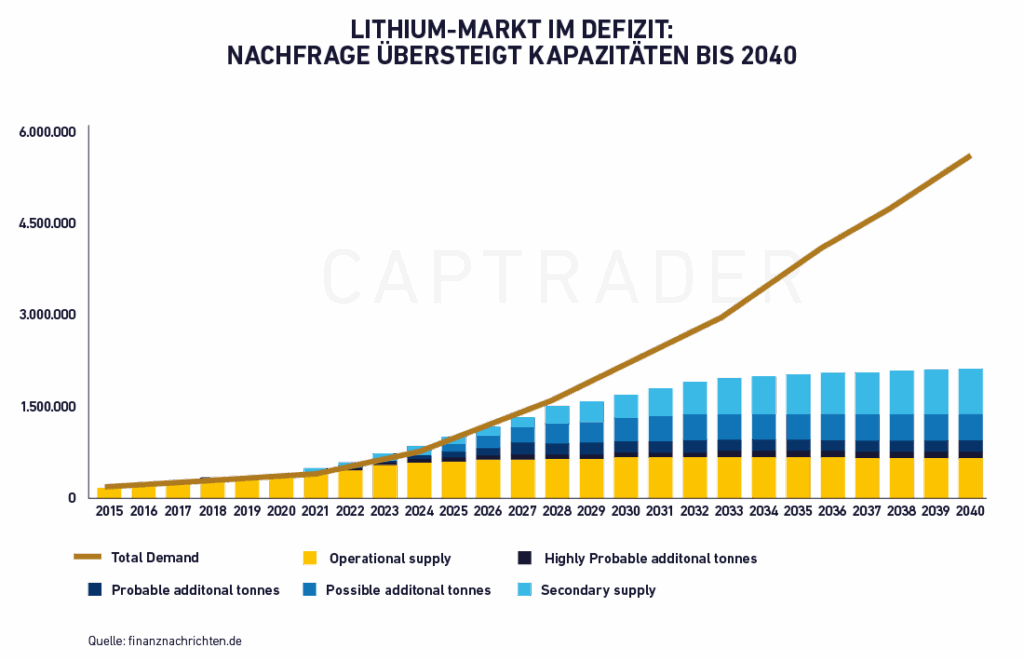
The core problem of the current market forecast is that, even when including possible and probable additional production volumes (colored bars), a steadily growing supply deficit yawns.
For investors and market observers, this scenario is a crucial signal: the long-term price stability and growth potential of lithium companies depend largely on how quickly new extraction projects can be implemented to cover the enormous demand in the long term.
While the historical data in this chart provides a baseline, they primarily underscore the need for continuous investment in the commodities sector so as not to stall the global energy transition through resource scarcity.
Lithium-ion batteries
A report from Allied Market Research forecasts that the market for lithium-ion batteries will reach a value of USD 189.4 billion by 2032. The compound annual growth rate (CAGR) will then be 15.2 % from 2023 to 2032.
- Main driverAutomotive industry with strong growth in electromobility.
- Key playersManufacturers such as Tesla, BYD and Volkswagen are investing billions in development and production expansion.
- ChinaOn the world's largest electric vehicle market, more than 1 million electric cars are currently sold per month, which ensures a high demand for lithium.
- Further demandPortable electronics such as smartphones, laptops, or tablets also rely on the metal.
- Renewable energiesEnergy storage for solar and wind power requires reliable storage technologies for a stable power supply.

The graphic shows the strong market growth for lithium-ion batteries through 2032. The automotive sector is by far the largest growth driver and offers the highest financial potential through 2032.
Renewable energies
The graphic below impressively illustrates the rapid development of global electricity generation from renewable energies between 2000 and 2030. While hydropower, as an established technology, shows a rather linear development, solar PV and wind power in particular have experienced a steep increase since the 2020s.
This development is leading to a massive expansion of total renewable power generation, which is expected to clearly exceed the 17,000 TWh mark by 2030.
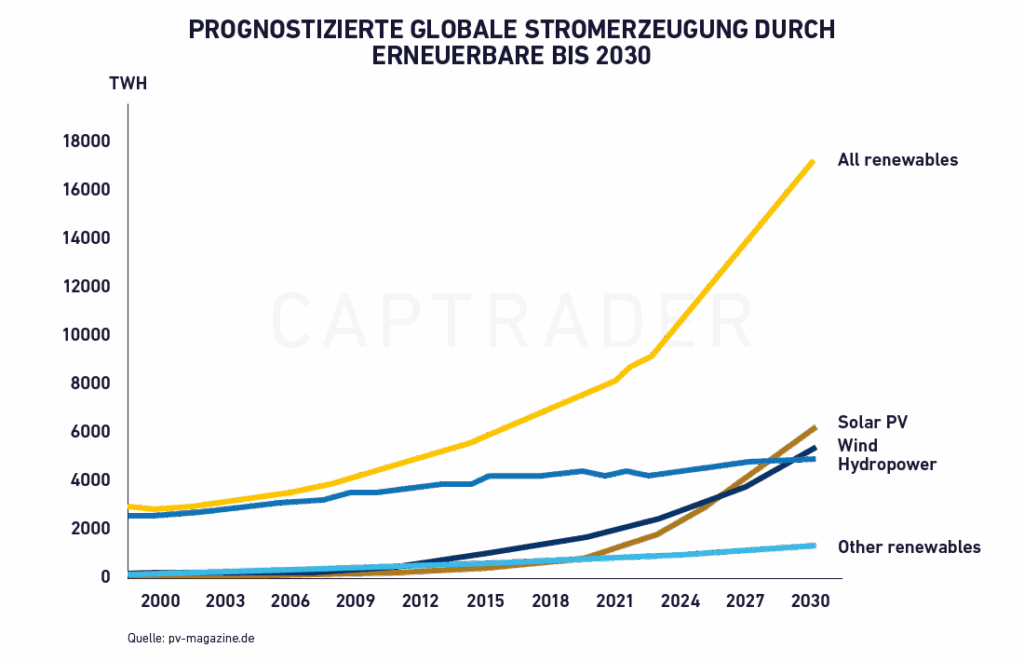
This massive expansion has a direct impact on the market for lithium stocks. Since solar and wind energy are volatile and are not always available when electricity demand is highest, the need for large-scale stationary energy storage systems (BESS) is growing exponentially as well.
These systems serve as buffers in the grid and are based predominantly on lithium-ion technology. Thus, the growth of renewables shown acts as a direct demand driver for lithium, since an efficient energy transition is not feasible without the storage capacities that lithium enables.
Construction of large-scale storage systems (stationary energy storage / BESS)
Lithium is not only used for Automotive stocks increasingly important, but will also be required to a high degree in the future for stationary energy storage (SES) systems, which stabilize power grids, balance out peak loads, and make the integration of wind and solar power feasible.
According to a recent market study, the global market for stationary energy storage is projected to grow from approximately $88 billion in 2023 to $282 billion in 2030, which corresponds to an average annual growth rate of approximately 21.6 %.

This significant expansion of home storage systems, industrial systems, and large-scale grid storage is driving a substantial increase in demand for lithium-based battery cells, quite independently of the development of electric vehicles.
Analysts also assume that stationary battery storage could account for a double-digit percentage of global lithium demand by 2030, which tends to support the commodity price in the long term and positions lithium stocks in a solidly grown market driven by both politics and technology.
Risk factors in lithium stocks: A detailed analysis for investors
Lithium stocks offer investors the opportunity to profit from the central role of this raw material in the global energy transition. However, they are also heavily dependent on volatile commodity prices, technological innovations in battery chemistry, and complex geopolitical frameworks.
Therefore, those who invest in exploration companies, mine operators, or refiners should understand the specific risk drivers of this sector and not just look at demand forecasts.
Margin pressure and cost structures in lithium stocks
The profitability of lithium companies depends crucially on the interplay between world market prices for lithium carbonate or lithium hydroxide and the respective extraction and processing costs.
In recent years, fluctuating raw material prices and more intense competition have put pressure on the margins of many producers.
- Heavy reliance on global lithium prices, which can quickly have a negative impact on earnings in the event of overcapacity.
- High operational costs for exploring new deposits and operating energy-intensive refineries.
- Lengthy and expensive approval processes that delay projects and dilute the return on capital employed.
- Inflationary pressure on energy and personnel costs, which could additionally burden operating margins under fixed offtake prices.
Structural change through new battery technologies
The energy sector is undergoing a profound transformation toward more efficient storage solutions and alternative battery chemistries. For lithium stocks, this means that today's extraction or processing methods do not automatically ensure future viability.
- High uncertainty regarding the market penetration of new battery technologies (e.g., solid-state batteries or sodium-ion batteries), which could alter the demand for lithium.
- Dependency on standardization in battery production, as new cell designs shift the specific demand for lithium quality.
- Competition from more efficient recycling processes, which could dampen the demand for primary-mined lithium in the long term.
- Pressure to transform for companies specializing in specific lithium grades that would have to expensively adapt their refinement processes in the event of a technological shift.
Economic situation, interest rates, and demand risks
Although lithium is supported by long-term trends, lithium stocks are sensitive to general interest rate levels and economic momentum, as end-users (primarily the automotive and energy storage industries) are themselves highly cyclical.
- Rising interest rates are making the financing of large mining projects more expensive and weighing on the valuations of growth companies in the sector.
- Economic downturns cause automakers to scale back their electric vehicle production, leading to a short-term oversupply of lithium and falling prices.
- Dependency on government subsidy programs for electromobility or the expansion of renewable energies, the elimination of which can curb market growth and thus lithium demand.
- The regional concentration of demand in a few key markets, such as China, Europe, or the USA, increases vulnerability to regional economic weaknesses.
Regulation, trade policy and supply chains
Lithium producers are closely linked to environmental regulations and international trade relations. Changes in these areas can fundamentally alter business models.
- Stricter environmental regulations for lithium mining (e.g., water consumption in salt flats) can limit production volumes or drive up production costs.
- Tariffs and trade conflicts drive up the cost of exporting battery raw materials and can call existing supply chains into question.
- Political instability in key producer countries (such as parts of South America) poses risks to the security of supply and the legal certainty of mining concessions.
- Disruptions in global supply chains due to geopolitical tensions can hinder the efficient distribution of the raw material.
An overview of the most important companies in the lithium stock sector
The following list provides an overview of a selection of companies operating along the lithium value chain: from exploration and mining to the refinement of battery raw materials. All values are sorted by their current market capitalization (as of May 2026).
| Company | ISIN | Country | Market capitalization in US dollars¹ |
| Sociedad Química y Minera (SQM) | US8336351056 | Chile | 26.5 billion |
| Ganfeng Lithium | CNE1000031W9 | China | 25.9 billion |
| Albemarle | US0126531013 | USA | 22.9 billion |
| Tianqi Lithium | CNE100000T32 | China | 19.2 billion |
| PLS Group Limited | AU000000PLS0 | Australia | 14.2 billion |
| Mineral Resources | AU000000MIN4 | Australia | 9.4 billion |
| Liontown Limited | AU000000LTR4 | Australia | 6.0 billion |
| IGO Limited | AU000000IGO4 | Australia | 4.2 billion |
| Lithium Argentina | CH1403212751 | Argentina | 1.7 billion |
| Standard Lithium | CA8536061010 | Canada | 0.95 billion |
To trade lithium stocks, you need a broker. Open your account with CapTrader and benefit from access to more than 170 international stock exchanges. In addition, trading fees are low: For US stocks, you pay 1 cent per share, with a minimum of $2.00 per order.


1. Albemarle
Albemarle (ISIN: US0126531013) is a global leading developer and producer of specialty chemicals and holds a central role as one of the largest lithium producers in the world.
Instead of limiting itself solely to pure raw material extraction, the company manages key parts of the value chain: from extraction from salt lakes and hard rock to processing into high-purity lithium carbonate and lithium hydroxide, which are essential for battery manufacturing in electromobility.
The company not only benefits from the high demand for battery raw materials, but also generates additional, stable sources of revenue through its specializations in the fields of bromine and refinery catalysts.
| Tax year | estimated revenue (in millions USD)¹ | Change compared to previous year¹ |
| 2025 | 5.143 | -4,37 % |
| 2026 | 5.732 | 11,46 % |
| 2027 | 5.994 | 4,57 % |
2. Ganfeng Lithium
Ganfeng Lithium (ISIN: CNE1000031W9) is a leading Chinese lithium specialist that has established itself as a global industry giant through consistent vertical integration ranging from raw material extraction to battery technology.
Instead of relying solely on extraction, the company controls essential parts of the value chain: from securing lithium resources in Australia, Argentina, and Canada to state-of-the-art refining into battery-grade lithium hydroxide and lithium carbonate.
This lithium stock not only sells high-quality battery raw materials to global automotive and cell manufacturers, but is also investing increasingly in its own battery manufacturing and innovative recycling processes, generating additional, future-oriented revenue streams.
| Tax year | estimated revenue (in millions USD)¹ | Change compared to previous year¹ |
| 2025 | 3.379 | 22,08 % |
| 2026 | 6.744 | 99,59 % |
| 2027 | 6.948 | 3,03 % |
CapTrader can do that:
At CapTrader, trading fees are extremely low: You can trade Chinese stocks starting at a 0.20 % order fee (with a minimum of 50.00 CNH).
3. IGO Limited
IGO Limited (ISIN: AU000000IGO4) is a diversified Australian mining company with a strategic focus on supplying battery metals that are critical to the global transition to clean energy.
Instead of focusing purely on traditional mining, the company is advancing an integrated strategy: from participating in and extracting world-class lithium deposits to downstream refining capacity in Kwinana, where high-purity, battery-grade lithium hydroxide is produced.
IGO participates significantly in the lithium market via joint ventures, combining this with expertise in the exploration and extraction of other critical metals such as nickel, copper, and cobalt.
| Tax year | estimated revenue (in millions USD)¹ | Change compared to previous year¹ |
| 2025 | 369 | -37,7 % |
| 2026 | 300 | -18,54 % |
| 2027 | 82 | -72,77 % |
4. Sociedad Química y Minera (SQM)
Sociedad Química y Minera de Chile (ISIN: US8336351056) is a leading Chilean specialty chemicals and raw materials group that holds a globally dominant position in the extraction of lithium from the Atacama Desert.
Instead of focusing purely on mining, the company controls the entire value chain: from cost-effective brine extraction and complex processing to the refinement into high-purity lithium carbonate and lithium hydroxide, which are indispensable for battery manufacturing in e-mobility.
The company not only benefits from its massive lithium capacity, but also generates robust, diversified revenue through its other divisions such as specialty fertilizers, iodine, and industrial chemicals.
| Tax year | estimated revenue (in millions USD)¹ | Change compared to previous year¹ |
| 2025 | 4.576 | 1,05 % |
| 2026 | 6.929 | 51,42 % |
| 2027 | 7.269 | 4,90 % |
CapTrader can do that:
At CapTrader, trading fees are extremely low: You can trade Chilean stocks with an order fee starting at 0.10 %.
5. Mineral Resources
Mineral Resources (ISIN: AU000000MIN4) is a diversified Australian industrial and mining company that occupies a unique market position through its broad portfolio of mining services, iron ore, and lithium.
Instead of relying on just a single source of raw materials, the company is pursuing an integrated strategy: from providing specialized mining and logistics solutions for third parties to operating its own lithium mines, which make a crucial contribution to supplying the global battery industry.
Mineral Resources generates steady cash flows through its mining services and complements them with high-margin commodity projects specifically tailored to the requirements of the battery metals market.
| Tax year | estimated revenue (in millions USD)¹ | Change compared to previous year¹ |
| 2025 | 3.221 | -15,27 % |
| 2026 | 4.362 | 35,45 % |
| 2027 | 4.380 | 0,41 % |


Conclusion: Investing in lithium - Is it worth it?
Lithium stocks offer investors an attractive, albeit demanding, return profile. The unstoppable trend toward electrification and the development of global storage infrastructure ensure a long-term positive demand forecast for the commodity. Companies that scale their production efficiently and lead technologically are likely to benefit the most from this development.
Nevertheless, the sector is not a sure-fire success. Investors must be aware that lithium stocks can be subject to strong price fluctuations due to commodity price volatility, complex geopolitical dependencies, and the risk of alternative battery technologies. In the short and medium term, setbacks are therefore more the rule than the exception.
Due to this pronounced volatility, lithium stocks are ideally suited as a more speculative addition in a core-satellite strategy, where they can purposefully complement the return potential of a defensive core portfolio.
For the structured building of your portfolio, the Core-satellite strategy proven as a stable foundation. Here, established industry giants with solid Dividendenhistorie the stable core of your portfolio. In addition, you can add higher-risk growth investments like lithium stocks as satellites to increase the return potential.
This proven investment concept is flexible and can be applied just as successfully beyond the commodities sector to other industries such as Tech stocks, Energy stocks or Oil stocks transfer.
List of sources:
(1) Source: Marketscreener from 05/03/2026
