


Many investors see steel stocks as a promising opportunity to benefit from the growth of the global steel market. The sector is performing positively due to rising steel prices, growing industrial demand, more efficient production processes, and the strong market position of leading companies.
This article explains which steel stocks are currently in a solid position and what opportunities and risks this sector offers. You will also learn which factors significantly influence the value of steel industry stocks.

The most important facts in brief:
- Global steel demand will likely increase continuously until 2030, driven by infrastructure programs, urbanization, and industrialization, especially in emerging markets.
- The specialty steel market is expected to grow at a CAGR of 5.3 % through 2030, with higher margins than those of mass-produced steel.
- The main risks are high cyclicality (economic dependency), volatile raw material and energy costs, trade policy (tariffs, trade conflicts), as well as high transformation costs due to decarbonization and CO₂ regulation.
What are steel stocks?
Steel stocks or steel industry stocks are shares in companies that operate along the entire steel value chain.
This includes, for example, companies that produce steel, process steel, develop new steel technologies, or manufacture and distribute steel blanks and products for industry and construction. These companies operate at the intersection of heavy industry, raw material markets, and industrial demand.
Despite changing market conditions, the steel sector remains relevant because steel is not only an indispensable material for industry, construction, and infrastructure, but also serves as an asset class in times of economic uncertainty.
Steel stocks are particularly suitable for investors who want to benefit from rising steel prices, growing industrial demand, and global infrastructure projects.
Steel stocks can be divided into different areas of the value chain. These segments react differently to steel prices, production costs, and economic sentiment.
- ProducersSteel producers are companies that manufacture, process, and resell steel to buyers. Their profits depend heavily on steel prices. When prices rise, their margins generally improve.
- development companyThese companies are developing new steel projects, investing in production capacities, or launching pilot plants for special steel alloys. They are associated with higher risks, but offer high share price growth potential upon success.
- Processing and manufacturing companiesThese companies manufacture steel products, store raw steel, or refine steel for sale or industrial applications. Their revenues are tied to the steel market and demand in target markets such as automotive, construction, or mechanical engineering.
- Trading and service companyThis includes companies that trade, supply, or finance steel, or offer logistics services for the steel industry. They benefit from high market activity and growing demand for steel, especially during economically strong phases.
- Service providerService providers offer technology, software, and services for the steel industry, such as production planning, quality control, plant maintenance, or specialized consulting. Their development follows the investments of steel producers and thus indirectly the steel market.
Some steel companies cover multiple stages of the value chain. This allows them to better compensate for fluctuations in individual sub-markets and achieve more stable earnings.


The market potential of steel stocks in 2026
Steel stocks will benefit in 2026 from an environment in which infrastructure programs, industrialization, and global demand for raw materials are pointing in the same direction.
Until 2030, a moderate but steady growth in global steel demand is expected, with emerging markets and major infrastructure projects in particular providing additional impetus.
At the same time, steel remains an indispensable basic material for construction, mechanical engineering, the automotive industry, and energy technology, which stabilizes base demand.
Key drivers of the market potential are:
- rising steel demand from infrastructure, residential construction, and industrial investments
- structural growth in emerging markets such as India, the ASEAN region, and MENA
- increasing use of special and high-grade steel in the automotive industry, energy sector, and mechanical engineering
As a result, a structural growth field is emerging in which the earnings potential increases along the entire steel value chain: from integrated steel producers and downstream processors to suppliers of specialty steel and higher-value products.
Structural demand growth through infrastructure and industrialization
Steel stocks are benefiting from a forward-looking long-term trend: According to OECD Steel Outlook 2025“Global demand for steel is expected to grow by an average of just under 1 % per year through 2030, with the momentum coming primarily from emerging markets.”.
The background includes major infrastructure programs, urbanization, the expansion of transport networks, as well as investments in industrial facilities and energy technology.
Particularly in the ASEAN region, the Middle East, and North Africa, above-average demand growth is expected, while demand in mature OECD markets tends to move sideways.
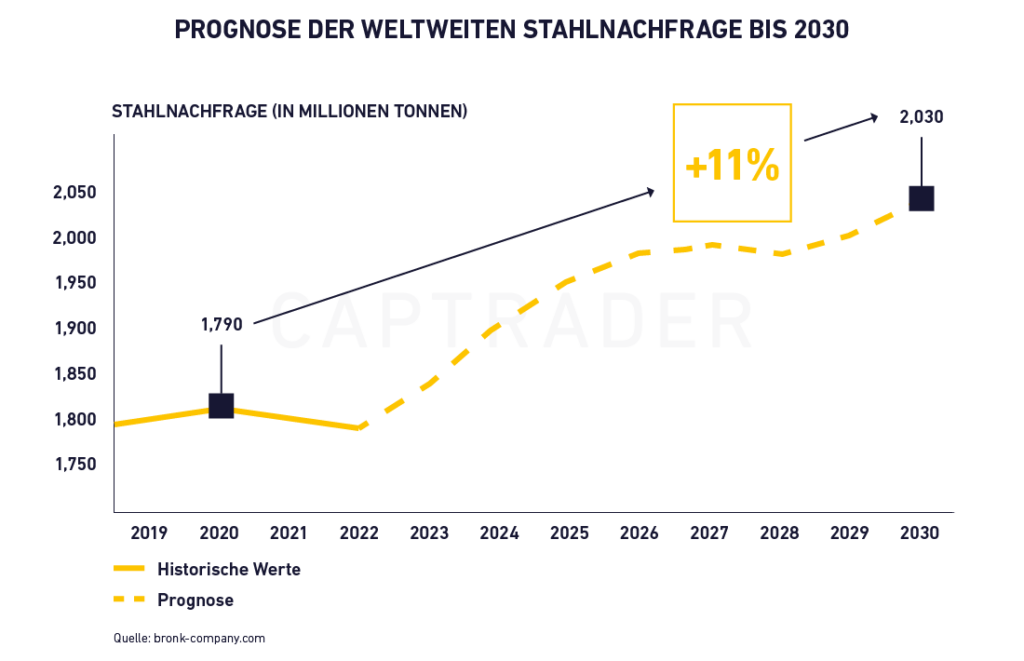
The chart illustrates the development of global steel demand from 2019 to 2030 in million metric tons. The solid line shows the actual values up to 2022, and the dashed line shows the forecast for the subsequent years.
In 2020, global steel demand stood at approximately 1.79 billion metric tons, as explicitly indicated in the graph. By 2030, demand is expected to rise to about 2.03 billion metric tons, representing an increase of approximately 11 % compared to 2020. The slight zigzag pattern of the curve shows that demand fluctuates in the short term, but the long-term trend is upward.
Higher-value segments: Specialty steel as an additional growth driver
A central component of the market potential of steel stocks is the growing share of specialty and high-quality steels, which allow for higher margins than conventional bulk steel.
Market studies assume that the global market for special steel will grow significantly by 2030: The Business Research Company expects a market volume of around 257 billion US dollars in 2030, up from just under 200 billion US dollars in 2025.
Several analyses support this forecast, driven by the automotive sector, mechanical engineering, energy, and demanding industrial applications.
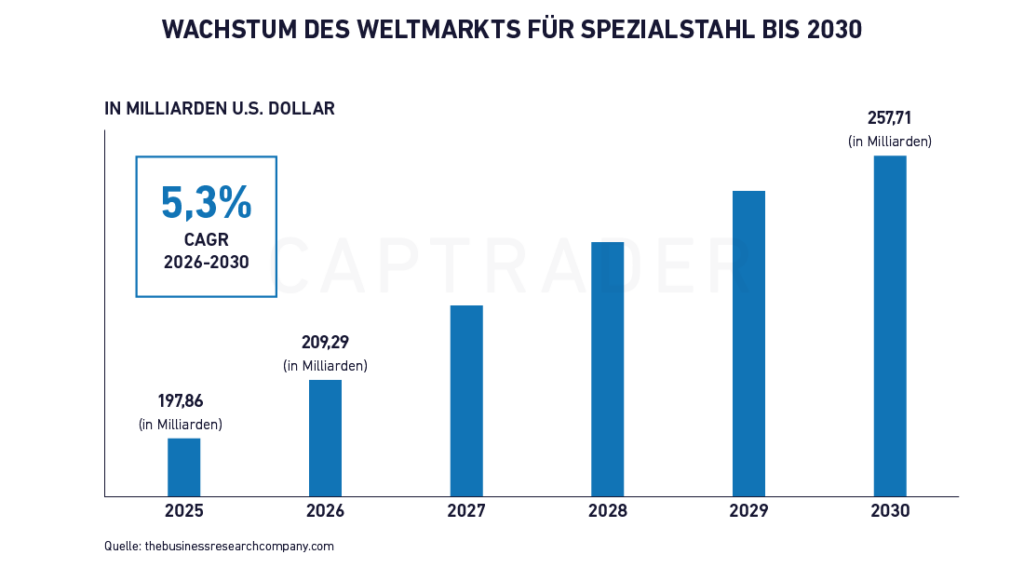
The chart illustrates the expected development of the global special steel market from 2025 to 2030 in billion US dollars. In 2025, the market volume is around 197.86 billion US dollars and is projected to rise to approximately 257.71 billion US dollars by 2030.
The compound annual growth rate (CAGR) is reported as 5.3 % for the period from 2026 to 2030. The bars grow larger from year to year, clearly illustrating that the specialty steel market is expected to grow steadily and dynamically during this period.
Additional impulses from regional shifts and capacity structure
Another aspect of the market potential for steel stocks is regional shifts and the development of global capacities.
While OECD data continues to show high overcapacity in the global steel market, demand is simultaneously shifting away from China toward other high-growth regions such as India, ASEAN (Indonesia, Vietnam, Thailand, Malaysia, and other Southeast Asian countries), and MENA (Middle East and North Africa).
This opens up opportunities for companies that are well positioned in these markets or benefit from export flows to these regions.
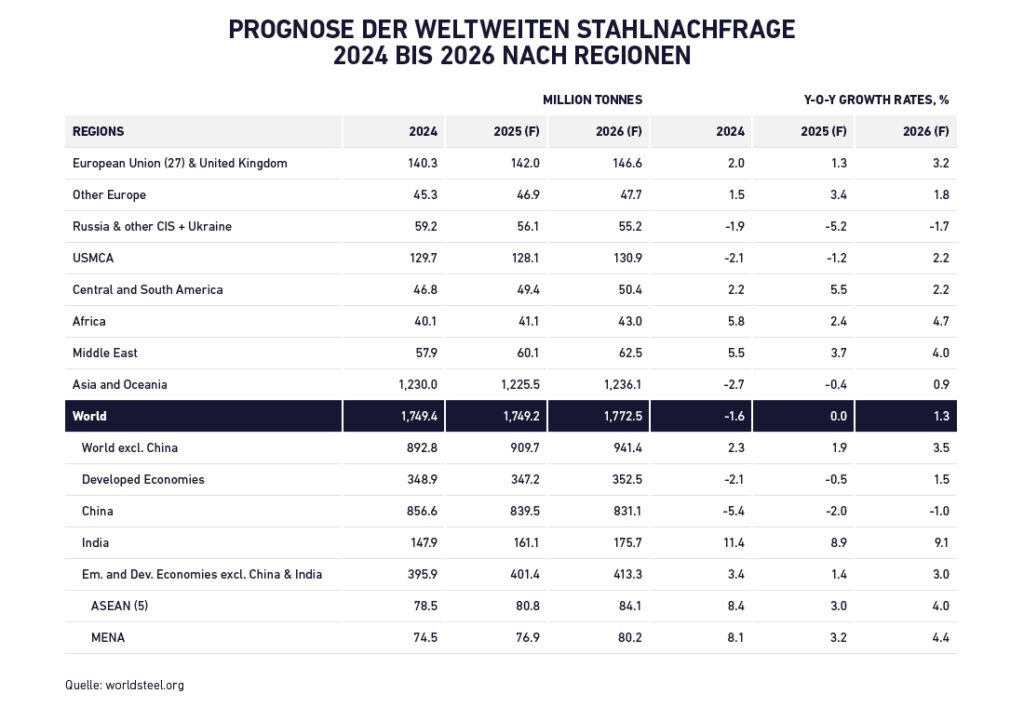
The graphic is structured as follows:
- The left column shows various regions and country groups such as the EU & UK, China, India, or the world.
- The middle columns show the forecasted demand quantities for finished steel in millions of metric tons for the years 2024, 2025, and 2026.
- The right column shows the respective year-over-year (y-o-y) growth rates, thus indicating how strongly demand increases or decreases each year.
Overall, global steel demand in 2025 will remain at the level of 2024 and is likely to continue to rise in 2026, with India, the Middle East, the ASEAN countries, and other emerging markets in particular recording higher growth rates than mature markets such as the EU or China.
Risk Factors in Steel Stocks: A Practical Analysis for Investors
Steel stocks are shaped by a variety of specific influencing factors that go well above and beyond classic stock market risks. Above all, the strong cyclical dependency, volatile cost structures, political interventions, and the pressure to transform through decarbonization determine the industry's development.
You should therefore keep a particularly close eye on the following risk areas when analyzing steel companies.
Cyclicality, demand, and margin pressure
The steel industry is one of the most cyclical sectors of all and reacts strongly to economic fluctuations. During economic downturns, demand from the construction, automotive, and industrial sectors often drops abruptly while prices simultaneously come under pressure.
Key risk drivers in this area:
- Economic slowdown with declining steel demand
- Overcapacity and global price pressure
- High fixed costs and strong operating leverage
- Volatile steel prices with rapid margin fluctuations
In practice, this combination regularly leads to significant drops in profits, which is why steel stocks frequently exhibit above-average share price volatility.
Commodity and energy price risks
Steel production is heavily dependent on raw materials such as iron ore, coking coal, and scrap, as well as on energy prices. Rising input costs can significantly weigh on margins, especially if they cannot be fully passed on to customers.
Key cost risks:
- Fluctuating prices for iron ore and coking coal
- High energy costs for electricity and gas
- Reliance on global supply chains
- Limited pricing power in weak market phases
Particularly in energy-intensive regions like Europe, it is evident that rising costs can significantly impair competitiveness and put pressure on profitability.
Trade policy, tariffs, and geopolitical risks
The global steel market is heavily influenced by political interventions. Tariffs, import restrictions, and subsidies can alter competitive conditions in the short term and lead to increased uncertainty.
Relevant political risks for steel stocks:
- Import tariffs and trade barriers
- Trade conflicts between major manufacturing countries
- State subsidies and market distortions
- Regional demand shifts driven by policy
For investors, it is therefore crucial to understand the markets in which a company operates and to what extent it depends on political frameworks.
Decarbonization and transformation costs
The steel industry is under growing pressure to reduce CO₂ emissions. The transition to climate-friendly production requires high investments and brings uncertainties regarding technologies and costs.
Important transformation risks:
- High investments in new production processes
- Rising CO₂ costs and regulatory pressure
- Technological uncertainties in „green steel“
- Short-term pressure on margins and cash flows
In the long term, this may result in competitive advantages, but in the short term, rising costs and increased investment risks often dominate the development of many steel companies.


The best steel stocks 2026
The following overview presents a selection of the world's most significant publicly traded steel companies, whose business models are closely tied to steel production, the processing of iron ore and scrap, and the supply of steel for industry, construction, and the automotive sector.
| Company | ISIN | Country | Market capitalization in US dollars¹ |
| Nucor Corp. | US6703461052 | USA | 57 billion |
| ArcelorMittal | LU1598757687 | Luxembourg | 53 billion |
| Steel Dynamics Inc. | US8581191009 | USA | 37 billion |
| JSW Steel Ltd. | INE019A01038 | India | 33 billion |
| Tata Steel Ltd. | INE081A01020 | India | 27 billion |
| POSCO Holdings | KR7005490008 | South Korea | 21 billion |
| Baoshan Iron & Steel | CNE0000015R4 | China | 19 billion |
| BlueScope Steel | AU000000BSL0 | Australia | 10 billion |
| Thyssenkrupp AG | DE0007500001 | Germany | 8 billion |
| Cleveland-Cliffs Inc. | US1858991011 | USA | 8 billion |
CapTrader can do that:
Open yours now Depot with CapTrader, to invest in steel stocks. Secure direct access to more than 170 international stock exchanges and benefit from attractive trading fees: trade US stocks starting at just 1 cent per share, with a minimum fee of only 2.00 US dollars per order. Start today and seize the opportunities of global markets.
1. Nucor Corp.
Nucor (ISIN: US6703461052) is the largest and most profitable steel company in the USA and is considered a global pioneer in the highly efficient production of recycled steel using electric arc furnaces (EAF).
The Dividend aristocrat operates a dense network of mini-mills (small steel mills that mostly use scrap metal and electric arc furnaces) across North America and supplies customized steel products to the construction industry, the automotive sector, and the energy and infrastructure industries.
| Tax year | estimated revenue (in million USD)¹ | Change from previous year¹ |
| 2025 | 32.494 | 5.73 % |
| 2026 | 38.061 | 17.13 % |
| 2027 | 38.761 | 1.84 % |
Instead of relying on capital-intensive, inflexible blast furnaces, Nucor utilizes the enormous flexibility of electric arc furnaces, which can be quickly ramped up or down depending on market conditions.
Thanks to this cost leadership, a historically grown low-CO₂ production, and an impressive dividend history of over 50 years of continuous increases, Nucor positions itself as a defensive premium quality leader in the global steel market.
2. ArcelorMittal
ArcelorMittal (ISIN: LU1598757687), headquartered in Luxembourg, is the leading integrated steel and mining company in the Western world, serving customers in over 160 countries.
The Blue-chip stock operates large-scale industrial plants in Europe, North and South America, and South Africa, and primarily supplies flat and long steel products for major projects in global shipbuilding, rail transport, and automotive engineering.
| Tax year | estimated revenue (in million USD)¹ | Change from previous year¹ |
| 2025 | 61.352 | -1,74 % |
| 2026 | 66.682 | 8,69 % |
| 2027 | 69.847 | 4,75 % |
As a global giant, ArcelorMittal faces the monumental task of having to decarbonize its primarily coal-based blast furnaces. Through massive investments in hydrogen technologies and direct-reduced iron (DRI), the group is trying to secure timely access to the CO₂-regulated markets of the future, making the stock a highly exciting turnaround bet on industrial climate change.
3. Steel Dynamics Inc.
Steel Dynamics (ISIN: US8581191009) is one of the newest and fastest-growing steel producers in the US, relying exclusively on state-of-the-art, circular-economy scrap recycling technologies.
The company operates highly automated production and processing sites in the American South and Midwest, primarily supplying high-growth customer segments in the manufacturing and transportation industries.
| Tax year | estimated revenue (in million USD)¹ | Change from previous year¹ |
| 2025 | 18.177 | 3,63 % |
| 2026 | 22.162 | 21,93 % |
| 2027 | 22.852 | 3,11 % |
By strictly focusing on electric arc furnace steel mills, Steel Dynamics benefits from extremely low fixed costs and an outstanding operating margin.
The combination of aggressive organic growth, the tapping into new product fields such as coated flat steel, and the avoidance of coal-based legacy burdens makes the company the darling of ESG-oriented investors in the industrial sector.
You can find more information on the environmental, social, and governance criteria in our article on ESG stocks.
4. JSW Steel Ltd.
JSW Steel (ISIN: INE019A01038) is the flagship company of the Indian JSW Group and the leading private steel producer in the fastest-growing infrastructure market in the world.
The company operates gigantic, integrated mega-plants in India as well as strategic manufacturing bases in the US and Italy to meet the rapidly growing demand for structural steel for Asian megacities and rail networks.
| Tax year | estimated revenue (in million USD)¹ | Change from previous year¹ |
| 2025 | 19.415 | -3,53 % |
| 2026 | 21.329 | 9,86 % |
| 2027 | 23.063 | 8,13 % |
While western markets struggle with stagnating demand, JSW Steel is riding an Indian investment wave.
The company is driving an aggressive capacity expansion and, in contrast to Western competitors, is focusing primarily on pure volume growth in emerging markets, making the stock an ideal cyclical growth bet for risk-tolerant investors.
CapTrader can do that:
At CapTrader, the trading fees are extremely low, even for stocks from India.
5. Cleveland-Cliffs Inc.
Cleveland-Cliffs (ISIN: US1858991011) is the largest flat-rolled steel producer and the leading supplier of automotive steel in all of North America.
The company controls the entire value chain, from its own iron ore mines and pelletizing plants in the US Midwest to the final rolling and finishing mills for major US automakers.
| Tax year | estimated revenue (in million USD)¹ | Change from previous year¹ |
| 2025 | 18.610 | -3,00 % |
| 2026 | 20.634 | 10,87 % |
| 2027 | 21.139 | 2,45 % |
Through radical acquisitions, Cleveland-Cliffs has transformed from a pure commodity supplier into a vertically integrated steel giant.
Thanks to absolute control over its own raw materials, the company is immune to global supply chain risks and benefits like hardly any other player from American protectionist tariffs, making Cliffs a highly resilient, North American specialty stock.
CapTrader can do that:
At CapTrader, the trading fees are extremely low: you can trade US shares from as little as $ 0.01 per share (order minimum $ 2.00) and German shares from as little as 0.1 % of the order volume (order minimum €2.00), options from €2.00, futures from €1.00, ETFs from €2.00 and much more!


Conclusion: Are steel stocks worth it in 2026?
Steel stocks could be rewarding for investors looking to benefit from the sector's clear growth projections. Continuous growth in global steel demand is expected through 2030. India, the ASEAN region, and the Middle East, in particular, offer above-average growth opportunities.
At the same time, you should not ignore the risks. The steel industry is one of the most cyclical sectors of all and is sensitive to economic fluctuations. In addition, volatile raw material and energy prices, trade conflicts involving tariffs, and high transformation costs due to decarbonization are weighing on the margins of many companies.
Overall, steel stocks could be a sensible component in a diversified portfolio if you have a long-term horizon and can weather the strong cyclicality.
You should focus on companies with a robust balance sheet, cost leadership, and a clear decarbonization strategy in order to capture the opportunities while minimizing risks.
If you are also interested in regular wealth accumulation with stocks, you can invest a fixed amount systematically via a Aktiensparplan invest.
Such a savings plan is not only suitable for Dividend shares, but can also be applied to Lithium stocks, solar stocks, commodity stocks, gold stocks or Automotive stocks apply and helps to build a diversified portfolio step by step.
List of sources:
(1) Source: Marketscreener from 06/01/2026
