


The delta is the most important and most frequently used option ratio among option traders. The delta is often used to decide which strike price/strike to select. The delta is one of the Option Greeks and can be calculated using the Black-Scholes formula. In practice, this task is performed by the trading software, where the delta of the Option can be displayed for each strike price. In this article you will learn what the delta of an option says and what influencing factors the option ratio depends on.
What is the delta of an option?
The delta of an option indicates how much the option price changes in the event of a movement of the underlying asset by one unit, all other things being equal.
A delta of 0.5 or 50 % thus means that the price of an option moves "half as fast" as the underlying; an increase in the price of a share by one EUR would thus cause the option price to change by 0.50 EUR.
Display of the delta in the TWS
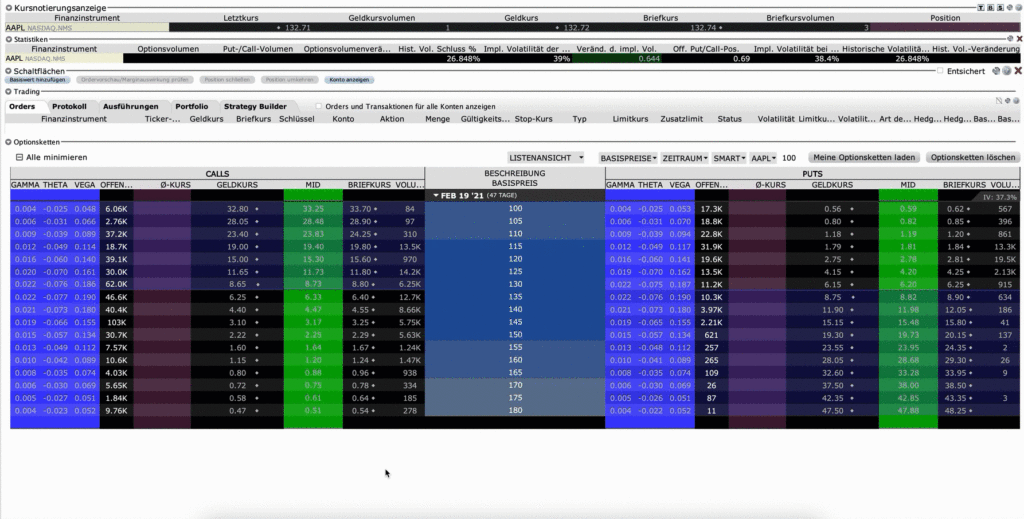
In the Trader Workstation you can display the delta of an option in the Option Trader. If the corresponding column is not yet displayed by default, you can click with the right mouse button in the header (left = calls, or right = puts). Then click on "Settings option chains". Now you can enter the word "Delta" in the field with the heading "Available columns" and thus find and add the delta.
Influence of Moneyness on the Delta
If you are in the Option chain If you look at the deltas of different options in the Option Trader of the Trader Workstation, you will see that the delta continuously increases or decreases in one direction or the other and thus obviously depends on the strike price of the option.
The further an option is in the money (In The Money), the higher its delta or: the further an option is out of the money (Out Of The Money), the lower its delta.
In the event of a Call option this means that the lower the strike price, the higher the delta.
In the event of a Put option this means that the higher the strike price, the higher the delta.
Like all Greeks, the delta is a ratio that is constantly changing. An increase in the price of the underlying means that the delta of a call option (all other things being equal) increases and that the delta of a put option decreases. Similarly, a decrease in the price of the underlying means that the delta of a put option (all other things being equal) increases and the delta of a call option decreases.
The option price and the delta
Since the delta of an option is directly related to the exercise price of the option, there is also a direct correlation between the delta and the option price:
The higher the delta of an option, the higher the option price.
Influence of time on the delta
Since options have a limited term and the time value of an option continuously decreases until the expiration date (time value decay), the remaining term also affects the delta of an option. However, a distinction must be made here between options that are at-the-money and options that are out-of-the-money.
Since an at-the-money option has approximately a 50 % probability of expiration for both a very short and a very long remaining term, the delta will also be approximately 0.5 or 50 %. However, for In The Money and Out Of The Money options, the delta approaches the value of 1 or the value of -1 or the value of 0, respectively, by the expiration date.
For example, imagine an option on the DAX with a strike price 20 % above the current price level. An option with a remaining term of only a few days has a very low delta, since the probability is extremely low that the index will rise by 20 % within a few days. The longer the remaining term of the option, the higher the probability that the DAX will rise by 20 % by the expiration date and thus the delta of the corresponding option also increases.
For call options applies:
The delta of In The Money Calls approaches 1 by the expiration date. The delta of Out Of The Money Calls approaches 0 by the expiration date.
For put options applies:
The delta of In The Money Puts approaches -1 by the expiration date. The delta of Out Of The Money Puts approaches 0 until the expiration date.
Influence of implied volatility on the delta
If market participants expect a high volatility, this will affect the implied volatility of the options and thus the option's Vega. A high Vega therefore means that there is a higher probability that an Out Of The Money option will expire In The Money on the expiration date and therefore also has an impact on the delta of an option.
The effects of implied volatility on the delta are similar to the effects of residual maturity on the delta described earlier, and primarily affect Out Of The Money and In The Money options.
The delta of Out Of The Money options (calls and puts) increases when the implied volatility increases. The delta of In The Money options, on the other hand, decreases.