


Besides the Delta, the Theta and the Vega, the Gamma one of the most important option ratios. The gamma expresses how the Delta of an option changes depending on the price of the underlying. In this article you will learn what the gamma is, what factors influence the gamma and how the option ratio changes depending on time and implied volatility.
What is the gamma of an option?
The gamma of an option indicates how much the delta of the option changes in the event of a movement of the underlying asset by one unit, all other things being equal.
For example, a gamma of 0.03 for an option with a delta of 0.3 (or 30) means that the delta of the option increases to 0.33 (or 33) or decreases to 0.27 (or 27) when the underlying moves by one unit. The value of the gamma is always positive.
Influence of Moneyness on Gamma
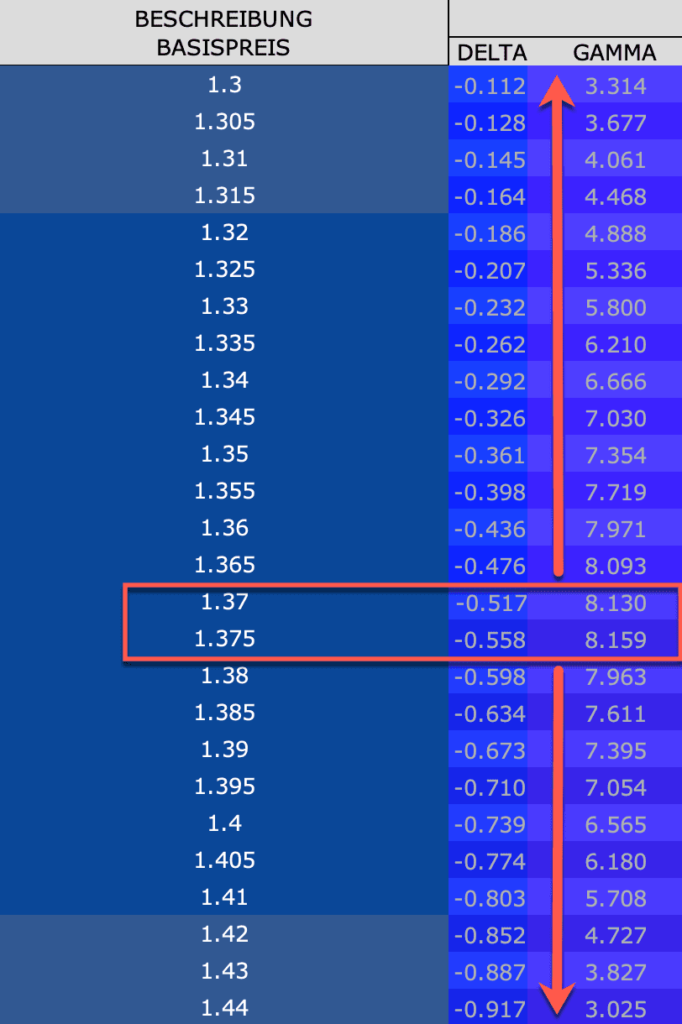
The gamma is always largest for at-the-money options and becomes smaller the further the strike price of the option is from the current price of the underlying. In other words, for options whose strike price is close to the current price of the underlying, the delta of the option changes much faster when the price of the underlying moves than for options that are far in the money or far out of the money.
Influence of time on the gamma
The time or time value decay of options also affects the gamma. It matters whether the respective option is in-the-money, at-the-money or out-of-the-money. For out-of-the-money and in-the-money options, the gamma tends to zero as the remaining term decreases. For an at-the-money option, on the other hand, the gamma increases as the remaining term decreases.
The reason for this is that the uncertainty of At The Money options is high until the expiration date and it is unclear whether the option will have a value at the expiration date or not. The price of an Out Of The Money option, on the other hand, tends to zero as the remaining term decreases; i.e. the closer the expiration date, the higher the probability that the option will expire worthless, which is why the delta and gamma also become lower. In The Money options approach the value of the underlying as the remaining term decreases; i.e. the delta approaches 1 and the gamma tends towards zero.
(Note: out of the money and in the money in this context means that the option must be several points out of the money or in the money. For a strike price that is only minimally out of the money or in the money, the gamma behaves similarly to an option with a strike price that is at the money).
Influence of implied volatility on the delta
With the influence of the implied volatility on the gamma of an option is the same as the influence of time on the gamma: A decreasing implied volatility means that the gamma of In The Money and Out Of The Money options decreases. For At The Money options, on the other hand, a decrease in implied volatility causes the gamma to increase.