


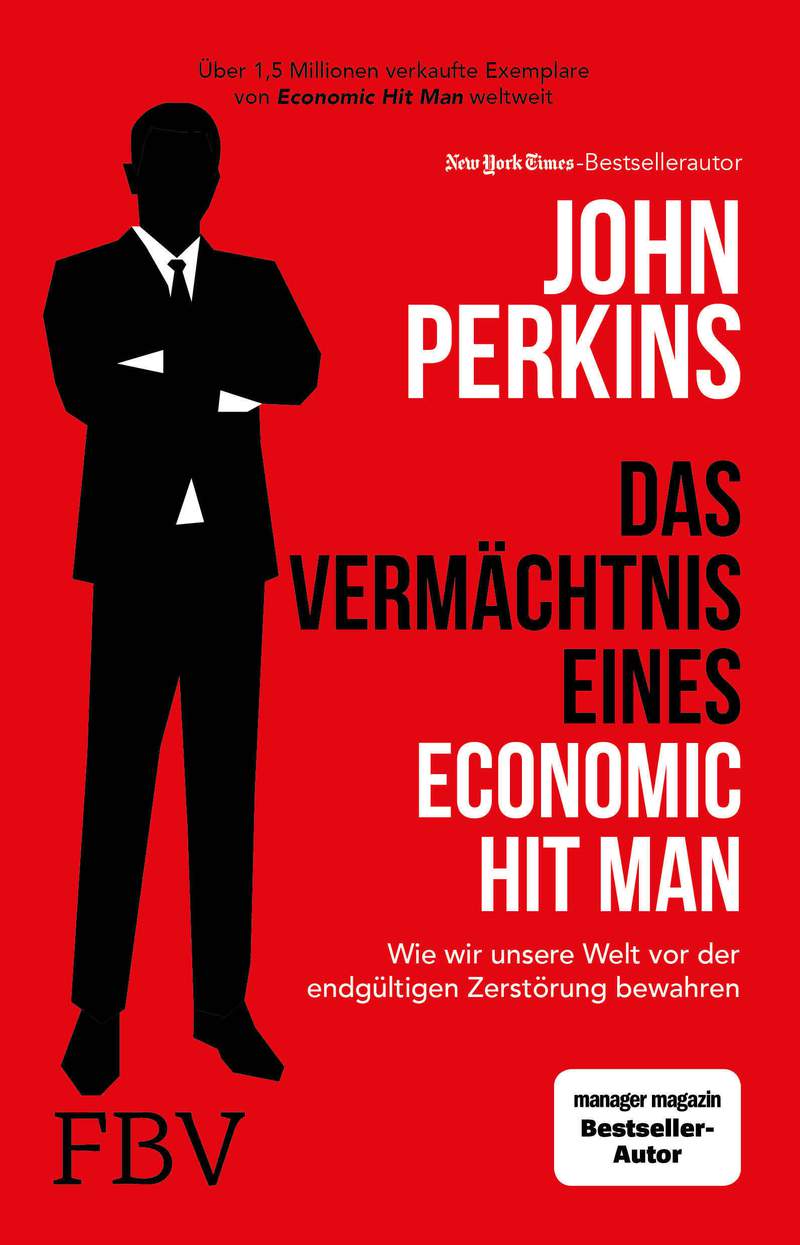
by John Perkins is a biography-like work by a New York Times bestselling author who puts his finger on the wound. The former economic hit man John Perkins describes from his personal experiences and things that were brought to him, how powerful states such as the United States, for example, operate a kind of economic colonization and thus bring dependence, suffering and destruction over the world. And he should know, because he has been in the first row of these very practices. A guilt that still weighs heavily on him. But this book is not only meant to be a rebuke against his former employers or the U.S. government; he also wants to show readers a way to save our world from ultimate destruction. For him, at least, a "business as usual" is not an option. To this day, he receives death threats for his statements and his work, but this does not stop him from making amends in a certain way and drawing attention to grievances.
"This book is about the damage I did as an agent in the service of the economic mafia and the reality-changing lessons I learned with Amazon. I then describe what I have done over the past 40 years to face my jaguars and apply what I learned to repair the damage I helped cause. I address the problems created by the greed and shortsightedness that currently prevails. Most importantly, I tell you what they can do. To change their lives and help all people live more harmoniously with nature and each other."
John Perkins

He was such an economic hit man. As a partner in a consulting firm, John Perkins convinced developing countries on behalf of major corporations to borrow from the World Bank and other U.S.-controlled institutions for the construction of infrastructure projects. This procedure then led to a relationship of dependency. These institutions now had effective means of exerting pressure through the loans in order to enforce their own interests or those of the USA. And they did so not only in the country itself, but also in their international representations.
At some point, John Perkins realized that his work and that of his colleagues was basically nothing more than a modern form of colonialism. That was the decisive point for him to resign and distance himself from it. In a first book he processed these experiences and in this book he now brings the story to a close by describing how he now tries to repair the damage caused.
"He argues for an 'economy of life'. This eliminates environmental damage, rehabilitates devastated areas, relies on recycling, and develops new technologies that benefit people and nature. John Perkins gives us a strategy for changing our lives and defending our territory - the Earth - against destructive policies and systems, so that each individual can contribute to the preservation of our habitat."
Financial Book Publisher
For twelve years, John Perkins did business as an economic hit man at the expense of the Third World in the interests of his U.S. clients. Communicated and befriended people and peoples who subsequently, left to their own devices, became victims of the system for which he was active. After his exit, he wrote dozens of books - directly or indirectly - about his time. He also taught at various universities and is an expert on environmental and social issues. It certainly helps that he always built close relationships during all his outreaches. Especially shamanism was his passion and he reports about it in this book.
This book was also intended to be, in a sense, a bridge between his previous books on indigenous cultures and his books on the global economy.
"How do we transform a destructive economy of death into a sustainable economy of life? What actions can they take to be their best selves?"
Marci Shimoff

Today, John Perkins is chairman of the nonprofit organization Dream Change Coalition, whose mission is to create a peaceful, just, stable world for future generations.
As a former "agent on behalf of the economy of death," as he calls it himself, he now sees it as his duty to change his own ideas and do everything in his power to help change dysfunctional systems so that they serve all people, plants and living things well.
Also for the term Economic Hit Man, there is of course a suitable definition in the book:
"Economic Hit Man (EHM) are highly paid experts who cheat countries around the world out of trillions of dollars. They funnel money from the World Bank, the U.S. Agency for International Development (USAID), and other foreign "aid" agencies into the accounts of large corporations and into the pockets of a few wealthy families who control the planet's natural resources. The Economic Hit Man's means are fraudulent financial analysis, election rigging, bribery, extortion, sex and murder. Their game is as old as power, but today, in the age of globalization, it has taken on new and terrifying dimensions. I know this, I was an EHM."
John Perkins
Personally, this book has once again held up a mirror of humility and gratitude to me. How privileged we can live and act in Europe and especially in Germany. An observation that the author had to make again and again in the deep Andean region and that made him ponder.
However, what he puts down on paper about his and his clients' machinations always left me speechless:
"At some point, however, I realized what I was really doing: using glossy economic studies to convince government leaders of countries around the world that had resources of interest to U.S. companies, such as oil, to accept huge loans from the World Bank, the Inter-American Development Bank, the Asian Development Bank, or one of their sister organizations. The funds were then used to contract U.S.-based construction companies for infrastructure projects. The loans plunged the countries into heavy debt. To pay them off, they had to sell their oil and other resources cheaply to our companies and meet other conditions that were in the best interests of an emerging American presidential empire.
In the end, the countries were never able to pay back the capital. But that was an integral part of the EHM strategy. We teamed up with the International Monetary Fund (IMF), forced countries to reschedule their loans and give away their oil and other resources cheaply to our companies - with no environmental or social strings attached. We persuaded them to privatize their utilities, prisons and schools, and other public sector enterprises and hand them over to U.S. investors. In some cases, we also forced them to vote with Washington against Cuba or another country in the United Nations or to allow the Pentagon to establish military bases on their soil."
John Perkins
It describes his path to emotional madness. Inwardly depressed and filled with self-hatred for all the things he did every day, or at least where he could do nothing about. This ruined him, his body and mind for years and probably cost him his marriage in the end. Maybe his resignation came at the right time. He probably couldn't have kept it up much longer.
"I was happy to no longer be part of that terrible system."
John Perkins
After he wanted to go public with these and many other findings for the first time, he already received the first death threats. Before a book contract was even signed, his former clients already knew what a risk he posed.
But he kept at it. In his first publications, he avoided direct references to his time as an economic hit man and convoluted the content. Nevertheless, he became heavily involved as a book author and gave lectures to point out grievances in the regions where he himself was active. He also flew back there to bring reconciliation where he was personally complicit in suffering.
A really crazy and stirring work by a globalization critic who puts his finger in the wound that many will probably not even be aware of. International politics - not only of the USA - is certainly a rather intransparent construct, where it is not always clear who is active here in whose interest at any given time. What John Perkins describes here at first hand, however, is striking to me.
But he is not only concerned with reprimanding. Rather, he is someone who advocates more togetherness instead of against each other and more understanding instead of colonizing instruction. In the spirit of the image of Condor and Eagle, who reunite every year and build a bridge between two peoples and cultures, he promotes exchange between them.
Not only to preserve cultural diversity, but also to stop exploitation and misery and bring real economic development to the third world.
Absolutely worth reading, although it is written in some places a bit lengthy and cumbersome. Nevertheless, very interesting and certainly not a book that you just devour and process. There is too much in it for that.