


Options and futures are forward contracts with a limited term. Options can be used to implement both simple and very complex strategies. In contrast to futures, shares or ETFs, the price of an option - the so-called option premium - is not exclusively dependent on the movements of the underlying asset; the option price is influenced by other factors such as the expected fluctuation range of a market.
In this article we will explain what the option premium or option price is and how it is arrived at and calculated. You will also learn what factors influence the option price.
What is the option premium?
The AmountThe amount that must be spent to purchase an option or the amount that is collected by selling an option is referred to as the option premium.
The option premium is therefore the Option price (option price). The term "premium" (English: option premium) is popular among option traders, since options are often associated with Insurances and thus the option price is seen as a kind of insurance premium which the option buyer pays to protect himself against price fluctuations. The option seller takes the position of the insurance company and may have to "compensate" the option buyer, for which he receives the option premium.
If you use options for speculative purposes as a private investor or trader, you should know which factors influence the option price in order to profit from them
The calculation of the option premium (multiplier)
For the analysis and trading of options, options traders often use a Option chainwhich allows to view options with different strikes and maturities. In the option chain, the bid and ask prices as well as the mid-price of each option are visible. In the option chain of the Trader Workstation, you can, for example, open an order mask by clicking on the bid or ask price in order to buy and sell options.
The option chain shows the Option price is not, however, the actual price of the option that must be paid when buying an option or that is received when selling an option.
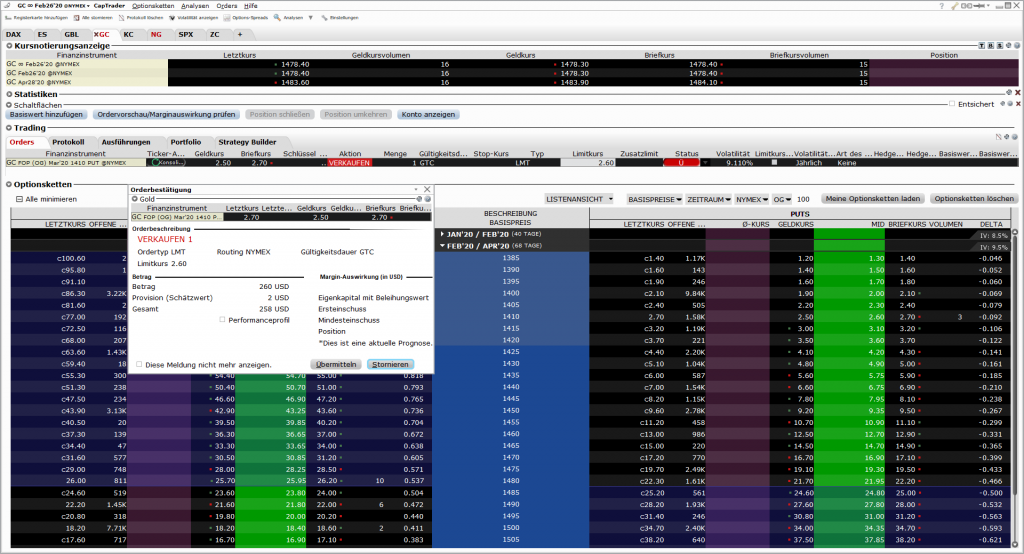
Each option has a multiplier that varies depending on the underlying. Thus, the price evident in the option chain must be multiplied by the multiplier to calculate the amount of the actual option premium.
For example, the subscription ratio of a stock option is 1 to 100, which means that with the purchase of an option, the option buyer receives the right to buy 100 shares. Therefore, the multiplier of Stock options 100.
For options on Futures and Indexes there are numerous different multipliers. The multiplier of a futures option is equal to the contract size of the corresponding futures contract. For example, with a future on WTI (Light Sweet Crude Oil, abbreviation CL) one moves the equivalent of 1000 barrels of crude oil. The multiplier of the CL options is therefore 1000.
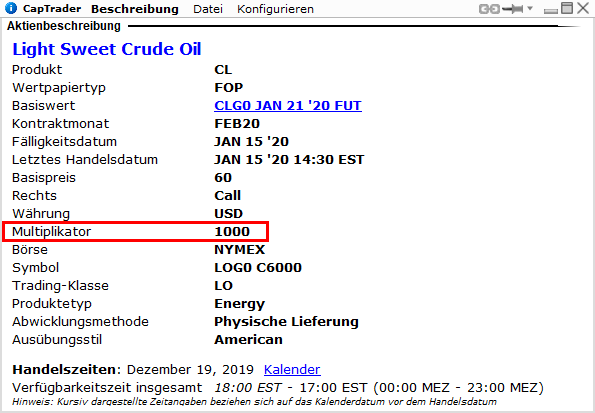
How to find the multiplier for each option
You can find the multiplier for each option in the Contract details. To see this, right-click on an option and then select the "Description" field under "Financial instrument info". Alternatively, you can open the description by double-clicking on the option.
Multipliers for different underlyings
(data without guarantee)
| Category | Underlying | Abbreviation | Multiplier |
| Stocks | Any share | any | 100 |
| Indexes | Dax Index | DAX | 5 |
| Indexes | Euro Stoxx 50 Index | ESTX50 | 10 |
| Indexes | S&P 500 Index | SPX | 100 |
| Indexes | E-mini S&P 500 Future | ES | 50 |
| Indexes | Russell 200 Index | RUT | 100 |
| Indexes | E-mini Russell 2000 Future | RTY | 50 |
| Indexes | Nasdaq 100 Index | NDX | 100 |
| Indexes | E-mini Nasdaq 100 Future | NQ | 20 |
| Metals | Gold Future | GC | 100 |
| Metals | Silver Future | SI | 5000 |
| Metals | Copper Future | HG | 25 000 |
| Energy | Light Sweet Crude Oil Future | CL | 1000 |
| Energy | Henry Hub Natural Gas Future | NG | 10 000 |
| Currencies | Euro Future | EUR | 125 000 |
| Currencies | British Pound Future | GBP | 62 500 |
| Currencies | Australian Dollar Future | AUD | 100 000 |
| Currencies | Canadian Dollar Future | CAD | 100 000 |
| Currencies | Japanese Yen Future | JPY | 12 500 000 |
| Bonds | 30 Year US Treasury Bond Future | ZB | 1000 |
| Bonds | 10 Year US Treasury Note Future | ZT | 1000 |
| Bonds | Euro Bund Future | ZB | 1000 |
| Grains | Soybean Future | ZS | 5000 |
| Grains | Soybean Oil Future | ZL | 60 000 |
| Grains | Soybean Meal Future | ZM | 100 |
| Grains | Corn Future | ZC | 5000 |
| Grains | Wheat Future | ZW | 5000 |
| Softs | Coffee "C" Future | KC | 37 500 |
| Softs | Cocoa Future | CC | 10 |
| Softs | Sugar No. 11 Future | SB | 112 000 |
| Softs | Cotton No. 2 Future | CT | 50 000 |
| Meats | Lean Hogs Future | HE | 40 000 |
| Meats | Live Cattle Future | LE | 40 000 |
| Meats | Feeder Cattle Future | GF | 50 000 |
Example: Sale of a put option on the Dax
As an example, we sell today at a score of about 13 225 points a Put option on the Dax index. We choose a strike of 12,000 points and a remaining term of 64 days.
In the option chain in the TWS Option Trader, we see the bid and ask price of the option. We create a limit order at mid-price. If we click on "Ü" for transmit, a window for the order transmission (order confirmation) opens. Here we see under "Amount" the premium we will receive for buying the option (48,50 EUR * 5 = 242,50 EUR).
Example: Purchase of a call option on the wheat future
The multiplier in the wheat future is 5000. In the option chain, we see that the current mid-price for a 550 call with a remaining term of 36 days is 13 1/8. However, the future is quoted in US cents per bushel. The option premium to be paid for the Call thus amounts to:
13 1/8 US cents * 5000 = 656.25 USD
Inner value and outer value
The option premium of an option consists of an intrinsic value and an extrinsic value.
The intrinsic value of an optionis the value that can actually be calculated at any point in time. In other words, the intrinsic value describes the value of the option under the assumption that it would expire at the current time. Out Of The Money (and At The Money) options therefore have no intrinsic value, as they are worthless upon expiration. In The Money options have an intrinsic value, which can be calculated from the difference between the price of the underlying and the strike price of the option (taking into account the multiplier).
If you take a look at the option chain of any underlying, you will notice that In The Money options trade at a higher value than the intrinsic value. Out Of The Money options also have a value, even though the intrinsic value of these options is zero.
The Difference between the actual value of an option and its intrinsic value is considered to be external value or current value is the term used. This occurs because market participants are willing to pay a price for an OTM option (or a premium for an ITM or ATM option) because it has the potential to "run into the money" (or increase in value) by the expiration date.
What influences the option price?
Whether the price of an option rises or falls, or whether an option is more expensive or cheaper compared to another option, depends on various factors. The option price is influenced by:
- Strike price of the option or moneyness
- Residual term or fair value
- Implied volatility
- Interest
Moneyness
The deeper an option is in the money, the higher its price. The further an option is out of the money, the lower its price.
As Call option buyer you benefited from a price increase of the underlying after the purchase of the option than Buyer of a put option profit from falling prices. If you speculate on rising prices, buying a call option that is way out of the money is significantly cheaper. However, it is also less likely that this option will have an intrinsic value by the expiration date.
As Call option seller they profit from falling prices of the underlying after selling the option, as Seller of a put option you profit from rising prices.
Residual term (fair value)
The external value of an option is also called Current value denotes. The longer the remaining term of an option, the higher its potential to reach a certain value by the expiration date. Therefore: The longer the remaining term, the higher the option price (with the same strike). On the expiration date, an option no longer has a time value and its value consists solely of its intrinsic value. Therefore, the time value decreases from day to day, which is called time value decay.
As an option buyer, time value decay has a negative effect on the purchased option; as an option seller, you can profit from time value decay.
Implied volatility
Implied volatility is the expected variation of a market. The higher the expected volatility, the higher the probability that an underlying will make a large movement. Therefore, the higher the implied volatility, the more expensive options are.
Since the implied volatility with Option pricing models If the implied volatility is determined from the option price using the Black-Scholes formula, the statement can also be reversed: The higher the option price, the higher the implied volatility.
So, as buyers of options, they profit from an increase in volatility, and as sellers of options, they profit from a decrease in volatility.
With Volatility indices such as the VDax-NEW, the VIX or the GVZ you can implied volatility monitor different markets. You can also find tools for analyzing implied volatility in Trader Workstation, as well as in other various providers.
Interest
For the calculation of the option price also play the Financing costs a role. As a buyer of a Call option you pay a lower price compared to the purchase of the underlying and can invest the difference risk-free. As the seller of a call, you have to keep the underlying or the countervalue free, which is why you cannot invest the capital and thus incur a financial disadvantage. This is priced in by a price premium.
When buying a Puts However, the sale of a put results in an interest disadvantage, since the amount cannot be invested risk-free in contrast to an immediate sale of the underlying. The sale of a put, on the other hand, results in an interest rate advantage, as the costs for the purchase of the underlying are incurred at a later point in time and the amount can be invested profitably in the meantime.
This fact is taken into account in the pricing of options, which is why put options are more favorable when interest rates are low.