


With swing trading, we profit from the ups and downs of stock market prices. Swing trading strategies enable attractive profits and are also suitable for occasional traders. Of course, there are also numerous risks to avoid!
We explain how swing trading works, which strategies are suitable and present the necessary signals and useful tips.

The most important in a nutshell
- In swing trading, we use smaller back and forth movements in stock market prices that occur during larger trends.
- Holding periods, profits and trading frequency are very flexible, but generally much slower than with day trading.
- Swing trading is merely a generic term for a trading style; the actual swing trading strategy depends on the person, goals and opportunities.
- Swing trades require less time and attention and are therefore also suitable for beginners and hobby traders.
What is swing trading?
A glance at the price of any share immediately shows that developments are never straightforward, but consist of numerous up and down movements. In swing trading, traders take advantage of precisely these oscillations!
- The generic term "swing trading" covers strategies and trading styles that benefit from swings.
- Swing movements of this kind arise as part of larger trends.
- Swing traders earn money through purchases and Short sales of rising and falling prices.
- They take advantage of several of these smaller price changes instead of relying exclusively on major market developments.
Swing trading is popular due to its high degree of flexibility, among other things: a position does not have to be Day trading The trading positions can be closed at the end of a trading day; they can remain open as long as the positive profit prospects remain.
If the indicators have changed and further gains are unlikely, experienced traders close their swing trades - this can be minutes, days or weeks later, depending on how strong and long-lasting a swing was.
In practice, it is impossible to time the ups and downs of prices perfectly. Traders always miss the absolute highs and lows. In swing trading, however, perfection is not the goal! This creates a form of trading with less pressure and stress, which appeals to many budding swing traders.


How does swing trading work in practice?
For swing trading, you focus on lucrative positions that can be held for several days - provided this is worthwhile. The whole process is therefore comparatively leisurely: it is not usually necessary to sit in front of the screen and monitor the development of trades.
- A regular check, for example once a day, is sufficient for many swing trading strategies.
- You also need to plan time and energy for analyzing worthwhile trades.
- However, as the number of open positions is usually limited, the effort involved here is also limited.
- In addition, many swing trading strategies are also suitable for trading in calm market conditions or long-term sideways movements.
- The upward and downward movements necessary for swing trading are also at least partially present in such phases and enable us to make solid profits.
Swing traders therefore do not have to wait for major movements on the stock markets. This is a major advantage over trend-following strategies, traders who Share trends and many other methods!
Good to know:
Steady markets pose a problem for many trading strategies. However, one group that is relaxed about such phases is options traders. If you Trade optionsyou can also benefit if the prices remain the same!
Swing trading strategies: Ideal for beginners and professionals?
Due to the manageable effort involved, swing trading is also suitable for working people who want to be active on the markets alongside their regular job. It therefore stands in contrast to very time-consuming Day trading strategies or the extreme form, the Scalping.
- With swing trading, it is often enough to check your own positions once a day.
- Active swing traders also log in three times a day - at the closing bell of the major international stock exchanges.
- Swing trading strategies are much more flexible overall and are also much less stressful psychologically.
- The time spent in front of the screen is also less hectic and does not always require maximum attention - swing trading is therefore less susceptible to stress-related careless mistakes.
It is hardly surprising that swing trading strategies statistically deliver the best results for private individuals. During experiments, earn money with day tradingInstead, the time of an open position determines which category you fall into.

The boundaries between swing trading and long-term investment often appear blurred. Even long-term investors sometimes sell a position after just a few days - but you would hardly call them swing traders.
Conversely, it can also happen that planned swing trades have to be closed after just a few seconds. However, this does not make the executing trader a day trader!
Swing trading strategies are particularly worthwhile in these markets
Not only is the actual swing trading strategy up to you; you also have a completely free hand in the selection of assets! Stocks, ETFs, Forex currency pairs, futures and many more are possible.
- Shares and share indices are clearly the most popular.
- Both forms are well suited for beginners, as there is usually already a good level of prior knowledge.
- The S&P 500 in particular is often the focus of swing traders.
- Other indices such as the Nasdaq 100 or the DAX are also possible.
- For individual stocks, you need to decide on a suitable level of volatility.
- Very volatile stocks are generally better for the Day trading with shares but could also be of interest to active swing traders.
The forex market is also very popular for swing trading strategies. Trading in foreign currencies has the highest liquidity, offers sufficient volatility and is accessible around the clock.


What swing trading strategies are there?
If you want to use swing trades, you should not simply open positions at random - a swing trading strategy is necessary to trade in a structured and potentially successful way!
Which swing trading strategy suits you depends on various personal factors. The choice is very extensive. We would like to introduce you to some well-known approaches:
Trend following strategy
If you recognize a larger trend, you can use the ups and downs in it for swing trading. The trend following strategy is a particularly simple and obvious swing trading strategy that attempts to do just that.
- Here too, various key figures, analysis methods and charts are used to identify trends.
- Signal services such as TraderFox, findings from the Social Trading or the use of AI Trading are also very popular.
- Once discovered, traders use the overriding trend to take several long and short positions.
- The end of a trend must also be recognized. Indicators such as the stochastic oscillator are suitable for this purpose.

The trend following swing trading strategy allows us to take advantage of upward and downward trends. However, if a movement develops too quickly, you can run into problems with your swing trades and "run behind the trend".
Breakout strategy / range trading
If prices have been moving sideways for a long time without any major trends emerging, or have moved strongly in one direction, traders expect an imminent breakout with a significant movement.
- Swing traders can take advantage of the small up and down movements while waiting for the big breakout.
- Since you stay within a specified range, this is also referred to as range trading.
- One of the clearest signs of a breakout is a high trading volume combined with high volatility.
- If prices have been moving between a support and a resistance line for a long time, a breakout becomes increasingly likely.
- If you place swing trades in anticipation of a breakout, you should prepare your positions above or below (depending on the expected direction) these lines.

For this strategy, it is important to correctly identify resistance and support lines. They can run upwards, downwards or sideways and often resemble channels. This is why the term "trend channel" has become commonplace.

A trend channel can point in different directions and is delimited by support and trend lines.
COT Swing Trading Strategy
The "Commitment of Traders" Report COT is an overview of open positions on the US commodities market. This report is available on Friday, after the close of US trading. You can use it to analyze the current situation and prepare swing trades for the following week.
- This swing trading strategy can only be applied to the commodities market in the USA, i.e. you can only trade futures or options with it.
- Unfortunately, there is no comparable report in other countries or other markets.
- For example, the COT allows us to detect particularly large long or short positions and use them to identify an imminent trend reversal.
- Complex COT signals and indicators are also available, which make calculations based on the report.
- As the report provides a good basis for comprehensive analyses, COT trading plays a special role among swing trading strategies.
Indicators and signals for swing trading strategies
How can a trader discover the right time for a swing trade? Through indicators, chart patterns and other Trading signals! They are the real heart of this form of trading.
The swing trading strategy in turn determines which indicators, trading signals, forms of Chart analysis etc. are used.
All indicators, patterns, key figures and other sources of information must be taken into account: They serve as forecasting tools, but are not guarantees! Despite correct use, developments may occur in practice that do not match the predictions of chart patterns and the like.
In any case, we recommend that you first develop your own swing trading strategy on a Demo account to try it out! If you achieve reliable profits with your swing trades here, it makes sense to switch to a "live account".
The most important key figures and indicators include
Moving average
The moving average is used to show an average value of price movements.
- It reliably compensates for short-term outbreaks (peaks, troughs) and enables a more realistic view.
- A specific period is required for the calculation.
- The longer the selected time interval, the slower the value reacts.
- It is designated as short-term (up to 50 days), medium-term (50 to 100 days) or long-term (100 to 200 days).
- A moving average can be used in many ways and forms the basis for further calculations.

There are also numerous sub-forms, such as the exponential moving average, in which the more recent values are weighted higher.
How to use the moving average in swing trading:
The moving average can be used very well to indicate changes in direction. This is done by looking at a short-term and long-term moving average on the same chart. Intersections of the two graphs are important indicators for swing trades.
- If a short-term moving average crosses from below, traders usually take this as a sign of an impending upward movement.
- If, on the other hand, the crossing occurs from above, a downward movement is to be expected.
Since you want to profit from the swings during a movement with swing trades, the moving average is particularly important: it shows you the direction in which a trend is moving and helps you to predict changes.
Volume
Volume is very easy to use for swing trading strategies, as no further calculations or special charts are required: It is a key figure that is available as standard and can be easily looked up.
- A look at the respective trading volume allows conclusions to be drawn about the strength of a movement
- A higher volume stands for a stronger trend
- A lower volume, on the other hand, indicates a slowdown and possibly a subsequent reversal.
Swing trades take place during a movement, i.e. in a trend. Thanks to the volume, you can always keep an eye on the "health" of the trend and make adjustments to your swing trading strategy.
Relative Strength Index (RSI)
How many units of an asset are currently being bought and sold? The relative strength index RSI provides this information in a simple way. Its value fluctuates between 0 and 100 and indicates whether a market is oversold or undersold.
- Values above 70 are considered a signal for an overbought market where a correction is to be expected. In this case, many swing trading strategies envisage a short position, for example through a Short sale, before.
- On the other hand, if the RSI is below 30, an undersold condition is assumed and a rise is expected - ideal for swing trades in a long position.
Stochastic oscillator
For your swing trading strategy, you can use oscillators ("swings") to discover a centerline and thus identify trends. The Greek word "stochastic" refers to guesswork or a dependence on chance.
- Stochastic oscillators are mainly used to measure changes between two trading periods.
- The basic concept is simple: if prices in one period were below those of the following period, there was an increase.
- In the event of a contrary development, the market has moved downwards.
- In swing trading, stochastic oscillators are used over several trading periods.
- A formula is now used to try to predict trends, turning points and price movements.
- Similar to the RSI, the oscillator fluctuates between 0 and 100, with a high value (usually 80 or more) being considered overbought and a low value (usually 20) being considered undersold.
- In addition, a three-day moving average is added. If the oscillator crosses the line, traders assume that a reversal of direction is imminent.
Together with other key figures and indicators, the appropriate entry points for swing trading can be derived.
Chart patterns
The Chart analysisThe analysis of patterns and shapes in the price charts is of great importance for many trading strategies. In addition to the typical Day trading charts it is also used in swing trading.
- Bull Flag
A flag is a rectangle, parallelogram or rhombus. The special form of the bull flag, on the other hand, does not necessarily represent an upward movement, but is almost always characterized by falling or sideways-moving prices.
This swing trading chart pattern gets its name from the fact that it is often followed by a strong, bullish movement.

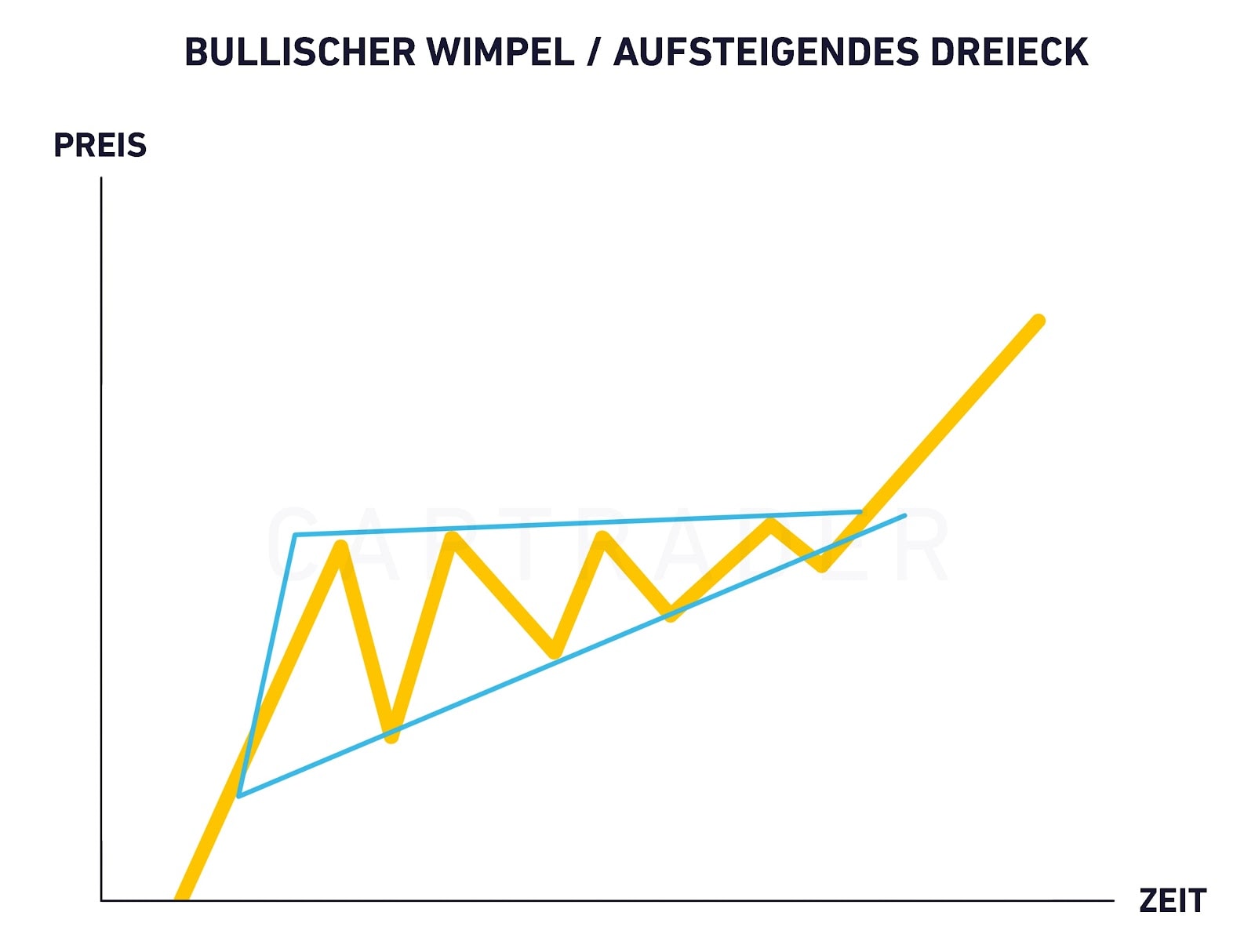
Ascending triangle
Triangles can be interpreted in different ways, depending on the direction in which the tip points.
The upward-pointing triangle is known as the "bullish pennant". It is a strong signal for an upward price trend.
A symmetrical triangle, where the apex points neither up nor down, is considered a possible signal for wait-and-see markets with an unclear direction. Swing traders can continue to profit here, but must be aware of the diminishing swings and the risk of a breakout.
Double bottom / double top
At first glance, the chart pattern of the double bottom is reminiscent of the letter "W". This figure is associated with an upcoming upward movement, which is supposed to begin at the second low (the "bottom").
In the case of the double top, it works the other way round: a fall is expected after the second peak, so that short positions can be worthwhile.
If this expectation is met, profits can be realized through long positions.
However, swing trading in a short position can also generate additional income before the end of the double bottom.

In addition to the chart patterns mentioned above, there are numerous other forms, each of which allows for its own interpretation. Traders often focus on a few patterns that are particularly useful for their particular swing trading strategy.
Advantages and disadvantages of swing trading and swing trading strategies
Swing trading strategies work very differently and each has its own focus and problems. However, swing trading has some general advantages and disadvantages that distinguish it from other forms of trading. These include
Advantages
- Cheaper than day trading or scalping: Active traders often place hundreds of positions per month and have to bear correspondingly high costs. Swing trading generally requires fewer transactions, which is reflected in lower costs.
- Little effort: You can engage in successful swing trading with comparatively little time. The positions placed are hedged accordingly and run without your intervention.
- Comprehensible: Swing trades are based on long-term trends and developments. This makes this trading style easier to understand and also less mathematical and theoretical than scalping, for example.
- Good profit prospects: Depending on the swing trading strategy and successful implementation, high profits await traders.
- Easy to get started: Getting started is comparatively easy and can be learned in a reasonable amount of time. Experienced private investors often describe the entry as very organic.
- Flexibility: Swing trading strategies offer a high degree of flexibility in terms of time, capital investment, selected assets and much more.
Disadvantages
- Risk: Swing trading involves considerable risks to your capital. Although the risks are lower than with other trading styles, swing trades can by no means be described as "safe"!
- Overnight Risk: There are often significant price changes between two trading days. While day traders and scalpers avoid this critical phase by closing their positions, swing traders are fully affected by them.
- Not suitable for all market phases: Most swing trading strategies run into difficulties during highly volatile market phases and can lead to higher losses.
- Losses add up: Many swing traders experience phases in which they lag behind the market movement. Instead of many small profits, they make many small losses that quickly add up.
- Missed profits: By focusing on small price swings, traders can avoid major price rallies.


Conclusion: Swing trading strategies allow entry into trading
Swing trading receives less attention than Day trading strategies or long-term equity investments. Nevertheless, if executed correctly, it enables handsome returns with manageable effort.
Swing trading gets its name from the swinging movements that occur on the markets as part of a trend. Even on the way up or down, there are always short reversals - swing trading strategies take advantage of these and place lucrative positions.
To detect such turning points, traders use various key figures and indicators, such as the moving average, volume, relative strength index or stochastic oscillators.
When and how a position is opened depends on the swing trading strategy used - you can't do without it, because haphazard transactions are guaranteed to lead to failure!
We recommend that interested persons first Paper Trading Account to familiarize yourself with swing trading. Also take a look at our article on the topic Trading signals is useful to enable the correct application.
