When investors discuss the topic of REITs, a name that many readers are likely to be familiar with comes up relatively quickly. "The Monthly Dividend Company" or Realty Income, THE flagship of the sector. In today's blog post, I would like to take a closer look at the company.
Business model and strategy: What exactly does Realty Income do?
Realty Income (TWS abbreviation: O, ISIN: US7561091049) is the No. 8 company by market capitalization among the leading Real Estate Investment Trusts (REIT) and specializes in properties with long-term leases. Since its founding in 1969, Realty Income has built a reputation as a reliable and stable player in the real estate sector. The company is best known for its monthly dividend payments.
Realty Income's portfolio currently comprises more than 15,000 properties that are let to a large number of commercial tenants. This diversification helps to spread risk and generate stable income. The properties are mainly located in the USA, although the company is also expanding internationally. The tenants come from a variety of sectors, including retail, grocery stores, pharmacies and fitness studios.

A key aspect of Realty Income's business strategy is its focus on high-quality locations and creditworthy tenants. This enables the company to conclude long-term leases (usually over 10 years) and generate stable income. Realty Income often relies on so-called triple net leases (NNN), in which the tenants bear all costs, including property taxes, building insurance and maintenance.
Market development: What happened recently
Nothing but expenses
If you look at the bare chart, you can quickly see that the last 8-9 years have not been much fun in terms of price and have also been very volatile. From the all-time high of around $80, it went down to $42 in the pandemic flash crash, only to scratch the $75 mark again by August 2022. And then the Fed's interest rate hikes made themselves felt. On the other hand, this meant that there were plenty of opportunities to enter the market. In the following, we want to clarify whether now is such a good time.
Takeovers, acquisitions and portfolio quality
Since the IPO, Realty Income has of course grown considerably and has now reached a size where acquisitions of individual properties are no longer as profitable. For this reason, the focus in recent years has also been on M&A in order to grow faster.
In 2021, VEREIT was acquired for around 11 billion. Just one year later, Realty Income acquired a large portfolio from CIM Real Estate Finance Trust for around 1 billion. At the end of 2023, the acquisition of Spirit Realty Capital for almost 10 billion was announced, which was successfully completed in early 2024.
In the first quarter of 2024, CEO Sumit Roy also communicated further investments, primarily in Europe, with a value of over 300 million and cash yields of over 8% in some cases. I would like to go into this in more detail in the "Adjusted Funds From Operations" section.
Focusing
As mentioned at the beginning, Realty Income's portfolio is already clearly focused on retail. However, if you take a look at the latest acquisitions, the focus is on other properties and sectors such as casinos, data centers and industrial properties.
This naturally diversifies the portfolio and supposedly reduces the risk. At the same time, however, this has an impact on the valuation, as REITs with a specialization have been valued higher in the past.
In the next paragraph, we take a closer look at the corresponding key figures!
Key figures: A look at the finances
Now we come to the exciting part for many investors, the key figures. I would like to focus in particular on debt, as this is still one of the most important factors that can decide the "fate" of a REIT in the current environment.
Debt and maturities
Realty Income is one of the few listed REITs to have an A or A3 credit rating, which should certainly be advantageous in terms of financing. With a Net debt/EBITDA from 5.5x the debt is perfectly fine.

The balance sheet is otherwise very solid and the maturities are well spread over the coming years. A term loan may have to be refinanced in 2026 due to the takeovers, but this should not be a problem.
Adjusted funds from operations
As mentioned in the "Takeovers and Acquisitions" section, there were investments in Europe with cash yields of >8% in Q1'24. This is quite an important development, because if you take a closer look at the chart below from the Investor Relations presentation, the yield (consisting of the Dividend yield of around 6% and internal growth) is only 8% if external AFFO growth is excluded.
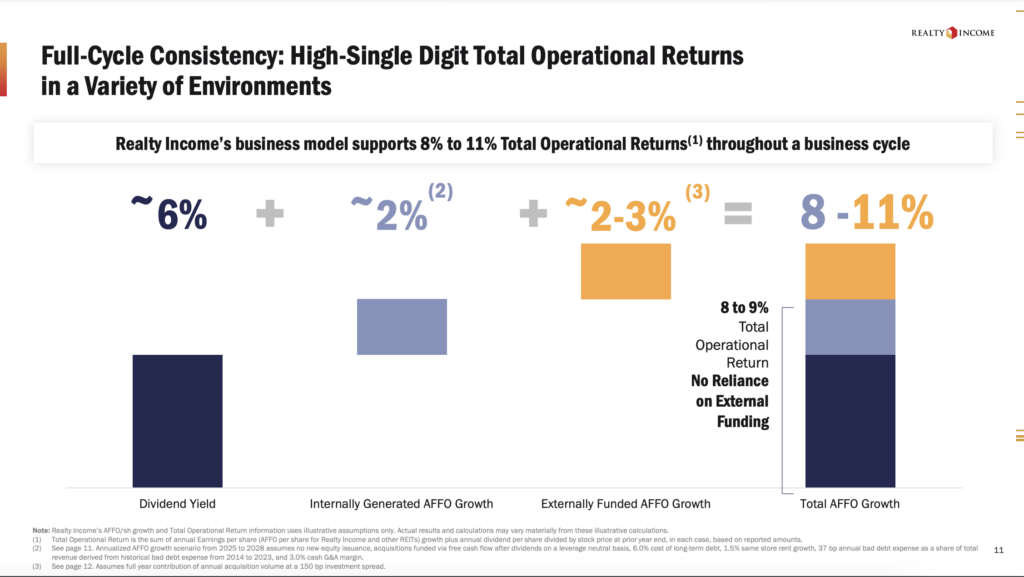
However, the latest acquisitions have now shown that it is possible for Realty Income to buy properties with correspondingly high cap rates, which is why AFFO growth is increasing overall.
Another aspect is that the higher investment yields of 8% will increase the Investment spread to 1.5% as the acquisitions are financed with a WACC of 6.5% (65% equity, 35% debt).
Multiples
With a P/FFO of 13x, Realty Income is naturally valued favorably, as historically a 16-19x multiple was the norm, also due to the good credit rating. Assuming FFO growth of 2%, an acceptable total return should be generated even in a very bad scenario (P/FFO falls to 10x).
Dividend: A reliable income stream
At almost 6%, the dividend is of course an elementary component of the total return. At Realty Income, this has been flowing and growing for over 25 years, so the REIT is a true Dividend aristocrat. However, some other representatives with this prestigious status have recently seen their dividends cut.
It is therefore all the more important that the Dividend is also secure and continues to flow even in bad times. With a payout ratio of around 74%, the company is at the lower end of the range of 70-90%, which is usual for REITs. The dividend should therefore be safe (for the time being).
Fortunately, the dividend is also growing at an annual rate of 3-4%. This year, for example, there have already been three increases.
Peer comparison
Agree Realty
When I talk about a REIT, I always like to take a look at the peers in order to make a better comparison. One such peer is Agree Realty (ADC)!
With a P/FFO from something under 16x ADC is not quite as cheap as $O, but this is due to its specialization, as the REIT, named after CEO Joey Agree, is effectively a triple net lease pure play without any forays into other sectors. And as mentioned at the beginning, REITs with specialization are often valued higher.

Another difference is the quality of the tenants. At Agree Realty, 68% of the tenants are "investment grade", at Realty Income "only" 36%.
But the other key figures are not bad either. Net debt/EBITDA is with 4,8x lower than that of Realty Income (5.5x), which Payout ratio of the dividend with 73% slightly lower and the Dividendenwachstum mit via 6% higher.
Options trading
I myself am also active as an options trader, but almost exclusively as a so-called "writer". Therefore, I am naturally also interested in REITs that are suitable for additional cash flow or for a favorable entry by means of a tender offer.
Attention: The earnings season has just started. ADC reports figures on 23.7. and Realty Income on 5.8.
Due to the current low Volatility (VIX) Unfortunately, the premiums are not as attractive as in volatile times. Nevertheless, both Realty Income and Agree Realty offer some interesting cash flow opportunities.
Realty Income
For Realty Income, there are options with a Strike of $52.5 in September or more conservatively with $50 in December that still offer halfway reasonable premiums despite the low volatility (VIX).
Agree Realty
With Agree Realty, an entry at a strike price of $55 in October may be interesting, although the premiums here are also rather moderate.