


The Pip represents the smallest possible movement of a currency in Forex trading represent. However, depending on the extent to which you trade, even such a tiny price change can have a significant impact. We explain how a pip works, what value it has and what significance it has for traders.

The most important in a nutshell
- A pip ("percentage in point") is the smallest price change that a currency can make.
- Pips indicate the movement of a currency. Together with the amount invested (lot), the profit or loss of a trade can be calculated.
- We show you how you can use pips in practical trading and what they are good for
Pip Trading: Definition
Trading is all about price changes. Whether you are day trading with Operating shares, Trade options or want to build up a long-term equity portfolio: The price changes decide whether you have been successful.
This is also the case when trading foreign currencies, i.e. forex trading. In this area, however, even the smallest changes are important! Even a hundredth of a percent can make a huge difference here, because traders are invested with very large amounts (or are involved in very large positions).
The smallest measurable price change is referred to as a "pip", which stands for "point in percentage".
- For many currencies, such as the US dollar or the euro, one pip corresponds to 0.01 %, i.e. one hundredth of a percent.
- When trading other currencies, such as the Japanese yen, there are other values. Here, one pip corresponds to 0.1 %.
- Larger price jumps are also indicated in pip (for example: price increase of the euro by 150 pip = increase of 1.5 %).
- Although percentages are possible, they are rather unusual in Forex trading.
CapTrader can do that:
Forex trading is a lucrative trading field that offers you a number of advantages (e.g. round-the-clock trading). Unfortunately, foreign currencies are not available with most brokers! However, CapTrader gives you access to these attractive assets with a huge selection of over 100 currency pairs!
Lots, pips, currency pairs: important terms explained
To better understand the meaning and use of pips in trading, it is helpful to know other important terms:
1. Base and quote currency
In forex trading, currencies are traded in pairs: One is bought and paid for with another currency. The unit that is purchased is called the base currency, while the means of payment is the quote currency.
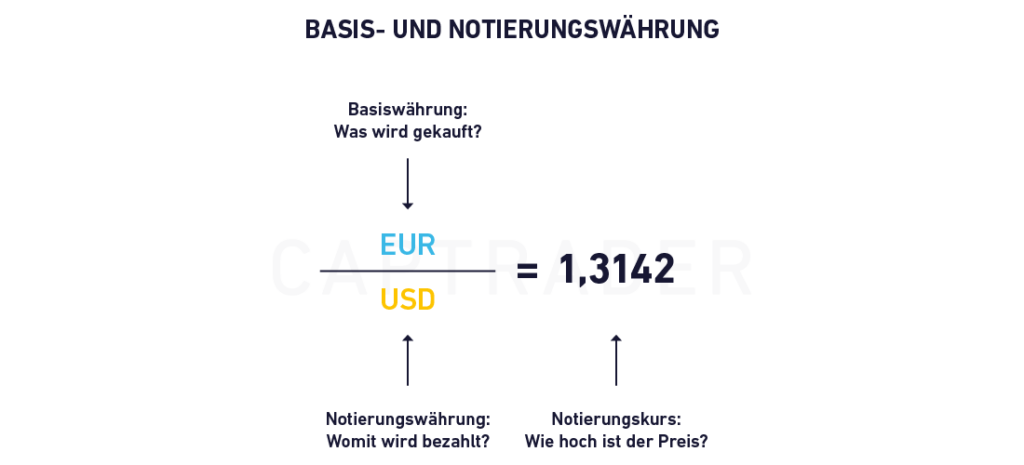
The price is usually quoted to 4 decimal places (exception: Japanese yen). A change to the fourth decimal place corresponds to one pip.


2. Plumb bob
Another key term to consider in the context of forex trading and pips is the lot. It describes the quantity of a currency that is traded, i.e. the size of a trade.
Currency pairs are traded in predetermined amounts, which means that traders cannot simply open any position size, but have to choose the right one for them from a range of lots.
The following are available:
| Lot designation | Scope |
| Standard | 100,000 units |
| Mini | 10,000 units |
| Micro | 1,000 units |
| Nano | 100 units |
The price of a lot is made up of the volume multiplied by the price of the currency.
Example:
You want to buy a standard lot of US dollars and pay for it in euros. The dollar exchange rate at the time of trading is € 0.95. The purchase price is therefore € 95,000

Such an investment would expose you to considerable risks - not to mention the enormous capital requirement.
However, you do not have to pay the full amount of €95,000 to purchase the lot! A broker like CapTrader offers you the option of margin trading. You only provide part of the money, the so-called margin. Your broker lends you the rest.
This not only reduces your capital requirement, but also creates a leverage effect: both your potential profits and any losses multiply depending on how much capital you have borrowed.
Regardless of how you purchased a nano, micro, mini or standard lot: After the purchase, the price of your US dollars may change. These changes are measured in pips and relate to a single currency unit.
If the price of your US dollar rises by 5 pips in our example, this corresponds to a change of 0.0005 $. Multiplied by the lot size of 100,000 $, this results in a profit of 50 $.
Good to know:
With CapTrader you can also Short sale on currencies and thus profit from falling prices!
Pipette and micro-pip
In the context of forex trading, you will occasionally come across the You may come across the terms pipette or micro-pip. This does not refer to the laboratory device for measuring liquids! A pipette is an even smaller unit of measurement for price changes that some brokers offer.
- This is a price change to the fifth decimal place
- Ten pipettes make one pipette
- It corresponds to 0.00001 monetary units (exception: Japanese yen). When trading in euros, this would correspond to 0.001 or one tenth of a cent.
These particularly small movements can play an important role when trading larger lots. However, if you are betting on micro, mini or nano, you will naturally have less interest in these mini movements.
Also with the Scalping pipettes are of particular interest. With this fast type of trading, traders are only invested for a few seconds or minutes and close positions after small profits.
Those who use this strategy often only aim for gains of a few pips. In this case, it may make sense to place a stop-loss order a few pips apart.
CapTrader can do that:
With CapTrader you get all Forex toolsthat are necessary for successful trading at a professional level. In addition to top-class trading software, this also includes the display of pipettes for particularly accurate calculations.
Importance of pips in trading
Anyone who has already invested in products such as shares and now wants to invest in Forex Learn to trade will initially be surprised by the concept of pips. Why is the percentage figure, as is usual for other assets, not sufficient here?
The simple answer would be: Because currencies are recorded to the fourth decimal place when trading. A term like Pip is simply simpler and easier to grasp than the exact percentage ("one hundredth of a percent").
However, this does not quite do justice to the importance of the Pip: Forex trading involves trading very large quantities of the respective currency. Positions here often have a value of up to €100,000! A single pip may "only" correspond to a hundredth of a cent, but for an investment of €100,000 this adds up to the equivalent of €10.
Jumps of several pips, which are not uncommon in Forex trading, can immediately mean larger profits or losses.
Good to know:
The sizes of currency trading mentioned here can be daunting, especially for newcomers; however, there are also significantly smaller positions and alternatives such as currency ETFs or options trading. Forex is therefore also Trading for beginners suitable.
Risk management through pips
Pips have many more practical uses in trading than just measuring price movements: They are also a important instrument for sensible risk and Money management!
Traders place take-profit, stop-loss and other types of orders to secure their profits and avoid major losses. The orders are created at intervals at the current price and trigger a sale when a predefined value is reached.
The central question that concerns all retailers is:
- How large should the distance in pips be between the current price and the respective order?
The answer depends largely on the strategy chosen:
| Strategy | How many pips profit per trade? | Stop-loss distance |
| Scalping - numerous trades with short terms and small profits | Traders aim for small profits of 5 to 10 pips per trade | Very close, often between 2 and 4 pips per trade |
| Day trading (intraday) - positions remain open for a maximum of one trading day | A popular destination is a Day trading profit per day in the amount of 50 pips per trade | Small distance, usually 50 % of the maximum profit, i.e. around 25 pips |
| Swing trading strategies - There is no predefined term here. Positions are opened when a trend reversal is expected. | No upper limit. A position is often closed manually when no further increase is likely. | No fixed distance. Trailing stop-loss orders are often used. |
| Trend following/position trading - the aim is to profit from long-term movements. | No upper limit. The holding period can be several weeks or months. | Larger intervals to exclude minor price fluctuations. |
CapTrader can do that:
With other brokers, you often search in vain for complex order forms and are therefore severely restricted in your trading - CapTrader, on the other hand, offers over 100 order types and algorithms as well as the possibility of comprehensive semi-automation through programs such as the AgenaTrader!
All information and strategies are strongly dependent on the selected solder size! For a standard lot with 100,000 monetary units, each pip corresponds to a price change of 100,000 × 0.01 % or 10 monetary units.
In contrast, a nano lot only contains 100 units of the respective currency. A single pip only results in a change in value of 100 × 0.01 % or 0.1 monetary units.
Each pip therefore has a greater effect on your result the larger the selected lot is.


Conclusion: The pip is a key indicator when trading foreign currencies
Foreign exchange trading is particularly popular among traders. It offers attractive profit opportunities thanks to high volatility, very good liquidity and round-the-clock trading. However, the price movements of the individual currencies are often very small - so small that a Percentage not precise enough appears.
The Pip as a smaller unit of measurement. It denotes the The smallest official price change that a currency can experience. It corresponds to one hundredth of a percent or a change of one point in the fourth decimal place. An exception is trading with the Japanese yen, where one pip represents only 0.1 %.
Some brokers even offer a fifth decimal place, the so-called pipette. Such small units of measurement can be useful because very large volumes are traded in Forex tradingA "standard lot" corresponds to 100,000 monetary units (e.g. €100,000 or USD 100,000).
A seemingly microscopic price change of one pip can already amount to €10 or USD 10. Jumps of several pips, which occur regularly, therefore quickly equate to several hundred dollars or euros!
Depending on your strategy (planned holding period, trading frequency, etc.) and the selected lot size a pip can have a greater or lesser influence on your trading.
Traders who are just starting out in forex trading should therefore familiarize themselves with the function and meaning of the pip. Other interesting articles for newcomers are Trading for beginners, Day trading strategies and the important topic Trading taxes.
