Your Broker for worldwide trading

Understanding volatility - Trump's influence on the options market

30%, 70%, 145% or no tariffs at all? What is currently happening in the trade war between the USA is unparalleled. In politically tense times, not only does media interest increase - the implicit volatility on the financial markets also regularly increases noticeably. We are currently observing precisely this phenomenon in the course of the trade war between Trump and the entire world, especially China.

But while many investors see this volatility as a risk, for experienced options traders - especially option writers - this is a potential opportunity. After all, excessive volatility means overvalued option premiums. Anyone who systematically collects premiums should take a particularly close look. In this blog post, we look at Trump's influence on implied volatility.

You are currently viewing placeholder content from Youtube. To access the actual content, click the button below. Please note that doing so will share data with third-party providers.

More Information

Implied volatility - the key to the option price

Before we look at the current situation, it is worth taking a brief look at how it works: Implied volatility (IV) is a central component of the option pricing formula (e.g. Black-Scholes). It reflects the range of fluctuation of an underlying asset expected by the market over the term of the option.

Rising IV → higher option prices

Falling IV → falling option prices

The IV is particularly important for writers: if options with an increased IV are sold, the premiums received are higher. If the IV falls after the sale, a volatility gain (vega effect) is generated in addition to the time value decay.

What causes volatility to rise?

Donald Trump's public presence and his polarizing influence on the US political landscape regularly cause noticeable swings in volatility indices. Especially in the run-up to important events such as:

  • Presidential elections
  • Debates about the electoral system or possible "irregularities"
  • Escalations of a geopolitical nature (e.g. China, NATO, Middle East)
  • Domestic political tensions (e.g. Supreme Court, congressional blockades)

These uncertainties are leading to a build-up of risk hedging by institutional market participants, which is directly reflected in increased demand for puts (especially far out of the money) and thus in rising implied volatility. The current trade war between Trump and the entire world is causing great uncertainty, which has led to an extreme increase in implied volatility.

The data situation: VIX, VXTLT, SPOTVOL and Co.

The VIXwhich is based on the options of the S&P 500 Index, is currently at an above-average level. On April 7, 2025, the VIX reached a level of over 60 in the course of the customs war, which has not happened since the volatility spike on August 5, 2024 (intraday high). It is interesting to note that the VIX has been above 40 for days, which has not happened since the coronavirus crisis.

Line chart of the VIX index from 2008 to 2023, showing fluctuations with peaks in 2008, 2020 and 2022. The chart contains horizontal grid lines and an orange cursor indicating a current value.
VIX - Classic fear indicator

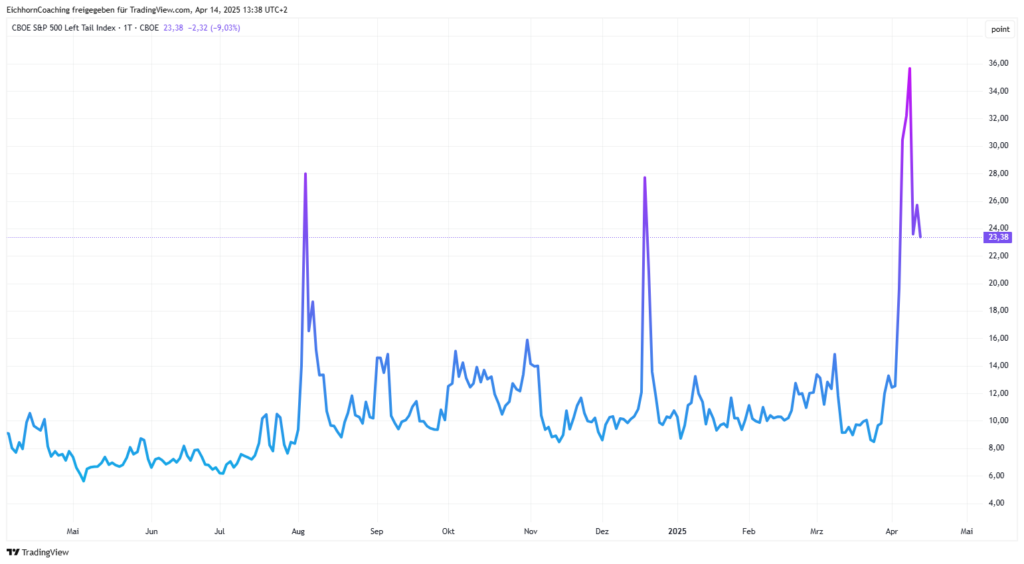
LTV - Left Tail Volatility Index

This basically works with the same logic as the VIX, but the LTV measures the implied volatility in the left tail of the distribution - i.e. the implied volatility of options that are very far out of the money, so-called "black-swan hedges". This index has also risen sharply:
Line chart showing fluctuating data points from April 2022 to April 2023, with notable peaks in August and January and a sharp rise in March.
LTV - Left Tail Volatility Index

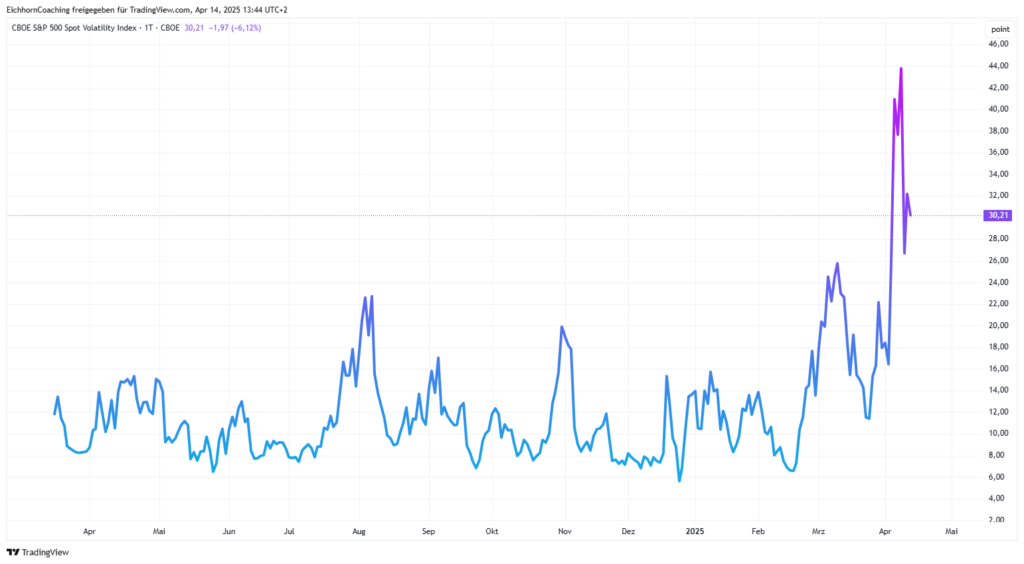
SPOTVOL - The IV on the money

The SPOTVOL Index is based on a completely different methodological approach. In contrast to the Left Tail Volatility Index (LTV), which only considers put options that are far out of the money - and thus specifically measures the price behavior of hedges against strong market losses - the SPOTVOL focuses on a completely different segment of the options market:

It only considers options that are quoted "at the money" (ATM).

This means that SPOTVOL provides precise information on how the market is pricing in short-term implied volatility where option prices react most sensitively to changes - namely around the current price level of the underlying.

This focus on ATM options makes the SPOTVOL particularly relevant for understanding the expected standard volatility, i.e. the volatility that is not driven by extreme events or tail risks, but results from the breadth of normal market fluctuations.
Line chart of the CBOE S&P 500 volatility index over time with two lines. The left line is blue and represents previous values, the right line is purple and shows an increase in volatility.
SPOTVOL - The IV on the money

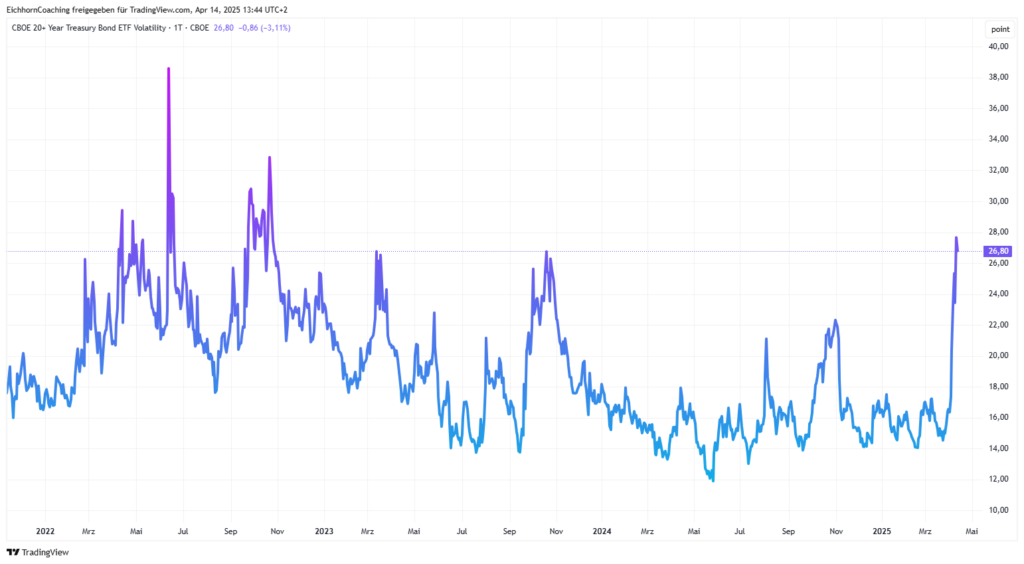
VXTLT - Volatility on US government bonds

The tariff war also left its mark on movements in government bonds, with the VXTLT, which tracks the volatility of long-term Treasury bonds (TLT), rising recently.
Line chart showing the price points for a financial value from 2021 to 2025 and highlighting fluctuations with peaks around mid-2022 and the end of 2023.
VXTLT - Volatility on US government bonds

Possible strategies for writers

Due to the well-known mean reversion effect, it can be assumed that implied volatility will fall again in the medium term - meaning that the VIX is also likely to fall below the 20 mark in the future. However, this realization alone is no guarantee of a safe profit trade. After all, it is currently impossible to make a reliable forecast of how far volatility may rise in the run-up to a decline.

The nervousness on the market is clearly noticeable: the Fear and Greed Index is currently in extremely pessimistic territory, in some cases below 5 points. At the same time, the VVIX - the volatility of volatility - is at an exceptionally high level of over 160. This combination indicates that a temporary high in implied volatility may already have been reached.

At the same time, however, uncertainty remains. It is therefore essential for writers - as with short volatility strategies in general - to pursue consistent risk management. This is the only way to prevent short-term swings from counteracting the overriding advantage of falling volatility.

The following points are therefore essential:

  • Cash Secured Puts on fundamentally sound quality stocks.
  • Put credit spreads below relevant technical support zones - with clearly defined risk and positive premium structure.
  • Conservative position sizes: Only part of the capital should be allocated to short vol trades.
  • Risk limitation via spreads: Strategies such as vertical spreads or Iron Condors define the maximum loss potential from the outset.
  • Hedging via VIX options: The targeted purchase of long VIX calls on volatility products can serve as insurance against sudden rises in volatility.

Anyone acting as a writer in times of heightened uncertainty not only needs a good feel for market sentiment and volatility levels, but also a clearly structured plan. Particularly in an environment characterized by political headlines and potentially surprising developments, it is important to exploit opportunities in a disciplined manner - and to consistently control risks. The current volatility situation undoubtedly offers an attractive environment for premium strategies. However, sustainable success can only be achieved if risk and position management are given top priority. If you pay attention to this, you can not only benefit from the current excessive volatility as a writer, but also position yourself strategically for a calmer market environment in the future.

You are currently viewing placeholder content from Youtube. To access the actual content, click the button below. Please note that doing so will share data with third-party providers.

More Information

Conclusion: Volatility as an opportunity - but with caution

The current increase in implied volatility, triggered by geopolitical tensions and the unpredictable impact of political players such as Donald Trump, poses particular challenges for the options market - but also offers specific opportunities for experienced writers.

An understanding of the underlying volatility indicators such as VIX, LTV, SPOTVOL or VXTLT is essential in order to make informed decisions. Anyone who recognizes that volatility tends to revert to the mean (mean reversion) can profit from excessive option premiums in a targeted manner - whether through cash-secured puts, spreads or more complex strategies such as iron condors.

Nevertheless, trading short volatility means betting against market fear - and this requires not only a robust set of rules, but above all disciplined risk management. Event risks, which can arise at any time as a result of political escalations, must always be factored in.

For professional writers, therefore, now is not the time for blind risk-taking - but for precise, risk-adjusted strategies with a clear edge.

THE NEXT WEBINARS WITH ALEXANDER EICHHORN AT CAPTRADER

A man with a shaved head and a short beard, wearing a black t-shirt, stands in front of a neutral gray background. He looks at the camera and smiles slightly, exuding the calm confidence often seen in experienced speakers.
Alexander Eichhorn

Alexander Eichhorn is the founder of Eichhorn Coaching and full-time trader and investor. His educational activities focus on providing optimal support for clients with large accounts. He also shows options traders how to get started quickly with profitable options trading through numerous blog articles and regularly publishes analyses and tips on the Eichhorn Coaching YouTube channel and in his monthly webinar series at CapTrader.

View all posts
Mandatory information and disclaimer

This is a marketing communication within the meaning of Section 63 (6) of the German Securities Trading Act and does not contain investment strategy recommendations, investment recommendations or financial analyses in accordance with Section 85 of the German Securities Trading Act and Article 20 of the Market Abuse Regulation. It therefore does not fulfill the legal requirements to guarantee the objectivity of investment strategy recommendations/investment recommendations/financial analyses. CapTrader GmbH or its employees are therefore not legally prohibited from trading or providing services in the securities products mentioned therein prior to publication of the information.

Past performance, simulations or forecasts are not a reliable indicator of future performance. Mandatory information and limitation of liability for CapTrader and any third-party content providers can be found at https://www.captrader.com/marketingmitteilung/angaben
Please note that investing in financial instruments involves high risks and take note of our disclaimer and the mandatory legal information at the locations indicated.

  1. Mandatory information

Responsible: CapTrader GmbH, Elberfelder Straße 2, 40213 Düsseldorf; Commercial Register Number: HRB 86537 Düsseldorf Local Court; VAT ID DE323771603; Managing Directors Andreas Weiß, Christian Weiß, Michael Heyder; Tel: +49 211-740786-00, Fax: +49 211-740786-90.

Zuständige Aufsichtsbehörde: Bundesanstalt für Finanzdienstleistungsaufsicht, Graurheindorfer Straße 108, D – 53117 Bonn und Marie-Curie-Str. 24-28 D – 60439 Frankfurt am Main, Tel: 0228 4108 – 0 Fax: 0228 4108 1550 E-Mail: poststelle@bafin.de; Institutsnummer 10156708

Conflicts of interest CapTrader in marketing communications: CapTrader GmbH confirms that it does not hold any positions in the mentioned financial instruments beyond the positions mentioned in the marketing communication itself, if applicable. There are also no other conflicts of interest within the meaning of CapTrader GmbH's Financial Analysis and Marketing Communication Policy.

Conflicts of interest and mandatory disclosures by the third-party content provider for marketing communications with financial instrument recommendations: See under https://www.captrader.com/marketingmitteilung/angaben  to creators of third-party content

The copyright to the marketing communication is reserved. Reprinting and distribution is only permitted with our consent.

  1. Disclaimer

By accepting the content, the recipient accepts the binding nature of the limitation of liability.

a) Disclaimer for third-party content

CapTrader GmbH offers authors - such as editors, guest commentators, agencies and companies - the opportunity to publish comments, analyses, news and company announcements. Their opinions do not necessarily reflect the opinions and views of CapTrader GmbH and its employees. CapTrader GmbH assumes neither liability nor guarantee for this content. This applies in particular to incomplete or incorrectly reproduced reports, incorrect price information and editorial errors. Liability claims relating to material or immaterial damage caused by the use or non-use of the published information or by the use of incorrect or incomplete information are fundamentally excluded.

b) Exclusion of liability for CapTrader's own content

CapTrader has taken its own information in this marketing communication from sources believed to be reliable, but has not verified all such information itself. Accordingly, CapTrader makes no warranties or representations as to the accuracy, completeness or correctness of the information or opinions contained herein. Subsequent changes cannot be taken into account. The marketing communication does not constitute an offer or solicitation to buy shares of the issuer and is in no way a substitute for advice appropriate to the investor and the property. We cannot verify whether the information in the marketing communication is in line with your personal investment strategies and objectives. We recommend that you consult an investment advisor for advice that is appropriate to the investor and the property. The marketing communication cannot and should not replace a securities prospectus and/or expert investment advice required for an investment. It can therefore never be the sole basis for an investment decision. By accepting the marketing communication, the recipient accepts the binding nature of the above limitation of liability.

CapTrader provides the information despite careful procurement and provision only without guarantee for the correctness / completeness, timeliness or accuracy and availability of the stock exchange and economic information, prices, rates, indices, general market data, valuations, assessments and other accessible content held and displayed for retrieval. This also applies to third-party content. Historical observations and forecasts are not a reliable indicator of future developments. The facts presented in particular in connection with product information are for illustrative purposes only and do not permit any statements to be made about future profits or losses. Any conditions stated are to be understood as non-binding indications and are dependent on market developments on the day of conclusion.

CapTrader accepts no liability for any direct or indirect damage caused by and/or related to the distribution and/or use of this marketing communication.

The information, opinions and statements correspond to the status at the time of preparation of the marketing communication. They may be outdated due to future developments without the publication being changed.

CapTrader is not obliged to update, amend or supplement the information in this marketing communication if a circumstance mentioned in this publication or a statement, estimate or forecast contained therein changes or becomes inaccurate. The presentation of the performance of financial instruments over previous periods does not provide a reliable indication of their future performance. No guarantee can therefore be given for the future price, value or income of any financial instrument mentioned in this publication.

Despite careful control of the content, we assume no liability for the content of external links. The operators of the linked pages are solely responsible for their content.

Distribution: This publication may only be distributed in accordance with the laws of the respective countries, and persons in possession of this publication should inform themselves about the applicable local regulations. The information contained herein is not intended for natural or legal persons who, due to their place of residence or business, are subject to a foreign legal system that imposes restrictions on the distribution of such information. The contents are therefore exclusively in German. In particular, this publication contains neither an offer nor an invitation to purchase securities to citizens of the USA, Great Britain and Australia.

Taxes: The tax treatment of financial instruments depends on the personal circumstances of the respective investor and may be subject to future changes, which may also have a retroactive effect.

Historical observations and forecasts are not a reliable indicator of future developments. The facts presented in particular in connection with product information are for illustrative purposes only and do not permit any statements to be made about future profits or losses. Any conditions stated are to be understood as non-binding indications and are dependent on market developments on the day of conclusion.

CapTrader accepts no liability for direct or indirect damage caused by and/or in connection with the distribution and/or use.

The information, opinions and statements correspond to the status at the time of preparation of the marketing communication. They may be outdated due to future developments without the publication being changed.

CapTrader is not obliged to update, amend or supplement the information if a circumstance mentioned in this publication or a statement, estimate or forecast contained therein changes or becomes inaccurate. The presentation of the performance of financial instruments over previous periods does not provide a reliable indication of their future performance. No guarantee can therefore be given for the future price, value or income of any financial instrument mentioned in this publication.

Despite careful control of the content, we assume no liability for the content of external links. The operators of the linked pages are solely responsible for their content.

Distribution: This publication may only be distributed in accordance with the laws of the respective countries, and persons in possession of this publication should inform themselves about the applicable local regulations. The information contained herein is not intended for natural or legal persons who, due to their place of residence or business, are subject to a foreign legal system that imposes restrictions on the distribution of such information. The contents are therefore exclusively in German. In particular, this publication contains neither an offer nor an invitation to purchase securities to citizens of the USA, Great Britain and Australia.

Taxes: The tax treatment of financial instruments depends on the personal circumstances of the respective investor and may be subject to future changes, which may also have a retroactive effect.

Email:

info@captrader.com

Send e-mail

Phone:

Hotline (Germany)
0800-8723370

Hotline (International)
00800-08723370

Further contact options