30%, 70%, 145% or no tariffs at all? What is currently happening in the trade war between the USA is unparalleled. In politically tense times, not only does media interest increase - the implicit volatility on the financial markets also regularly increases noticeably. We are currently observing precisely this phenomenon in the course of the trade war between Trump and the entire world, especially China.
But while many investors see this volatility as a risk, for experienced options traders - especially option writers - this is a potential opportunity. After all, excessive volatility means overvalued option premiums. Anyone who systematically collects premiums should take a particularly close look. In this blog post, we look at Trump's influence on implied volatility.
Implied volatility - the key to the option price
Before we look at the current situation, it is worth taking a brief look at how it works: Implied volatility (IV) is a central component of the option pricing formula (e.g. Black-Scholes). It reflects the range of fluctuation of an underlying asset expected by the market over the term of the option.
Rising IV → higher option prices
Falling IV → falling option prices
The IV is particularly important for writers: if options with an increased IV are sold, the premiums received are higher. If the IV falls after the sale, a volatility gain (vega effect) is generated in addition to the time value decay.
What causes volatility to rise?
Donald Trump's public presence and his polarizing influence on the US political landscape regularly cause noticeable swings in volatility indices. Especially in the run-up to important events such as:
- Presidential elections
- Debates about the electoral system or possible "irregularities"
- Escalations of a geopolitical nature (e.g. China, NATO, Middle East)
- Domestic political tensions (e.g. Supreme Court, congressional blockades)
These uncertainties are leading to a build-up of risk hedging by institutional market participants, which is directly reflected in increased demand for puts (especially far out of the money) and thus in rising implied volatility. The current trade war between Trump and the entire world is causing great uncertainty, which has led to an extreme increase in implied volatility.
The data situation: VIX, VXTLT, SPOTVOL and Co.
The VIXwhich is based on the options of the S&P 500 Index, is currently at an above-average level. On April 7, 2025, the VIX reached a level of over 60 in the course of the customs war, which has not happened since the volatility spike on August 5, 2024 (intraday high). It is interesting to note that the VIX has been above 40 for days, which has not happened since the coronavirus crisis.

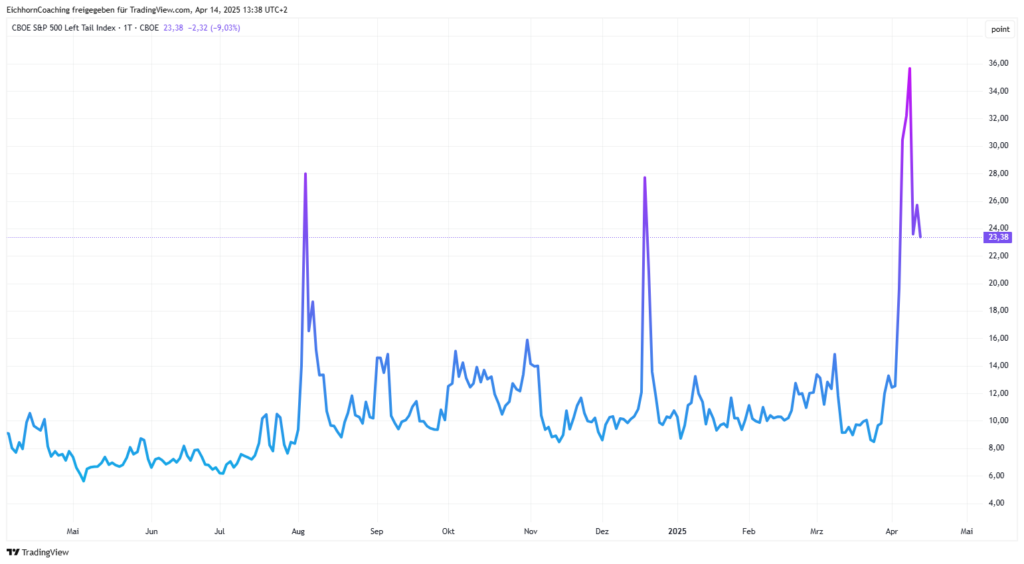
LTV - Left Tail Volatility Index
This basically works with the same logic as the VIX, but the LTV measures the implied volatility in the left tail of the distribution - i.e. the implied volatility of options that are very far out of the money, so-called "black-swan hedges". This index has also risen sharply:
SPOTVOL - The IV on the money
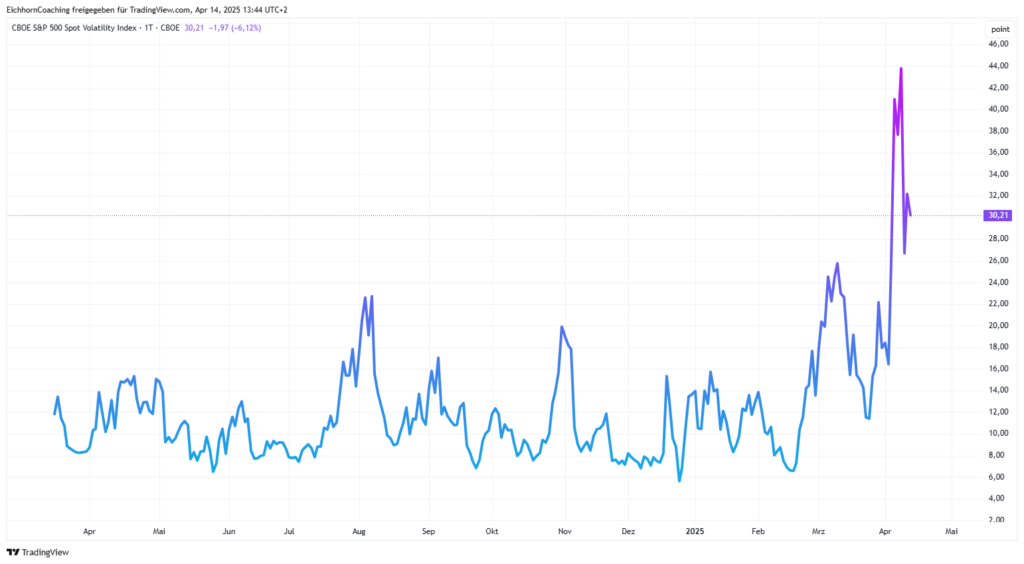
The SPOTVOL Index is based on a completely different methodological approach. In contrast to the Left Tail Volatility Index (LTV), which only considers put options that are far out of the money - and thus specifically measures the price behavior of hedges against strong market losses - the SPOTVOL focuses on a completely different segment of the options market:
It only considers options that are quoted "at the money" (ATM).
This means that SPOTVOL provides precise information on how the market is pricing in short-term implied volatility where option prices react most sensitively to changes - namely around the current price level of the underlying.
This focus on ATM options makes the SPOTVOL particularly relevant for understanding the expected standard volatility, i.e. the volatility that is not driven by extreme events or tail risks, but results from the breadth of normal market fluctuations.
VXTLT - Volatility on US government bonds
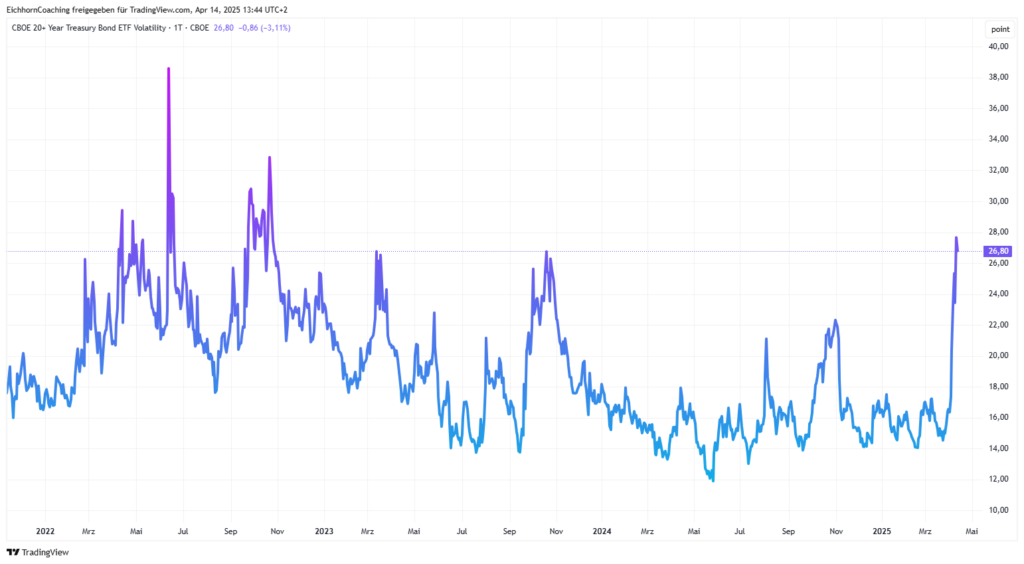
The tariff war also left its mark on movements in government bonds, with the VXTLT, which tracks the volatility of long-term Treasury bonds (TLT), rising recently.
Possible strategies for writers
Due to the well-known mean reversion effect, it can be assumed that implied volatility will fall again in the medium term - meaning that the VIX is also likely to fall below the 20 mark in the future. However, this realization alone is no guarantee of a safe profit trade. After all, it is currently impossible to make a reliable forecast of how far volatility may rise in the run-up to a decline.
The nervousness on the market is clearly noticeable: the Fear and Greed Index is currently in extremely pessimistic territory, in some cases below 5 points. At the same time, the VVIX - the volatility of volatility - is at an exceptionally high level of over 160. This combination indicates that a temporary high in implied volatility may already have been reached.
At the same time, however, uncertainty remains. It is therefore essential for writers - as with short volatility strategies in general - to pursue consistent risk management. This is the only way to prevent short-term swings from counteracting the overriding advantage of falling volatility.
The following points are therefore essential:
- Cash Secured Puts on fundamentally sound quality stocks.
- Put credit spreads below relevant technical support zones - with clearly defined risk and positive premium structure.
- Conservative position sizes: Only part of the capital should be allocated to short vol trades.
- Risk limitation via spreads: Strategies such as vertical spreads or Iron Condors define the maximum loss potential from the outset.
- Hedging via VIX options: The targeted purchase of long VIX calls on volatility products can serve as insurance against sudden rises in volatility.
Anyone acting as a writer in times of heightened uncertainty not only needs a good feel for market sentiment and volatility levels, but also a clearly structured plan. Particularly in an environment characterized by political headlines and potentially surprising developments, it is important to exploit opportunities in a disciplined manner - and to consistently control risks. The current volatility situation undoubtedly offers an attractive environment for premium strategies. However, sustainable success can only be achieved if risk and position management are given top priority. If you pay attention to this, you can not only benefit from the current excessive volatility as a writer, but also position yourself strategically for a calmer market environment in the future.
Conclusion: Volatility as an opportunity - but with caution
The current increase in implied volatility, triggered by geopolitical tensions and the unpredictable impact of political players such as Donald Trump, poses particular challenges for the options market - but also offers specific opportunities for experienced writers.
An understanding of the underlying volatility indicators such as VIX, LTV, SPOTVOL or VXTLT is essential in order to make informed decisions. Anyone who recognizes that volatility tends to revert to the mean (mean reversion) can profit from excessive option premiums in a targeted manner - whether through cash-secured puts, spreads or more complex strategies such as iron condors.
Nevertheless, trading short volatility means betting against market fear - and this requires not only a robust set of rules, but above all disciplined risk management. Event risks, which can arise at any time as a result of political escalations, must always be factored in.
For professional writers, therefore, now is not the time for blind risk-taking - but for precise, risk-adjusted strategies with a clear edge.