Anyone who has been following the news in recent weeks could hardly fail to notice what is currently driving the markets: geopolitical escalation in the Middle East, an oil price on a rollercoaster ride and a VIX that has firmly established itself in the 25+ range. For options traders, this means stress - but also opportunity. In this March analysis, we look at precisely these three issues and show how you can use the high volatility to your advantage in a structured way: with bear call spreads on the VXX.
1. crude oil: from geopolitical shock to trade opportunity
What began at the end of February 2026 has given the commodity markets a historic shock. Coordinated airstrikes on Iranian infrastructure - by the US and Israel under the code name "Operation Midnight Hammer" - have turned the Strait of Hormuz into a crisis zone. Around 20 % of the world's oil supply flows through this maritime bottleneck every day. Since the lockdown due to sea mines and drone threats, tanker insurance has been largely suspended.
As a result, the WTI crude oil price shot up from the mid USD 60 range to over USD 100 within a few trading days - with a brief spike near USD 120. Since then, the market has calmed down somewhat: traders are taking profits and initial diplomatic signals from the White House give hope of a possible de-escalation. Nevertheless, prices remain volatile and levels remain elevated.
What does this mean for options traders? Exactly what we already mentioned in the January analysis have described: High normalized volatility makes premiums attractive - both on the side of Cash Secured Puts on equities as well as volatility strategies such as the Bear Call Spread on the VXX. However, the decisive factor is: first understand the market situation, then act.
2 The OVX: When oil volatility explodes
The OVX (CBOE Crude Oil ETF Volatility Index) is the equivalent of the VIX - only for crude oil. It measures the 30-day volatility expected by the market, based on option prices on the USO ETF (which in turn tracks the NYMEX WTI future).
In normal market phases, the OVX fluctuates between 25 and 35. Values above 50 are already considered exceptionally high - typically in phases such as the Covid crash in 2020 or the Russia-Ukraine shock in 2022. The OVX is currently trading at over 100 - a level that clearly eclipses the last 52 weeks (52-week low was 23.59).
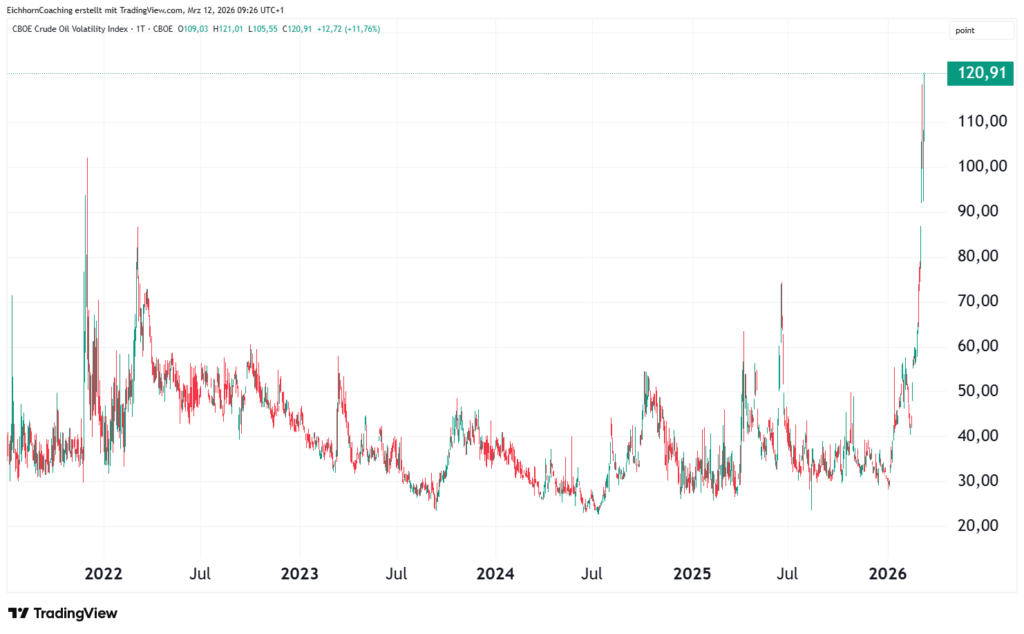
What an OVX of 100 actually means:
- The market expects daily price fluctuations of around 3.0-4.5 % in the price of crude oil
- Option sellers receive extremely high premiums - but the risk is also correspondingly high
- Directional betting on oil is very dangerous: a headline tweet can move the price by 10 % in minutes
- Structured strategies - e.g. wide bear call spreads or butterflies on oil ETFs or VXX (more on this in a moment) - make more sense in such phases than directional trading
For option writers, the OVX above 100 is a double-edged sword. The premiums are temptingly high, but the actual risk does not justify unhedged short positions. Anyone trading here should only work with clearly defined, limited risks of loss - i.e. with spreads instead of naked options.
3. the VIX: the fear index in crisis mode
Alongside the OVX, the VIX - the classic "fear index" for the S&P 500 - has also risen significantly. After reaching an annual low of 13.38 at the end of 2025, when the market was in high spirits, the picture has changed dramatically since the beginning of March 2026.
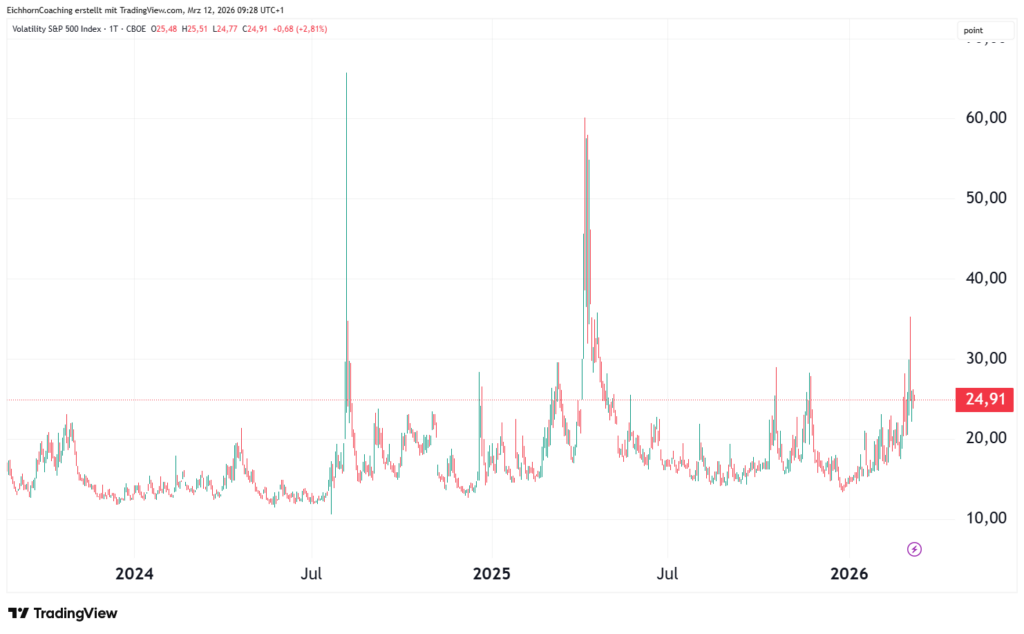
The VIX is currently at around 24-26 - well above the psychological level of 25, which is seen by institutional traders as a transition to a "high volatility regime". A VIX at this level signals that the market is pricing in daily fluctuations of around 1.5 % in the S&P 500.
Three scenarios that will determine the further course of the VIX:
- De-escalation in the Middle East: US navy secures tanker routes, Strait of Hormuz reopens → VIX decline towards 18-20 possible
- Status quo / escalation at a low level: VIX remains in the 22-28 range, premium environment remains attractive
- Expansion of the conflict, Iranian counterattacks on oil infrastructure → VIX spike to 35-40+ cannot be ruled out
For options traders, the middle scenario is the most interesting: a VIX that remains elevated but does not produce another spike is ideal for shorting volatility with bear call spreads. Premiums remain high and time value decay works for us.
4. short volatility with bear call spreads on the VXX
You cannot trade the VIX directly - it is only an index. But via the VXX, the iPath Series B S&P 500 VIX Short-Term Futures ETN, volatility can be traded indirectly. The VXX always holds a long position in the first two VIX futures and attempts to reflect an average term of 30 days.
The special feature of the VXX is its structural weakness over time: Because the VIX futures curve is in contango most of the time (i.e. trailing contracts are more expensive than leading contracts), systematic rolling losses occur when futures are constantly rolling. The VXX buys expensive and sells cheap - day after day. In calm market phases, the VXX continuously loses value, making it an attractive short candidate.
Important caveat: This does not apply in times of crisis with backwardation! When panic dominates the markets - as is currently the case - the VXX can rise extremely quickly and sharply. This is why you should never short the VXX naked (uncovered). The bear call spread is the smart alternative.
A bear call spread on the VXX consists of two legs:
- Short call (sold): A call with a strike above/at the current VXX price. A premium is received.
- Long call (bought): A call with an even higher strike. You pay a lower premium but hedge the maximum risk of loss.
The result: you receive a net premium (difference between the premium received and the premium paid), and the maximum risk of loss is limited to the distance between the strikes minus the premium.
Example trade (illustrative, not a specific trading recommendation):
- VXX currently approx. 33
- Term May with 64 days RLZ
- Short call at 33 gives approx. $550 premium
- Long call at 63 costs approx. $100
- Maximum profit: $450
- Maximum loss: $3,000 without premium income
Bear call spreads on the VXX should only be set up when the VIX is already high - i.e. not in quiet market phases when the VIX is below 20. The reason is simple: when the VIX is low, the VXX and VIX can still rise sharply. With a VIX of 25+, a return to normality (mean reversion) is structurally more likely, even if the timing remains unknown.
The current situation with a VIX of 24-26 and a VXX well above normal levels is a classic environment for this strategy - but with clear risk management:
- Bear call spreads only, no naked short calls
- Set strikes far enough out of the money to absorb short-term spikes
- Select a position size so that a maximum loss does not seriously jeopardize the account
- Duration not too short: 4-12 weeks give the trade time to develop
- Actively monitor the trade: Close out early if the VIX spikes again to > 35-40
Conclusion: Crisis as an opportunity - with a clear head and limited risk
The March analysis shows once again how strongly geopolitical events can move the markets in a very short space of time. An OVX above 100 and a VIX above 25 are not an everyday occurrence - but they open a window of opportunity for options traders that does not exist in calm phases.
The tools we presented in the January analysis - cash secured puts on fallen quality stocks, coupled with monitoring social media sentiment as a contra-indicator - continue to apply. In addition, the current environment offers an attractive opportunity to profit directly from a future normalization of volatility with bear call spreads on the VXX.
The most important thing here is that limited risk is not an option, but an obligation. Anyone who trades naked short calls on a VXX at an elevated level is playing Russian roulette. The bear call spread, on the other hand, allows you to participate in the structural weakness of the VXX and the mean reversion of the VIX - with a clearly defined worst case. Discipline, patience and position management are key. As always.