


In uncertain markets, many investors seek stocks that offer stability in addition to returns. These are companies supported by physical demand. Sustainable stocks seem destined for this role because they combine global ESG standards, renewables, and ethical business models, and often pay high, regular dividends.
At the same time, there are legitimate concerns. The energy transition, stricter regulations, and accusations of greenwashing are changing the demand base. This article shows whether sustainable stocks will still be sensible and up-to-date in 2026 and what you should pay attention to before investing.

The most important facts in brief:
- Sustainable stocks are shares in companies that consider environmental, social, and governance factors.
- Your courses are heavily dependent on ESG ratings and benefit from stable demand for green solutions.
- Global demand for sustainable investments is unlikely to collapse by 2030, but rather to grow or stabilize slowly.
What are sustainable shares?
Sustainable stocks are company shares in the green energy industry, meaning in companies that earn their money with renewables, ethical production, processing, or services related to ESG (Environmental, Social, Governance) criteria.
They are considered a classic growth sector and remain relevant despite criticism because large quantities of sustainable solutions, tech, and green products continue to be needed worldwide.
Sustainable stocks can be broadly divided into several segments of the value chain, each reacting differently to ESG trends, regulations, and policies.
- EnvironmentThese include companies that develop renewable energy, reduce CO2 emissions, and conserve resources. They are highly dependent on subsidies. If subsidies increase, profits and often stock prices tend to grow significantly more than the market.
- SocialThese companies ensure fair supply chains, workplace diversity, and community benefit programs. They care about ethical standards. Their revenue primarily comes from long-term contracts. This makes their cash flows stable and independent of short-term trends.
- Corporate governanceCompanies with clear, transparent leadership, measures against corruption, and good risk management. The compliance margin is crucial. This is the difference between regulatory risks and the prices of sustainable products.
- ESG Tech ProviderThese companies supply technology, software, and services such as AI optimization, analytics, or ESG audits for the majors. Their success depends on how much the majors invest.
Market segmentation by sustainability focus
The following table provides a quick overview of the sector allocation in the sustainable investment universe:
| Industry | Focus & Role in Portfolio | Sustainability leverage |
| Renewable energies | Growth & Infrastructure | Decarbonization of the power mix (solar, wind, green hydrogen) |
| Environmental Technology | Innovation & Efficiency | Circular economy, water treatment, filter technologies |
| Mobility & Logistics | Transformation | E-mobility, rail freight infrastructure, biofuels |
| Finance | Multiplier | "Green Finance, ESG-compliant lending, sustainable asset strategies |
| Construction & Real Estate | Energy efficiency | Serial renovation, low-carbon cement, smart building control |
| Agriculture & Food | Resource Resilience | Regenerative Agriculture, Precision Farming, Protein Alternatives |
For those who want to familiarize themselves with stock market basics, our guide offers Aktien für Anfänger A good introduction.
Good to know:
ESG-Majors are the large, globally leading companies that are fully sustainably integrated and lead in all three ESG areas: Environmental, Social, and Governance.


ESG Ratings and Benchmarks
Sustainability doesn't look the same everywhere. Two leading global rating systems determine ESG ratings: MSCI ESG and Sustainalytics ESG Risk.
Both systems are high-quality and reliable, but they differ in their origin, methodology, and market focus. These differences directly impact the valuation and performance of sustainable stocks.
MSCI ESG Rating: The Global Benchmark
MSCI ESG is the world's most widely used rating system, headquartered in New York. It rates companies on a scale from AAA (leading) to CCC (high risk).
What makes MSCI special?
- Global FocusUsed by institutional investors worldwide
- BranchenvergleichCompanies compete against direct competitors in the same sector
- Detailed analysisOver 1,000 ESG data points per company
- Market share: Accounts for approximately 70 % of all global ESG ratings
MSCI identifies particularly tech-driven ESG leaders with high growth potential, making it ideal for tech and innovation stocks.
ESG ratings compare a company's sustainability quality with industry standards. An AAA rating from MSCI means that the company is among the best in its industry.
Sustainalytics ESG Risk Rating: The Risk Specialist
Sustainalytics, with roots in Europe (Morningstar group), uses a different approach. It assesses a company's actual sustainability risk on a scale of 0 (lowest risk) to 100 (highest risk).
What makes Sustainalytics special?
- Risk focusMeasures concrete risks from environmental, social, or governance factors
- Quantitative approachNumbers instead of letters, which makes comparison easier
- Industry-independentAssess absolute risks, not just industry comparisons
- Regional Strength: Dominates 30 % of the European and Asian markets
Sustainalytics is perfect for identifying "greenwashing" and avoiding companies with real risks.
The direct comparison
| Criterion | MSCI-ESG | Sustainalytics |
| Scale | AAA to CCC | 0-100 points |
| Focus | Relative industry position | Absolute Risks |
| Seat | New York (USA) | Amsterdam/Toronto |
| Market share | 70 % global | 30 % Europe/Asia |
| Ideal for | Growth stocks | Risk minimization |
Look at both ratings! MSCI shows growth potential, Sustainalytics shows real risks. Top ESG majors like Microsoft mostly have AAA (MSCI) + Score <10 (Sustainalytics)
The market potential of sustainable stocks
Sustainable stocks could benefit from several long-term growth drivers in the coming years. These include the global expansion of renewable energies, the increasing electrification of industry and transport, stricter regulatory requirements, and the growing capital demand for infrastructure, efficiency, and digitalization.
1. Energy Transition (Green Stocks)
Laut Forecasts The transformation of the energy system remains a significant long-term growth driver for sustainable stocks, as it triggers high and sustained investments in renewable energy, storage solutions, power grids, and electrification.
Companies with scalable business models, recurring revenue, or direct exposure to the expansion of solar, wind, and grid infrastructure are particularly attractive.
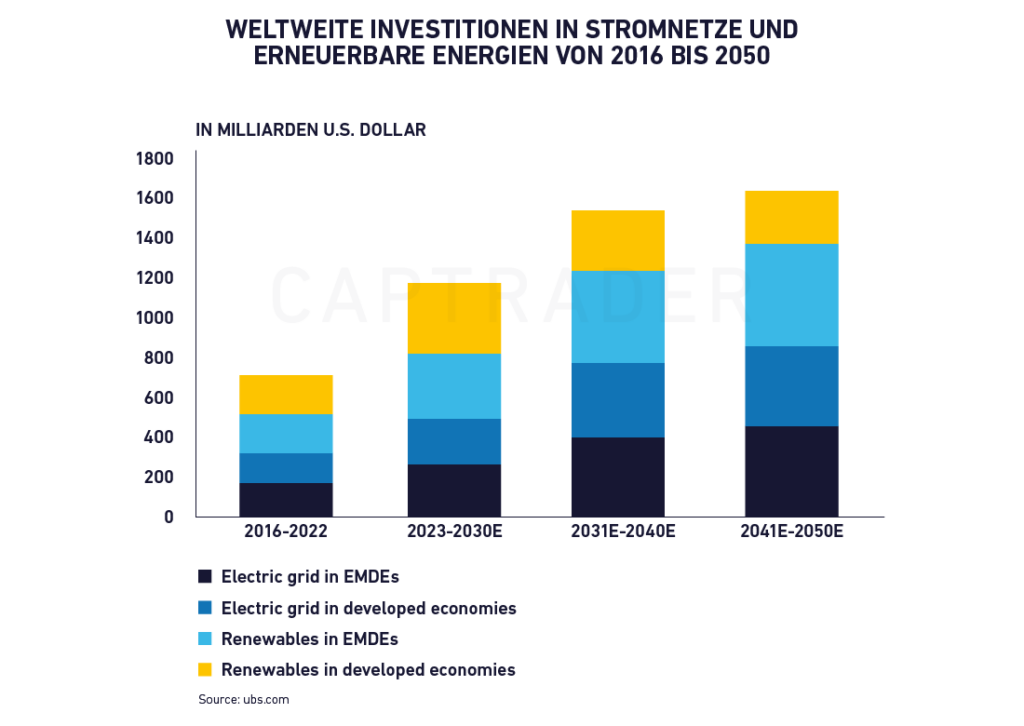
- The energy transition requires a dramatic increase in investments in the electricity grid, estimated at around $450 billion USD annually by 2030 for grids alone.
- The main reasons are the variability and decentralization of wind and solar energy, as well as an expected 60 % increase in electricity consumption by 2030 due to the electrification of heating, transportation, and industry.
- In the EU, necessary investments in electricity infrastructure are projected to reach €584 billion by 2030, facing challenges from decentralized generation and rising demand.
The following chart shows how many billions of USD are invested annually worldwide in electricity grids and renewable energy, broken down by developed economies and emerging/developing countries (EMDEs).
2. Circular Economy with Eco-Friendly Stocks
ESG-compliant companies benefit from the EU Green Deal through recycling and material loops, which reduces raw material costs and creates new markets.
The Deloitte/BDI Study forecasts a positive outlook for Germany as an industrial hub. By 2030, the share of recycled materials could rise from 44 % to 58 % for steel and from 53 % to 72 % for aluminum. This would reduce dependence on imports, conserve resources, and lower CO₂ emissions.
The following graphic illustrates the macroeconomic opportunities of a more circular economy for Germany as an industrial location by 2030. It visualizes two key effects: employment and value creation.
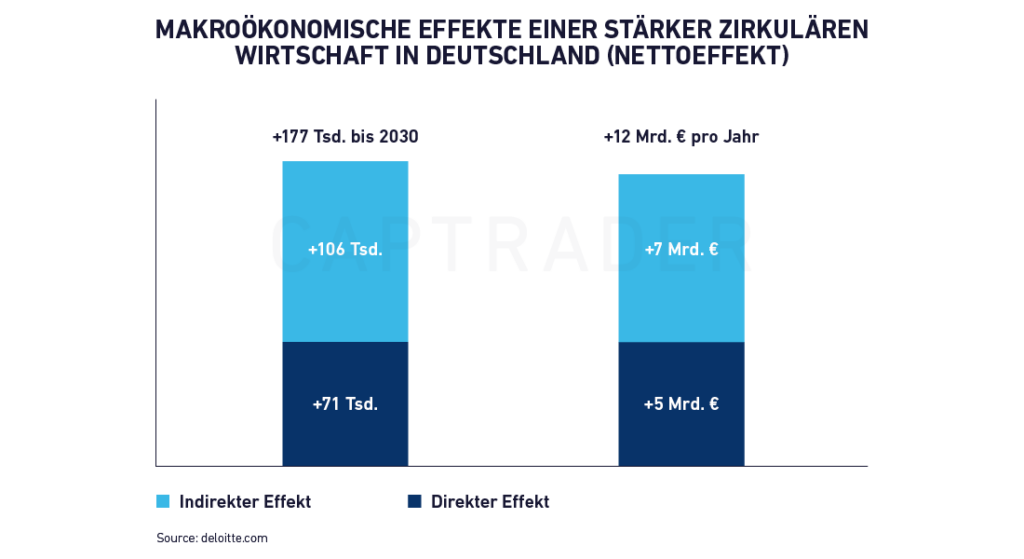
The left column shows that around 177,000 additional jobs could be created by 2030. Of these, 71,000 result from direct effects (e.g., increased employment in recycling, reprocessing, and reuse) and 106,000 from indirect effects (e.g., new value chains and supplier industries).
The right column shows an annual increase in gross value added of €12 billion, of which €5 billion is due to direct effects and €7 billion to indirect effects.
3. Social Factors
Within the ESG criteria, the social dimension is gaining increasing importance for the long-term performance of stocks. The study „Germany's Best Employers 2025“Great Place to Work shows that an excellent corporate culture is not a „feel-good factor,“ but a measurable indicator of operational resilience, innovation, and human capital retention.".
Companies that set high standards in workplace culture secure a decisive advantage in times of skilled labor shortages. High employee retention reduces recruitment costs and protects existing company know-how from being lost.
- High employee retention: 86 % of employees at top employers plan to stay with the company long-term. The German average is significantly lower.
- Employer Branding: A referral rate of 88 % makes these companies magnets for talent, ensuring their long-term viability during periods of transformation (e.g., AI implementation).
A central aspect of social sustainability is the mental and physical health of the workforce. ESG-oriented companies minimize the risk of operational disruptions and high rates of absenteeism through preventative cultural initiatives.
- Psychological safety: While the national average is only 43 % of employees who feel their health is protected in the workplace, this figure rises to 82 % among the „Best Employers.“.
- Trust culture: 91 % of employees experience a management style that emphasizes personal responsibility rather than strict control, which increases the company's agility.


Risks of sustainable stocks
Those who invest in sustainable stocks today must not confuse ecological necessity with the harsh reality of the capital market. A company can want to save the world and still fail as an investment. The following risk areas represent the biggest hurdles to a stable return.
Political Volatility and the „Subsidy Paradox“
The dependence of many sustainable business models on government frameworks is probably the most critical risk. We are in an era where climate policy is increasingly becoming the subject of polarized election campaigns.
While the expansion of renewable energies is technologically a given, its financial attractiveness often hangs by a thread. When governments are under budgetary pressure or shift political priorities, green subsidies are the first to come under pressure for justification.
- Subsidy erosionA sudden stop of tax credits or purchase premiums (as we have seen with e-mobility) can cause sales markets to collapse within a few quarters. Companies that are not profitable on their own without government protection represent a highly speculative investment.
- Election cycle riskElections in the US or the EU often lead to uncertainties about future climate policy. A change in political direction can massively slow down investments in green infrastructure or block approval processes for years.
- Bureaucratic overloadEU regulatory requirements demand unprecedented data depth from companies. For smaller, innovative firms, this means an enormous administrative burden that ties up capital that should actually be flowing into research.
The interest rate trap in capital-intensive industries
An often underestimated factor is the correlation between ESG stocks and interest rate levels. Sustainable infrastructure projects, from offshore wind farms to huge recycling centers, are characterized by extremely high initial investments and very long payback periods. This makes them disproportionately susceptible to fluctuations in the bond market.
- The Problem of Refinancing: Many green-growth companies operate with a high level of debt leverage. If interest rates rise, new loans become significantly more expensive, which can completely erode the profitability of projects that were planned based on a 1 % interest rate when interest rates reach 4 %.
- Deterioration risks in the portfolioAnalysts value companies based on the present value of their future earnings. Since these are often far in the future for sustainable projects, every interest rate increase mathematically necessitates a devaluation of the current stock price.
- Project freezes and margin pressureIt has already happened in 2024/2025 that large wind projects were stopped due to increased material and interest costs. This risk of „unprofitability despite demand“ remains a central burden factor in 2026.
Greenwashing and the Erosion of Investor Confidence
Another massive risk is the dilution of the concept of sustainability. Billions have flowed into ESG funds in recent years, tempting many corporations to „greenwash“ their business reports, making them appear more environmentally friendly than they actually are. In 2026, regulators and critical short-sellers will be scrutinizing these reports more closely than ever before.
- The „social washout“While CO2 data is hard to measure, the social component often remains vague. A company might have excellent environmental metrics but suddenly become the target of boycotts or forced sales by large investors due to poor working conditions in its supply chain.
- Rating arbitrariness and index riskThe lack of standardization in ESG ratings remains a danger. If a stock suddenly falls out of an ESG index due to a methodological change by a provider like MSCI, automated ETFs have to sell the stock en masse, leading to artificial selling pressure.
- Legal consequencesWith the tightening of ESG legislation, the liability risks for management are increasing. In 2026, false statements about sustainability will no longer just lead to a bad reputation, but to tangible lawsuits and claims for damages that can burden the balance sheet.
Best sustainable stocks in 2026
In the search for top-tier investments, companies that are not only economically strong but also proactively master future challenges are coming to the forefront.
Crucial for this selection is the Morningstar ESG Risk Score. This measures the financial risk that can arise from environmental, social, or governance factors. Unlike pure ethics ratings, this score assesses in absolute terms how much the economic value is at risk. The lower the score, the more secure the forecast.
The following table shows the top candidates for 2026, whose ESG risk is rated as very low:
| Company Name | ISIN | Sektor | Sustainalytics ESG Risk Score 2 |
| Experian | GB00B19NLV48 | Industry | 6,41 |
| RELX | GB00B2B0DG97 | Industry | 8,11 |
| Danaher | US2358511028 | Healthcare | 8,95 |
| Thomson Reuters | CA8849038085 | Industry | 9,43 |
| AutoZone | US0533321024 | Consumer staples | 9,49 |
| Waters | US9418481035 | Healthcare | 9,56 |
| Agilent Technologies | US00846U1016 | Healthcare | 10,04 |
| Cisco Systems | US17275R1023 | Technology | 10,19 |
| Lowe's Companies | US5486611073 | Consumer staples | 10,46 |
| Novartis | CH0012005267 | Healthcare | 10,93 |
Those who want to trade stock market fluctuations intraday should first familiarize themselves intensively with suitable Day trading strategies and a consistent Money Management to deal with.
RELX
RELX PLC is a leading global provider of information-based analytics and decision tools for professional and business customers. The company operates in the scientific, medical, risk, and business sectors. Particularly through its Elsevier division, RELX provides the crucial scientific data foundation for research into hydrogen technologies and renewable energies.
RELX is considered an ESG pioneer as its business model is based on digital knowledge and has very low CO2 intensity. Furthermore, the company supports global research on tackling climate change through its analyses.
| Tax year | Estimated Revenue (GBP) 1 | Change compared to previous year 1 |
| 2025 | 9.59 million | +1,65 % |
| 2026 | 10.175 million | +6,1 % |
| 2027 | 10.805 million | +6,19 % |
2. Danaher
Danaher Corporation is a global innovator in the life sciences and diagnostics sectors. With subsidiaries like Pall and Hach, the company is a world leader in water technology. Danaher develops solutions for water purification, testing, and filtration, making them a key player in achieving the global sustainability goal of "Clean Water.".
Besides the environmental aspect, Danaher is known for its efficient management system (DBS), which minimizes waste and continuously increases resource efficiency in production.
| Tax year | Estimated sales (in US dollars) 1 | Change compared to previous year 1 |
| 2025 | 24.568 million | +2,9 % |
| 2026 | 25.622 million | +4,29 % |
| 2027 | 27.096 million | +5,75 % |
3. Cisco Systems
Cisco Systems, Inc. is a Blue chip share and the world's leading provider of network solutions for the Internet. The company is shaping the "Green IT" of the future by developing highly efficient hardware that massively reduces the energy consumption of data centers. Cisco technologies are also the backbone for intelligent power grids (smart grids), which are essential for the energy transition.
The company pursues a strict circular economy and is committed to achieving net-zero emissions across its entire value chain by 2040.
| Tax yearr | Estimated sales (in US dollars) 1 | Change compared to previous year 1 |
| 2025 | 56.654 million | +5,3 % |
| 2026 | 61.57 million | +8,68 % |
| 2027 | 64.971 million | +5,52 % |
4. Agilent Technologies
Agilent Technologies Inc. is a leading provider in the fields of life sciences, diagnostics, and applied chemical markets. The company is known for its "Green Labs" initiatives. Agilent develops analytical instruments that consume less energy and fewer solvents, helping labs worldwide reduce their environmental footprint.
Through Agilent's precise analysis technology, environmental toxins in water, soil, and air are monitored worldwide, making the company an essential partner for environmental protection.
| Tax year | Estimated sales (in US dollars) 1 | Change compared to previous year 1 |
| 2025 | 6.948 million | +6,73 % |
| 2026 | 7.39 million | +6,36 % |
| 2027 | 7.840 million | +6,08 % |
5. Novartis
Novartis AG is a Swiss pharmaceutical company and one of the largest pharmaceutical companies in the world. In the ESG sphere, Novartis shines with its "Green Chemistry," which redesigns drug manufacturing to minimize waste and emissions. The company also focuses on social sustainability through improved access to medicine in emerging markets.
Novartis aims to be carbon-neutral in its own operations by 2025 and to sustainably optimize its entire supply chain by 2030.
| Tax year | Estimated sales (in US dollars) 1 | Change compared to previous year 1 |
| 2025 | 56.674 million | +9,57 % |
| 2026 | 57.282 million | +1,07 % |
| 2027 | 60.589 million | +5,77 % |
Before you select individual shares, you first need a securities account. How to set up a securities account step by step Open an account, you can find out in CapTrader's detailed guide.
One proven approach is the Core Satellite Strategy, where stable quality values form the core and high-growth stocks are added as satellites. In addition to oil stocks, this strategy can also be used in other industries, such as Bank stocks, Tourism Stocks or Consumer Goods Shares be applied.
CapTrader can do that:
At CapTrader, the trading fees are extremely low: you can trade US shares from as little as $ 0.01 per share (order minimum $ 2.00) and German shares from as little as 0.1 % of the order volume (order minimum €2.00), options from €2.00, futures from €1.00, ETFs from €2.00 and much more!


Conclusion: Are sustainable stocks worth it in 2026?
Sustainable stocks will be far more than just an ethical statement in 2026; they will be a strategic decision for defensive stability and long-term growth.
Companies that lead in ESG rankings (like the Morningstar Risk Score) benefit from higher regulatory certainty, better access to affordable capital, and strong retention of skilled professionals.
While the sector has become more volatile due to interest rates and political debates, the fundamental transformation of the economy towards circular systems and renewable energies is irreversible. Those who invest in sustainable stocks should focus on strong "ESG Majors" with broad competitive advantages.
Sustainable stocks offer an ideal combination of moderate growth, high risk resilience, and often attractive dividends, making them a solid anchor in a diversified portfolio.
List of sources:
Marketscreener 04/07/2026
(2) morningstar.com 07.04.2026
