Your Broker for worldwide trading

When the dividend wobbles: Alternatives to common shares for income investors

Income investors usually pursue one goal and that is a stable and predictable cash flow. For many, the monthly or quarterly dividend payment is more than just a bonus - it is the heart of their investment strategy. But what happens if these dividends are suddenly reduced or canceled altogether? Especially with popular high-yield vehicles such as mREITs (Mortgage Real Estate Investment Trusts) or BDCs (Business Development Companies), this risk is real.

A chart showing the capital structure of companies in stages from lowest to highest risk - senior secured debt, senior debt, subordinated debt, preferred stock and common stock - ideal for a fourth quarter REIT sector overview.

Capital Stack (Source: marketrealist.com)

However, instead of foregoing such investments altogether, it may be worth taking a closer look at the capital structure of these companies - or more precisely, at the so-called capital stack. This is where you will often find attractive interest-bearing alternatives to ordinary shares, such as Preferred shares, Baby Bonds or Noteswhich not only promise stable returns, but are also structurally better secured.

Capital structure

In corporate financing, the capital stack describes the order in which capital providers are served in the event of liquidation or restructuring of a company. At the top of the stack is the Senior Debtin other words, senior debt instruments. The following Subordinated debt and Preferred sharesbefore, at the very bottom, the Common Sharesi.e. the ordinary shares.

The lower an investment is in the capital stack, the greater the risk (simplified) - but also the potential upside. Conversely, the higher you position yourself in the stack, the more stable the expected cash flow - albeit usually with limited price potential.

For income investors, the question is therefore often decisive: Do I want high dividends with high risk, or would I prefer predictable distributions with increased security? Those who prefer the latter will find interesting alternatives in the upper part of the Capital Stack.

Examples

Preferred shares

Preferred shares are a widely used financial instrument in the USA, issued primarily by REITs, financial institutions (i.e. banks, etc.) and BDCs. They are a kind of hybrid between a share and a bond: they are listed similarly to shares, but usually have a fixed dividend rate - similar to a coupon payment for bonds - and are issued at USD 25 each. However, a preferred share can have many other features, e.g. it can be "called". However, the company does not necessarily have to do this. The call is then also made at USD 25 (occasionally there are deviations), regardless of whether the share price is below this level.

A great advantage: Dividends on preferred shares must be paid in full before a single cent can be distributed to common shareholders. In practice, this means that preference shareholders often continue to receive dividends in times of crisis, while the ordinary dividend is reduced or canceled.
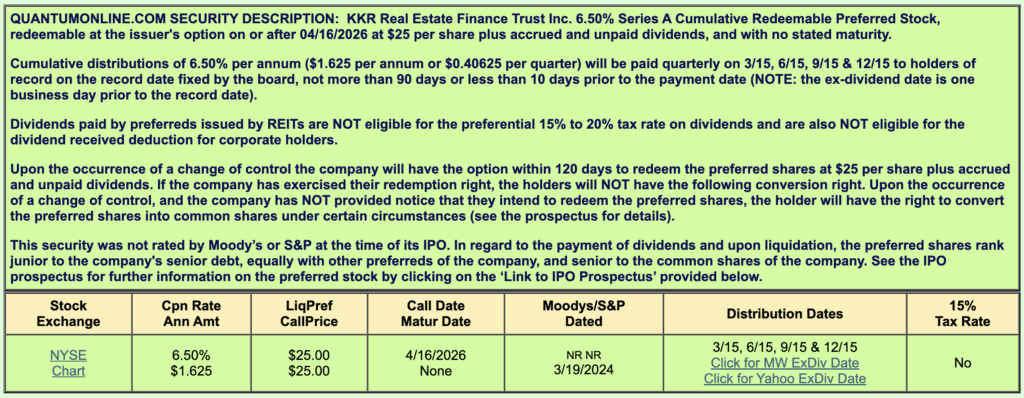
A table of security details for KKR Real Estate Finance Trust Inc. 6.50 % Series A Cumulative Redeemable Preferred Stock, including prices, dates, ratings and dividend information for this REIT in a Q4 sector overview format.

Preferred Shares Details (Source: quantumonline.com)

One example: KKR Real Estate Finance Trust (TWS ticker KREF), an mREIT that invests in commercial mortgages, did not fare so well with investors when interest rates were raised sharply, mainly due to the office portion of the portfolio. The ordinary share is therefore more volatile - and investors are pondering the sustainability of the dividend. The KREF PRAThe preferred share of the company, on the other hand, offers a fixed coupon of 6.50 % (with call option) - and ranks above the ordinary share in the capital stack. And the share price is currently only just over USD 18!

A table with company symbols, names and products in German, with "IIPR PRA - INNOVATIVE INDL PTYS INC PFD SRA" with "Aktie" as product and provides a REIT Q4 sector overview.

IIPR Preferred Share (Source: TWS)

Another example is Innovative Industrial Properties (TWS ticker: IIPR), a REIT specializing in cannabis real estate. Here, too, there has recently been speculation about possible dividend cuts, as some important anchor tenants are currently experiencing problems. Anyone who still wants to participate in the stable rental income but fears a loss of the ordinary dividend could switch to the preferred share (TWS ticker: IIPR PRA) or one of the outstanding Notes (e.g. the 5.50 % Senior Notes due 2026).

Baby Bonds

Baby bonds are nothing more than listed corporate bonds aimed specifically at private investors. They typically have a nominal value of USD 25 (instead of USD 1,000 for institutional bonds) and are traded on exchanges such as the NYSE or Nasdaq.

These are often subordinated bonds (subordinated debt), which are serviced after the senior debt but before the shares in the event of insolvency. They offer fixed coupons, quarterly interest payments and usually have a term of between 5 and 10 years.

One aspect is transparency and liquidity: unlike traditional bonds, baby bonds can be bought and sold on the stock exchange like shares - which makes them ideal for income-oriented private investors.

Many BDCs, such as Gladstone Capital (TWS ticker GLAD) or OFS Capital (TWS ticker OFS), finance themselves via baby bonds, which can offer yields of 7 % and more - with manageable risk as long as the company is solidly positioned.

Classic bonds 

In the USA, notes are the collective term for bonds with a medium term - usually between 2 and 10 years. In addition to preferred shares, many listed REITs or BDCs primarily use notes for refinancing, often with a fixed interest rate and repayment at par value.

In contrast to preferred shares or baby bonds, notes can be collateralized debt obligations which means better creditor protection in the event of an emergency. Investors looking specifically for senior secured notes can sometimes find very attractive opportunities.

An example: The above-mentioned note from IIPR (CUSIP: 44988FAD2) has a 5.50 % coupon maturing in May 2026. At the current price below par, this results in an even higher effective yield - with significantly greater security compared to the ordinary share.

Common share vs. note

The example of Innovative Industrial Properties also shows quite clearly how the common shares have performed compared with the notes.

Investment in IIPR (Common Shares)

  • Entry course at the beginning of 2023: approx. 100 USD
  • Dividend yield (ongoing): ~7-8 %
  • Share price development until April 2025: around -50 % (current price ~50 USD)
  • Dividends have been paid to date, but a reduction is on the cards
  • Total income: negative, despite high current income

Investment in IIPR 5.50 % Senior Notes 2026

  • Entry course at the beginning of 2023: approx. 90 USD (below par)
  • Fixed coupon: 5.50 % p.a., quarterly payment
  • Course currently closer to Par price (approx. 95 USD)
  • Yield-to-maturity: approx. 10%
  • Total return: constantly positive

Risks

As attractive as these instruments may seem, they are of course not a free lunch! Baby bonds or preferred shares of highly indebted companies in particular can default in an emergency. It is therefore important:

  • Balance sheet analysisHow much debt is already in the stack? What is the interest coverage ratio?
  • Liquidity checkCan the company service the interest and dividends even in the event of a crisis?
  • Call riskMany preferred shares or baby bonds can be called early - usually at par value. Anyone who buys above par risks capital losses.

The Rating

Another frequent criticism of baby bonds or preferred shares is the rating: "They don't even have a rating!" Or even worse: "It's all non-investment grade, so I'd rather keep my hands off it."

In fact, many of these instruments either unrated are - i.e. have not received an official rating from Moody's, S&P or Fitch - or are in the area of BB or lower (High Yield) be classified as high risk. However, this does not necessarily mean that the issuer risk is high.
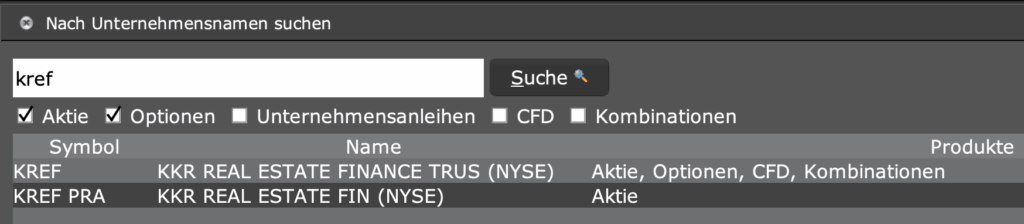
A financial search interface displays results for "kref" and lists two entries of KKR REAL ESTATE FINANCE REIT (KREF and KREF PRA) with product types, providing a quick sector overview for the fourth quarter.

KREF Preferred Share (Source: TWS)

Especially in the case of smaller REITs or BDCs, companies often forego an official rating in order to save costs - because a rating process is expensive and ties up resources. And for relatively small issues (e.g. volume of USD 100 million or less), the effort is often not worthwhile from the company's perspective.

What does this mean for investors?

  • No panic with "unrated" or BB ratings - The fundamental analysis of the issuer is more important.
  • Interest coverage ratio and Leverage ratio (debt/equity or net debt/EBITDA) are more meaningful than a label.
  • An unrated preferred share of a REIT with a conservative balance sheet and stable cash flow may, under certain circumstances safer than a BBB rating for a company with a cyclical business model.

In short, the lack of a rating is a risk signal - but not a criterion for exclusion.

Sources & Tools

Specialized databases are helpful in the search for suitable preferred shares or baby bonds, e.g:

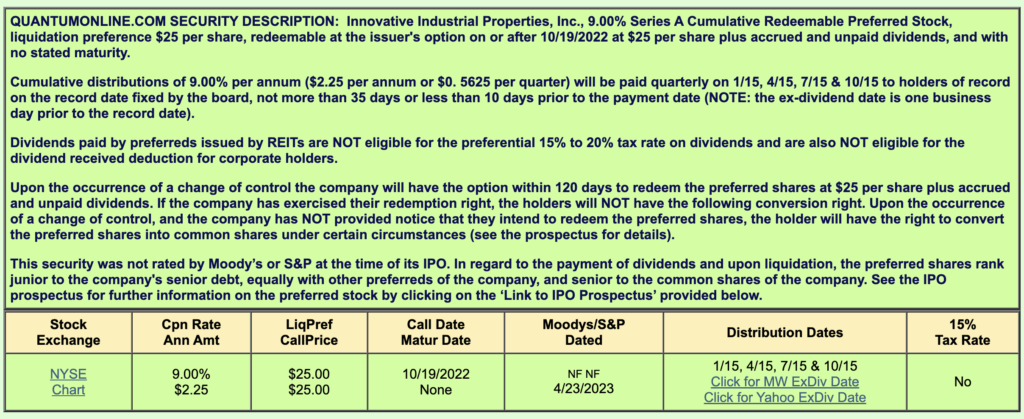
Financial details table for the 9.00 % Series A Preferred Shares of Innovative Industrial Properties, with dividends, dates, ratings, redemption information and a summary of relevant terms for this REIT; Q4 sector overview included.

Preferred Shares Details (Source: quantumonline.com)

It is also worth taking a look at the Investor Relations pages of the respective companies - here you can usually find the terms of the bonds and preferred shares in detail.

Conclusion

For income investors, looking beyond ordinary shares can be extremely valuable. Preferred shares, baby bonds and notes offer attractive opportunities to position yourself strategically in the capital stack - and thus achieve stable returns even in volatile markets.

Especially when the dividends of mREITs or BDCs come under pressure, these alternatives can help to secure the income portfolio - and at the same time open up interesting opportunities for returns.

Philipp Kaessinger with a beard and a gray collared shirt stands in front of a textured, dark background.
Philipp Kässinger

Philipp Kässinger has been investing privately on the world's stock exchanges since 2009. Initially focusing on ETFs, since 2019 he has specialized in predominantly cash-flowing individual stocks, particularly REITs and BDCs as well as shares from more exotic sectors such as shipping. P2P loans and options trading also provide additional cash flow. He has also been publishing monthly articles on his blog since 2019 investdiv.eu and Instagram channel @investdiversified, with the aim of reporting on his investments in a wide range of asset classes. Always broadly diversified and with a view beyond the horizon.

View all posts
Mandatory information and disclaimer

This is a marketing communication within the meaning of Section 63 (6) of the German Securities Trading Act and does not contain investment strategy recommendations, investment recommendations or financial analyses in accordance with Section 85 of the German Securities Trading Act and Article 20 of the Market Abuse Regulation. It therefore does not fulfill the legal requirements to guarantee the objectivity of investment strategy recommendations/investment recommendations/financial analyses. CapTrader GmbH or its employees are therefore not legally prohibited from trading or providing services in the securities products mentioned therein prior to publication of the information.

Past performance, simulations or forecasts are not a reliable indicator of future performance. Mandatory information and limitation of liability for CapTrader and any third-party content providers can be found at https://www.captrader.com/marketingmitteilung/angaben
Please note that investing in financial instruments involves high risks and take note of our disclaimer and the mandatory legal information at the locations indicated.

  1. Mandatory information

Responsible: CapTrader GmbH, Elberfelder Straße 2, 40213 Düsseldorf; Commercial Register Number: HRB 86537 Düsseldorf Local Court; VAT ID DE323771603; Managing Directors Andreas Weiß, Christian Weiß, Michael Heyder; Tel: +49 211-740786-00, Fax: +49 211-740786-90.

Zuständige Aufsichtsbehörde: Bundesanstalt für Finanzdienstleistungsaufsicht, Graurheindorfer Straße 108, D – 53117 Bonn und Marie-Curie-Str. 24-28 D – 60439 Frankfurt am Main, Tel: 0228 4108 – 0 Fax: 0228 4108 1550 E-Mail: poststelle@bafin.de; Institutsnummer 10156708

Conflicts of interest CapTrader in marketing communications: CapTrader GmbH confirms that it does not hold any positions in the mentioned financial instruments beyond the positions mentioned in the marketing communication itself, if applicable. There are also no other conflicts of interest within the meaning of CapTrader GmbH's Financial Analysis and Marketing Communication Policy.

Conflicts of interest and mandatory disclosures by the third-party content provider for marketing communications with financial instrument recommendations: See under https://www.captrader.com/marketingmitteilung/angaben  to creators of third-party content

The copyright to the marketing communication is reserved. Reprinting and distribution is only permitted with our consent.

  1. Disclaimer

By accepting the content, the recipient accepts the binding nature of the limitation of liability.

a) Disclaimer for third-party content

CapTrader GmbH offers authors - such as editors, guest commentators, agencies and companies - the opportunity to publish comments, analyses, news and company announcements. Their opinions do not necessarily reflect the opinions and views of CapTrader GmbH and its employees. CapTrader GmbH assumes neither liability nor guarantee for this content. This applies in particular to incomplete or incorrectly reproduced reports, incorrect price information and editorial errors. Liability claims relating to material or immaterial damage caused by the use or non-use of the published information or by the use of incorrect or incomplete information are fundamentally excluded.

b) Exclusion of liability for CapTrader's own content

CapTrader has taken its own information in this marketing communication from sources believed to be reliable, but has not verified all such information itself. Accordingly, CapTrader makes no warranties or representations as to the accuracy, completeness or correctness of the information or opinions contained herein. Subsequent changes cannot be taken into account. The marketing communication does not constitute an offer or solicitation to buy shares of the issuer and is in no way a substitute for advice appropriate to the investor and the property. We cannot verify whether the information in the marketing communication is in line with your personal investment strategies and objectives. We recommend that you consult an investment advisor for advice that is appropriate to the investor and the property. The marketing communication cannot and should not replace a securities prospectus and/or expert investment advice required for an investment. It can therefore never be the sole basis for an investment decision. By accepting the marketing communication, the recipient accepts the binding nature of the above limitation of liability.

CapTrader provides the information despite careful procurement and provision only without guarantee for the correctness / completeness, timeliness or accuracy and availability of the stock exchange and economic information, prices, rates, indices, general market data, valuations, assessments and other accessible content held and displayed for retrieval. This also applies to third-party content. Historical observations and forecasts are not a reliable indicator of future developments. The facts presented in particular in connection with product information are for illustrative purposes only and do not permit any statements to be made about future profits or losses. Any conditions stated are to be understood as non-binding indications and are dependent on market developments on the day of conclusion.

CapTrader accepts no liability for any direct or indirect damage caused by and/or related to the distribution and/or use of this marketing communication.

The information, opinions and statements correspond to the status at the time of preparation of the marketing communication. They may be outdated due to future developments without the publication being changed.

CapTrader is not obliged to update, amend or supplement the information in this marketing communication if a circumstance mentioned in this publication or a statement, estimate or forecast contained therein changes or becomes inaccurate. The presentation of the performance of financial instruments over previous periods does not provide a reliable indication of their future performance. No guarantee can therefore be given for the future price, value or income of any financial instrument mentioned in this publication.

Despite careful control of the content, we assume no liability for the content of external links. The operators of the linked pages are solely responsible for their content.

Distribution: This publication may only be distributed in accordance with the laws of the respective countries, and persons in possession of this publication should inform themselves about the applicable local regulations. The information contained herein is not intended for natural or legal persons who, due to their place of residence or business, are subject to a foreign legal system that imposes restrictions on the distribution of such information. The contents are therefore exclusively in German. In particular, this publication contains neither an offer nor an invitation to purchase securities to citizens of the USA, Great Britain and Australia.

Taxes: The tax treatment of financial instruments depends on the personal circumstances of the respective investor and may be subject to future changes, which may also have a retroactive effect.

Historical observations and forecasts are not a reliable indicator of future developments. The facts presented in particular in connection with product information are for illustrative purposes only and do not permit any statements to be made about future profits or losses. Any conditions stated are to be understood as non-binding indications and are dependent on market developments on the day of conclusion.

CapTrader accepts no liability for direct or indirect damage caused by and/or in connection with the distribution and/or use.

The information, opinions and statements correspond to the status at the time of preparation of the marketing communication. They may be outdated due to future developments without the publication being changed.

CapTrader is not obliged to update, amend or supplement the information if a circumstance mentioned in this publication or a statement, estimate or forecast contained therein changes or becomes inaccurate. The presentation of the performance of financial instruments over previous periods does not provide a reliable indication of their future performance. No guarantee can therefore be given for the future price, value or income of any financial instrument mentioned in this publication.

Despite careful control of the content, we assume no liability for the content of external links. The operators of the linked pages are solely responsible for their content.

Distribution: This publication may only be distributed in accordance with the laws of the respective countries, and persons in possession of this publication should inform themselves about the applicable local regulations. The information contained herein is not intended for natural or legal persons who, due to their place of residence or business, are subject to a foreign legal system that imposes restrictions on the distribution of such information. The contents are therefore exclusively in German. In particular, this publication contains neither an offer nor an invitation to purchase securities to citizens of the USA, Great Britain and Australia.

Taxes: The tax treatment of financial instruments depends on the personal circumstances of the respective investor and may be subject to future changes, which may also have a retroactive effect.

Email:

info@captrader.com

Send e-mail

Phone:

Hotline (Germany)
0800-8723370

Hotline (International)
00800-08723370

Further contact options