


Platinum stocks allow investors to participate in the scarce precious metal platinum with a focused approach. With a little analysis, you can quickly identify which platinum producers will benefit from stable demand and structural scarcity, and where speculative price potential and valuation risks outweigh these factors.
This article on platinum stocks will show you the most important drivers of the platinum price, introduce selected publicly traded platinum companies, and assess their opportunities in the current market environment. Additionally, you will learn about the typical risks, such as high volatility, political uncertainties in producing countries, and cyclical industrial demand, that you should definitely consider when investing in platinum mining stocks.

The most important facts in brief:
- Platinum is a scarce precious metal with growing demand from the automotive industry, jewelry industry, and hydrogen technologies, which is why its price has significantly increased since mid-2025.
- Platinum stocks are mainly suitable for investors who want to specifically profit from the precious metal without buying physical platinum.
- For 2026, platinum is expected to remain at a high level, offering opportunities for platinum stocks, but only with clear risk management and diversification in the portfolio.
What are platinum stocks?
Platinum stocks are investments in companies whose business is largely centered around the precious metal platinum, such as producers, processors, or major consumers in the industrial and jewelry sectors.
Platinum mining stocks are stocks of mining companies that explore for and mine platinum and other platinum group metals (PGMs), and whose profits depend heavily on the price of platinum and their respective extraction costs.
The platinum sector primarily comprises mining companies in South Africa, Russia, Canada, and Australia, as well as integrated raw material corporations and specialized PGM producers. You can find these stocks on exchanges such as Johannesburg, London, Toronto, or Sydney, and often also as secondary listings in Europe.
For those who wish to familiarize themselves with stock market basics, our guide on Aktien für Anfänger a clear introduction.


What is platinum and what makes it so valuable?
Platinum is a rare, silvery-white, lustrous precious metal that ranks among the most valuable raw materials on Earth. Chemically, it belongs to the group of so-called platinum group metals and is characterized by exceptionally high density, refractoriness, and corrosion resistance.
These properties make it not only interesting for jewelry making but especially for technical and industrial applications where stability and durability are required.
In addition to its function as a precious metal, platinum plays a crucial role in modern industry, especially as a catalyst in the automotive and chemical sectors. For instance, it helps transform harmful exhaust gases in cars or makes chemical reactions more efficient.
Platinum will continue to play an important role in the future, for example in hydrogen technology and the development of fuel cells that enable sustainable energy conversion.
Extraction and Occurrence
- Major ore suppliers: South Africa (approximately 55 % of global production), Russia, Canada, Zimbabwe.
- Platinum is extracted from ores such as copper-nickel ores or platinum group metal ores.
- A significant portion of platinum today also comes from recycling, particularly from old vehicle catalytic converters.
The production of platinum
Platinum production is a complex process that typically takes place in mines containing platinum deposits.
The extraction of platinum can be done through underground mining or open-pit mining. In underground mining, tunnels are dug into the earth to access the platinum deposit.
In opencast mining, the upper layers of the earth are removed to access platinum deposits. Platinum mining is often complex and expensive, as the metal is found in only small quantities in specific areas of the Earth and extraction is time-consuming.
The mining process begins with extracting the ore from the rock, followed by separating the platinum metal through chemical processes. Platinum production is an energy-intensive process that also has environmental impacts, particularly concerning air pollution and waste products.
Nevertheless, platinum is an important raw material for many industries, especially in jewelry manufacturing and the automotive industry, where it is used as a catalyst.
Integrate with code so that the current price is always displayed
Use of Platinum
Platinum is one of the most versatile metals available. Its special properties, such as high temperature resistance, excellent catalytic activity, and exceptional corrosion resistance, make it indispensable for many applications.
1. Industry and Technology
In industry, platinum is particularly in demand due to its resistance and catalytic effect. It remains stable even at high temperatures and enables numerous chemical reactions that are essential for the production of many everyday goods.
Catalysts in the automotive industry:
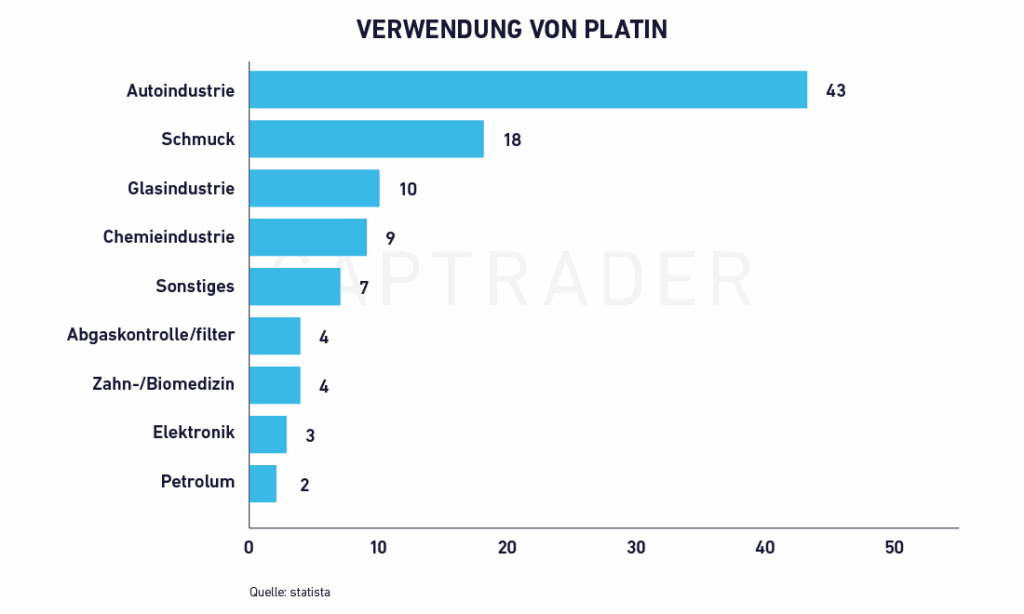
- About 40 to 50 % of global platinum production is used in exhaust catalysts
- Converts harmful exhaust gases (CO, NOx, HC) into less harmful substances
- Contributes significantly to reducing air pollution
Chemical industry
- Catalyst in the production of nitric acid, fertilizers, and silicone compounds
- Resistant to high temperatures and aggressive chemicals
- Essential for numerous industrial production processes
Electronics and Glass Manufacturing
- Use in electrical contacts, sensors, and thermocouples
- Application in the manufacturing of optical fibers and specialty glasses
- Especially stable and durable under extreme production conditions
2. Future Technologies
Platinum is also of great importance in modern energy technologies. The precious metal plays a key role in sustainable developments, particularly in the areas of the hydrogen economy and environmentally friendly mobility.
Fuel Cells and Hydrogen Economy:
- Central function as a catalyst in fuel cells
- Enables the reaction between hydrogen and oxygen for electricity generation
- Use in hydrogen vehicles and hydrogen production
- Important for the development of clean, emission-free energy sources
3. Jewelry and Investment
Besides technical applications, platinum remains a coveted precious metal in the luxury and financial sectors. It combines timeless beauty with economic value, symbolizing permanence and purity.
Jewelry making
- Noble, silvery-white appearance with high gloss
- Very resistant to scratches and tarnishing
- Ideal for high-quality jewelry such as rings, necklaces, and watches
Investment and Finance
- Use for coins, bars, and investment metals
- Considered a stable and value-retaining investment
- Popular alternative or complement to gold
Where was the most platinum mined in 2025?
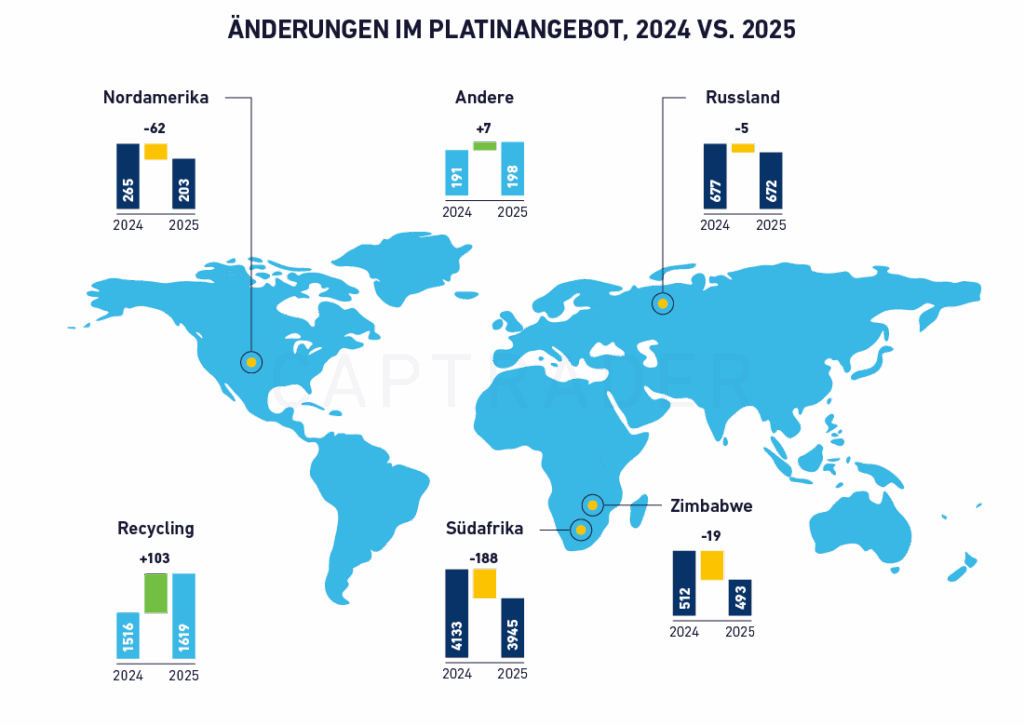
The following chart shows how the global platinum supply is projected to change from 2024 to 2025 („koz“ stands for „thousand ounces“).
- North AmericaDecrease from 265 to 203 thousand (-62).
- RussiaSlight decrease from 677 to 672 koz (-5).
- South AfricaSignificant decrease from 4,133 to 3,945 thousand tons (-188).
- ZimbabweDecrease from 512 to 493 koz (-19).
- Other CountriesIncrease from 191 to 198 KOZ (+7).
- RecyclingIncrease from 1,516 to 1,619 thousand tons (+103 thousand tons).
Mine production is declining in almost all major regions, while recycling is significantly increasing as an important source of supply.
The market shares for the 2025 platinum supply (Total: 7,130 koz) can be directly derived from the graphic. South Africa continues to dominate with over half of the production, while recycling gains importance. The descending sorting clearly shows the hierarchy of suppliers.
| Region | Percentage (%) |
| South Africa | 55,33 |
| Recycling | 22,71 |
| Russia | 9,42 |
| Zimbabwe | 6,91 |
| North America | 2,85 |
| Other | 2,78 |


The market potential of platinum stocks
Platinum stocks could be interesting in 2026 because platinum plays a role in important industrial applications and remains particularly relevant for exhaust gas purification as well as certain hydrogen technologies.
This results in a potential opportunity profile for investors that is heavily dependent on the development of the metal price, production costs, and the operational efficiency of producers.
Major platinum producers can generate significant cash flows under improved market conditions and stable costs. Depending on the company, some of these funds can be allocated to dividends, debt repayment, or investments in mining infrastructure, which can support long-term enterprise value.
Why the platinum price has been rising since mid-2025
Since mid-2025, the price of platinum has doubled from around $1,000 per troy ounce to over $2,000 in January 2026. The main reasons are a persistent supply deficit coupled with sharply rising demand, combined with a weak US dollar and strong investor interest.
The key influencing factors are a tight supply with high demand and a weak US dollar:
Tight offer
- South Africa accounts for about 55 % of the world's platinum production, but it repeatedly experiences power outages, strikes, and very old facilities, which is why less platinum can be mined.
- In Russia, sanctions and transportation issues are making mining more difficult, and hardly any new mines are being developed.
- Although more platinum is recovered from old catalytic converters and jewelry, this is not enough to close the gap between supply and demand.
Strong demand:
- Platinum is used in catalysts for diesel and hybrid cars because emission regulations are becoming increasingly strict.
- Many people (especially in China) prefer white gold that contains platinum, and the growing middle class is buying more jewelry.
- Platinum is used in hydrogen technologies, in the production of specialty glass, and in electronics.
Financial & Psychological Drivers
- A weak U.S. dollar makes commodities like platinum cheaper and more attractive to investors.
- Strong inflows into platinum ETFs due to its long-standing undervaluation compared to gold.
These drivers will very likely ensure a reliable increase in revenue in the coming years. Short-term oriented traders try to frequently use short-term trends Swing trading strategy by trading medium-term price movements in equities.
Projected demand for platinum jewelry through 2032
A promising report from Report Prime The global platinum jewelry market is forecast to have a solid future, with market volume expected to rise from USD 5.85 billion (2025) to nearly USD 8 billion by 2032.
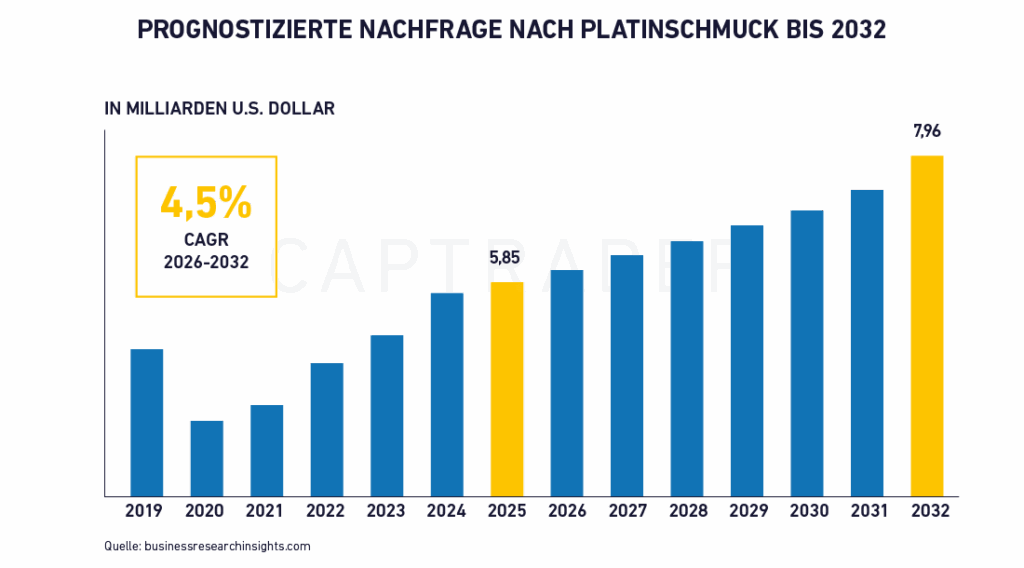
- Growth: The market is expanding at a moderate rate, with a compound annual growth rate (CAGR) of 4.50 %.
- DriverKey factors include rising incomes in emerging markets, the popularity of platinum for engagement rings, and the booming online trade.
- RegionsThe Asia-Pacific region, in particular, is considered a key market for the coming years, alongside North America and Europe.
The forecast concludes that platinum will maintain its position as an exclusive luxury good, gaining additional reach through technological trends in distribution (e-commerce).
The Renaissance of Industry: Platinum as the Key to Megatrends
Industrial demand for platinum is gaining momentum and increasingly supporting the market independently of fluctuations in the automotive sector. Analyses show that platinum plays a central role in several growth areas.
- Hydrogen economyPlatinum is a proven catalyst in PEM electrolyzers for the production of green hydrogen. With the global expansion of electrolysis capacities, this sector could significantly boost demand for platinum. For this reason, forecasts predict strong growth up to 2030.
- Glass and Chemical Industry: In glass manufacturing for displays and optical fibers, platinum-based crucibles are used, which are convincing due to their heat resistance. In biofuels and synthetic fuels, too, Platinum catalysts to efficiency, with expected capacity expansions.
Good to know:
Platinum is establishing itself as an indispensable strategic raw material due to its versatile industrial applications, growing far beyond its classic role and significantly shaping the key technological industries of the future.
The Largest and Most Well-Known Platinum Stocks at a Glance
Among the world's leading platinum producers are Anglo American Platinum, Ivanhoe Mines, and Impala Platinum. Anglo American Platinum is a subsidiary of Anglo American and is the largest platinum producer in the world.
Two other major platinum producers are Canada's Ivanhoe Mines and South Africa's Impala Platinum.
In the table below you will find an overview of the largest and most important companies in the platinum industry:
| Company | Country | ISIN | Market Capitalization (USD) |
| Valterra Platinum (formerly Anglo American Platinum) | South Africa | ZAE000013181 | 24.92 billion |
| Ivanhoe Mines | Canada | CA46579R1047 | 18.1 billion |
| Impala Platinum | South Africa | ZAE000083648 | 17.7 billion |
| Sibanye Stillwater | South Africa | ZAE000259701 | 13.04 billion |
| Northam Platinum | South Africa | ZAE000298253 | 9.33 billion |
| African Rainbow Minerals | South Africa | ZAE000054045 | 2.94 billion |
| Zimplats Holdings | Guernsey | GB0061284906 | 1.71 billion |
| Platinum Group Metals | Canada | CA72765Q8829 | 0.33 billion |
Source: Market Screener from 01/31/26
Anyone who wants to profit from stock market movements daily should thoroughly research beforehand. Day trading strategies and solid Money Management learn. This knowledge can be applied not only to platinum stocks but also to other industries, such as Bank stocks, Tourism Stocks or Consumer Goods Shares be applied.
In the following section, we introduce you to a selection of interesting platinum stocks.
1. Valterra Platinum (formerly Anglo American Platinum)
Valterra Platinum is a Blue chip share and a South African mining company and one of the world's leading primary producers of platinum group metals, which include platinum, palladium, rhodium, and iridium.
The company operates mines, smelters, and refineries primarily in South Africa and Zimbabwe, covering essential stages of the value chain. With its strong position in the global PGM (Platinum Group Metals) market, Valterra plays a central role for industries such as automotive, chemical, and jewelry. This makes it one of the most significant specialized suppliers of platinum group metals worldwide.
The renaming of Anglo American Platinum to Valterra Platinum is related to its spin-off from former parent company Anglo American. As part of a group restructuring, Anglo American is focusing more on copper and iron ore, while the platinum business has been divested as a standalone entity.
| Tax year | Estimated sales (in US dollars) | Change compared to previous year |
| 2025 | 6.820 million | +1,03 % |
| 2026 | 8.868 million | +30,03 % |
| 2027 | 8.472 million | -4,46 % |
Source: Market Screener from 01/31/26
2. Sibanye Stillwater
Sibanye-Stillwater is among the largest global producers of precious metals: a leader in platinum, the second largest in palladium, and the third largest in gold. The company was founded in South Africa and, through acquisitions, also acquired the only platinum mines in the USA.
The group operates mines and facilities in South Africa, the United States, Zimbabwe, Canada, and Argentina. The headquarters are located in Weltevreden Park, South Africa. The stock is traded on the Johannesburg Stock Exchange and has a market capitalization of approximately 13.04 billion USD.
| Tax year | Estimated sales (in US dollars) | Change compared to previous year |
| 2025 | 7.775 million | +11,94 % |
| 2026 | 10.463 million | +34,57 % |
| 2027 | 9.797 million | -6,37 % |
Source: Market Screener from 01/31/26
3. Platinum Group Metals
Platinum Group Metals is a Canadian exploration and development company headquartered in Vancouver, Canada. It was founded in 2000 and focuses primarily on PGMs such as platinum, palladium, and rhodium, as well as gold and by-products like copper and nickel.
The main focus is currently on the so-called “Waterberg Project.” This is located in the Bushveld Complex (Northern Limb, South Africa) and represents the core asset of the platinum share.
It has demonstrable reserves of up to 25 million ounces of PGM equivalent, with a projected mine life of over 50 years. Comprehensive analyses confirm the economic viability of the project.
Platinum Group Metals has not generated significant revenue to date, as it has primarily focused on exploration and project development. However, the upcoming Waterberg project holds great potential for it to become a relevant producer of platinum and palladium in the future.
4. Zimplats Holdings
Zimplats Holdings mines platinum group metals as well as other metals like nickel, gold, copper, cobalt, and silver from a large deposit in Zimbabwe.
The Zimplats Platinum Mine operates several underground mines in the Ngezi region, which supply various concentrator plants. A central complex, such as the Selous Metallurgical Complex, undertakes the concentration, smelting, and production of platinum group metal white matte.
The company holds mining rights in relevant areas and follows a typical production process that includes exploration, extraction, crushing, grinding, smelting, and refining.
| Tax year | Estimated sales (in US dollars) | Change compared to previous year |
| 2025 | 827 million | +7,82 % |
| 2026 | No forecast available | No forecast available |
| 2027 | No forecast available | No forecast available |
Source: Market Screener from 01/31/26
Risks of Platinum Stocks
Before investing in platinum stocks, it's important to be aware of the typical risks. This is because attractive opportunities in the precious metals and mining sector, in particular, can be accompanied by significant fluctuations.
- Political and economic uncertaintyIn key emerging markets like South Africa and Russia, for example, through strikes, regulatory changes, or sanctions, which can affect production and profits.
- Strong dependence on the price of platinumA falling or stagnant price directly burdens the earnings and share prices of mining companies and can lead to strong price fluctuations.
- Economic riskWeaker demand from the automotive, industrial, or jewelry sectors can significantly depress company revenues.
- Exchange rate and interest rate risksEspecially because many platinum mines invoice in US dollars or other foreign currencies, while a large portion of the costs are incurred locally.
- High production costs and limited flexibilityMany mines are already operating at the edge of profitability, meaning any increase in costs, change in energy prices, or production disruption will significantly impact profits and valuations.
CapTrader can do that:
At CapTrader, the trading fees are extremely low: you can trade US shares from as little as $ 0.01 per share (order minimum $ 2.00) and German shares from as little as 0.1 % of the order volume (order minimum €2.00), options from €2.00, futures from €1.00, ETFs from €2.00 and much more!

Conclusion: Are platinum stocks worth it?
Platinum remains a precious metal with tight supply and a structural deficit, which is expected to be in demand long-term due to jewelry demand and new technologies such as hydrogen fuel cells.
Platinum stocks offer opportunities for high returns if the price continues to rise. At the same time, they are associated with high risks, such as political uncertainty in producing countries, dependence on the platinum price, economic fluctuations, and currency and interest rate risks.
For investors, a small, diversified stake in platinum stocks can be sensible, ideally combined with physical platinum, to spread risk while simultaneously profiting from the structural supply-demand imbalance.
