


One reason why Options increasingly popular among private traders as well, is their versatility. Options are not only suitable for directional trades, but can also be used within the framework of a still holder strategy to profit from a sideways market. Strategies such as the short strangle, the iron condor or the long butterfly are suitable for this purpose. A lesser known strategy is the Iron Butterfly. In this article you will learn how to trade an Iron Butterfly and what to look out for.
Definition Iron Butterfly
The Iron Butterfly is a Option strategy, which consists of four options. Thereby a Call option and a Put option sold at the same strike price. At the same time, a call option with a higher strike price and a put option with a lower strike price are bought.
You can think of an Iron Butterfly as an Short Straddle where, in addition to hedging, a call option and a put option are bought. Likewise, the Iron Butterfly can be explained as a combination of a Bear Call Spread and a Bull Put Spread, where the short strikes are at the same level.
The option strategy belongs to the class of credit spreads, which means that at the opening of the trade, the trader receives a net option premium, as the income from the sold options is higher than the expenses for the purchased options.
P&L diagram of an Iron Butterfly
The P&L diagram of the Iron Butterfly with its typical tent shape is reminiscent of the profile of a Long Butterfly. The closer the price of the underlying is to the strike price of the sold options at expiration, the higher the profit.
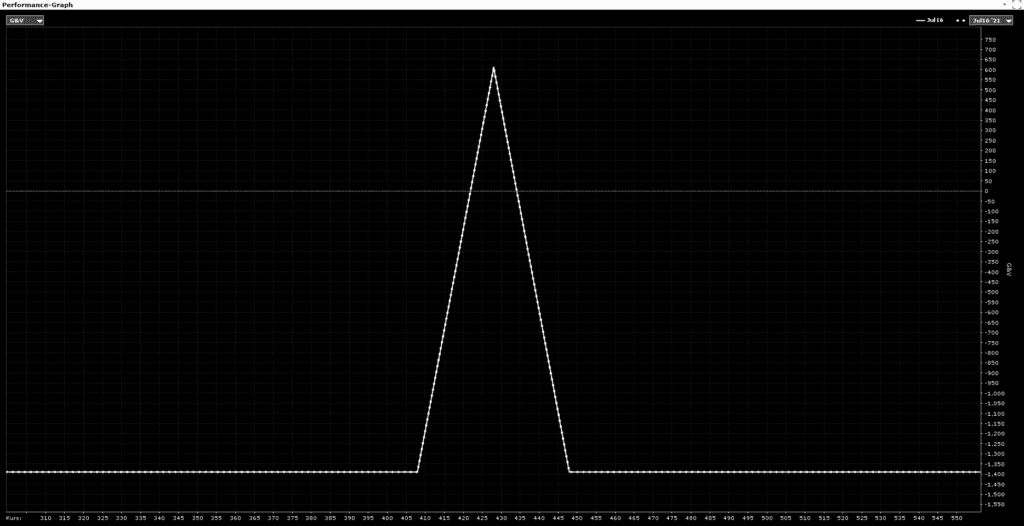
What to look for when trading an Iron Butterfly
As can be seen from the P&L diagram, the use of an iron butterfly is suitable if you assume a sideways movement of the underlying. In addition, the option strategy is often used when speculating on a decline in implied volatility.
Maximum loss
The maximum loss of an Iron Butterfly is limited and occurs when the underlying is quoted above the strike price of the long call or below the strike price of the long put at expiration.
The maximum loss can be calculated as follows, subtracting the collected premium from the distance of the strike (width of the spread):
Max. Loss = Long Call - Short Call - Option premium
Or:
Max. Loss = Short Put - Long Put - Option Premium
Maximum profit
The maximum profit occurs if the iron butterfly is held until the expiration date and expires exactly at the price level of the sold options. Since the probability of this is relatively low, option traders usually terminate the trade before the expiration date, as soon as the trade is a certain amount in the plus.
Break Even Point
The break-even point is reached when the underlying has moved so far away from the price level of the sold options (the straddle) that the loss is equal to the premium collected.
Break Even Point = Short Call + Premium
Or:
Break Even Point = Short Put - Premium
Implied volatility
The Iron Butterfly is benefiting from a decline in the implied volatilitysince the vega of the sold options is higher than the vega of the bought options. For this reason, the strategy is often used after a rise in the IV.
Residual term and fair value expiry
The longer the remaining term of an Iron Butterfly, the higher the option premium collected. Like other option writing strategies, the Iron Butterfly generates a small profit day by day (all other things being equal) due to time value decay.