


With the Volatility index VIX Chicago's options exchange has created a metric that allows traders to helps to assess market developments. The special thing about it: you can also trade the VIX and thus profit directly from rising and falling volatility! You can find out how this works and how you can use the index for forecasts here.

The most important in a nutshell
- The VIX volatility index reflects the prices of options on the S&P 500 with 30 days to maturity. As options contracts are often used as hedges, the sentiment, confidence or fear of market participants can be identified.
- A high/rising VIX indicates that price fluctuations are imminent. Prices often, but not always, fall.
- A low/falling volatility index stands for calm markets without strong price fluctuations. Often, but not always, this means price stability.
- You can use the index as an underlying for options and thus profit directly from volatility.
What is the VIX?
To make profits on the stock market, traders need to correctly predict price movements. To do this, they use a large arsenal of key figures and technologies, such as trading charts, Volume Trading Analysis that Fundamental analysis for shares and much more.
With the VIX, the volatility index of the CBOE options exchange in Chicago, traders have another particularly exciting tool at their disposal. Although it is "only" the Measured value for options on the S&P 500 the VIX is ideal for determining market sentiment and predicting potential crashes.
The way it works is surprisingly simple:
- Market participants use options to hedge against crashes, crises and other price changes or to profit from them.
- In turbulent times and when fluctuations are expected, the need for hedging increases and more options are purchased. This increases the option price.
- The VIX measures this price change. It records the costs for put and call options with a remaining term of 30 days.
- A high value indicates a high demand for options contracts, which points to unrest and fear in the markets.
- A low value indicates that demand for hedging is low. The markets are confident and do not fear any imminent price changes.
The VIX indicates the implied volatilityalso known as "projected volatility". It is one of three volatility indicators and is used to future developments.
The two other volatilities that traders encounter time and again are:
- Standard deviation: Measures price changes of an asset over a defined period of time.
- Beta: Measures the volatility of an asset in relation to the market. An asset is more volatile than the market with a value of over 1.0 and less volatile with a lower value.

VIX as a "fear barometer"
The volatility index only reflects the price at which options with the S&P 500 as the underlying are traded. Strictly speaking, it therefore only refers to the well-known share index. However, the development of the S&P 500 is of course closely linked to the US economy and consequently the whole world! Traders use the VIX is therefore a key figure for the entire US market and the global economy.
Stock market crashes and corrections are undesirable events that can wipe out huge sums of money in a matter of minutes. So it's no wonder that traders are afraid of such phases!
- The comparatively gentle correction of the AI bubble in January 2025 resulted in the loss of one trillion euros within a few hours.
- In February 2020, the COVID crisis hit an already weakened economy. The damage was enormous: the S&P 500 fell by more than 12.5 % and wiped out over 3.5 trillion euros.
- During the financial crisis of 2007 and 2008, the 30 most important US shares (represented in the Dow Jones Industrial Average Index) lost more than 50 % in value. In total, almost 10 trillion dollars in private assets were wiped out in the USA. The financial crisis contributed directly to the emergence of the euro crisis.
The VIX can fear of these and similar events: If traders expect an imminent setback, demand for options increases. Because these can be used to:
- Minimize the damage of price declines. Options contracts are ideal for Hedging strategies and thus avoid damage in the event of a crash.
- Generate profit from crises. Options contracts are an excellent way to profit from falling prices.
The rising demand for options leads to a higher price, which in turn drives up the VIX. As the volatility index is the mood of the market participants, the term "Anxiety barometer" naturalized.
The following guide values are used to interpret the index:
| 0 to 15 | 15 to 25 | 25 to 30 | over 30 |
| Very low volatility. The market is optimistic. | Low volatility. No particular market sentiment. | Increased volatility. Markets are unsettled. | Very high volatility. The markets are expecting a sharp turnaround soon. |
VIX as underlying
An index is a list of Stocks, short-term bondscryptocurrencies or other assets that are compiled on the basis of defined rules. The best-known examples are the S&P 500 (comprising the 500 largest US stock corporations by market capitalization) or the DAX (40 most liquid stock corporations from Germany).
The VIX is an indexHowever, it behaves somewhat differently than the well-known share indices, for example. Its content is not a classic asset. It is therefore not directly tradable.
Here come the Derivatives into play: If we Trade options or Future Trading no "tangible" values are required. Traders can use interest rates, the weather or volatility as an underlying. You can trade the VIX in several ways:
VIX futures
Futures are contracts between two equal trading partners. They are executed at a fixed point in time and can be used for hedging or speculation, for example.
With a VIX future, you speculate on a single futures contract and its price on the expiry date. The value of the VIX during the term is irrelevant; only the price of the future determines success or failure.
However, developments during the term can have a major impact on your futures contract.
- By default, the Term structure curve in the "Contango" form: Later contracts are more expensive than those with an earlier expiry date.

- In some cases, however, the curve can reverse its trend. This results in the so-called "Backwardation", where later futures are cheaper, i.e. those that expire soon.

The reason for the inverted term structure curve may be a high demand for immediate hedging. If many traders buy VIX futures because they expect a price change in the near future, the price of these contracts rises. It is therefore hardly surprising that a VIX term structure curve in backwardation often precedes a major crash.
Like all exchange-traded products, a VIX future naturally also has a price based on supply and demand. The equivalent value of a future is calculated by multiplying the current price by the multiplier set by the exchange. For example, a VIX future of 20 has an equivalent value of USD 20,000. Changes in the VIX can result in high profits or losses due to these strong leverage effects. We therefore strongly recommend that you hedge such transactions accordingly and take out a suitable Hedging to operate.
The further a VIX future is in the future, the less correlation there is between its price and the current VIX price. On the other hand, the closer the expiry date approaches, the greater the impact of current price changes on the future.
CapTrader can do that:
CapTrader is one of the few providers on the German market to offer you access to futures and options - and at excellent conditions! With us you can trade futures from as little as €2.00 per contract, EU options from €2.00 and US options from €3.50 $ per contract!
VIX options
Options are also contracts between two trading partners. However, they do not have equal rights: The buyer of the option has a right to choose and can execute the contract or let it lapse, depending on what is advantageous to him. The seller has no choice and must follow the buyer's decision. You can find out more about how the contracts work in our article Trade options.
You can Options with the VIX as underlying trade. Such contracts have some special features:
- The price of options is based on the VIX futures for the respective expiry date, not on the current level of the volatility index. However, you do not trade the futures contract itself, it is only a pricing tool.
- The exercise type is always "European", i.e. they are not settled until the expiry date.
- Each VIX option is multiplied by a factor of 100.
- Settlement always takes place via cash settlement. As the underlying is not an asset, a tender would not be possible.
- The capital requirement is manageable (multiplier 100) and the contracts are therefore also suitable for options trading with small accounts.
VIX futures options
Options on VIX futures are new VIX optionswhich have only been available to dealers since 2025. These are Options that use a VIX future as the underlying. In the event of exercise, you will receive a future booked into/out of your securities account (depending on whether it is a long position or a short position). Short sale has acted).
These contracts have the following characteristics:
- American exercise type. You can also exercise the contracts during the term and do not have to wait until the expiry date.
- VIX futures options are subject to a multiplier of 1,000.
- Settlement always takes place by physical delivery. You actually receive the VIX future in or out of your securities account (depending on the type of option selected)
- Future options require a comparatively large amount of capital (multiplier 1,000) and are therefore more suitable for options trading with large accounts
ETF and ETN
Exchange traded funds and exchange traded notes are two types of financial instruments that also allow transactions with the VIX. They come in different variants and represent either VIX futures or options on VIX futures.
How you achieve this goal can vary greatly from product to product. We therefore strongly recommend to study the functionality and possible points of use in detail before investingto avoid disappointments and losses.
If we look at the S&P 500 VIX Futures Enhanced Roll UCITS ETF from Amundi and its historical performance, for example, it quickly becomes clear that this ETF is only worthwhile when the VIX rises, especially before major crises. During the COVID crisis in February 2020, for example, the exchange-traded fund gained around 200 % within a few days.
The Amundi S&P 500 VIX Futures Enhanced Roll UCITS ETF shows the typical performance of a VIX ETF. There are many comparable products available from other providers.
ETFs and ETNs can be traded on numerous exchanges without any special requirements. They are therefore also suitable for market participants who have little experience and are unable or unwilling to trade complex products such as futures or options.
Please note:
- Most VIX ETFs and ETNs are generally not suitable for long-term investments. They increase in value when the volatility index rises in price and are therefore designed for hedging. However, there are also exceptions; you should therefore always consider how the product in question works before investing.
- VIX ETF and ETN are often based on VIX futures with very long maturities (several months). The current value of the volatility index does not necessarily allow conclusions to be drawn about the prices of these future contracts!
- Many products based on the VIX appear Comparatively expensiveCosts of 1 % p.a. and more are not uncommon. However, due to the short investment period (the investment products are only intended for short-term investments of a few days in the event of acute risks), these expenses are negligible.
CapTrader can do that:
We provide you with a huge range of more than 20,000 ETFs and enable you to trade both futures and options. This ensures that you are guaranteed to find the right product for VIX trading!
Variants of the VIX
The VIX is undoubtedly the best-known volatility index, but there are other indices that also provide useful insights into the market situation. The Chicago Options Exchange (CBOE), for example, publishes other volatility figures:
- Nasdaq-100 Volatility Index (VXNSM)
- CBOE Dow Jones Industrial Average Volatility Index (VXDSM)
- CBOE Russell 2000 Volatility Index (RVXSM)
There are also numerous examples of the "classic VIX" on the S&P 500. Variants. You differ in the term of the underlying options and thus allow forecasts to be made for different time periods. The combination of several volatility indicators in particular can provide helpful information for traders.
- CBOE 1-Day Volatility Index (VIX1D), maturity one day
- CBOE ShortTerm Volatility Index (VIX9DSM), maturity nine days
- CBOE Volatility Index (VIX), "standard variant", term one month
- CBOE S&P 500 3-Month Volatility Index (VIX3MSM), maturity three months
- CBOE S&P 500 6-Month Volatility Index (VIX6MSM), term six months
- CBOE S&P 500 1-Year Volatility Index (VIX1YSM), maturity one year
Another variant is the VVIXIt reflects the demand for options on the VIX and thus reflects the volatility of volatility. This index can also be a useful forecasting tool, but is not itself tradable.

Where can I find the VIX at CapTrader in the Trader Workstation TWS?
Would you like the VIX as a forecasting tool you have several options at your disposal. Firstly, you can use the volatility index directly via the Website of the CBOE call This allows you to quickly gain an insight into the current volatility values; however, this method is not really practical for trading.
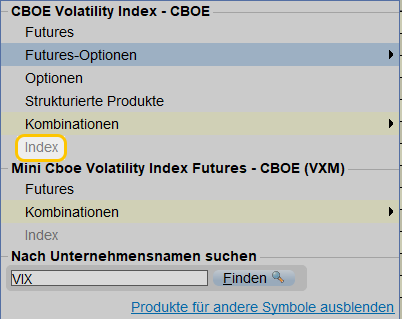
It is easier for most traders to use the index Display directly in the respective trading software to leave. In the popular Trader Workstation this works as follows:
- Enter the search term "VIX" in a free line of the watch list and confirm with "Enter"
- Select the hit "Index" to display the index, alternatively select the hits "Options" or "Futures" for forward transactions on the VIX.
CapTrader can do that:
We provide you free of charge with various Platforms for trading. These include, for example, the powerful Trader Workstation, which best trading appTraderFox Tradingdesk, which enables direct integration of the TraderFox signals allowed and much more.
Conclusion: Crash forecast and lucrative trading with the VIX
The VIX is a volatility index published by the CBOE exchange that tracks the demand for options on the S&P 500. Since options contracts are often used to hedge one's own portfolio, various insights into the mood of the markets can be gained from them:
- Low VIX (0 to 15): Market participants are very optimistic and do not expect any major changes.
- Medium (15 to 25): The mood is neutral.
- High (25 to 30): The markets are unsettled, demand for hedging through options is increasing.
- Very high (over 30): Market participants are panicking and anticipate very sharp price fluctuations in the near future.
On the basis of the changes and the current value, important Insights into the market situation and possible stock market crashes especially in conjunction with other indicators.
The index is based on options with 30 days to maturity; variants with other maturities are also available and can provide additional information. Traders can also Trading futures, options and products such as ETFs based on the VIX and thus profit directly from volatility!
Trading with the VIX as the underlying can be used for hedging or price speculation and can generate attractive profits. However, all products have their own advantages and disadvantages. We therefore recommend that you read our articles on the subject of Trade options and Future Trading and to read trading strategies initially on a CapTrader Paper Trading Account without risks.
