For a change, today's article "BDCs - dividend cover and the interest rate turnaround" is not about Real Estate Investment Trusts (REITs)but another interesting investment vehicle for income investors. Anglo-Saxon business development companies (or BDCs for short) have long been a favorite playground for this group of cash-flow-savvy investors. These types of investee companies provide debt and equity capital to mid-sized companies in the US and, due to their special regulatory status (Investment Company Act of 1940), do not have to pay corporate income tax as long as they distribute at least 90 % of their net taxable income. On the one hand, this structure leads to high and quite predictable dividends, on the other hand, BDC investors bear the credit risk of a potentially illiquid loan portfolio. In this article, I would therefore like to take a look at the current situation in the sector and highlight the effects of falling interest rates and explain them using examples.
What exactly are BDCs?
BDCs primarily finance private companies that are too small for the public bond market. The capital structure of the portfolios consists largely of senior, variable-rate loans (so-called first-lien loans) with short maturities. The borrowers pay a spread (typically SOFR + 3-6 percentage points), so that the BDCs' interest margins increase when the short-term reference interest rate rises. However, many BDCs also make equity co-investments or subscribe to mezzanine capital. Due to this mix of loan and equity financing, BDC portfolios are not only sensitive to interest rates, but also exhibit a certain correlation to the economic environment.
In order to mitigate the regulation somewhat, BDCs are allowed to increase their leverage ratio to a maximum of 2:1, i.e. they are allowed to use USD 2 of debt for every USD of equity. Many companies operate below this limit (they are then "underleveraged") and deliberately increase their debt when new investment opportunities arise. They may (theoretically) only pay dividends if the net investment income (NII), i.e. interest income less operating costs, is sufficient (dividend coverage). The risk/return profile of the sector is based on this fact.
Current situation and market environment
A look at some research reports and articles on BDCs shows that we are dealing with a growing universe of business development companies. The assets under management of listed BDCs grew by a whopping 38% YoY in Q1 and an impressive 8% compared to the previous quarter. But you also have to look at the details. The "heavyweights" in the sector have only grown moderately, with the majority of growth coming from newly launched BDCs.

(Source: lsta.org, BDC Quarterly Wrap: 1Q 2025)
What is also noticeable is that the BDCs were still pulling hard on the levers as interest rates rose in 2023, but by the first quarter of 2025 the average net debt had fallen to 0.91× (average of the largest BDCs: 1.01×). The companies are therefore operating below the legally permitted leverage.
The portfolio composition continues to shift in favor of the somewhat safer first-lien loans, which now account for 86.4 % of the total portfolio, while the equity share has fallen to 7.1 %.
As a risk-conscious investor, you should look at two key figures in addition to leverage: Non-Accruals and Payment-in-Kind (PIK) income.
The average non-accrual ratio as at March 31, 2025 was 1.36 % of fair value. At the same time, the proportion of PIK income where the borrower does not pay in cash but pays elsewhere is increasing. The weighted average share of PIK income climbed from 6.22 % to 7.01 % of total interest income. Investors should keep an eye on this key figure, as a high PIK share can be a warning sign of deteriorating credit quality.
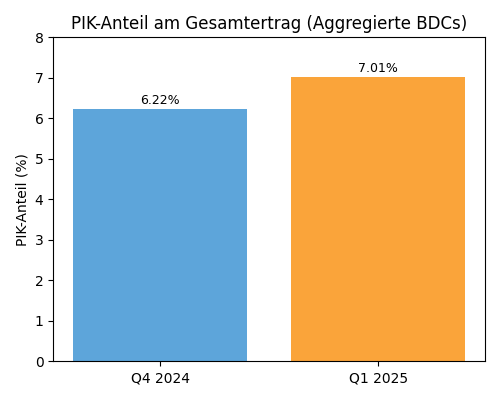
This clearly shows that the PIK share has continued to rise in Q1 2025. Around 18 % of the BDCs examined even have a PIK share of over 10 %, which is a very critical development.
Non-accruals in comparison
The so-called non-accruals unfortunately require their own paragraph, as they are a critical cog in the dividend coverage wheel. Non-accruals measure the proportion of loans where interest or principal payments are at risk of defaulting or have defaulted (usually 60 days) and no more income is expected or can be recognized. The lower this figure, the higher the health of a BDC's portfolio. The following chart shows the non-accruals of some selected BDCs and the sector average.
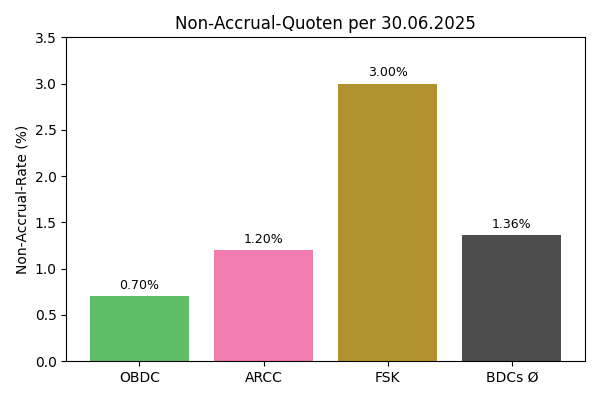
While Blue Owl Capital Corp. (TWS ticker: OBDC, ISIN: US69121K1043) is well below the industry average (1.36 %) at 0.7 %, Ares Capital (TWS ticker: ARCC, ISIN: US04010L1035) still has a solid ratio of around 1.2 % despite a slight increase. FS KKR Capital (TWS ticker: FSK, ISIN: US3026352068), on the other hand, is well above average with non-accruals of 3.0 % (fair value) and 5.3 % (cost). A high value does not automatically mean that a dividend cut is imminent, but it does signal increased pressure on net investment income (NII).
The interest rate turnaround and possible effects on BDCs
BDCs benefit in times of rising interest rates as most of their loans have floating interest rates. In 2022 and 2023, floating spreads increased sharply, as BDCs had financed themselves at fixed interest rates and at the same time granted floating-rate loans, which ultimately caused the net investment income of many BDCs to literally explode and led to dividend increases and special dividends in many places. But what will happen when the US Federal Reserve (Fed) cuts interest rates in September?
- Immediate effect on NII: An interest rate reduction reduces the reference rate (SOFR) to which the variable loan interest rates relate. Although many contracts contain floors (e.g. 1 % or 0 %), as soon as interest rates fall below this threshold, interest income falls immediately. At the same time, the financing costs of the BDCs (interest on borrowed capital, administration fees) initially remain constant, meaning that the net margin shrinks.
- Dividend effects: As BDCs must distribute at least 90 % of taxable net income, dividends reflect NII developments almost 1:1. Companies with low dividend coverage have to cut their distributions first when interest rates fall. The following chart shows how well OBDC, ARCC and FSK currently cover their dividends with the NII:
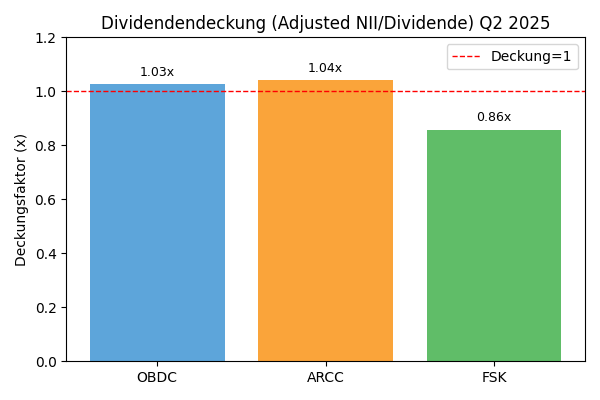
The key figure is calculated by dividing the adjusted NII per share by the dividend paid. OBDC achieved an adjusted NII of $0.40 per share in the second quarter of 2025 and paid out $0.39, so the dividend coverage for the quarter is just under 1.03×. ARCC generated NII $0.50 per share and paid out a dividend of NII $0.48, which corresponds to a comfortable coverage of 1.04×. FSK, on the other hand, only generated net investment income (adjusted) of $0.60 with a dividend payout of $0.70, which means that the dividend is not covered, which could lead to a cut in the medium term.
However, there are still a few points to consider that could at least postpone a reduction in the future:
- Spillover income as a buffer: Many BDCs accumulate surplus interest income in good times, which they are not allowed to distribute immediately (so-called Spillover). This cushion makes it possible to support the dividend in weaker years. Ares Capital pointed out in the Q2 2025 earnings call that core earnings continued to exceed the dividend and that there are "significant spillover reserves". BDCs without spillover, on the other hand, have to react more quickly.
- Underleveraged vs. expansion of debt: BDCs with low debt (less than 1×) have scope to leverage their balance sheet in order to partially compensate for interest rate losses. For example, they could take out additional loans and thus grant new, higher-yielding loans. However, this approach increases the risk. If BDCs are already operating at the 2:1 limit, the only remaining option is to use "non-GAAP tricks" (increasing PIK, realizing unrealized gains, etc.) or ultimately a dividend cut.
Focus on three BDCs
Main Street Capital - the BDC blue chip
Main Street Capital (TWS ticker: MAIN, ISIN: US56035L1044) is considered the "gold standard" among BDCs. The management invests quite conservatively, non-accruals have been below 1 % for years, the leverage ratio is around 0.80×, and over 60 % of the portfolio consists of first-lien loans. In addition, MAIN frequently participates in direct investments (equity co-investments), which provide additional price gains in strong years. In return, the market pays a high premium to the net asset value (NAV), which is why the price-to-NAV ratio (P/NAV) is 1.46× on average, i.e. 40-50% above the intrinsic value and currently a whopping 2×.
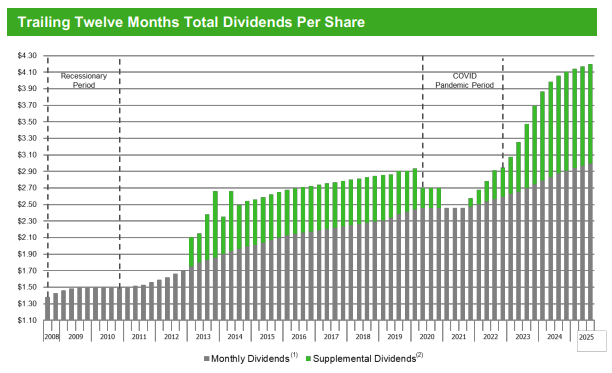
The current NII of $1.07 clearly covers the dividend (regular dividend accumulates $0.765 per share with monthly payout) and there is significant spillover income. However, the premium valuation means that the current dividend yield is below 7 %. A dividend cut with falling interest rates (at a moderate pace) is rather unlikely. However, an entry at the current valuation is not necessarily advisable.
Blue Owl Capital Corp. - favorable and solid
OBDC, formerly Owl Rock Capital (and still named as such by some data services), is trading at a discount of around 5-10 % to its NAV despite good operational performance. In the second quarter of 2025, BDC reported an adjusted NII of $0.40 and announced a regular dividend of $0.37 plus a special dividend of $0.02, for a total of $0.39. The special dividend was lower, which is also the first thing to be tackled. Non-accruals were only 0.7 %, and net debt was around 1.0×. PIK Income as a percentage of total income amounted to around 6.3 % (USD 29.6 million vs. USD 485.8 million), which is still moderate but has increased recently.
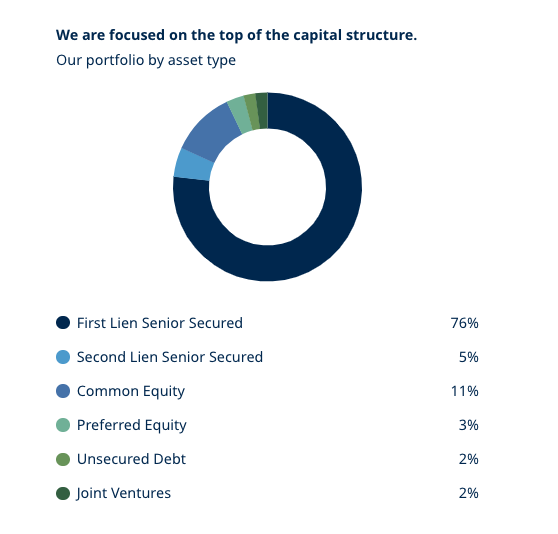
OBDC has a growing loan portfolio (most recently there was a merger with OBDE), which mainly consists of first-ranking loans to tech and service companies with strong cash flows. In times of falling interest rates, OBDC could moderately increase its debt in order to support the NII. In addition, the company plans to continue paying out supplementary dividends as long as the NII is significantly higher than the regular dividend. For investors with patience, the discount to NAV could therefore represent an attractive entry opportunity.
FS KKR - also favorable but with increased risk
FSK was formed in 2021 from the merger of FS Investment and KKR Credit and is one of the largest BDCs with a portfolio of over USD 15 billion. The share is trading at a discount of around 18 % to NAV, making it cheaply valued at first glance. But as is so often the case, there are reasons for such a discount, which you can see when you look at the key figures. In Q2 2025, the adjusted NII fell to $0.60 per share, but $0.70 was distributed. Non-accruals rose to 3.0 % (fair value) and 5.3 % (cost), and net leverage increased to 1.20×.
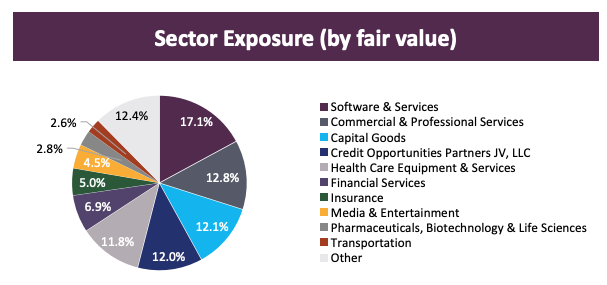
This makes FSK an example of the need for investors to pay attention to sustainability when paying high dividends. If the Fed cuts interest rates significantly or further loans go into non-accrual, there is a very likely threat of a dividend cut. The proportion of PIK income is also comparatively high (over 8 %), which in combination with rising non-accruals further increases the risk.
Options trading
I myself am also active as an options trader, but almost exclusively as a so-called "Style holder". That's why I'm naturally also interested in the BDCs, which options are suitable for additional cash flow or for a favorable entry by means of a tender offer. The good thing is that many BDCs can be optioned accordingly, unfortunately the spreads are often higher and currently the Volatility (VIX) at a very low level, which is why in my opinion it is not absolutely necessary to place short puts, also because the interest rate turnaround in the USA is imminent. What might be worthwhile, however, are covered calls if you already have large positions in your portfolio.
Main Street Capital
For MAIN, for example, covered calls with a Strike of USD 69.7 in September or with Strike 74.7 USD in December which can generate additional cash flow.
Conclusion
BDCs offer high current income and are particularly interesting for income-oriented investors. However, the environment is currently changing. The proportion of PIK in portfolios is increasing and falling interest rates are likely to put pressure on margins. While premium BDCs such as Main Street Capital are equipped with robust balance sheets, low debt and spillover cushions, investors should take a very close look at BDCs with an increased discount and correspondingly high dividend yield. Dividend coverage, non-accruals, PIK ratio, leverage and the ratio of price to NAV are decisive key figures. Anyone investing in BDCs or wanting to enter via option strategies should not only look at the high dividend yield, but also evaluate the fundamental risks.