Welcome to 2025 for a new blog article. Today we are once again talking about a rather unknown Real Estate Investment Trust (REIT)which has a very interesting risk/reward ratio. We are talking about CBL & Associates Properties, a REIT for which the last few years have been very volatile.
Business model and strategy: What does CBL & Associates Properties do?
CBL & Associates Properties (TWS abbreviation: CBL) is (once again) a genuine small cap REIT with a focus on mainly malls and open-air centers in the mid-market segment. With a market capitalization of around USD 888 million and a P/FFO of around 4.5x, the US company is massively undervalued compared to its peers such as Simon Property Group, Tanger or Macerich.

CBL is one of the companies that did not survive the pandemic well and had to file for bankruptcy. Since its return from Chapter 11 bankruptcy proceedings in 2021, however, the situation at the REIT has changed dramatically. Through a fundamental restructuring, the company was able to reduce around 2 billion US dollars in debt, revitalize its balance sheet and thus reposition itself financially. Since then, CBL has pursued a clear strategy: (further) reducing debt, returning unprofitable properties to lenders and increasing the return on capital for shareholders through dividends and share buybacks. CBL appears to be a jewel overlooked by the market.
Portfolio & Acquisitions
CBL currently manages a portfolio of 91 properties, mainly located in the growing Sunbelt region of the USA. During the restructuring, the company returned unprofitable properties in economically stagnating regions such as the Midwest and focused more on dynamic markets (e.g. in the Sunbelt states).
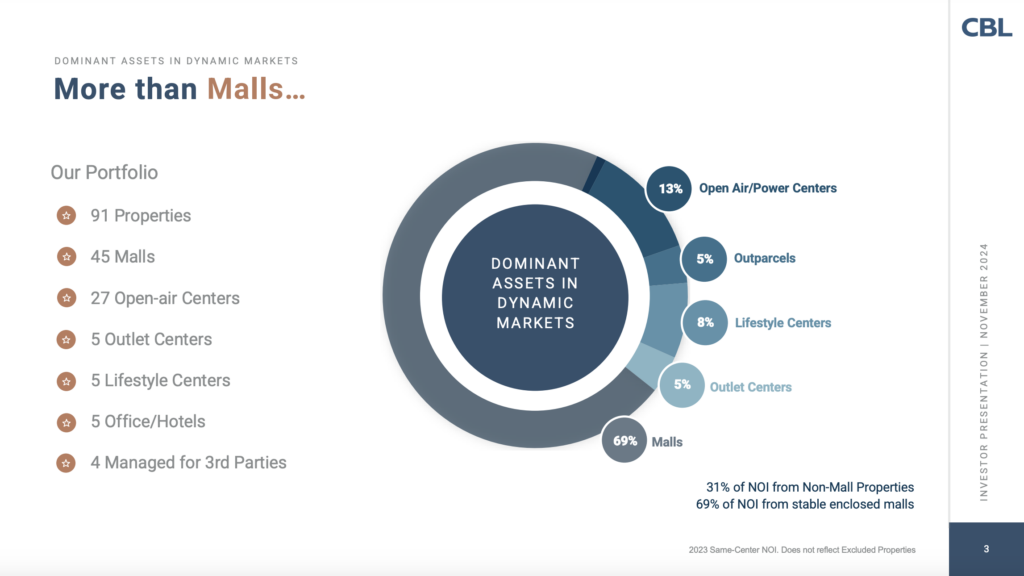
The current geographical distribution of the portfolio shows a strong concentration in southern states such as Texas, Kentucky and Tennessee, which are known for their economic dynamism and population growth.
Key figures: A look at the figures
A healthy balance sheet is a decisive criterion for investors in REITs. CBL & Associates Properties' balance sheet was in poor condition for various reasons, but after the restructuring it is in perfect order. Even a little more, because in my opinion there is a lot of potential for a future upside.
Debt and maturities
CBL's management has made impressive progress in terms of debt and has now reduced net debt from 6.4x net operating income (NOI) to below 5x and is in the process of reducing it further. If you exclude the properties that do not generate cash flow, then it is even closer to 4x. At the same time, the dividend payout has increased by a full 60 % since 2022, while the company has bought back shares worth over 25 million US dollars. And this is very likely to continue.
To take a closer look at the assets that do not have a Cash flow delivered. Part of CBL's strategy is to return these unprofitable properties (via so-called "non-recourse loans") to the lenders, which has given CBL a certain operational flexibility that is rarely found in other REITs. These properties were a burden on the balance sheet but contributed nothing to cash flow. So by returning them, CBL was able to reduce its leverage without reducing operating income.
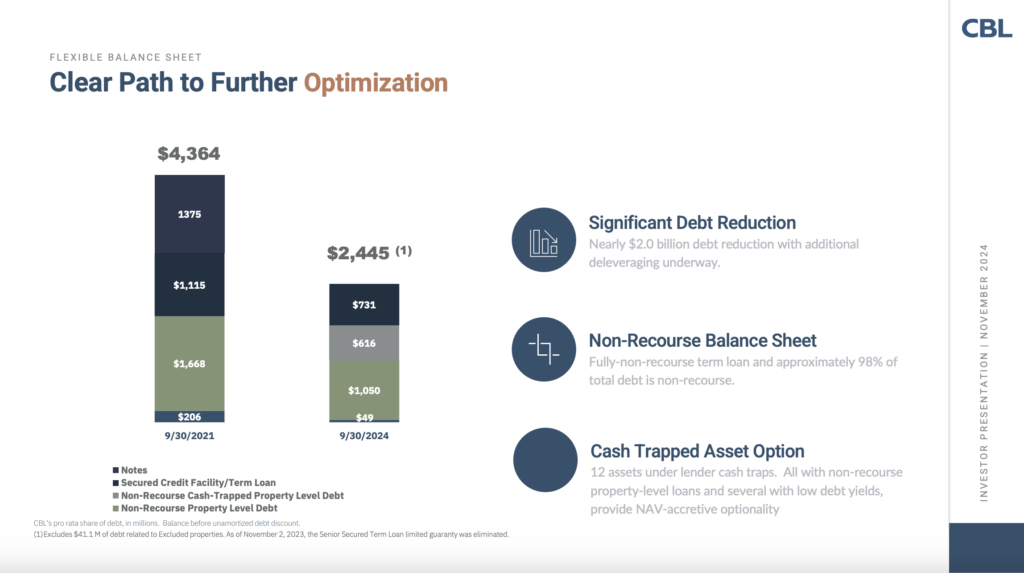
A particular advantage for CBL in the current market environment is the high proportion of variable interest rates in its debt (approx. 39 % of liabilities). In an environment of falling interest rates, this leads to considerable savings in interest costs. Following the latest interest rate cuts by the Federal Reserve, interest expense is expected to fall by around USD 7.4 million per year. And each further interest rate cut reduces this further.
However, the management is also refinancing fixed-interest debt very wisely. For example, the interest rate on a smaller 45 million US dollar loan was reduced from 8.2% to 5.86% by postponing the maturity date by 8 years to 2034.
(Adjusted) Funds From Operations
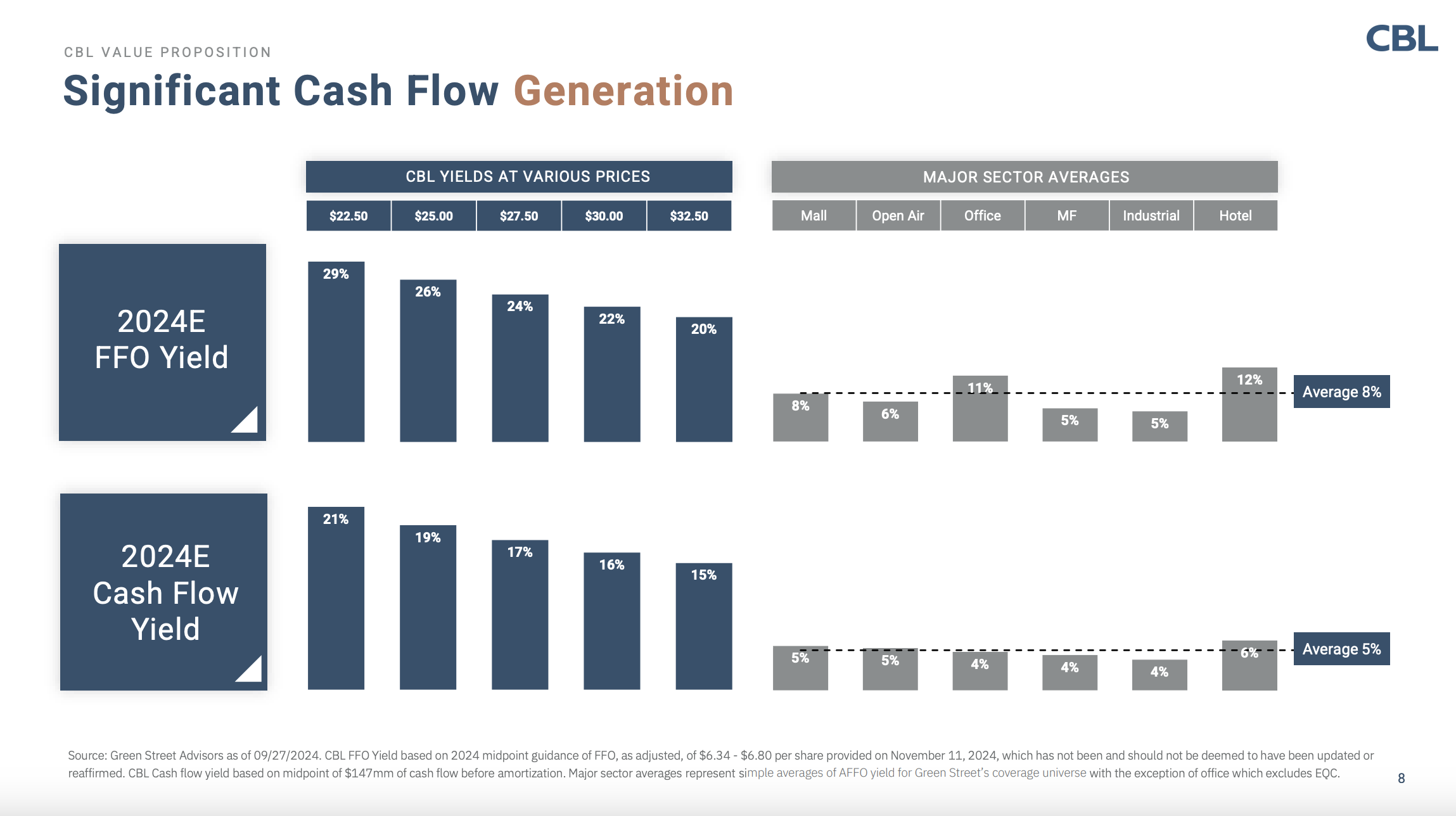
CBL currently generates a free cash flow yield of around 16 %, while the dividend yield is currently around 5.5 %. With a discretionary cash flow of USD 67 million per year, CBL has sufficient funds to continue to reduce debt and return capital to shareholders. Funds from operations are also expected to grow by up to $7% p.a. in the coming years (due to lower interest costs), which in turn would significantly increase free cash flow.
Dividend (and share buy-backs)
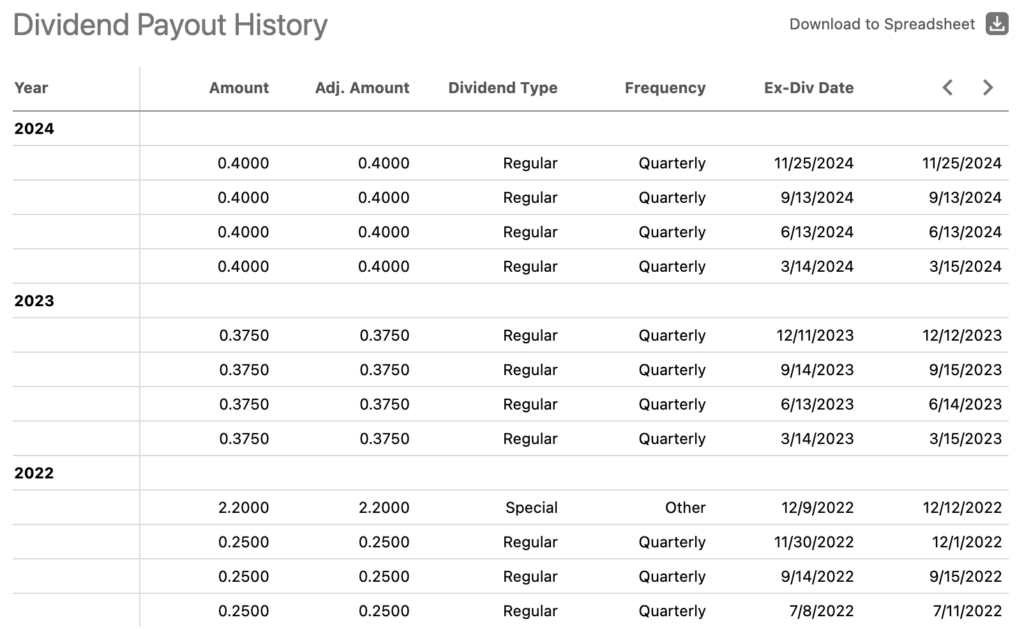
CBL has evolved from a pure restructuring case to a REIT that prioritizes shareholder returns. The dividend has risen from USD 1 to USD 1.60 since 2022 (excl. special dividend). In addition, management has done a lot for shareholders in 2024, as CBL has, among other things, repurchased approximately 8% of the outstanding shares and increased the Dividend is likely to increase further in the future.
Video: Concrete gold with REITs vs own real estate | Philipp Kässinger REIT Profiinvestor
Peer comparison: Higher rating among competitors
CBL is currently trading at a P/FFO of 4.5x, while comparable REITs such as Tanger (SKT), Macerich, Kimco (KIM) Simon Property Group or Whitestone REIT are (in some cases) valued considerably higher. The discrepancy is extraordinary even in the highly differentiated REIT sector and offers investors a potentially attractive entry opportunity.
One reason for the lower valuation: CBL's portfolio has an implied cap(italization) rate of around 18 %, which is well above the industry average.
- Simon Property Group (SPG)SPG is the market leader in the high-end mall sector and has been in my personal portfolio for some time with a total return of over 200%. Simon Property shows where CBL can go, because the REIT, like many other retail-focused businesses, had massive problems in 2020. In the meantime, the dividend has also returned to pre-COVID levels, the occupancy rate is very respectable at over 96% and SPG has now also refinanced itself on a long-term basis thanks to its excellent credit rating and at acceptable interest rates. On the other hand, all this means that the valuation is no longer so attractive and there is only a minimal undervaluation (P/FFO 13.5x).
- Macerich (MAC)Macerich is probably just as well-known as SPG, albeit much riskier. Since the new CEO came on board, however, the whole thing looks like a classic turnaround, as the REIT is selling assets and issuing shares with the aim of strengthening the balance sheet. This is also urgently needed, as MAC has a high level of debt, not only in comparison with CBL. And yet the REIT is valued significantly higher with a P/FFO multiple of approx. 12.6x.
Options trading
I myself am also active as an options trader, but almost exclusively as a so-called "writer". Therefore, I am naturally also interested in CBL, which options are suitable for additional cash flow or for a favorable entry by means of a tender. Unfortunately, the spreads here are very wide.
The Volatility (VIX) has retreated somewhat from the slightly higher levels in December.
CBL & Associates Properties
For CBL, there are options with a Strike from $28 in March or with $28 in July which still offer halfway reasonable premiums despite the lower volatility (VIX) and the high spread.
Whitestone REIT
In the case of WSR, which is valued more favorably than the other peers, an entry at a strike price of $12.5 in June be interesting.