The REIT sector offers many different companies with, in essence, the same business model. Real estate is owned and/or developed and ultimately rented out. However, there are some exotic companies that Real Estate Investment Trusts (REIT) structured, but are quite different from "normal" REITs. In today's blog post, I have brought along one such company that we want to take a closer look at.
Business model and strategy: What makes Safehold "exotic"?
The "exotic" I have brought with me today goes by the name of Safehold (TWS abbreviation: SAFE, ISIN: US78646V1070) and is an innovative REIT that specializes in ground leases. With a rapidly growing portfolio and a unique structure, Safehold has achieved a leading position in this niche of the market. This structure provides SAFE and its investors with stable, predictable income over very long periods of time, often several decades. The management pursues a strategic vision that aims to maximize the growth potential in a largely untapped market. More on this in a moment!
Ground leases as core business
What exactly are ground leases? They are at the heart of SAFE's business model. These are long-term land leases that usually have a term of 99 years or even longer. These contracts allow the tenant to use the land for the construction/development and operation of buildings, while Safehold continues to own the land. This offers several advantages:
- Efficiency for developers: A common problem for real estate developers to date is that not only do they have to bear the cost of building or developing the property, but up to 30 % of the total cost can be spent on acquiring the land. By renting the land from Safehold, developers can avoid these significant costs, increasing the efficiency and profitability of the project. This frees up capital that can be invested in other parts of the project or in additional project developments. SAFE takes advantage of the separation of land and property.
- Long-term, inflation-protected cash flows: Property rents contractually increase by 2% p.a., and there are often inflation clauses, which guarantees Safehold stable and predictable income over decades.
- Low risk: As SAFE retains ownership of the land, the risk is significantly reduced compared to traditional REITs. The land itself generally does not lose value, and even if the tenants do not continue to operate their buildings, Safehold retains the valuable land.
- Value appreciation potential: Land in the best locations in urban areas increases in value over time, especially in rapidly growing cities. Safehold can therefore benefit from the increase in value without having to invest in the development or construction of buildings.
- Reversionary Interest: Another very interesting point is the "reversionary interest" or reversionary clauses. At the end of a ground lease (but also in the event of a "default"), the entire property on the land, including all buildings erected on it, becomes the property of Safehold. This means that at the end of the lease term, Safehold not only owns the land, but also the buildings on it, which can significantly increase the value of the property. This reversionary clause represents an additional increase in value for Safehold, as the company gains full ownership of real estate without having borne the costs of its construction or maintenance.
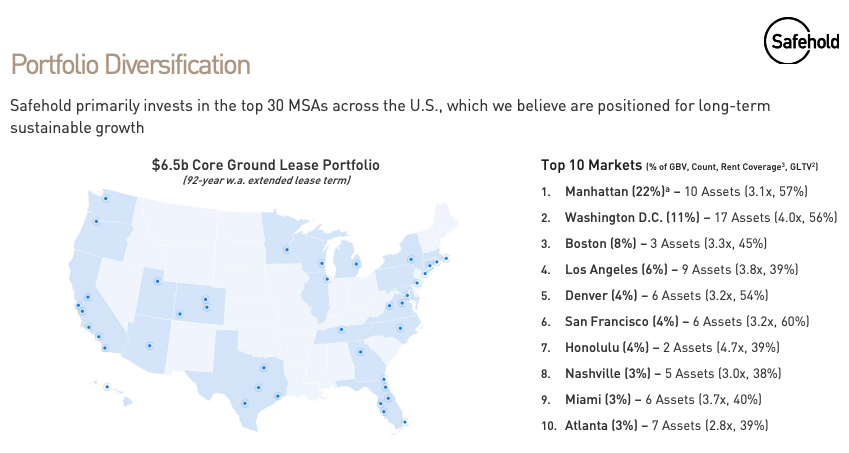
Portfolio Diversification (Source: Safehold Q2'24 Earnings Results)
SAFE is the largest owner of ground leases in the US, with a portfolio that currently comprises over USD 6.5 billion in ground lease portfolio value (GLPV). The portfolio spans 30 leading urban markets, further emphasizing its diversification and long-term growth potential.
Strategic orientation and portfolio growth
Safehold is pursuing a clear growth strategy based on expanding into new markets and extending the existing portfolio. The strategy comprises several key components:
- Expansion into new markets: Safehold has expanded its presence across 30 markets in the USA in recent years. These markets have been selected for their economic potential and demographic trends that promise long-term growth. The focus is on cities such as New York, Los Angeles, San Francisco, Washington D.C. and other major metropolitan areas. In the future, cities in the Sunbelt states are likely to be attractive.
- Focus on first-class properties: SAFE makes targeted investments in properties in prime locations that are characterized by high demand and limited supply. This ensures that the properties have considerable profit potential in the long term and can generate stable cash flows at the same time.
- Capital structure: Safehold uses a diversified capital structure to achieve its growth targets. This includes both equity and debt financing. The recent merger with iStar has enabled Safehold to expand its capital base and access new sources of funding (through an improved credit rating), which will continue to drive growth in the future.
Caret units: another innovation
Caret is an interesting instrument that Safehold Management has developed to record the future value growth of its properties and make it available to shareholders, i.e. a "value creation" tool. It represents a key component of SAFE's strategy.
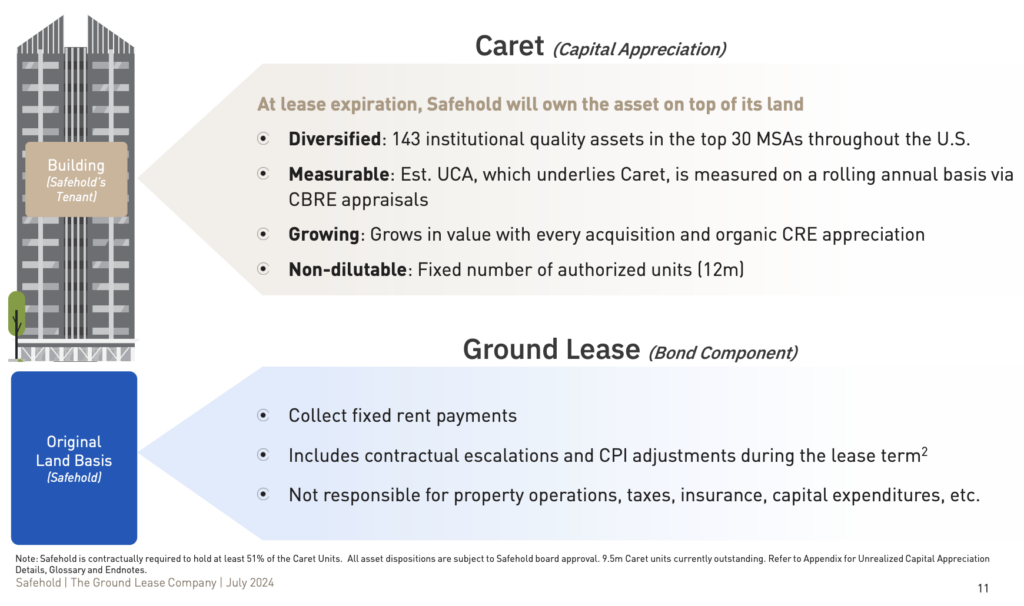
Caret Introduction (Source: Investor Presentation Safehold July 2024)
- Definition: Caret units, represent the long-term increase in value of the properties. This means that investors benefit not only from the stable rental income, but also from the increase in value of the properties themselves, which is realized over time.
- Integration into the evaluation: Caret plays a central role in the valuation of Safehold, as it has a significant influence on the long-term increase in value. The current value of Caret, which reflects the long-term appreciation of the properties, is continuously assessed and made transparent by Safehold (see Unrealized Capital Appreciation, UCA). As at the end of Q2'24, UCA is estimated at USD 9.1 billion
- Dell's participation in Caret: A strong signal of confidence in Safehold's long-term vision and the innovative strength of Caret Units came in 2022, when Michael Dell, founder of Dell Technologies, acquired a USD 20 million stake in Caret Units through his investment company MSD Capital. acquired a USD 20 million stake in Caret Units through his investment company MSD Capital. This investment shows that Caret Units have potential, not only for traditional REIT investors, but also for institutional investors.
Market development: What happened recently
Merger of iStar and Safehold
In 2023, the merger of Safehold with the former external manager iStar, an important player in the financing and management of real estate, was completed. This merger was not strategically insignificant and has significantly strengthened Safehold.
- Background: iStar already held a large stake in SAFE before the merger and was instrumental in the financing and growth of the company. The merger gave Safehold access to iStar's extensive resources and expertise, which has significantly strengthened the company's financial base.
- Strategic advantages: The merger enabled Safehold to expand its capital base and tap into new sources of financing. In addition, the synergies from the merger led to significant cost savings and improved operational efficiency.
- Portfolio expansion: The merger also enabled SAFE to significantly expand its portfolio and acquire additional properties in prime locations, which has further strengthened its market position.
Another spin-off: Star Holdings
Following the merger, Star Holdings was spun off as an independent company. Star Holdings manages certain non-core real estate and loan portfolios that do not fit into Safehold's core strategy.
- Special Situation: I mention Star Holdings (TWS: STHO, ISIN: US85512G1067) in this analysis for a specific reason. This is because STHO also holds shares in Safehold, namely around 13.5 million SAFE shares as of August 6, 2024, which are currently worth over USD 300 million. However, the market capitalization of Star Holdings is only around USD 165 million! The company's stated goal is to maximize the value of its assets with the aim of liquidating them completely in the coming years and returning the capital to investors. It is therefore very possible that the final proceeds per share will (significantly) exceed the current share price. Jay Sugarman, CEO of Safehold, may also share this view, as he holds a significant stake in STHO.
Interest rate sensitivity and effects
Due to its focus on ground leases, Safehold has a significantly higher interest rate sensitivity than other REITs, as the long-term contracts often provide for fixed or only slowly adjustable rental payments. Rising interest rates increase the cost of capital and squeeze margins, especially when Safehold acquires new properties or has to refinance existing loans. In addition, the income from ground leases does not usually increase to the same extent as interest rates rise or have risen. This was also one of the reasons why SAFE's share price fell to its knees.
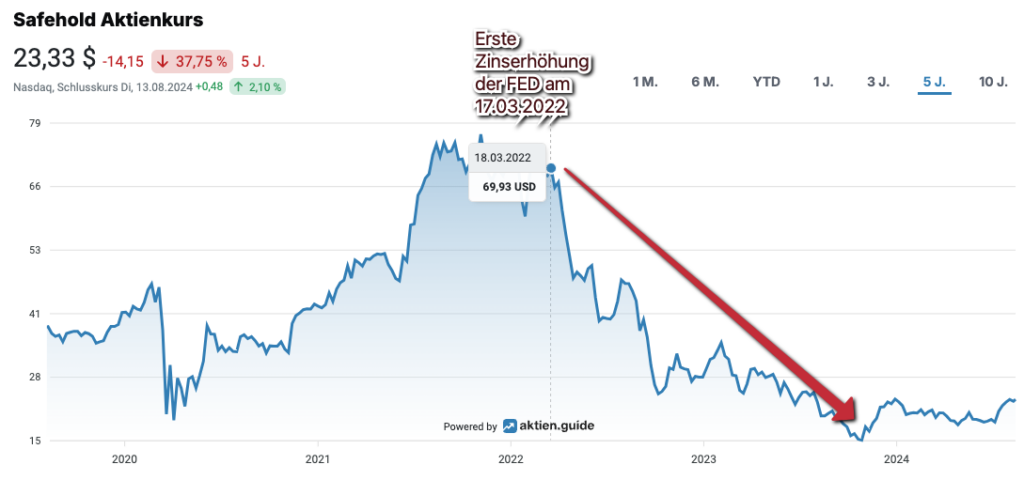
5-year chart of Safehold, start date of FED interest rate hikes (source: aktien.guide)
If interest rates fall, however, Safehold will benefit more than average, as the cost of capital will fall and the value of future rental income will increase at the same time. Demand for ground leases could also increase, as investors are looking for stable and secure long-term income in an environment of lower interest rates.
Key figures: A look at the finances
Now we come to the exciting part for many investors, the key figures. I would like to focus in particular on debt, as this is still one of the most important factors that can determine the "fate" of a REIT in the current environment. Of course, this also applies to the "exotic" safehold.
Debt and maturities
Safehold pursues a fairly conservative debt strategy based on long-term financing in order to increase the company's stability and minimize interest rate risk. CEO Jay Sugarman has communicated this clearly time and again. Since most of their cash flows have maturities of over 90 years, it makes sense to push the maturity of their debt as far back as the market will allow.
- Long financing terms: Safehold therefore relies on long-term financing structures that are well staggered in order to minimize the risk of interest rate changes. As of July 2024, the average term of the debt is a full 21 years, which offers the company financial flexibility and planning security. Relevant maturities will not occur again until 2027.

- Investment grade rating: Following the merger with iStar, Safehold has a A3 or BBB+ rating incl. positive outlook from leading rating agencies. This investment grade rating enables SAFE to raise debt capital at more attractive conditions, among other things.
Adjusted funds from operations
Safehold generates stable, inflation-hedged income from its ground leases, which is reflected in the continuous growth of AFFO. Further growth in AFFO is expected in the future due to the expansion of the portfolio and the synergies from the iStar merger. Nevertheless, SAFE's Adjusted Funds From Operations and the resulting multiples are perhaps less meaningful than those of other REITs, in particular due to the special business model. Therefore, analysts and SAFE's management use the "Unrealized Capital Appreciation" or UCA. I think you should use both.
Unrealized Capital Appreciation (UCA)
The Unrealized Capital Appreciation (UCA) is the key figure that represents or is intended to represent the unrealized increase in the value of the land. Safehold uses the UCA ratio to show the increase in value of the land over the term of the lease. This appreciation is often realized over decades and provides Safehold and SAFE investors with additional income potential. The current UCA value of the portfolio is over USD 9 billion.
The dividend
Of course, there is also a dividend. Shareholders currently receive USD 0.177 per share per quarter, which corresponds to a dividend yield (FWD) of currently 3.10%. At first glance, this seems relatively safe. However, if you look purely at the cash flows, the dividend has not really been covered in recent quarters. The rating agency Fitch also seems to have noticed this in the meantime.
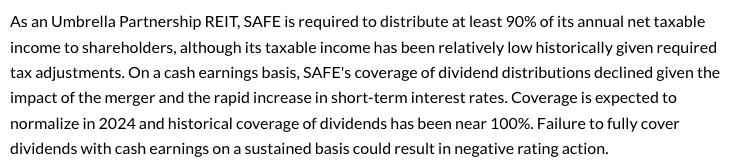
Fitch Affirms Safehold at 'BBB+'; Outlook Remains Positive (Source: fitchrating.com)
However, the aforementioned cash flows should recover in 2025, also due to the very likely first interest rate cuts. Then the Dividend also be (more) secure.
Risks
There are always risks everywhere, and therefore also with SAFE. In my opinion, the main risk apart from a dividend cut is the very unstable office market in the USA, where a number of defaults are very likely to occur in the coming months and years.
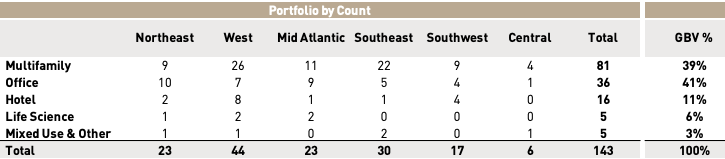
Portfolio Diversification (Source: Safehold Q2'24 Earnings Results)
Office is the largest sector in the Safehold portfolio. The downside of "reversionary interest" is that SAFE could own many of these office buildings in the next 3-4 years and may not want to because they are worth significantly less (some are already being "flogged" at part 90% discount).
Peer comparison
Safehold vs. traditional REITs
The peer comparison is rather short for Safehold because it is de facto the only REIT that specializes in ground leases at 100%. There are two REITs that I would nevertheless like to mention:
- W. P. Carey Inc. (TWS abbreviation: WPC, ISIN: US92936U1097): W. P. Carey is a diversified REIT that is undergoing a transformation into an industrial REIT. WPC also holds a number of ground leases in its portfolio, although these only make up a small part of the overall portfolio.
- Vornado Realty Trust (TWS abbreviation: VNO, ISIN: US9290421091): VNO is an office REIT, mainly focused on New York City. The company has also used ground leases in the past, particularly for high-profile real estate projects.
Options trading
At the last Articles on Realty Income (TWS: O, ISIN: US7561091049) was the Volatility (VIX) quite low. This has changed somewhat in the meantime, with a spike up to 65 and a current value of >18. The option premiums are therefore slowly becoming interesting again. There are option chains for both SAFE and STHO.
I myself am also active as an options trader, but almost exclusively as a so-called "writer". Therefore, I am naturally also interested in REITs that are suitable for additional Cash flow or for a favorable entry by means of delivery.
Safehold
For SAFE there are Short Puts with a Strike from $20 in September or a little longer running with $22.5 in October that offer halfway reasonable premiums.
Star Holding
For STHO there are Short Puts with a Strike of $12.5 in September or a little longer running with $12.5 in November an.