


The Ratio Put Spread is a Option strategywhich profits from a moderately bearish development of the underlying and at the same time also makes a small profit or only a relatively small loss when prices rise. The risk, on the other hand, lies in sharply falling prices. The ratio put spread consists of a different number of bought and sold put options.
Definition Ratio Put Spread
A ratio put spread is an option strategy that consists of a purchased Put option (Long Put) and several put options sold (Short Put) with a lower strike price and the same remaining term. The ratio of short puts to long puts is usually 2:1 or 3:1; in principle, however, the strategy can also be traded with any other ratio (e.g. 4:1, 3:2, 5:3, etc.).
Depending on the choice of underlying prices and ratios, a (usually relatively small) debit (cost) or credit (premium income) is generated when opening the trade.
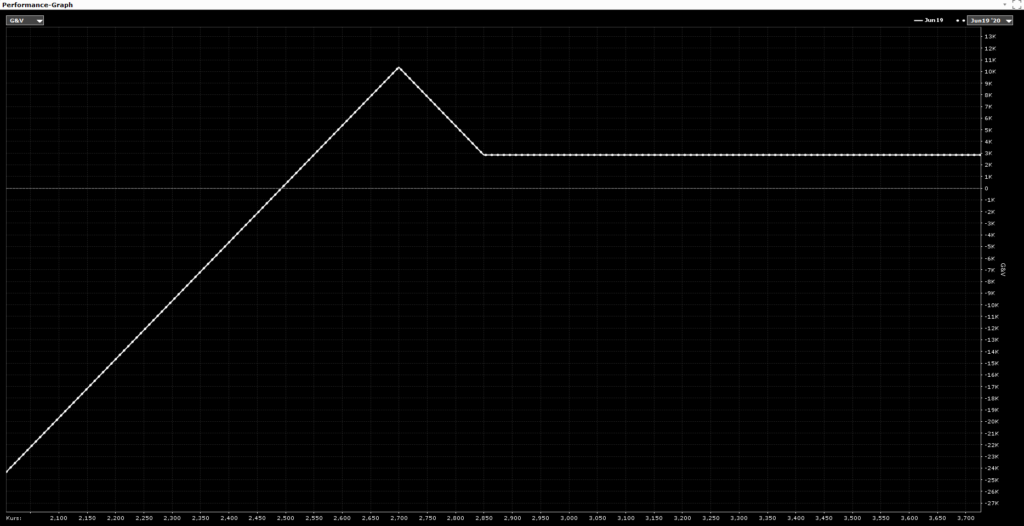
The maximum profit typically occurs on the expiration date a few points below the current market price. However, if prices fall sharply, a loss is incurred.
P&L diagram of a ratio put spread
The profit and loss chart of this 2:1 ratio put spread makes it clear that the price zone where the maximum profit occurs is a few points below the current market price. However, in case of very strong falling prices, the downside risk is not limited.
What should I pay attention to when trading a ratio put spread?
The Ratio Put Spread can be used, for example, to react in a downward trend to a Consolidation or an early Trend reversal to speculate. Since the trade can often be opened with a net credit (premium income), especially on the stock markets, a profit is made both when prices rise and when they fall moderately. However, if the market falls sharply, the downside risk is not limited.
Maximum and realized loss
A ratio put spread is a Bear Put Spread with one or more additional short puts. If the underlying falls below the price level of the short put, the bear put spread achieves the maximum profit (width of the spread), but the additional short put achieves a loss.
The further the underlying falls, the higher the overall loss will be, since the gain of the Bear Put Spread can only compensate the loss of the additional short put up to a certain point. Therefore, you can calculate the loss on the expiration date by determining the loss of the naked short put and subtracting the gain of the bear put spread and the premium collected. (If the trade was opened with a net debit, the premium is added).
Maximum profit
The maximum profit is achieved when both short puts expire worthless and the long put simultaneously achieves the highest possible profit. This is the case if the underlying on the expiration date is exactly at the price level of the short puts quoted. The profit is equal to the width of the spread plus the premium collected (or minus the premium paid).
Maximum profit = strike price long put - strike price short put + net credit
Or:
Maximum profit = strike price long put - strike price short put - net debit
Break Even Point
The break even point can be calculated by subtracting the possible maximum profit from the price level of the short put. This is the price level at which the loss of the naked short put is compensated by the gain of the spread (+ credit or - debit).
Break Even Point = strike price short put - maximum profit