Welcome to a new blog post! As in the last article, today I would like to focus on a sector that is essential for the global economy rather than on a single stock. Similar to REITs I have decided to publish sector analyses on a regular basis, but of course I will also highlight one or two individual companies.
The sector I would like to write about today is the Shipping sector and here the tanker segment. This is a central component of the global movement of goods. In particular, it plays a crucial role in the international trade of oil, oil products and raw materials (also known as dry bulk). Without tanker companies providing ships to transport raw materials, the world's oceans would be pretty quiet - and the global economy would be in dire straits. So let's take a look at what makes this sector so important, what challenges it has to overcome, what opportunities there are and which companies stand out here.
The importance of the tanker sector for the global economy
The tanker sector is crucial to the global trade in commodities. It is estimated that around 80% of global oil consumption is delivered via tankers. The sector ensures that resource-rich regions such as the Middle East, Brazil and Australia can transport their products to the major consumption centers in Asia, Europe and North America.

Major Crude Tanker Routes (Source: edfin.substack.com)
History shows how important and at the same time how vulnerable the sector is and how big the impact on our economy can be. The closure of the Suez Canal during the Suez Crisis in 1956, the oil crises of the 1970s, the Russian invasion of Ukraine in 2022 and, most recently, the geopolitical tensions between Israel and Iran make it clear how dependent the global economy is on functioning transportation routes and the availability of raw materials.
The dry bulk sector is also indispensable. Bulk carriers transport dry bulk goods such as iron ore, coal and grain - essential raw materials for steel production, energy generation and food. The growing demand from China, India and other emerging countries in particular has led to a significant increase in demand for dry bulk ships since the 1990s.
Many different influencing factors
The tanker and dry bulk market is heavily dependent on supply and demand for commodities, geopolitical developments and regulatory requirements. Oil prices in particular (but also prices for iron ore, etc.) play a key role, because when demand for oil rises, the demand for tankers for transportation also increases. Political uncertainties in oil-rich regions or sanctions can lead to a sudden increase in transportation costs and volatility in share prices. Environmental regulations, such as the reduction of emissions (e.g. IMO 2020, which limits the sulphur content in marine fuels), also have a major impact on the operating costs and efficiency of ships.
Another important factor is fleet growth, i.e. the number of new ships coming onto the market. New orders (newbuilds) for ships are recorded in a subsector's order book and set in relation to the existing fleet. This provides information on how much new capacity is under construction and how the supply of available ships could develop in the future. If too many new ships are ordered and launched, freight rates fall as the supply of transport capacity exceeds or may exceed demand.
Fun fact: well over 90% of the shipyards that build or can build crude/product tankers and dry bulk carriers are in Asia, especially in China, Japan and South Korea.
At the same time, high scrapping rates (see "Scrapping" below) of older ships are having a slightly stabilizing effect on the market, with ships being on the water for longer and longer.
How do tanker companies make profits?
The profits of tanker companies depend directly on freight rates, i.e. the fees charged for the transportation of goods. These rates depend on various factors such as oil production, seasonal effects (seasonality is always a big issue!) and geopolitical events. Tanker operators rely on a mixture of spot rates and longer-term charter contracts to diversify their income. Phases in which there is a sudden increase in demand for transport capacity, such as after a political conflict or in the event of unforeseen supply bottlenecks, are particularly lucrative.
The shares are often valued with the P/NAV multiple. The ships are accordingly assets and become more valuable, especially when demand exceeds capacity. Many companies sell older ships when prices have risen in order to rejuvenate the fleet.
Another important point is the so-called "scrapping" of older ships. The older a ship is, the more inefficient it becomes, especially in view of stricter environmental regulations. By scrapping, companies can reduce losses from the declining profitability of old ships and at the same time benefit from higher prices resulting from a shortage of capacity.
Ship types in the tanker sector
Crude/Product Tanker
There are lots of different types of ship in the crude and product tanker segment alone. And many more variants of these. Large ships, such as the VLCC, which was first built in response to the oil crises of the 1970s, are mainly used for long distances.

Oil Tanker Sizes (Source: U.S. Energy Information Administration)
There are also other types of ship in the dry bulk segment. Here too, large variants such as Capesize and VLOC are used to transport iron ore, coal and bauxite, for example, mainly from Brazil and Australia to China or India.
Bulk Carrier

Dry Bulk Carrier Sizes (Source: czapp.com)
Differentiation of the sectors
Crude Tanker
Crude tankers transport crude oil directly from the production sites to the refineries. The crude oil market is heavily influenced by geopolitical factors such as sanctions, wars and production cuts, which has a direct impact on demand for crude tankers.
- Frontline Ltd. (Ticker: FRO, ISIN: BMG3682E1921) is one of the largest players in the crude tanker sector. Frontline operates a fleet of VLCCs, Suezmax and LR2/Aframax vessels. The company benefits from volatile spot rates and is known for its aggressive dividend policy when freight rates are high.
- DHT Holdings (Ticker: DHT, ISIN: MHY2065G1219) is a VLCC Pure Play. The fleet consists of 24 ships with an average age of 10.5 years. DHT is an absolute dullard in the sector, but pays out almost all profits 1:1 as dividends.

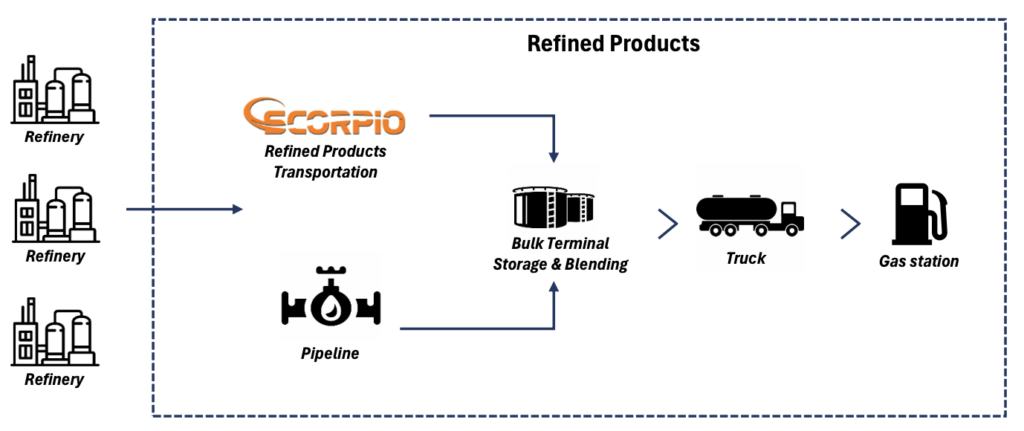
Oil Product Production: From Extraction to Distribution (Source: Breakwave Advisors)
Product Tanker
Product Tankers transport refined products such as petrol, diesel or kerosene from refineries to regions of consumption. Demand is closely linked to industrial production and consumer behavior.
- Ardmore Shipping (ticker: ASC, ISIN: MHY0207T1008) operates a fleet of smaller MR-type tankers, which are primarily used for the transportation of oil products on shorter routes. The ships have an average age of 9.8 years, which is quite young. ASC relies heavily on innovative technologies to reduce emissions in order to lower operating costs.
- Scorpio Tankers (Ticker: STNG, ISIN: MHY7542C1306) is the largest company in this segment with over 100 LR2, MR and Handymax vessels. The fleet is young and among the most modern and low-emission, which is particularly advantageous in times of stricter environmental regulations and makes the company very attractive to potential buyers.
What is a Product Tanker? (Source: Scorpio Tankers October 2024 Company Presentation)
Dry bulk
Dry bulk carriers primarily transport raw materials such as coal, iron ore, grain and bauxite. This market is heavily dependent on global industrial production and the demand for raw materials from large economies, particularly China.
- Star Bulk Carriers (Ticker: SBLK, ISIN: MHY8162K2046) is one of the larger stocks in the sub-sector, operating a total of 161 bulk carriers. The fleet also includes some very large vessels such as Newcastlemax (17x) and Capesize (18x). A merger with competitor Eagle Bulk was only completed in April of this year. It is interesting to note that SBLK is one of the largest positions at Howard Marks Oaktree.
- Himalaya Shipping (Ticker: HSHP, ISIN: BMG4660A1036) is a young company that has only been in existence since 2021 and is listed on the Oslo and New York stock exchanges. It operates a fleet of 12 dry bulk vessels, all of the Newcastlemax type. In the sector, Himalaya Shipping is more of a small newcomer compared to the top dogs Golden Ocean or Star Bulk.
Options trading
I myself also act actively Optionsbut almost exclusively as a so-called "writer". I am therefore naturally also interested in shipping shares that are suitable for additional Cash flow or for a favorable entry by means of delivery. The Volatility (VIX) is currently at a slightly higher level again, so the premiums are definitely interesting.
Reminder: the quarterly figures of many companies are due soon. This should be taken into account.
- Frontline: For FRO there are Short Puts with a Strike of $20 or $21 in November or a little longer running with $20 in January '25 an.
- Scorpio Tankers: For STNG there are Short Puts with a Strike of $62.5 in November or somewhat more conservative and longer running with $55 in January '25 an.
- Star Bulk Carrier : For SBLK there are Short Puts with a Strike from $19 in November or and longer continuously with $18 in January '25 an.