


Trading options presents exciting opportunities for individuals with large accounts, but it also comes with specific challenges. We will explain how to best utilize options trading and what to consider regarding taxes, risk management, and capital management.
The most important in a nutshell
- Options trading for large accounts was historically limited by loss offset restrictions but is now very lucrative again.
- With substantial wealth, the requirements change. Income strategies are particularly attractive here, while risky forms lose their appeal.
- Examples of such income strategies include the Iron Condor and the Wheel strategy, which we will explain here.
- A trading GmbH can offer attractive tax advantages, especially with large accounts.
Options Trading for Large Accounts: The Importance of Available Capital
Trading options is a particularly lucrative way to use your own capital: the contracts offer countless possibilities and can generate attractive returns in all market conditions. However, traders must consider various key figures and influencing factors:
- Find the correct base value: Options are contracts between two trading partners. But what is actually traded? The underlying asset (the good to be traded) is a central point in options trading, as the choice influences all other factors. For example, you can trade contracts on stocks, bonds, or exchange rates., Commodity options use, Options trading with ETFs operate and much more.
- Don't forget to secure it: As with all financial transactions, there is risk with options. Some contracts can theoretically generate unlimited losses and must therefore be hedged correctly. This is done, for example, by using the Delta hedging or consolidates multiple contracts into extended strategies.
- Understanding Options Greeks The Option Greeks are a group of key figures that describe various influences on an option contract. The best known is Delta (Δ): it describes how much a change in the underlying asset affects the option price.
- Keep an eye on the yield curve: Also the Term structure curve is an important factor for successful options trading. Traders should be able to understand and interpret them to increase their chances of success.
- Choose the appropriate options form: Traders have a variety of contracts available to them. European or American style of exercise? Compensation or physical delivery? Expiration of 90, 30, 10... days, or would you prefer 0DTE?
- Make a prognosis Every options trade is ultimately based on a prediction. Traders use a variety of metrics and tools, such as Volatility indices, to predict market developments, open and, if necessary, close or “roll” appropriate trades.
Traders are thus very busy finding and managing profitable positions. They regularly forget that The size of the account also plays a key role in options trading plays! Available capital influences trading strategies, risks, and Money Management, even before a trade is opened at all!
It is of course particularly pleasant to have a considerable fortune at your disposal, as all strategies are open to the owner. However, it also comes with additional challenges. These are almost all psychological/personal in nature!
Less return necessary: Those who engage in options trading with small accounts usually try to greatly increase their capital through high profits (and greater risks). On the other hand, those who are already equipped with a large account often feel the urge for high returns less intensely.
Interest in cash flow: Once a large account has been built and personal milestones have been achieved, traders will want to profit from their success sooner or later. Cash flow strategies that generate income without reducing trading capital are particularly attractive here.
Less risk desired: When trading options with large accounts, losses are significantly more costly. A risk of 1 % of the capital may be manageable for small accounts, but for large accounts, it amounts to several thousand euros!
Security is becoming more important: Anyone who has already built up a large account definitely doesn't want to lose it again! Hedging, risk management, and diversification now play a much larger role.
Planning for the future: A large account can form the basis for one's retirement, the purchase of a property, or other far-reaching life decisions. Traders therefore inevitably think about the further use of assets – a process that is not yet a factor with small accounts.
Tax questions: With options trading for large accounts, there are significant profits and a corresponding tax burden. Tax questions are therefore increasingly coming into focus. Furthermore, a VvGmbH Trading GmbH becomes increasingly attractive with growing assets.
Additional Resources: Those who have a large account can easily invest in coaching and seminars, professional software, signal services, or even professional asset management.
CapTrader can do that:
Mit den Managed Accounts hat CapTrader created a special form of asset management that offers significant advantages to traders with large accounts. Professional portfolio managers manage your investment in your best interest, while you maintain full transparency and control at all times.
Differences between large and small/medium accounts
Before we analyze strategic and practical particularities of options trading with large accounts, we first need to clarify the question: What even is a “big account”? Here there are no generally valid definition; However, the following guidelines have become established:
| Small account | Middle Account | Large account |
| €10,000 to approx. €45,000 | €45,000 to approx. €90,000 | 90,000 € and more |
- For amounts of Effective options trading is unfortunately hardly possible for under €10,000., so that one typically assumes this minimum amount.
- The limits roughly correspond to the median annual salary in Germany (approx. €45,000) or multiples thereof.
- In countries with higher or lower average incomes, the thresholds can vary accordingly. For example, for a Wertschriftendepot in Switzerland significantly higher amounts.
It’s no coincidence that annual salary serves as an important benchmark: Anyone who has several times the median income available for options trading is in a very privileged position. When you consider that successful traders can easily achieve returns of between 10 and 20 % per year, it quickly becomes clear that, how attractive trading with large accounts is:
Example calculation
Available capital: €360,000 (eight times median income)
Average return from options trading: 12.5 % per annum.
Profit per year: €45,000 gross
So, an account with eight times the median income is sufficient for a seasoned trader to achieve the German median income solely through options trading. At this point, at the latest, a trader could easily pursue trading as a full-time occupation and earn an attractive income.
Practical Considerations for Trading Options with Large Accounts
A large fortune leads to changed perspectives and priorities for traders. However, there are also completely practical aspects that change due to available capital.
- Contract size. Options are standardized derivatives whose content is always fixed. For example, an option on US stocks always comprises exactly 100 securities. Therefore, the amount to be traded cannot be set continuously, as is the case with Day trading with shares is possible. Those with a large fortune actively Trade options will, therefore, has three options:
- Using multiple identical contracts. Instead of just one option, you can open two, three, five, or more positions. Naturally, this increases your earnings in case of success (in absolute euro/dollar amounts); however, the potential loss also multiplies. Since the potential damage also accumulates, this method is only of limited use: Few traders have the iron nerves to accept potential losses of several thousand euros – even if they have a very large account.
- Use multiple different contracts. With sufficient capital, it is possible to engage in “more options trading” and open many different positions (various strategies, on different underlying assets...). This way, you could leverage your capital and margin (the ability to Debt capital trading) to utilize ideally and generate maximum returns. Of course, “trading more options” is easier said than done in practice: traders quickly find themselves in the unfavorable situation of no longer finding suitable trades. Furthermore, the time and effort required increases if you want to open and manage too many positions. Options trading then quickly becomes a full-time job, which doesn't appeal to every trader!
- Use as few contracts as possible. Of course, you don't have to use your entire capital with maximum efficiency for options trading. Even with a large account, you can open individual positions that then only represent a small percentage of your assets. For the rest of your assets, there are more than enough other investments available, such as short-term bonds, dividendenstarke Aktien or classic Value Aktien. With CapTrader Managed Accounts There is also the possibility to outsource part of your capital to lucrative asset management, thereby ensuring an attractive overall return.
- Trading in expensive underlying assets: There is an incredible variety of possible underlying assets for options trading, which come with vastly different prices. Individuals with large accounts are able to trade all underlying assets without difficulty, while traders with smaller fortunes often experience limitations.
Example calculation small account:
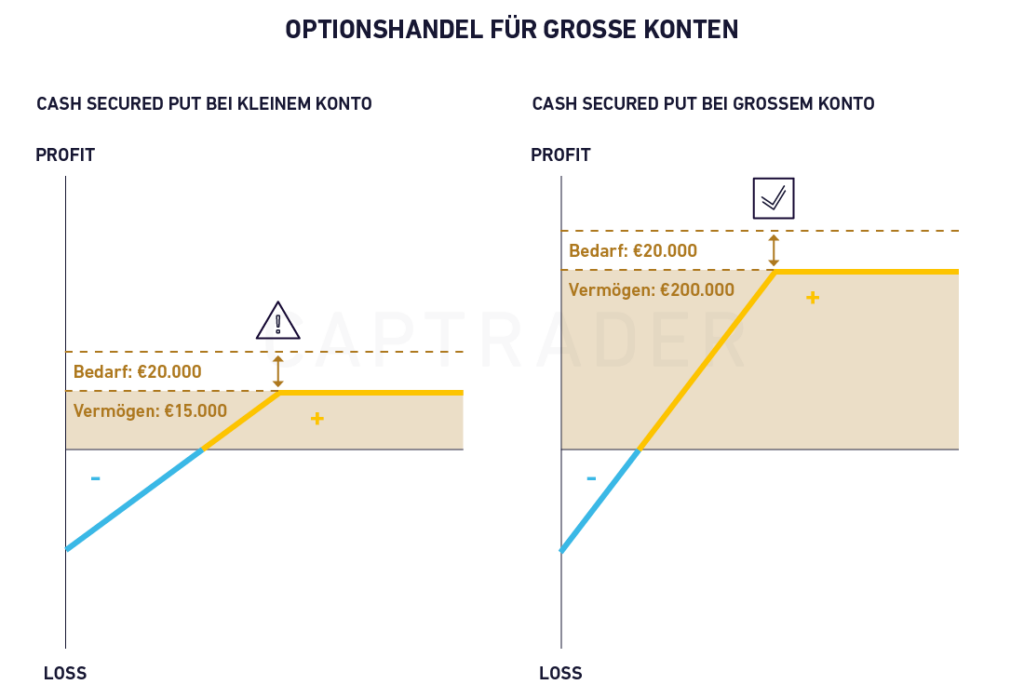
The Apple stock is currently at €220. A trader with a small account of €15,000 wants to Wheel strategy apply to the security to generate additional income. He therefore plans to open a cash-secured put on Apple stock as the underlying asset with a strike of €200.
Option price: 100 shares x €200 = €20,000
The cost of the option for €20,000 exceeds the dealer's available €15,000. This is because if prices fall, the put option will be exercised, and the stocks will have to be bought for €20,000 or the contract will be closed at a loss.
While margin trading would make it possible to open this position despite insufficient capital, it's hardly advisable to bet everything on one card, and the trader will not execute this trade.
Example calculation large account:
Let's start with the same assumptions (cash-secured put on Apple stock, option price: €20,000), but with a large account of several hundred thousand euros, a different picture immediately emerges. A trader with a large account can enter the position without problems and doesn't even need margin from their broker.
Upon receiving the exercise option, 100 Apple shares are booked into his account at a total price of €20,000. He can now proceed with the second part of the wheel strategy, the covered call. Due to the size of the portfolio, good diversification is maintained.
Loss offsetting and tax issues
In the years From 2020 to 2024, loss offsetting for private individuals in Germany was capped at €20,000. In practice, this meant that various option strategies (such as the Iron Condor) and options trading with large accounts became rather unattractive for private individuals: gains and losses from forward transactions could only be offset to a very limited extent, resulting in a high tax burden comb.
Therefore, the method of choice for active options traders with medium or large accounts was Trading-LLC, also asset-managing GmbH or VvGmbH named. Beside many tax benefits (for example in stock trading) there was also a full offset of losses possible.
Private traders, however, were able to Turn of the year 2025 breathing a sigh of relief: Thanks to a law change, the Loss offsetting is possible without limitation again. Therefore, a trading GmbH is no longer strictly necessary for effective options trading with large accounts; however, it can still be very worthwhile!
A Trading-GmbH offers numerous advantages:
- There are enormous tax relief, since capital gains and investment income are taxed only minimally, assets within such a company can multiply rapidly and the compound interest effect comes into full play.
- Your own Assets can be consolidate them at a central location. This not only enables protection against external access, but also facilitates transfer as part of an inheritance.
- You can Immobilien und andere Gegenstände abschreiben, Deduct management costs and even a managing director's salary. Only the remaining total profit is subject to tax – not all capital gains, as is the case for private individuals.
However, there are also disadvantages to consider:
- Steuervorteile greifen nur, solange das Vermögen innerhalb der Gesellschaft verbleibt. Upon payout, capital gains tax or the personal income tax rate generally applies. Therefore, this corporate form is usually only worthwhile if the money remains in the GmbH for the long term.
- Das eingebrachte Capital is no longer readily available to you. Die Entnahme geht mit einer erhöhten Steuerlast einher. Von verdeckten Entnahmen und ähnlichen Vorgängen ist dringend abzuraten, da die Behörden schnell Verdacht hegen könnten.
- Es fallen erhebliche Kosten, for example for annual financial statements, Chamber of Commerce contributions, etc. The fees for a tax advisor should also not be underestimated and quickly add up, especially with a large number of trades. The personal effort involved (time and energy for administration) can also be enormous. In addition, as a company, you often have to pay higher fees for services such as bank accounts or brokerage accounts. Founding a VvGmbH is therefore particularly worthwhile for individuals with large accounts where the tax savings exceed the expenses.
CapTrader can do that:
We offer our business clients the same trading terms as we do to retail clients. With extremely low trading fees—such as $ 0.01 per share for U.S. stocks (minimum order: $ 2.00), options starting at 2.00 €, or futures starting at 1.00 €, you can achieve even better returns with your VvGmbH!
Are you interested in founding a VvGmbH? Then you should consult a tax advisor or lawyer specializing in this topic.
From practice: Option strategies for large accounts
Options trading with large accounts pursues different goals than trading with small or medium-sized portfolios. “Returns at any cost” takes a backseat; instead, a reliable cash flow and the protection of accumulated wealth growing in importance.
Therefore, ideal for options trading with large accounts are Income strategies. In the following, we would like to present two popular variants.
If you are not yet familiar with the basics such as put, call, long, short, or how options work, we recommend reading our article “Trade options".
Iron Condor
The Iron Condor is a strategy consisting of four options:
- A long put that is further out of the money
- A short put that is closer to the money
- A long call that is further out of the money
- A short call that is closer to the money
With the Iron Condor You speculate on a constant price of the underlying asset. The maximum profit is on the Premiums for the two sold options, minus broker fees and option costs, is limited.
However, should the price of the underlying asset rise above the long call or fall below the short call, your iron Condor fails. The maximum loss in this case corresponds to the price difference between the Long Call and the Short Call or the long put and short put – depending on which direction the price of the underlying asset moves.
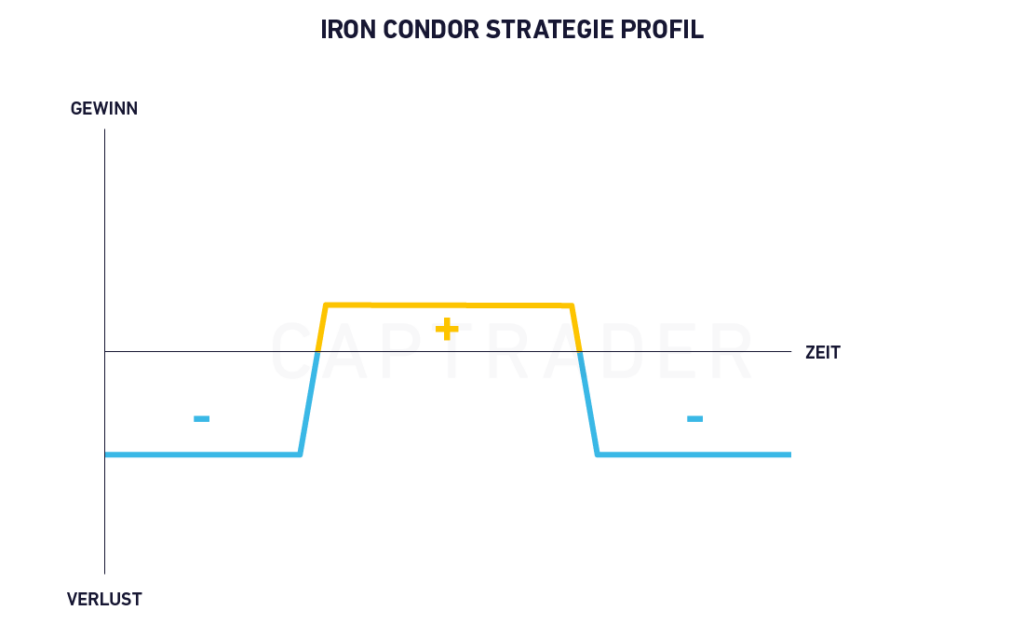
Traders with large accounts appreciate the Iron Condor as attractive income strategy with limited risk. The two further out-of-the-money put and call options protect you against major losses. With an underlying asset whose price remains largely constant during the term, a continuous cash flow can thus be generated.
Good to know:
By shifting the inner (closer to the money) short put and short call, it is possible to adjust the iron condor for falling and rising prices. This allows you to profit from Bull and bear benefit. The profit and risk profile of the strategy remains unchanged.
Due to the four components of this option strategy, it can lead to high transaction costs come that attack your return. When using the Iron Condor, therefore, a affordable broker particularly recommended.
Here’s what CapTrader can do: With options trading starting at €2.00 per trade for contracts in Europe and $3.50 for contracts in the U.S., CapTrader offers you exceptionally affordable options trading. We are the ideal partner for generating a steady cash flow and have extensive experience managing large accounts.


2. Wheel Strategy
The Wheel strategy is composed of two components combined, which on their own are already among the most popular options strategies of all: the Cash-Secured Put and the Covered Call. These two forms are applied in constant repetition to generate attractive additional income with manageable risk.
The process is as follows:
1. Invest in a Cash-Secured Put
First, select a high-quality stock from which you assume good long-term prospects. Also the Optionshandel mit ETF This is possible here: Exchange-traded funds can also serve as good underlying assets for a cash-secured put.
Subsequently Sell a put option on the stock for a price that is below the current market price. You must maintain the necessary capital, to purchase 100 securities at the agreed-upon strike price. Therefore, this strategy is particularly well-suited for options trading with large accounts.
There are Two Possible Outcomes of the Put Option
- The price of the stock remained above the strike price of the option. The other party will not exercise the option and will not sell the shares to you, since a better price is available on the stock exchange. The contract expires worthless, and you may record the premium as profit after deducting brokerage fees. You can now repeat the process with this (or another) stock to generate additional income.
- The stock price has fallen below the option's strike price. The other party will now exercise the option and sell the securities to you at the higher price. The money will be debited from your account, and the shares will be transferred to your brokerage account. Since this is an attractive company and you had the necessary capital available, you will not suffer any real loss.
Both outcomes are positive at first, since you have either made a profit or acquired an attractive stock. However, dangers lurk on two fronts:
- Your Fundamental analysis was inadequate or due to unforeseeable events reduce the company's stock price during the option's term. You will then be purchasing a worthless or low-value stock at a very high price. In this case, it may make sense to close out the contract early at a loss.
- Stock prices keep rising. Although you can generate a steady profit through cash-secured puts, you will never receive the desired shares. As a result, you will miss out on the potential return from a rise in the stock price.
The "Cash-Secured Put" is repeated over and over again and generates a bonus every time, which you can count as a profit. Sooner or later, however, there will be a Exercise and the shares will be transferred to your brokerage account. In this case, you can proceed with the second part of the wheel strategy:
2. Covered Call
One of the cash-secured puts was exercised and the Shares have been credited to your portfolio. You are now in the ideal position to to execute a covered call and to profit once again!
To do this, proceed as follows:
- Create a short call for the acquired shares
- The strike should be chosen so that the share price remains below it at the end of the term.
Here too, there is again two possible results:
- The stock price remains the same or falls and is lower than the option's strike price at the end of the term. The contract expires worthless since it would not make sense for the counterparty to exercise it (on the exchange, the counterparty could purchase the shares significantly cheaper). You can book the premium minus the broker fees as profit.
- The stock price is rising and is higher than the strike price at the end of the term. The counterparty will demand exercise and buy the securities from you at a lower price. In return, you receive the cash amount and may also keep the premium minus broker fees.
The Covered call is also repeated., until sooner or later it is exercised. Your shares have now been sold, but you have received the agreed purchase amount. You can now go back to step 1 and create a new Cash Secured Put. This process repeats over and over, which Wheel strategy gives its name.
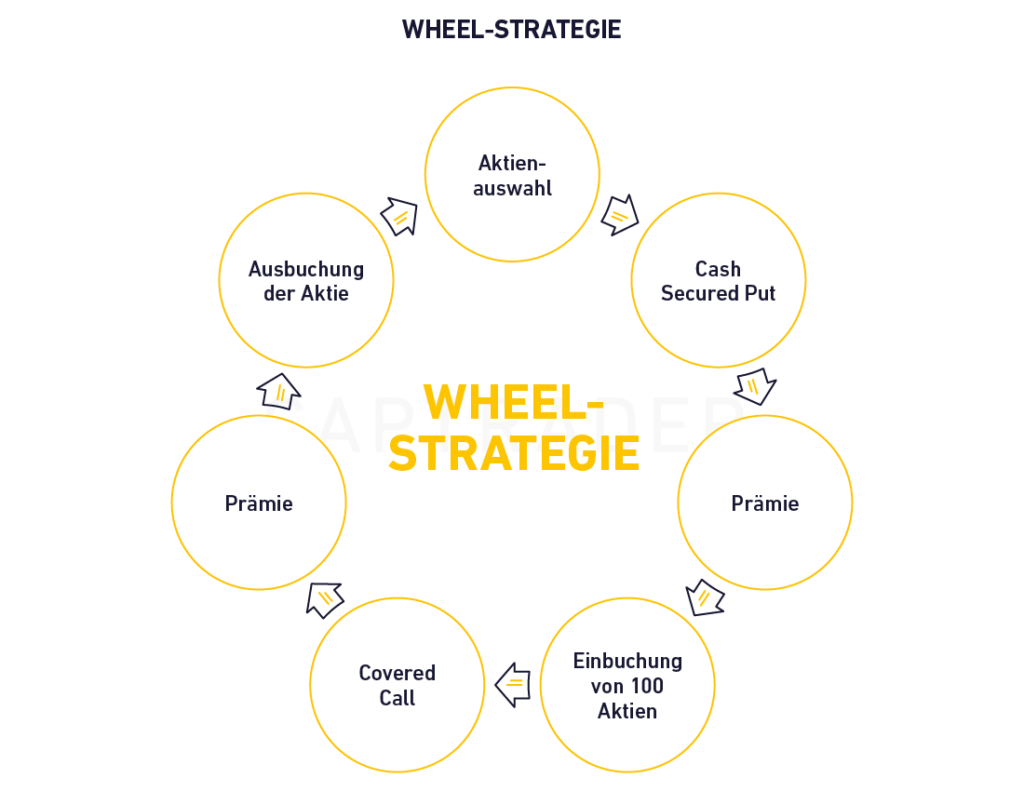
The Wheel strategy can of course also be applied to small and medium-sized portfolios. When it comes to options trading however, it is particularly well-suited for large accounts. Because the cash-secured put is easier to execute (even possible without problems for expensive stocks) and represents a lower risk, as it makes up only a small part of the total assets.
Conclusion: Different goals and strategies in options trading with large accounts
Most traders have to make do with limited funds and dream of a large fortune with which all strategies can be implemented at will. But experienced traders with large accounts know: The additional capital also brings new challenges!
First of all does the objective change for most people. Options trading with large accounts is generally designed more for capital preservation. Income strategies offer the opportunity to, regular cash flow to generate without endangering the assets.
For example, this is a great place for Iron Condor and the Wheel Strategy Both approaches combine continuous income with a manageable risk to your capital.
Achieving maximum returns through risky trades, on the other hand, takes a back seat. For example, if a loss of two percent of the total assets occurs, this sounds manageable at first. With large accounts, however, these two percent can quickly equal the equivalent of a monthly salary! Amounts that only a few traders are already willing to risk.
If you Start options trading with large accounts would like to, we recommend you first a look at our article “Hedging strategies for volatile markets" to throw.
