Welcome back to another article about REITs! Earnings season is not quite over yet, but many of the larger REITs have already presented their figures to investors, which is why we want to look at the results of the third quarter in today's article REIT Q3 Sector Overview - Between interest rate turnaround and supply pressure. In September, the US Federal Reserve cut the key interest rate by 25 basis points for the first time in nine months and narrowed the target corridor to 4 to 4.25 %, followed directly by the next cut of 25 basis points (3.75 to 4 %) in October. For Real Estate Investment Trusts (REIT), which are particularly sensitive to interest rates due to long-term rental agreements, higher debt financing ratios and distribution obligations, the turnaround in interest rates marks a turning point. Falling financing costs open up new scope for refinancing and acquisitions, even if the pace of further interest rate cuts is slowed.
At the same time, Q3 2025 illustrates how differently the individual real estate segments are developing. Net lease REITs with long-term triple net leases are benefiting from stable cap rates and falling capital costs. In the healthcare and life sciences sector, the strong wave of construction between 2020 and 2022 is creating an oversupply, while regulatory uncertainties and high interest rates are curbing demand. The self-storage sector is returning to normal after the pandemic-related boom in demand and the leading providers are increasingly focusing on digital distribution channels and cost efficiency in order to maintain their margins.
As usual, the following article summarizes the most important developments in the sectors mentioned and highlights 1-2 representative REITs in each case.
Net Lease REITs
Net lease REITs are characterized by long-term triple-net leases in which the tenants bear most of the ancillary costs and thus generate stable cash flows. This structure allows the companies to precisely coordinate the interest expenses and terms of their financing. In Q3 2025, borrowing costs fell as a result of the Fed's interest rate decision, while cap rates settled at around 7 %. This leads to higher investment spreads, i.e. a greater difference between purchase yield and financing costs, which makes refinancing easier. As the market for detached retail and logistics properties has been well received, there is no apparent oversupply - unlike in other segments.
Realty Income
Realty Income (TWS ticker: O, ISIN: US7561091049) is the established industry leader in the net lease sector, whose business benefited in the third quarter. The REIT increased net income attributable to shareholders to USD 315.8 million and achieved adjusted funds from operations (AFFO) of USD 1.08 per share. The company invested a whopping USD 1.4 billion in new properties, which generate an average initial cash yield of USD 7.7 %. Rental management also proved to be efficient, as the company was able to realize 103.5 % of the previous rent on new leases and lease renewals.
FFO = Net income + amortization + depreciation - capital gains from property sales - interest income
Real estate is depreciated over many years. This depreciation reduces net income, which is actually nonsensical. This is why there are funds from operations (FFO), which add back the depreciation and make further adjustments.
AFFO = FFO + rent increases - capital expenditure - maintenance costs
FFO is a standardized key figure, but it is not perfect, as investment expenditure (e.g. for the purchase of a property) is not taken into account. The adjusted funds from operations (AFFO) take this into account.
The leverage ratio is comparatively moderate at 5.4 × net debt / EBITDA. Realty Income took advantage of the favorable market conditions to place longer-term bonds and secure its financing on favorable terms until 2033.
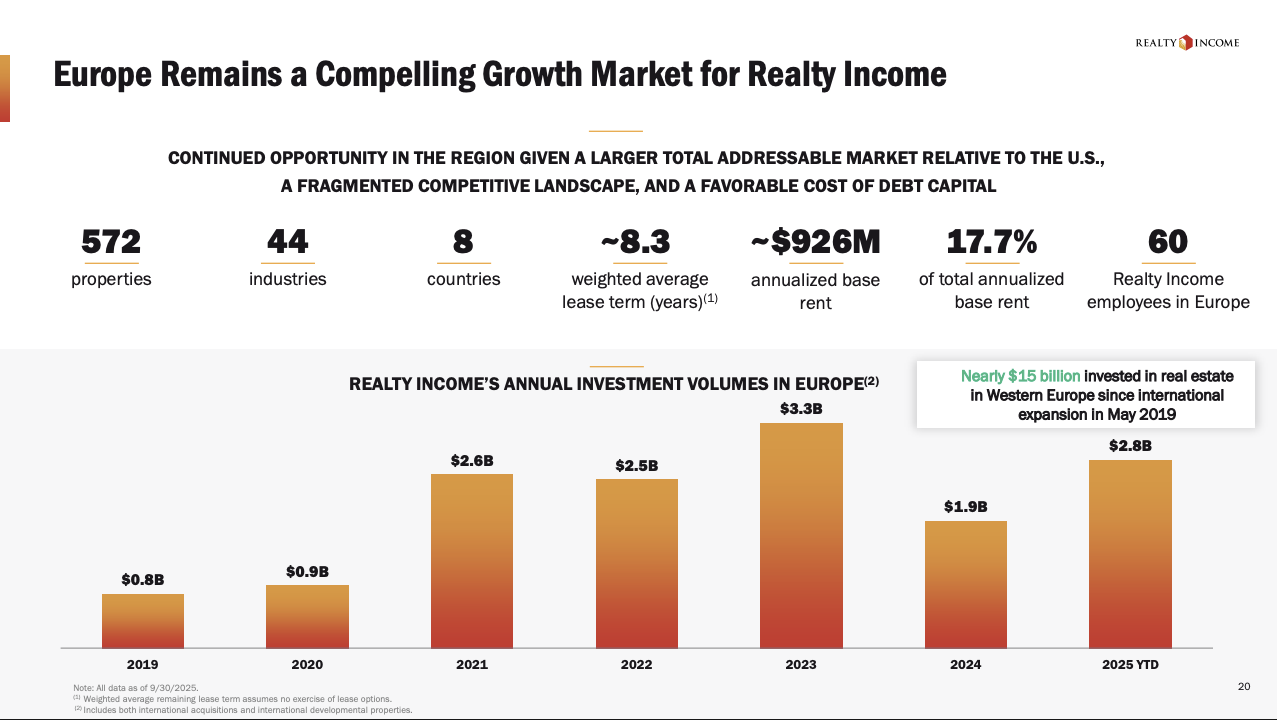
Realty Income Europe as a growth market (Source: $O Quarterly Investor Presentation)
For the year as a whole, the management is expecting an AFFO of between USD 4.25 and USD 4.27 per share and is planning further investments of around USD 5.5 billion. Interestingly, the majority of acquisitions are being made in Europe, where the company is now making around 2/3 of its current purchases. The average contract term of over nine years ensures a high degree of predictability. The monthly dividend reflects this stability and, at the current share price, corresponds to an annual Dividend yield of around 5.8 % with a conservative payout ratio of around 75 %.
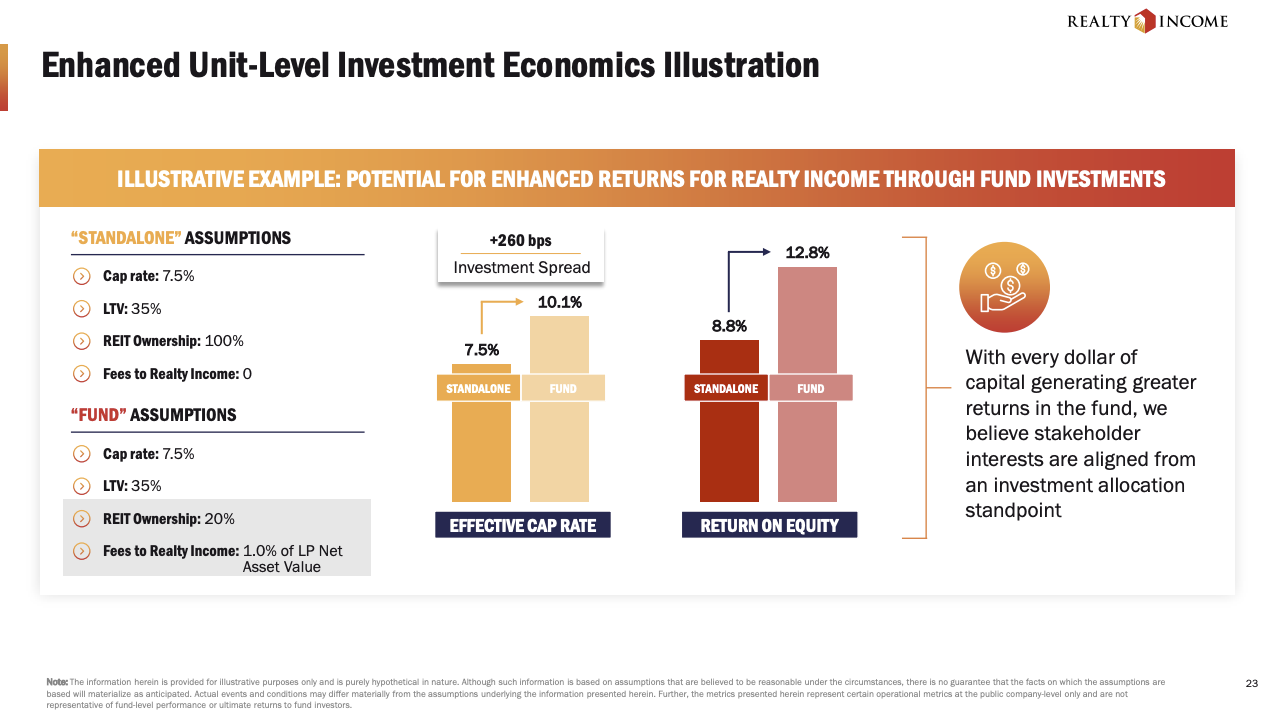
Private Capital (Source: $O Quarterly Investor Presentation)
Good to know: In the Q3 quarterly presentation, management introduced a new line of business, namely the utilization of private capital. Realty Income has launched an open-ended perpetual life private
Capital fund, which is aimed at institutional investors such as pension funds, foundations and insurance companies. This vehicle is intended to complement the existing business model without significantly burdening the balance sheet and to tap additional sources of capital in the form of fees. CEO Sumit Roy emphasized in the earnings call that the REIT intends to use the fund to gain access to deeper pools of capital and to continue investing even in phases of lower spreads. The allocation of the investment volume between the balance sheet and the fund is to be disclosed transparently in future supplements.
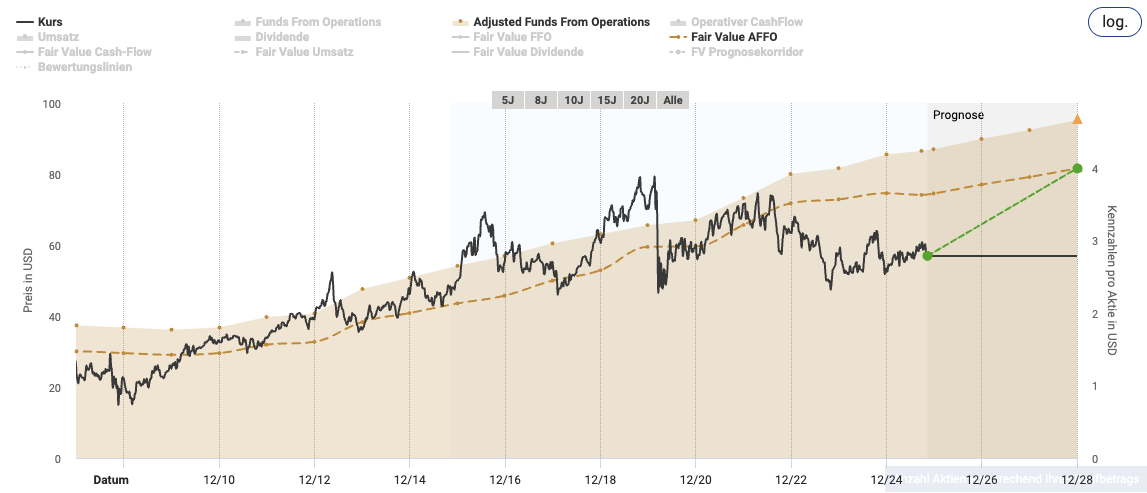
Fair value of Realty Income (source: aktienfinder.net)
Realty Income is still undervalued by historical standards, as the current P/AFFO is just over 13x, while the average over the last 10 years was >17x.
NetSTREIT
The smaller peer NetSTREIT (TWS ticker: NTST, ISIN: US64119V3033) reported an AFFO of USD 0.33 per share for the third quarter, which corresponds to an increase of around USD 3% compared to the previous year. Funds from operations amounted to USD 0.29 per share. The strong external growth was striking: 50 properties with an investment volume of USD 203.9 million were acquired; the initial cash yield amounted to USD 7.4 %. At the same time, NetSTREIT placed a forward equity program of USD 219.8 million and took out a term loan of USD 450 million with terms of five and a half and seven years.
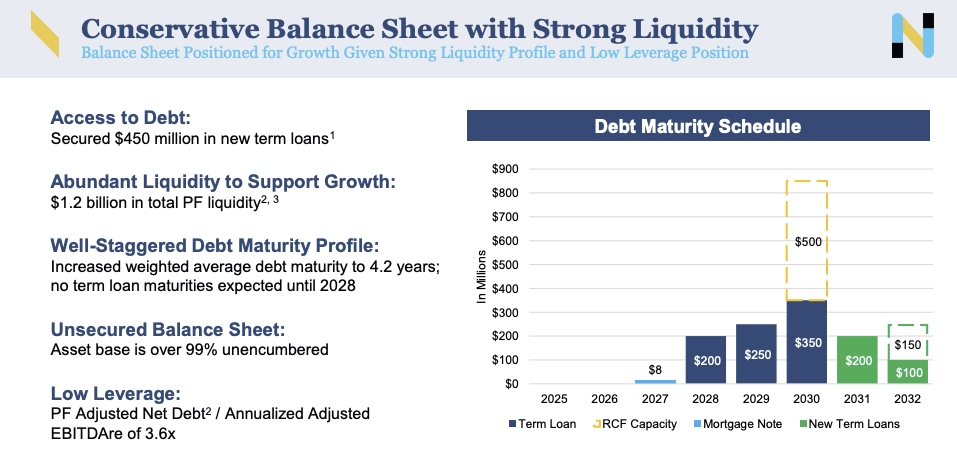
Debt and maturities (source: NetSTREIT Investor Presentation October 2025)
The company's balance sheet is healthy: the occupancy rate is almost 100 % (i.e. no vacancies), the average remaining lease term is 9.9 years and around 62 % of the tenants have an investment grade rating. The liquidity cushion amounts to more than USD 1.1 billion and the ratio of net debt to EBITDA is pro forma 3.6 ×, which is very low compared to many peers.
NetSTREIT is more concentrated than Realty Income and focuses on freestanding retail properties with daily needs such as supermarkets, car repair shops, gas stations and fast food restaurants. In view of the falling cost of capital, management increased the investment plan for 2025 to USD 350 to 400 million and confirmed the AFFO target range of USD 1.29 to 1.31 per share. The aim remains to further diversify the tenant base, grow opportunistically and achieve an investment grade rating in the medium term. The current dividend yield is around 4.7 %.
Healthcare REITs
The life science industry experienced a construction boom in 2020-2022, which led to a significant oversupply of laboratory space. At the same time, high interest rates, weak IPOs by biotech companies and uncertain regulatory policies by the US administration are curbing demand. The increasingly visible consequences: declining occupancy rates, higher incentives for possible lease extensions and generally stagnating rents. In the long term, the sector remains structurally attractive, as the population is ageing (keyword: silver tsunami), biotech innovations (e.g. mRNA therapies) and AI-supported research can ensure rising demand. In the short to medium term, however, cost control, project postponements and capital recycling will dominate.
Alexandria Real Estate Equities
The best-known representative of the sector, which unfortunately is often assigned to the office sector, is Alexandria Real Estate Equities (TWS ticker: ARE, ISIN: US0152711091), which was driven into the ground after the Q3 earnings. Rightly so? In large parts, yes!
The California-based REIT, which is one of the largest landlords of life science real estate, suffered a significant decline in the third quarter for the first time in years. (Adjusted) funds from operations per share fell to USD 2.22, compared with USD 2.37 in the previous year. Depreciation and amortization led to a balance sheet loss of USD 1.38 per share. The occupancy rate of the properties operated fell to 90.6 %, with the so-called megacampus locations, i.e. campus-like clusters of several buildings in Boston and elsewhere, continuing to generate around 77 % of rental income.

Summary of debt
(Source: ARE - Third Quarter 2025 Earnings Press Release and Supplemental Information)
Debt increased significantly over the course of the year to Net debt / EBITDA 6.1 × and, according to management, should fall back into the range of 5.5 to 6.0 × by the end of 2025. At the same time, the company has high liquidity of USD 4.2 billion and has an average remaining debt maturity of 11.6 years, the longest in the entire REIT universe of companies listed in the S&P 500. The rental agreements contain 97 % automatic rent adjustments, which at least stabilizes the cash flows somewhat.
The strategic focus is currently on reducing the project pipeline. The plan for 2025 and 2026 is to sell properties, sub-portfolios and land that are not required for operations. While the megacampus strategy remains at the core of activities and the proportion of investment-grade tenants is 53 %, many planned projects will be postponed for the time being because the market is oversaturated with laboratory space. In the earnings call, the management also pointed out that the dividend of currently $5.28 per share (around 9.8 % dividend yield) could be adjusted to the prevailing market conditions. This cautious wording leaves room for cuts. Personally, I assume a reduction of 40-50 % in Q1 2026. In addition, it may be necessary to sell further assets, even if this means a significant dilution. ARE therefore has a high risk that the aforementioned points could have a further negative impact on the share price performance.
Self-storage REITs
The self-storage industry boomed during the pandemic due to home offices, relocations and the purchase of various consumer goods, which led to high demand. Since 2023, both occupancy rates and rental growth have normalized. At the same time, completions are falling noticeably. The large listed providers are focusing primarily on increasing efficiency, expansion and digitalization in order to maintain margins despite flattening rents. In addition, government interventions such as rent controls (e.g. in Los Angeles) are limiting growth, but will be lifted in 2026.
Public Storage
The market leader in the self storage sector, Public Storage (TWS ticker: PSA, ISIN: US74460D1090), was able to deliver a solid result in Q3. Core FFO amounted to USD 4.31 per share, which corresponds to growth of around 2.5 %. Same-store NOI margin was a remarkable 78.5 %, and net income reached $2.62 per share. While revenues in the existing portfolio increased only slightly, newly added assets and expansions contributed over USD 20 million in additional revenue.
NOI = Net Operating Income, i.e. real estate income less operating costs (taxes, maintenance costs, insurance, etc.). NOI ultimately shows how profitable a property is in day-to-day operations.
Public Storage is continuing its expansion course: In the quarter under review, the company acquired 49 units with 3.4 million square feet of space and completed expansion projects of over 300,000 square feet. A total of 3.9 million square feet are under construction or expansion. Debt remains moderate at a ratio of around 4.2 × net debt / EBITDA, giving the company sufficient financial leeway.
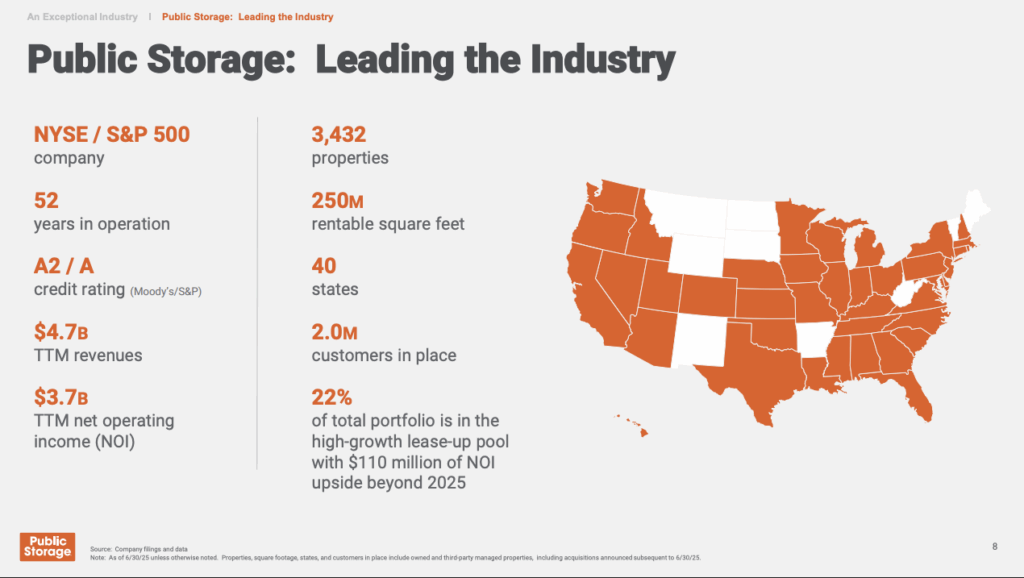
Locations (Source: Public Storage - Company Update September 2025)
Despite a slight decline in the occupancy rate, Public Storage is working consistently on efficiency. Thanks to the increased use of digital sales channels and the use of artificial intelligence, which now enables more than 85 % of customer interactions, the working hours required per unit have been reduced by over 30 %. However, there are regional differences. West Coast markets such as California are once again showing double-digit sales growth rates, while in Los Angeles temporary rent restrictions are slowing growth. These restrictions are due to expire at the beginning of 2026.
Due to the pleasing development, the management has once again raised its forecast for the year and is forecasting higher growth rates for same-store NOI, non-ame-store NOI and core FFO. Demand remains robust even in a weakened economy and the company has sufficient capital for further acquisitions. At the current share price, the dividend yield corresponds to around 4.3 %, with the payout ratio remaining conservative at only around 70 %.
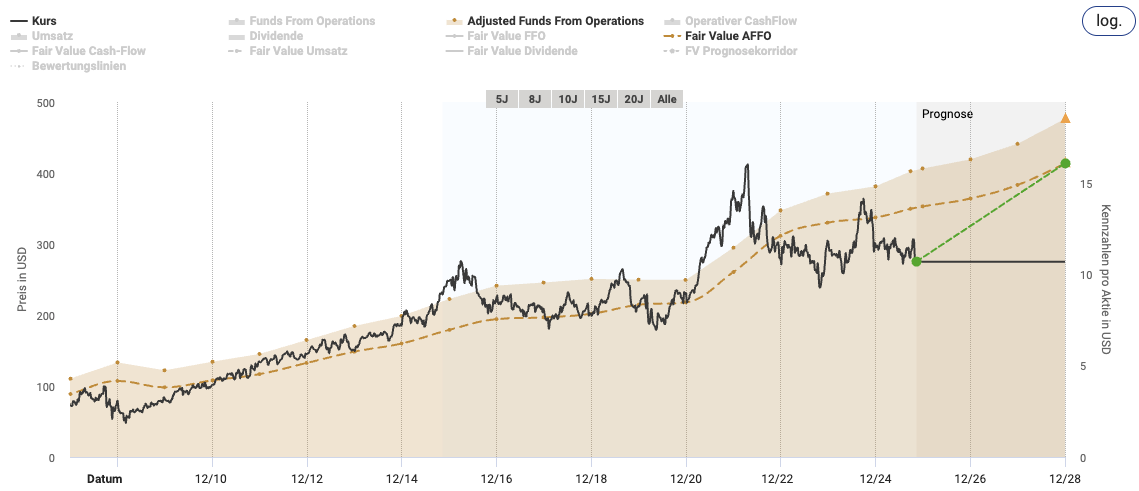
Fair value Public Storage (source: aktienfinder.net)
Public Storage is also undervalued. The current P/AFFO is only slightly below 18 ×, but the average over the last 10 years was >22 ×.
Options trading
I myself also act actively Optionsbut almost exclusively as a so-called "writer". I am therefore naturally also interested in the REITs mentioned above, which are suitable for additional Cash flow or for a favorable entry by means of delivery. The Volatility (VIX) is back at a level below the 20 mark after a spike. Unfortunately, the spreads at NTST are too high.
- Realty Income: For O there are Short Puts with a Strike from $55 in December '25 or longer continuously with Strike from $55 in December '26 that deliver a decent premium.
- Alexandria Real Estate Equities: At ARE, the mark around $50 is interesting, where the low was in 2014 and 2016, so the Short Puts with a Strike of $50 in December '25 worth a look. For 2026, I would wait for the possible dividend cut.
- Public Storage: For PSA a Bull Put Spread mit Strikes of $270 for the short put and $260 for the long put in December '25 an.
Conclusion
Q3 2025 reveals three very different realities. In the Net Lease segment, which is benefiting from the incipient interest rate turnaround and stable real estate prices, Realty Income is delivering consistent results and increasing its dividends, while NetSTREIT is shining with higher growth and a solid balance sheet. In the life science sector, oversupply and political uncertainties are having an impact: Alexandria is reducing its development pipeline, selling assets and considering adjusting its dividend, meaning caution is warranted. Self Storage is in a phase of normalization, but continues to benefit from efficiency programs and acquisitions. Public Storage was also able to increase FFO in the third quarter and raise its forecast.
The interest rate cut by the Fed and the prospect of further steps are creating new opportunities for yield-oriented investors. A diversified mix of defensive net lease stocks and selectively positioned specialty REITs could pay off in the coming quarters. However, investors should pay attention to the sector-specific risks and pay particular attention to short-term phases of weakness, e.g. in the life sciences sector.