Welcome to my first blog article in 2026. Today I'm talking about one of the most defensive large cap Real Estate Investment Trusts (REIT) from the gaming and entertainment segment. VICI Properties combines extremely long triple-net leases with annual inflation adjustments and a now less concentrated tenant base. Income-oriented investors may be interested due to the current situation.
Business model and strategy: What does VICI Properties do?
VICI Properties (TWS ticker: VICI, ISIN: US9256521090) leases iconic gaming and leisure properties on an extremely long-term triple-net basis, where tenants bear nearly all costs and leases include annual rent escalations. The portfolio is 100 % leased and rents were fully collected even in 2020, in the middle of the pandemic when everything was closed, which demonstrates the resilience of the model very well.
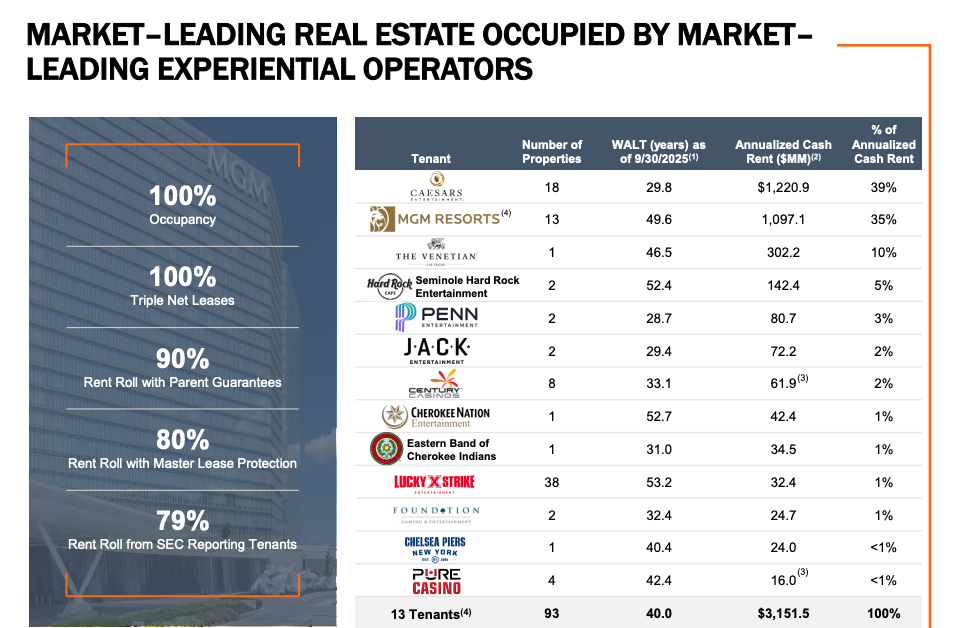
The weighted average remaining term of these rental agreements, including options, is around 40 years, making the cash flow very predictable. An increasing proportion of the rent is also linked to inflation, which protects the real earning power.
Portfolio & Acquisitions
The portfolio includes dozens of gaming assets on the Las Vegas Strip and in regional markets, as well as other leisure properties such as meeting and event space. This makes VICI the largest owner of hotel room properties and privately held MICE (Meetings, Incentives, Conventions & Exhibitions) space in the U.S., providing additional diversification within the leisure ecosystem. The geographic spread covers more than 15 US states plus Canada, which reduces dependence on individual markets.

VICI has continued to acquire assets over the past twelve months and has gradually reduced its dependence on individual tenants and properties. This can be seen in the current IR presentation. The cash flow from rents is now spread across a broader set of operators and property clusters along the „Experiential Real Estate“ spectrum.
Excursus: Las Vegas in focus
The focus on Las Vegas naturally remains visible. Weaker impetus from tourism or a subdued gaming environment regularly hit the headlines and then rub off on operator shares. Classification is important! VICI is a landlord with very long master leases, annual escalations and high rental cover, not an operator. It was precisely this construct that proved its worth in the 2020/21 stress test, when operators suffered massive losses but continued to pay rent under the master leases as planned.
Recently, there has been increasing discussion about the regional Caesars lease structure, which accounts for a noticeable proportion of the rent (39 %) and is seen in parts with tighter cover. This is where the protection of master leases, which bundle many properties and prevent individual locations from breaking away, comes into play. Caesars has recently invested billions in the regional portfolios, which is initially a burden but will support profitability in the medium term. In practice, VICI solves such constellations proactively by only making concessions if valuable assets or contract improvements are received in return. Even in a negative scenario in which individual rents were adjusted, the Distribution As things stand today, this is likely to be sustainable, meaning that a temporary dip in growth rather than a break in the equity story can be assumed.
Balance sheet and relevant Kennzahlen
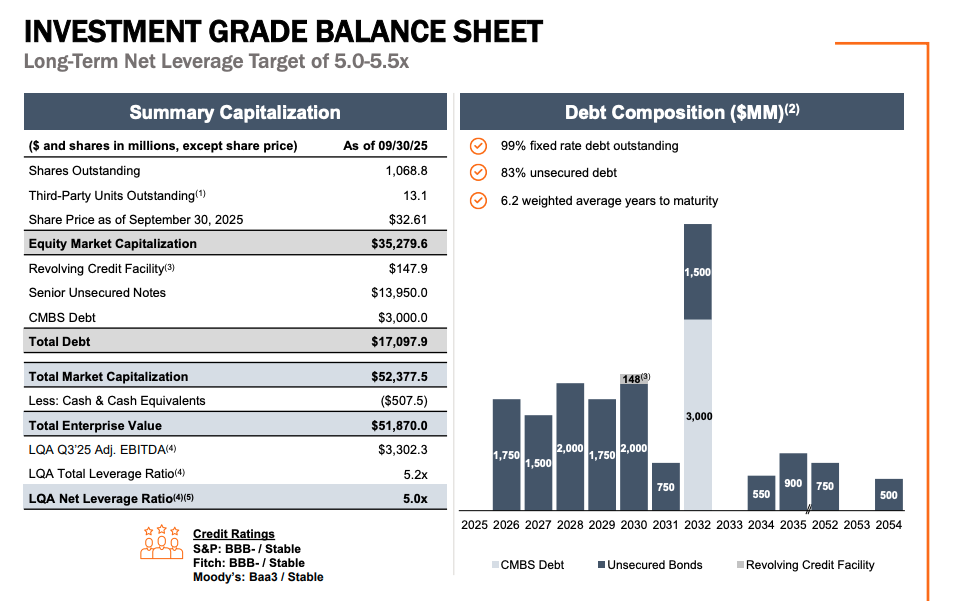
A healthy balance sheet is of course not only important for REITs, but since these logically have a higher Debt-equity ratio than other companies in other sectors. VICI Properties has an investment grade balance sheet:
- Net debt / EBITDA: 5,2x
- Average remaining term: 6.2x
- 99 percent of debt is at fixed interest rates
- Credit ratings: Fitch (BBB- / Stable), S&P (BBB- / Stable), Moody's (Baa3 / Stable)
Debt and maturities
Upcoming maturities are always important as they can have a major impact on the maneuverability of a REIT. At VICI, refinancing of USD 1.5-2 billion is due every year over the next few years. This is certainly not a small amount, but it is manageable and, above all, manageable.
Dividend and the payout ratio
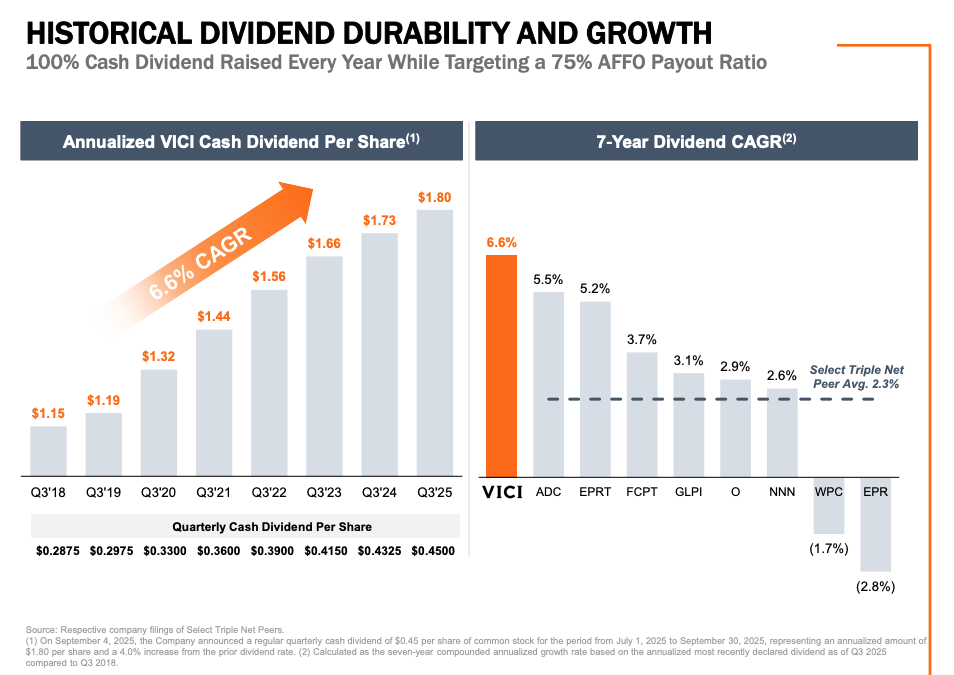
VICI Properties pays a regular quarterly dividend of USD 0.45 per share, i.e. a total of USD 1.80 per year. This corresponds to a Dividend yield of currently 6.34 %. The dividend has been steadily increased since the IPO, averaging 6.6 %. The payout ratio in relation to the Adjusted Funds From Operation is a respectable ~75%, i.e. there is not much in the way of a regular increase in the dividend.
Evaluation and outlook
VICI Properties is currently trading at an AFFO multiple of around 12x. This puts the REIT below the historical multiple of 14x.
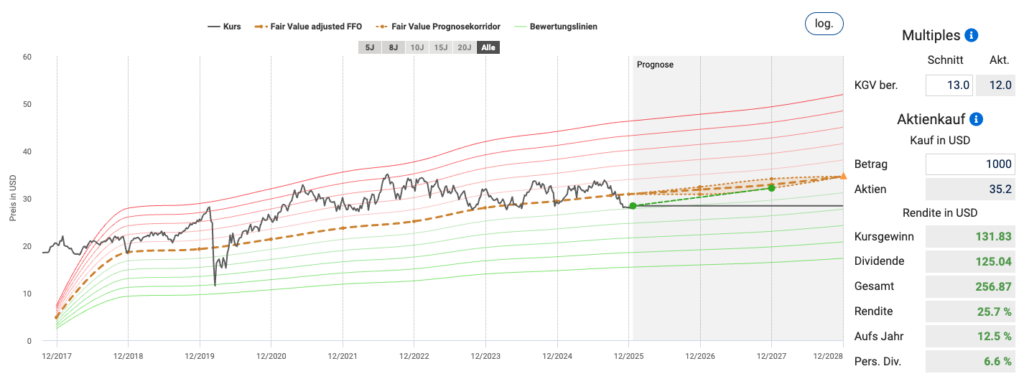
VICI is therefore significantly undervalued. A return to a P/AFFO of only 13 (taking into account some margin of safety) could mean a total return of >12% p.a.. A very attractive risk/reward ratio!
Options trading
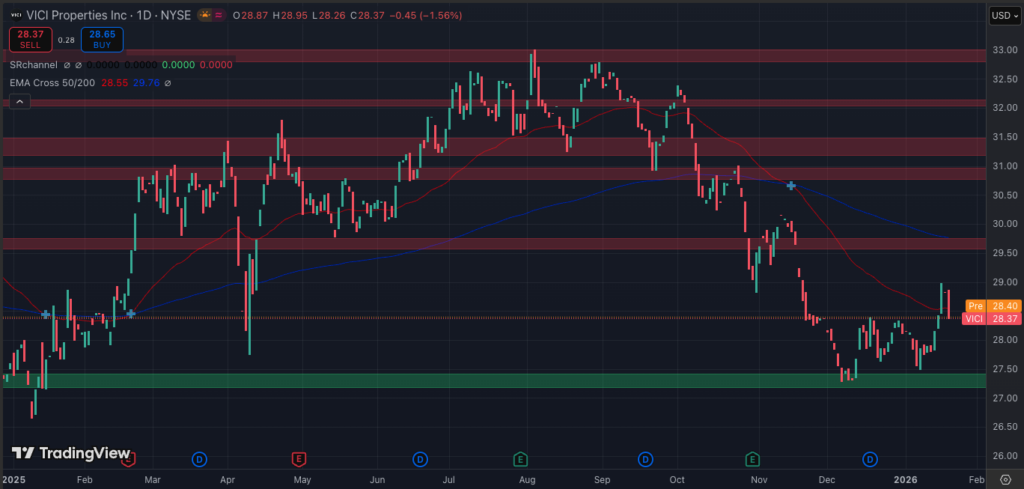
I myself am also active as an options trader, but almost exclusively as a so-called "writer". I am therefore naturally also interested in VICI, which Options are suitable for additional cash flow or for a favorable entry by means of a tender offer. Unfortunately, the spreads are higher here.
The Volatility (VIX) is still in calmer waters despite a slight increase due to the discussions surrounding Greenland and rising Japanese bond yields.
VICI Properties
For VICI there are currently Short Puts with a Strike of $27.5 in March on or longer continuously with a Strike of $27.5 in January'26, which offer very nice bonuses.
Conclusion
VICI Properties is a cash flow compounder with very long leases, (growing) inflation protection and a balance sheet that deserves the investment grade label. The fact that the rents were even paid at 100 % in 2020 speaks for the mission-critical nature of the properties. The mix of contractually anchored growth, high occupancy and efficient cost structure results in reliable, real protected distributions. For those who value defensive income with a structural tailwind, this is a REIT that delivers predictably and, in our experience, copes well with temporary challenges.