Welcome to another blog post! In my posts, I take a lot Real Estate Investment Trust (REIT) under the microscope, the last one was an analysis of Mid-America Apartment Communities. This time, the focus is on Centerspace, a small-cap REIT in the residential sector that specializes in apartment properties in the US Midwest and Rocky Mountain states. As with the previous articles, I would like to start with a brief overview of the environment for residential REITs, and then explain how Centerspace's business model works and which key figures are relevant. Finally, I would like to pose a question (and offer an answer option): "Who will take over Centerspace?".
The environment for residential real estate in the US is currently characterized by quite opposing trends. On the supply side, new construction is noticeably slowing down, as the pipeline of planned housing has significantly decreased after the boom years of 2022-2024. On the demand side, the employed population and the number of households are only growing slowly, because both job and population growth in the US have slowed down (the latter mainly due to political decisions). At the same time, real estate prices and mortgage rates are so high that many renters cannot afford to buy a home. Apartment/Residential REITs are also operating within this area of tension.
Business Model and Strategy: What does Centerspace do?
Centerspace (TWS ticker: CSR, ISIN: US15202L1070) currently has a market capitalization of around 1.1 billion USD. Founded in North Dakota in 1970, it today operates 61 apartment complexes with a total of 12,263 units across seven states. The focus is on the metropolitan regions of Minneapolis, Denver, Boulder/Fort Collins, Omaha, and smaller markets such as Rochester (MN) and North Dakota. The apartments are predominantly Class B properties, meaning they are solid but not entirely new units, and are targeted at middle-income professionals. CSR rents out the apartments including utilities, handles maintenance and renovations, and finances itself through rents and moderate debt.
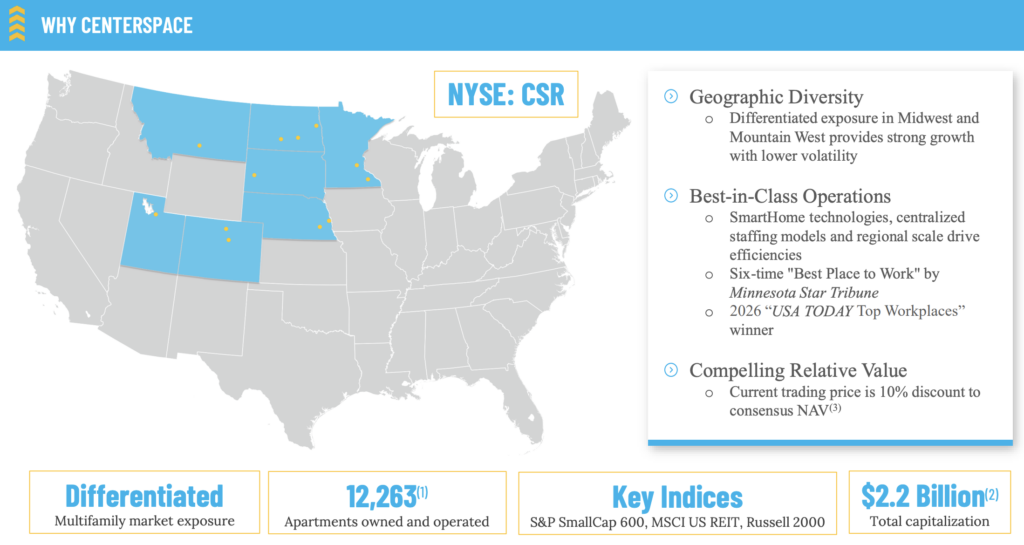
Unlike major Sunbelt players such as Camden Properties Trust (TWS ticker: CPT, ISIN: US1331311027) or Mid-America Apartment Communities (TWS ticker: MAA, ISIN: US59522J1034), Centerspace deliberately focuses on markets with lower levels of new construction. The portfolio is broadly diversified and also boasts a high occupancy rate. In the first quarter of 2026, the weighted average occupancy rate stood at 95.4 %. This clearly demonstrates that demand in these regions remains stable, even if rental growth temporarily slows.
Current situation
Centerspace released its first-quarter results in early May 2026. From an operational standpoint, the leasing market remains stable, but profits are being impacted by higher financing costs. Overall, the company reported Funds From Operations (FFO) per share of $1.07, while adjusted core FFO stood at $1.12. Both metrics are approximately 7–9% below the prior-year level, primarily due to higher interest expenses.
Same-store performance was also subdued. Sales remained at the previous year’s level, but operating costs rose by 1.7 %, causing net income for comparable properties to decline by 1.1 %. At the same time, Centerspace managed to slightly increase average occupancy to 95.4% YoY. Rent growth was mixed, as was the case with many peers. New leases were 2.1% lower than the previous year, while renewals were concluded at a rate 3.1% higher. On balance, this resulted in a slightly positive rental effect, with an impressively high tenant retention rate of 54.1%.
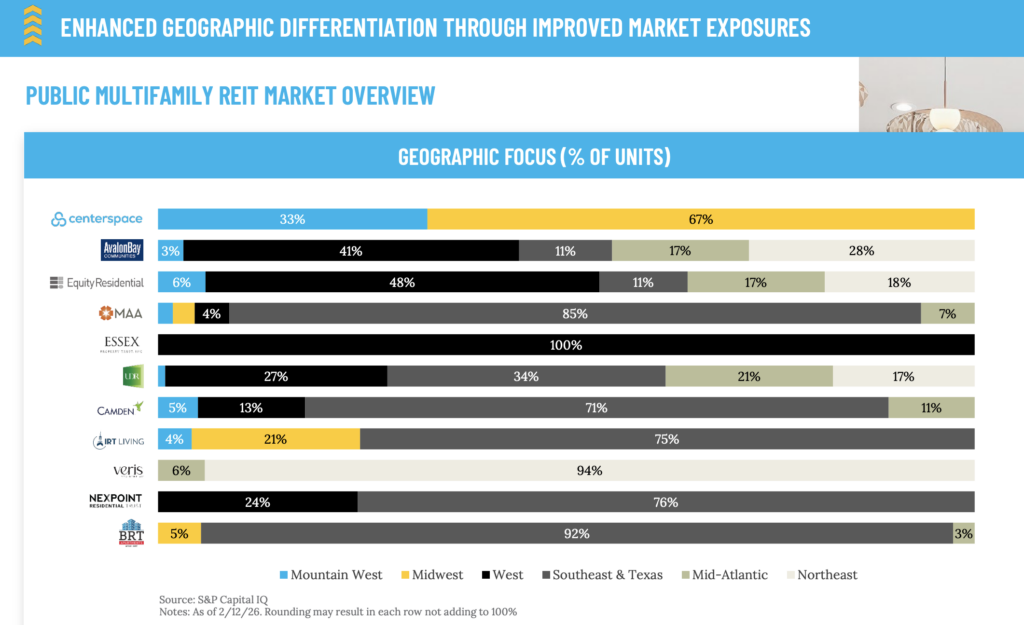
(Source: Centerspace February 2026 Investor Presentation)
On the financial front, CSR has a reasonably solid liquidity position of approximately $261 million (consisting almost entirely of unused credit lines). This cushion enables the REIT to meet its ongoing obligations and make opportunistic investments depending on market conditions. Despite the dip in earnings, management has confirmed its full-year forecast. Core FFO for 2026 is expected to range between USD 4.81 and USD 5.05 per share, while the FFO range has been raised slightly to USD 4.65 to USD 4.92. This is based on slightly growing revenues and moderately rising costs, while Net Operating Income (NOI) is expected to range from –0.5% to +2%.
In summary, many indicators suggest that 2026 will remain a transitional year, as is the case with many other residential REITs. The interest burden still weighs heavily, but the business is operationally robust and demand in the aforementioned core markets is stable. If the construction pipeline continues to shrink as expected, Centerspace could benefit more from rent increases again from 2027 onwards. Until then, high occupancy secures earnings.
Strategic Alternatives
In November 2025, the board announced that it was exploring „strategic alternatives,“ including a potential sale, merger, or continuation in its current form. In Q1 2026, management reconfirmed that this process is ongoing, although no specific timeline has been established. The background to these considerations is the current very high discount of the stock price compared to the estimated market value of the portfolio.
Institutional investors, such as the activist hedge fund Land & Buildings, have repeatedly called for this valuation gap to be closed through a company sale. However, Land & Buildings has since withdrawn from Centerspace, which, in my opinion, significantly diminishes the likelihood of a quick deal. The management has, however, emphasized that if no offers are forthcoming, they can sell assets at any time and use the proceeds for share buybacks, which is at least a sign of shareholder orientation, even though "carving up" would not be the optimal solution. Incidentally, potential buyers would be well-known private equity players such as Blackstone (TWS ticker: BX, ISIN: US09260D1072) or Blue Owl Capital Inc. (TWS ticker: OWL, ISIN: US09581B1035), both of which have acquired numerous REITs from various sectors in recent years.
Market environment in Centerspace core markets
The market in the Midwest and Rocky Mountain states, where Centerspace mainly operates, is characterized by moderately growing populations, low new construction activity, and stable employment. While major cities like Austin or Nashville are suffering from high completions, the supply overhang in Minneapolis, Denver, and other CSR markets is less pronounced. Nevertheless, the demand side is not a given. Net migration to the US has noticeably declined in 2025, and labor force growth remains subdued. On the other hand, the continued increased unaffordability of homeownership is a factor, as it extends the length of stay for many renters and stabilizes demand for rental apartments. Overall, CSR demonstrates that Residential REITs can achieve attractive returns even outside the booming Sunbelt regions.
Key figures and valuation
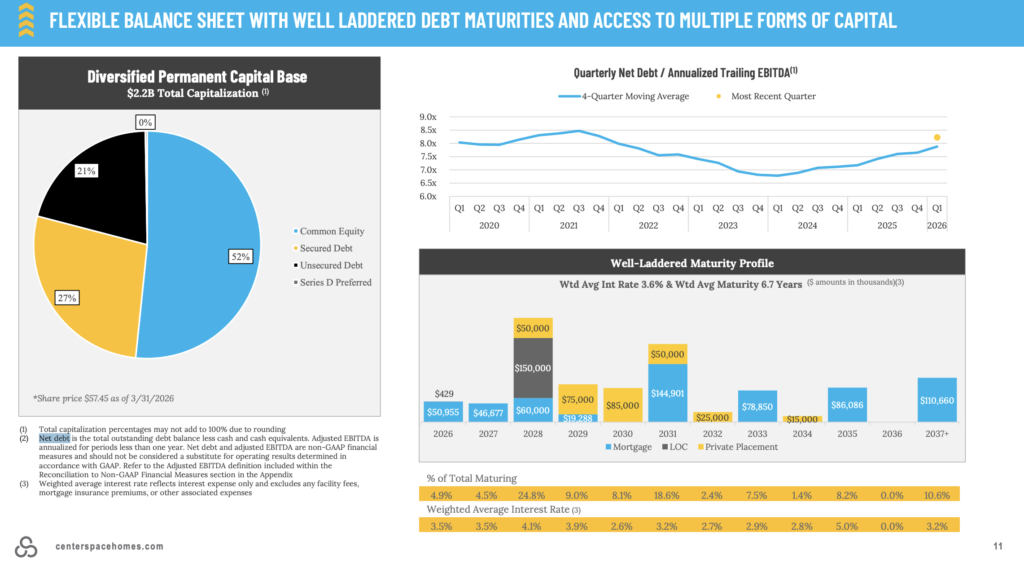
In this article, I again point out that a solid balance sheet is not only important for REITs, but should be particularly considered there, as REITs have a higher Debt-equity ratio exhibit compared to other companies in other sectors. Here are some numbers from CSR's balance sheet:
- Net debt / EBITDA: ~7.5x
- Average remaining term: 6.7x
- Most of the debt has a fixed interest rate (at an effective rate of 3.61% p.a.)
Debt and maturities
The maturity profile of the debt is stretched out. In 2026, loans totaling approximately USD 51 million will still be due, and another USD 47 million in 2027. In 2028, the credit line will need to be refinanced (see graphic below), and there is a major maturity in 2031. Interest expenses are likely to increase in the coming years, partly due to the development of inflation and its impact on U.S. bond yields. However, thanks to the long maturities and the high proportion of fixed-interest debt, this is all manageable. However, the high overall debt makes Centerspace much more sensitive to potential interest rate hikes.
Evaluation and outlook
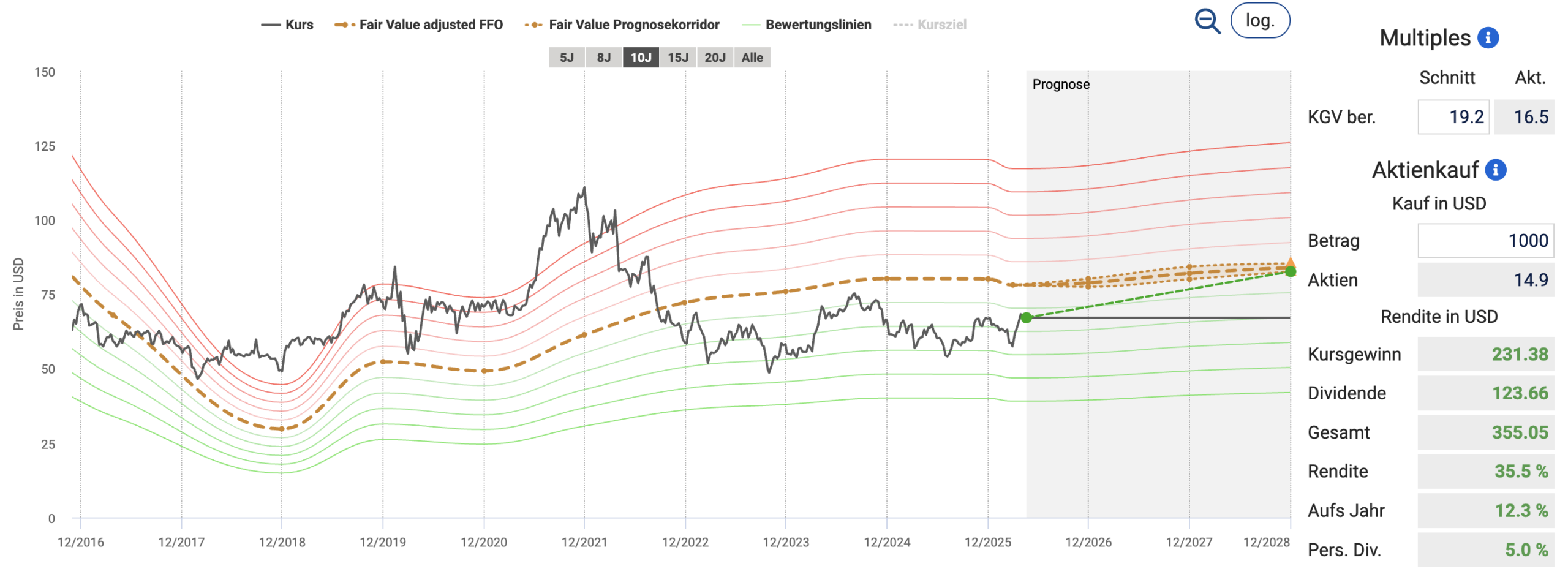
CSR is currently trading at about 16.5 times expected AFFO; historically, this multiple has been nearly 20×. A return to a historical P/AFFO ratio would therefore imply a total return of >12 %.
Dividend and Payout Ratio
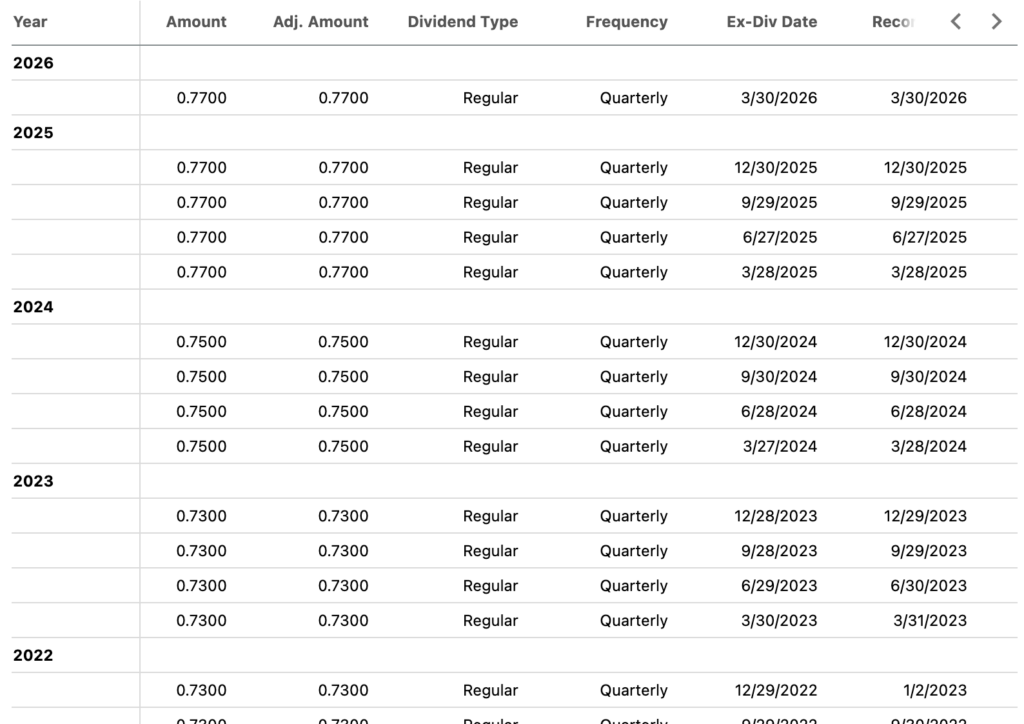
The key data for Dividend look like this:
- Dividend per share: currently $0.77 USD per quarter or $3.08 USD per year.
- Payout ratio: The dividend amounts to approximately 63% of core FFO, leaving sufficient room for investments and debt service
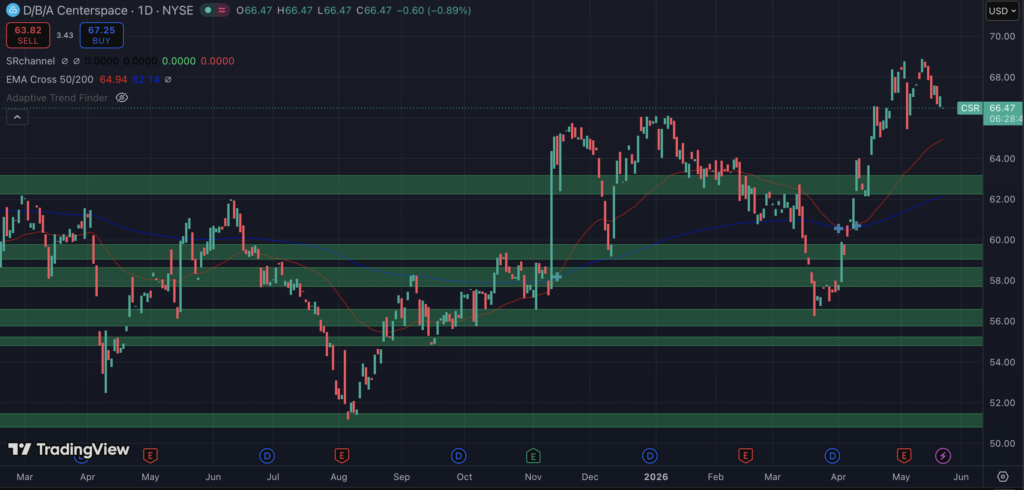
- Dividend yield: At a share price of 67, the yield is approximately 4.6%.
The high level of debt leaves little room for significant dividend increases, but as long as operations remain stable and debt obligations are met, the payout appears well-covered. A reduction in debt would improve the scope for dividend increases in the medium term, but is also not the focus of the Strategic Review.
Options trading
I myself also act actively Options, but almost exclusively as so-called "option writers." Therefore, I am naturally also interested in the aforementioned REITs, which ones are suitable for additional Cash flow or for a favorable entry by means of delivery. The Volatility (VIX) (has trended further down in the meantime, despite all geopolitical and stock market events). Unfortunately, options on CSR have greatly increased spreads and I would leave options on peers AvalonBay Communities (TWS ticker: AVB, ISIN: US0534841012) and Equity Residential (TWS ticker: EQR, ISIN: US29476L1070) aside due to the upcoming merger.
- Mid-America Apartment CommunitiesFor MAA, options include Short Puts mit Strike by $120 in July 2026 that deliver a decent premium (increased spread)
- Camden Property TrustFor CPT, ATM short puts with longer maturities are suitable Strike of $100 in November '26 that deliver a nice bonus
- Essex Property TrustFor ESS, a Bull Put Spread mit Strikes of $240 for the short put and $230 for the long put in January 2022offer 7.
Conclusion
Centerspace is a small, concentrated residential real estate REIT with a strong presence in underserved regions. Operational development is stable, occupancy rates and net operating income are growing moderately, and the company has sufficient liquidity. However, high leverage and limited diversification are risk factors that justify a lower valuation compared to peers. The ongoing review of strategic alternatives, however, opens up opportunities for upside, even if it could take longer to materialize, as evidenced by the withdrawal of activist investor Land & Buildings. For long-term investors who anticipate a normalization of the residential market in the US generally and particularly in the Midwest, and who value an above-average dividend yield and a significant discount to net asset value, Centerspace may still be of interest. Those who prefer a larger and financially stronger player will find more attractive risk/return profiles with Camden, MAA, or UDR.