Welcome to another blog post. In Analysis: Mid-America Apartment Communities (TWS ticker: MAA, ISIN: US59522J1034), I want to focus today on a very special Real Estate Investment Trusts (REIT) sector and the company MAA, a heavyweight in the residential sector. The company has been a fixture among apartment REITs in the US for years, possessing a broadly diversified portfolio of modern apartments in growing Sunbelt metropolises and operating with a conservative balance sheet. However, the latest quarterly figures and a look at 2026 show how significantly interest costs and temporary oversupply can depress earnings. Therefore, a closer look at the company and its environment is worthwhile.
Business Model and Strategy: What does MAA do?
Mid-America Apartment Communities is one of the largest publicly traded apartment landlords in the US with over 104,000 units and a market capitalization of around USD 15 billion. The portfolio is concentrated in the Sunbelt, in dynamic economic regions such as Texas, Florida, Georgia, and North Carolina. These locations benefit from above-average population and employment growth, which has historically led to double-digit rent increases.
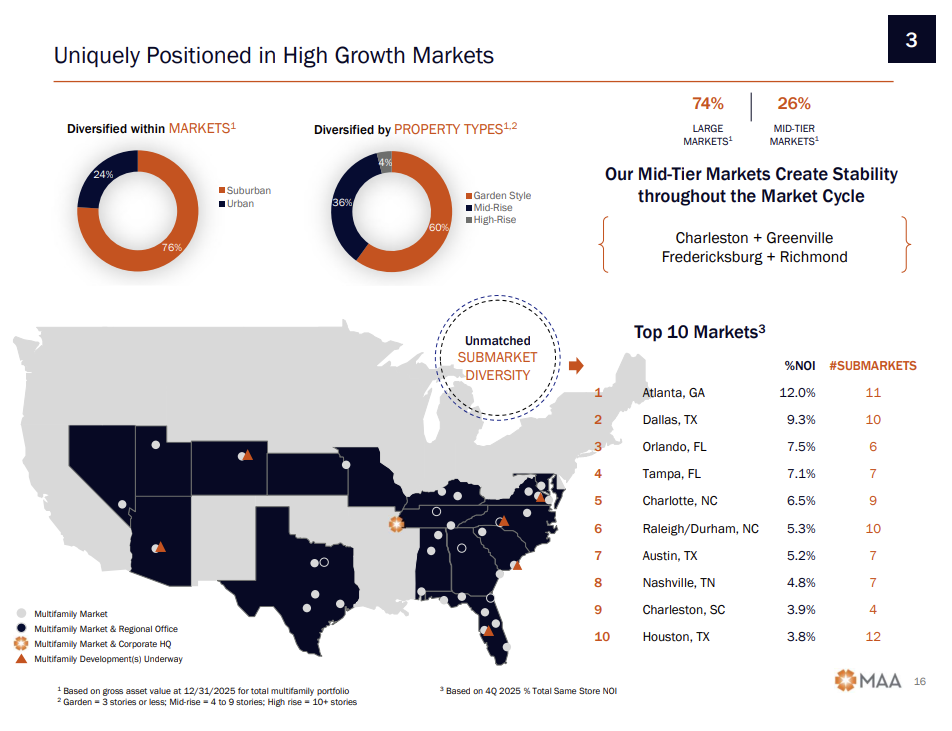
(Source: MAA 2026 Citi Global Property CEO Conference
MAA pursues a „Class A“ strategy, focusing on well-appointed apartment complexes with a high level of service. Customer satisfaction is among the best in the sector, reflected in extremely low tenant turnover of just over 40% (yes, that does seem low!). The company is organized as an Equity REIT 100% and distributes the majority of its operating profits accordingly as dividends.
Current situation
The figures for the fourth quarter of 2025 and the outlook for 2026 present a mixed picture. Although MAA was able to maintain its adjusted FFO per share (the so-called Core FFO) at a stable $8.74 for the full year 2025, the operational momentum has indeed waned. Net operating income (on a same-store basis) recorded slightly declining revenues in the last quarter due to a marginal decrease in rents and a corresponding increase in operating costs. The growth drivers were primarily completed new construction projects, the leasing success of which at least partially offset the decline in profits from the existing portfolio.
For 2026, management expects Core FFO of $8.35–$8.71 per share (average $8.53), representing a slight decrease. The main reason for this is higher interest expenses on ongoing financing. Without this effect, earnings would actually increase slightly despite negative same-store development.
Meanwhile, the average physical occupancy rate has remained constant at 95.6%, and the share of move-outs due to home purchases was only 11.1%, reflecting the continued unaffordability in the US housing sector.
Excursion: Market situation in the residential sector
The performance of residential REITs depends not only on the company's own strategies, but also to a large extent on supply and demand on the housing market. After the pandemic, a record number of apartments were completed in 2022-2024. Building permits skyrocketed, especially in the Sunbelt, as many people moved from expensive coastal metropolitan areas to more affordable states and developers responded to this trend. However, there are now far fewer building cranes on site. According to data from CoStar, the number of national housing completions in 2025 has slumped from 685,000 units in the previous year to 365,000. In the particularly hot Sunbelt markets such as Austin, Dallas/Fort Worth and Atlanta, the decline is even more pronounced. In Austin, for example, completions are expected to fall by 68 %. This slowdown in supply lays the foundation for a new leasing cycle as soon as the many vacant new buildings have been absorbed. MAA's management expects this development in 2027.
On the demand side, the current situation needs a more nuanced view. The U.S. population of working age is only growing through immigration, and this has significantly slowed down in 2025 (for specific reasons). Furthermore, employment growth has cooled, which is dampening household formation. However, one piece of good news for landlords remains the extremely poor affordability of homeownership. According to J.P. Morgan, the ratio of home prices to income in the U.S. has been near historical highs for three years. Many renters, despite falling mortgage rates, cannot afford to purchase their own property and remain in the rental market longer. This structural demand supports high occupancy rates.
Balance Sheet and Relevant Key Figures
In almost every article, I preach that a healthy balance sheet is not only important for REITs, but should be particularly considered there, as REITs logically have a higher Debt-equity ratio than other companies in other sectors. Here are some figures from MAA's balance sheet:
- Net debt / EBITDA: 4,3
- Average remaining runtime: 6.4x
- 87 percent of the debt is fixed-rate (at an effective 3.8%)
- Credit Ratings: Fitch (A- / Stable), S&P (A- / Stable), Moody's (Baa1 / Stable)
Debt and maturities
The next major refinancing is scheduled for September 2026, when a USD 300 million bond with an interest rate of only 1.2% will mature. In addition, management plans to repurchase the outstanding preferred shares in the second half of 2026. Due to these measures and the financing of the development pipeline, interest expenses are likely to increase by more than 15% in 2026, which is quite substantial. However, the remaining maturities are well staggered, so that major maturities will not be due until 2027.
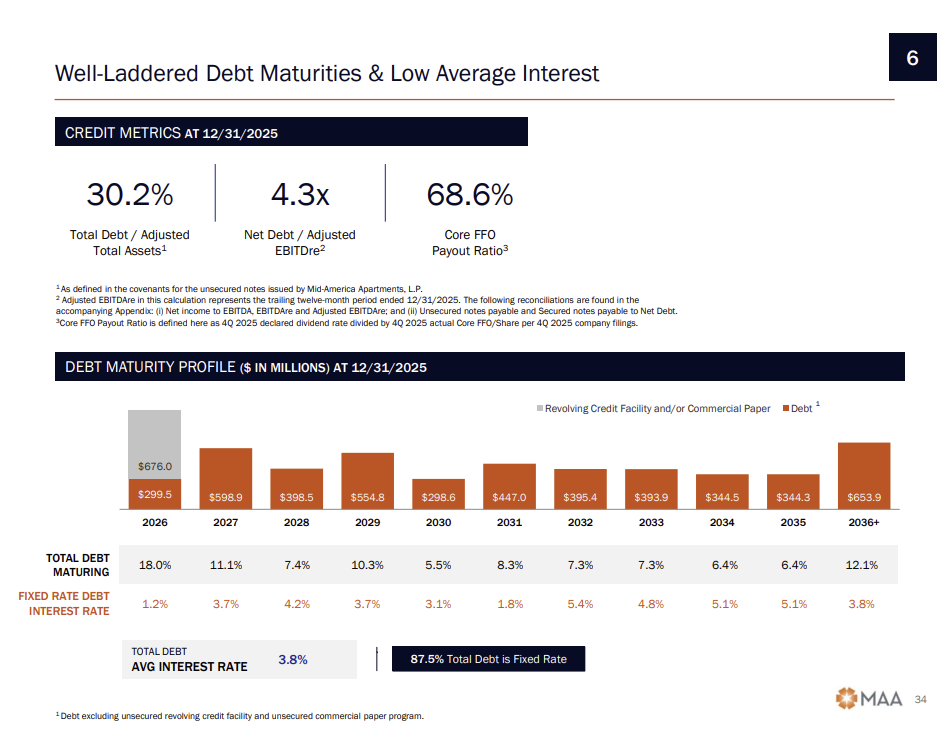
(Source: MAA 2026 Citi Global Property CEO Conference
Dividend and the payout ratio
MAA increased its quarterly dividend at the end of 2025 from $1.47 to $1.53 per share. This corresponds to an annualized payout of $6.12 and a Dividend yield of just under 4.8%. Relative to the expected core FFO of 8.53 USD per share, the payout ratio is therefore around 72%(after the dividend increase), leaving room for future increases. MAA has been continuously increasing its dividend for 15 years, even during more difficult periods.
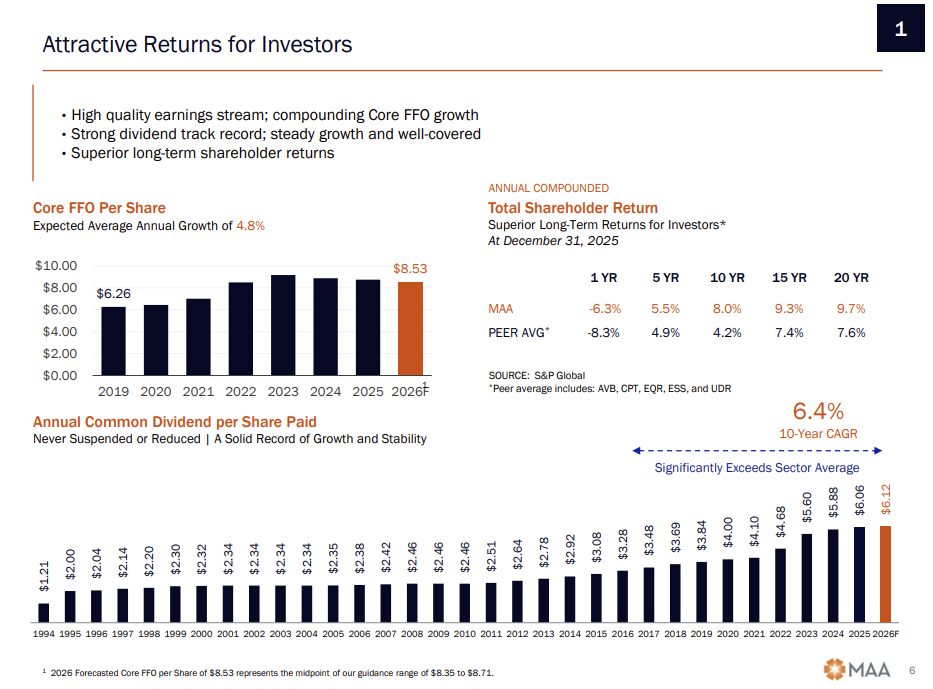
(Source: MAA 2026 Citi Global Property CEO Conference
Evaluation and outlook
The stock is currently trading at around 16 times expected AFFO, which is clearly below its 10-year average of approximately 19x. A return to its historical P/AFFO would mean a total return of around 10 %.
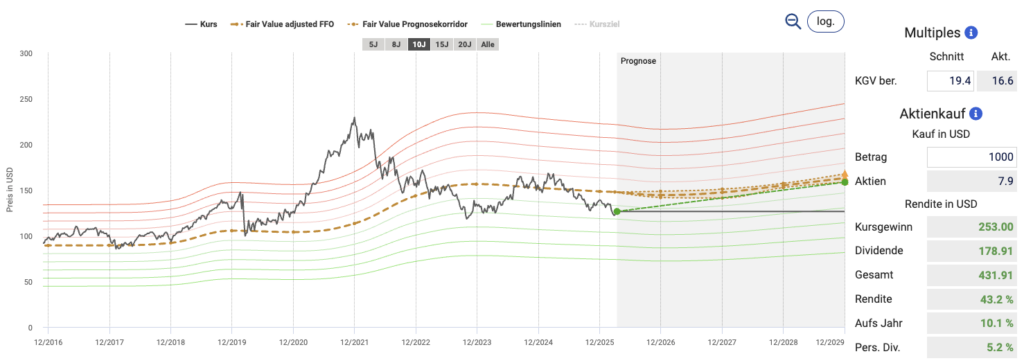
The graphic displayed above shows the current multiple compared to the historical average, signaling moderate upside potential. In the long term, MAA is well-positioned to benefit from a recovering rental market given its high-quality portfolio structure and disciplined financial management, even though higher interest costs are a burden in the short term.
Peers
Besides MAA, there are several other publicly traded residential REITs that are important for comparison. Camden Property Trust (TWS ticker: CPT, ISIN: US1331311027), like MAA, focuses on the Sunbelt and impresses with lower debt and growth-oriented management. AvalonBay Communities (TWS ticker: AVB, ISIN: US0534841012) and Equity Residential (TWS ticker: EQR, ISIN: US29476L1070), on the other hand, are primarily present in coastal regions and metropolises and benefit from higher entry barriers, but also have higher valuations. UDR (TWS ticker: UDR, ISIN: US9026531049) acts as a hybrid with a presence in Sunbelt and coastal cities.
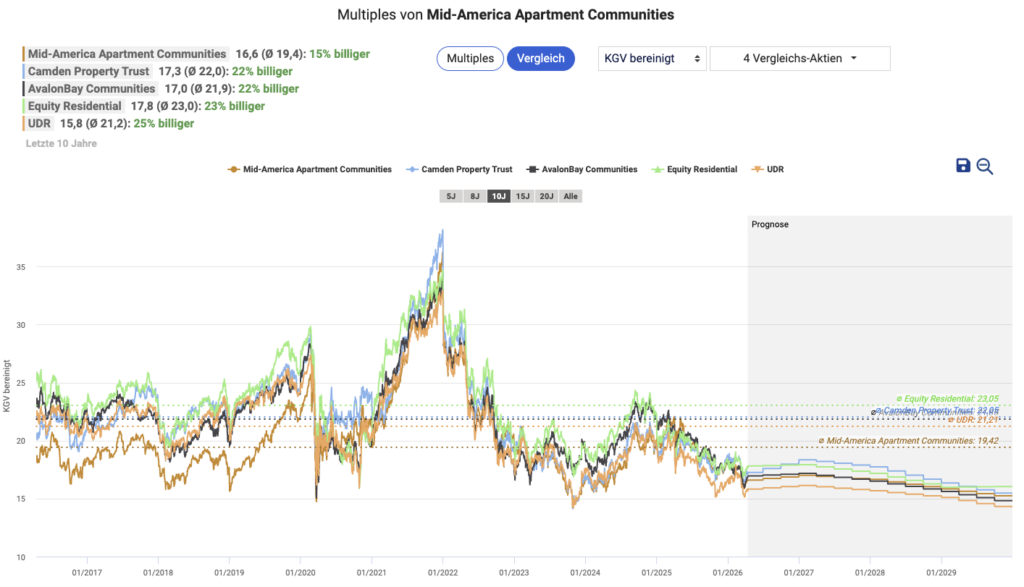
A comparison of current valuation metrics shows that MAA is more favorably valued with a P/AFFO multiple of approximately 16.6x compared to EQR and CPT (around 17x) and AVB (all 17-18x), but slightly more expensive than UDR (<15x). It is also quite clear that all stocks are valued 1/5 to 1/4 cheaper than in the past, which is why the entire Residential REIT sector is worth a look.
Options trading
I myself also act actively Options, but almost exclusively as so-called "option writers." Therefore, I am naturally also interested in the aforementioned REITs, which ones are suitable for additional Cash flow or for a favorable entry by means of delivery. The Volatility (VIX) has meanwhile significantly receded. Options on UDR are not much fun, because the spreads are unfortunately too wide.
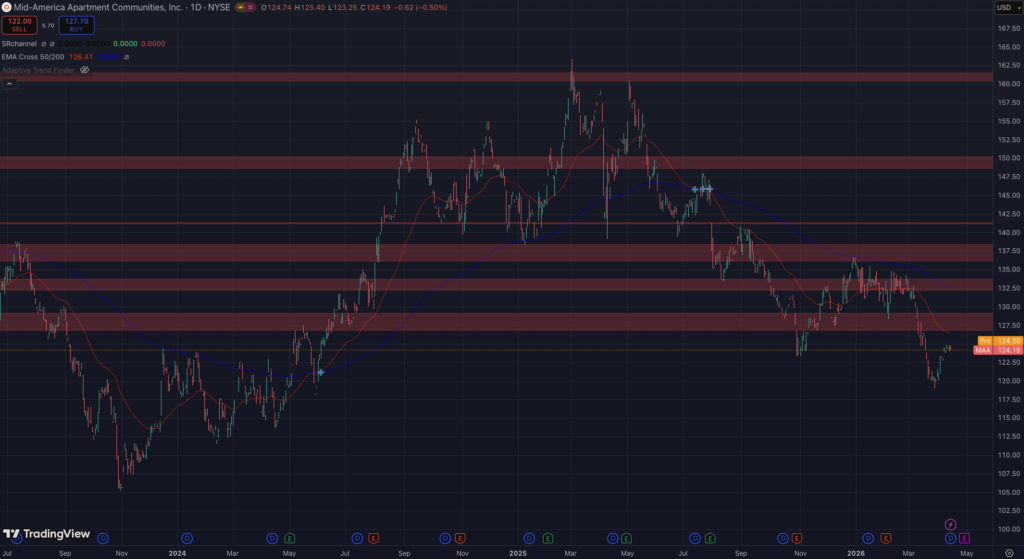
- Mid-America Apartment CommunitiesFor MAA, options include at the money Short Puts mit Strike by $120 in June '26 that deliver a decent premium (increased spread)
- AvalonBay Communities: At AVB, short puts with a Strike of $165 in June '26 worth a look or longer running with Strike $160 in October '26 to
- Camden Property TrustFor CPT, ATM short puts with longer maturities are suitable Strike of $100 in November '26 that provide a decent bonus
- Equity ResidentialFor EQR, ATM short puts are suitable Strike by $60 in June '26 an ongoing or longer-running with Strike from $55 in December '26
Conclusion
Mid-America Apartment Communities is a true quality value in the residential sector, which should benefit long-term thanks to its focus on high-growth Sunbelt markets. In the short term, however, higher interest costs and the ongoing absorption of the past construction boom are weighing on results. Management has planned very cautiously for 2026, expecting a slight decline in Core FFO. At the same time, significantly declining new construction activity, combined with the low homeownership rate, suggests that rents could pick up again from 2027. For patient investors, MAA therefore offers the opportunity for solid total returns from dividends and moderate growth.