Most of the earnings are now through. In today's blog post, I would therefore like to return to the figures for the Real Estate Investment Trusts (REIT) look. As with the Blog post on the Q2 figures I would like to use this format on a regular basis. In this article there are again two representatives, as last time Net Lease and Residential (in my opinion this is where the most interesting REITs are currently to be found). Basically, every REIT can be assigned to a sector quite easily, depending on the type of property or its purpose (with a few exceptions). The business model may often be the same, but within a sector there are specific challenges for the companies.
Net Lease REITs
Yesterday, the Fed cut interest rates by a further 25 basis points, which was actually expected by all market participants. However, the FED sees "only" two interest rate cuts in the coming year, which apparently surprised many investors, as there was a significant sell-off. As bond yields have made a decent leap upwards, this also affected net lease REITs in particular, which strictly speaking is not a separate sector according to Nareit but rather a business model, which has its own peculiarities. (Triple) net lease primarily means that the landlord has to pay for almost all costs, be it maintenance, taxes or insurance. Net lease REITs usually have very long-term leases of up to 20 years, including various renewal options and annual rent increases as well as inflation clauses. On the one hand, this all ensures lower expenses for the company and, on the other, a certain amount of organic growth. As a result, net lease REITs often have a lower valuation than REITs from other sectors. And because they rely on acquisitions for inorganic growth, net lease REITs are very likely to lead the recovery when interest rates fall, but also suffer when interest rates fall less
NNN REIT
NNN REIT (TWS symbol: NNN, ISIN: US6374171063) is probably the most boring of all net lease REITs. The third quarter was actually quite disappointing, which was mainly due to two tenants, Badcock Furniture and Frisch's. Both are in a difficult economic situation. Both are in a very difficult economic situation, including the possibility of Chapter 11 insolvency. For NNN, this ultimately means that the rents for these two tenants may be completely or partially canceled. This announcement caused a small sell-off in the REIT. If you look at the two companies, you will see that they are only responsible for 0.6% and 1.5% of rental income respectively. So you could get the impression that the market reaction is quite an overreaction.
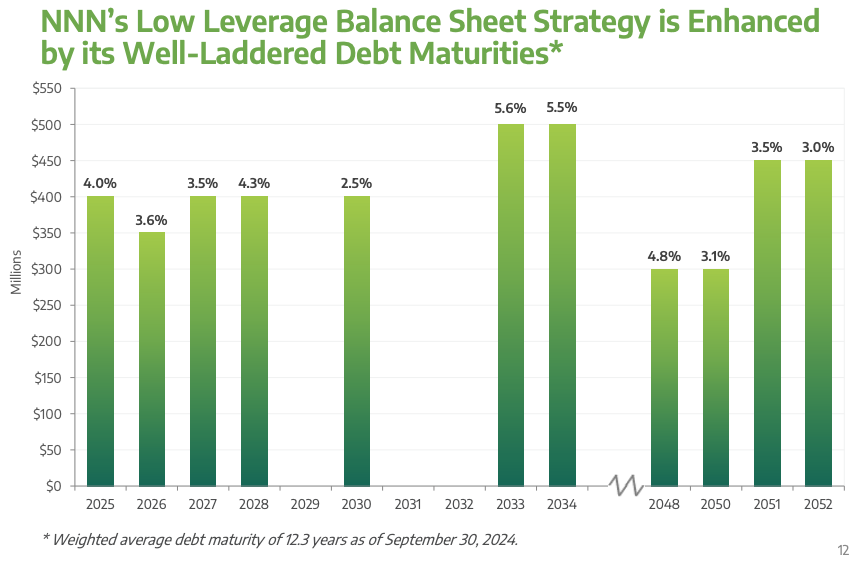
Well-Laddered Debt Maturities (Source: NNN REIT Investor Update October 2024)
On the positive side, however, there are also a few points that need to be mentioned. For example, NNN is the REIT with the longest average maturity, namely over 12 years. In addition, the REIT is now very cheaply valued with a P/AFFO of only 12x. In view of the dividend paid for 34 years (Dividend yield approx. 5.7%) and a higher historical P/AFFO multiple of 15.8x, there is still some upside here in my opinion.
EPR Properties
EPR Properties (TWS abbreviation: EPR, ISIN: US26884U1097) is a net lease REIT for which investor sentiment is persistently negative, but which nevertheless delivers quite reasonable results. The REIT is also somewhat more specialized, as it focuses on specialized real estate in the entertainment, leisure and education sectors, such as cinemas (AMC is a tenant!), amusement parks and much more.

Portfolio detail (source: EPR Properties Investor Presentation Q3 2024)
YoY, some key figures, such as AFFO per share, declined due to deferred rental income. EPR is gradually reducing its exposure to cinemas by selling some cinemas and reinvesting the proceeds in other properties. However, with >150 properties, cinemas still represent the largest part of the portfolio and it will be a long time before it has significantly reduced its exposure to cinemas. EPR has a big problem in my opinion, namely the low valuation itself (P/AFFO <9x). If this were at a reasonable level, the REIT could issue shares to drive portfolio diversification. However, since this is not the case, the only solution is either to resort to (further) debt or to use the existing cash flow, which is less likely to generate growth. In my opinion, neither of these are arguments for multiple expansion. On the positive side, the dividend yield is almost 8% and the dividend can certainly be described as safe, at least as things stand today. Which would definitely help if the environment for "cinemas" itself recovers and more profits are made here.
Residential REITs
Residential REITs are also currently facing some challenges. Demand for rental housing remains high and is being supported by the limited affordability of owner-occupied homes, as mortgage rates remain stubbornly high (at least for the time being). Furthermore, house prices are not falling much, at least if you look at the data. While it's true that rental growth has flattened out quite a bit, that's because the many newly built multifamily properties coming on the market are being absorbed. The growth in the supply of new homes is about to fall. And since interest rates are still high and apartment rents are still low on average, new multifamily development will not recover. I therefore expect the number of newly built apartment buildings to fall sharply over the next few years.
Armada Hoffler
Armada Hoffler Properties (TWS abbreviation: AHH, ISIN: US04208T1088) is actually a "true" diversified REIT that also develops and builds real estate itself. Many of these are so-called mixed-use properties that can be found in the portfolio. Also retail, multifamily and office. In principle, mixed-use assets combine all areas and are increasingly in demand. However, as the portfolio share of multifamily assets has increased significantly, I classify AHH as a residential REIT.
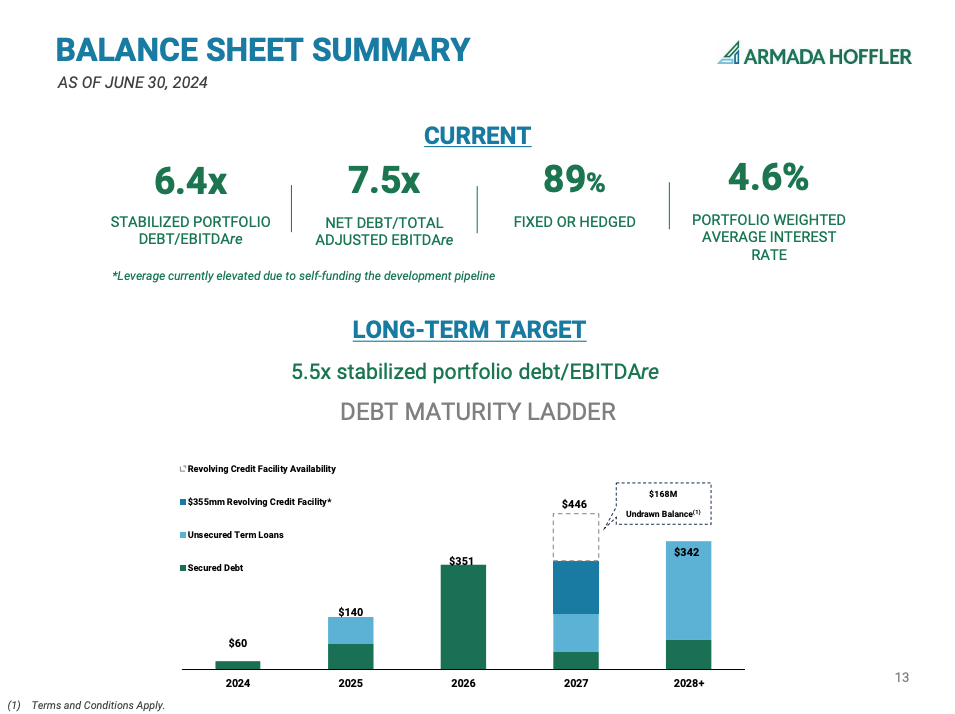
The remaining office assets are probably the reason for the very low valuation of P/AFFO at around 11x, but historically the AHH was valued at a multiple of around 14-15x. Another reason is the increased debt, which is being reduced as a priority. Until the valuation changes again, there is an 8% dividend yield with a rather conservative payout ratio. In Q3, many investors will no doubt have been bitterly disappointed by the management's decision to reduce debt by issuing new shares, which has a rather dilutive effect when the valuation is taken into account. But perhaps this is only a temporary negative, as the decision to issue shares is part of a larger plan to prepare the balance sheet for new development projects. And these should then have a strong value-enhancing effect and increase the FFO per share again.

What is also interesting is that two insiders together bought shares from this issue worth $2 million.
AvalonBay Communities
One of the major players in the residential sector is AvalonBay Communities (TWS abbreviation: AVB, ISIN: US0534841012). AVB's portfolio, which is predominantly positioned on the coasts (consisting mainly of Class A properties), showed stable strength in the third quarter. The New England and Pacific Northwest regions were particularly positive, with net operating income increasing by a good 5%. Across the portfolio, there was slight growth in FFO of around 3%. AVB has also launched four new development projects, two in Texas and two in North Carolina. The timing seems to be quite good for this, as sunbelts are in demand and the current oversupply will most likely have been absorbed by the time the development work is completed.
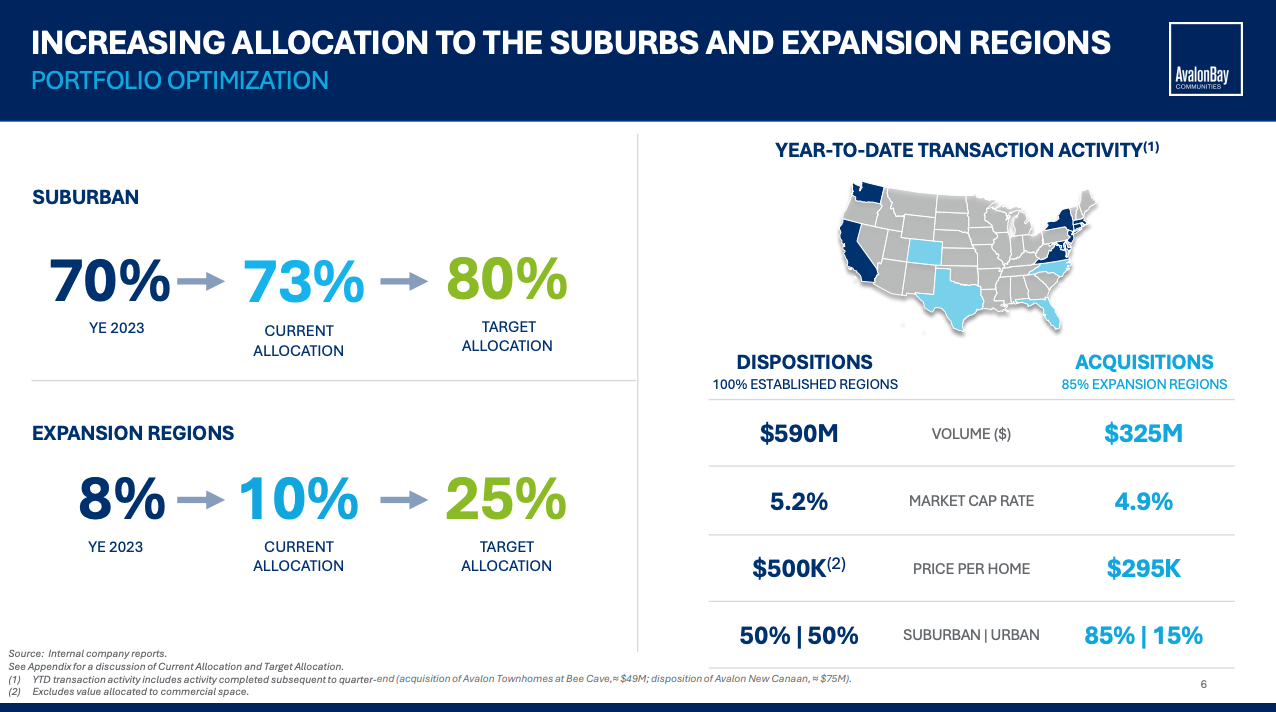
Overall, the management's aim is to actively acquire multi-family properties in strategic markets outside of AVB's traditional coastal areas and thus further diversify the portfolio. A look at the debt (net debt/EBITDA approx. 4.2x) is not a cause for concern, as this is quite low for REITs. Only the valuation with a P/AFFO of approx. 21.7x is no longer particularly attractive, but rather fairly valued, considering the historical multiple of approx. 23.7x.
Options trading
I myself also act actively Optionsbut almost exclusively as a so-called "writer". I am therefore naturally also interested in REITs that are suitable for additional Cash flow or for a favorable entry by means of delivery. The Volatility (VIX) has recently been very low, which has had a negative impact on the level of potential premiums. However, there has been a spike in volatility since yesterday's Fed interest rate decision.
- NNN REIT: For NNN there are Short Puts with a Strike of $40 in January '25 or a little longer running with $40 in March '25 that deliver decent premiums.
- EPR Properties: For EPR there are Short Puts with a Strike of $40 in February '25 an.
- Armada Hoffler Properties : For AHH there are Short Puts with a Strike of $10 in February '25 an.
- AvalonBay Communities : For AVB there are Short Puts with a Strike of $210 in January '25 or more conservative and longer-term with $185 in April '25 an.
Thank you and Happy holidays!
That's it from my side for this year and I would like to thank all the readers of my articles. However, the next blog post is already planned and will probably be published in mid-January. The focus will be on a small cap REIT from the retail sector!
With this in mind, have a great Christmas and a happy new year 2025!