2025 is drawing to a close and many of us are already looking forward to the festive season with friends and family. As this will be the last article of the year, I would like to wish all readers a Merry Christmas and a Happy New Year.
But before that, there is some input on Real Estate Investment Trusts (REITs)! In today's REIT outlook 2026 I take a look at the most important sectors and present what I consider to be the most interesting REIT in each case. Each section contains a brief classification of the macro environment and a personal assessment of the company.
Diversified REITs
Armada Hoffler Properties
Armada Hoffler Properties (TWS abbreviation: AHH, ISIN: US04208T1088) is something I have tended to assign to the residential sector in my own portfolio, but officially it is still a mixed-use REIT that invests in office, retail and residential real estate in the USA (and also offers project-related services). After a turbulent past in which the company realized many construction and development projects for third parties, the new CEO has begun to shift the strategy more towards recurring rental income. The portfolio figures show that letting remains robust: a good 96 % of the office space and around 96 % of the retail portfolio are let, and even in the residential segment the ratio is just over 94 %. This stability is remarkable because demand has shifted in many office markets due to rising vacancy rates. However, AHH owns high-quality Class A properties in growth regions that are still in demand.
The valuation discount is still quite large. Based on the normalized FFO guidance of around USD 1.05 per share, the share is trading at P/FFO 7x at the end of 2025, which corresponds to a discount of around 50 % to the net asset value. Although debt is higher than at many US peers, the new Management Board is gradually reducing it. For 2026, I expect above all that the realignment towards stable portfolio properties will pay off. If the company reduces its debt ratio and completes more projects, this could lead to a significant revaluation. For patient investors, the REIT not only offers double-digit upside potential, but also a now well-hedged Distribution of currently almost 8 %.

For income investors, the preferred shares with the TWS ticker AHH.PR.A (ISIN: US04208T2078) could be worth a look, as this cash flow is (more) secure and there is also some upside up to the issue price of USD 25 per preferred share.
Tower REITs
SBA Communications
SBA Communications (TWS ticker: SBAC, ISIN: US78410G1040) operates cell towers in the USA and numerous other countries - from Brazil to South Africa - and is benefiting from the growing demand for data transmission. Unlike some competitors, the portfolio is geographically diversified, which allows the company to compensate for currency and economic fluctuations. In 2025, SBA took over around 7,000 towers from the South American operator Millicom, while at the same time withdrawing from Canada and investing almost 200 million US dollars in buying back its own shares. Following the last major Sprint customer loss, the AFFO per share remained stable and the guidance for 2026 is just under USD 12.9 per share. The REIT is currently valued at around 15 times operating cash flow, while the historical average is around 20. The dividend yield of 2.34 % is comparatively low, but the payout ratio is only around a third of AFFO, so there is still plenty of scope for dividend increases in the future.
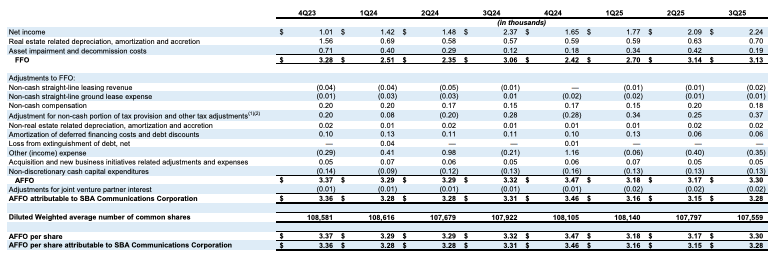
(Source: SBA Supplemental Financial Data Third Quarter 2025)
In 2026, the increasing penetration of 5G networks in particular should provide a tailwind. The international expansion course and further share buybacks could provide additional support for earnings per share. Although tower REITs are sensitive to changes in the investment budgets of mobile network operators, I expect the expected interest rate environment with a downward trend in yields to lead to a normalization of valuations. Accordingly, I believe that a significant price increase is likely as soon as the market recognizes that the American network dismantling is largely complete and international business continues to grow.
Self-storage REITs
CubeSmart
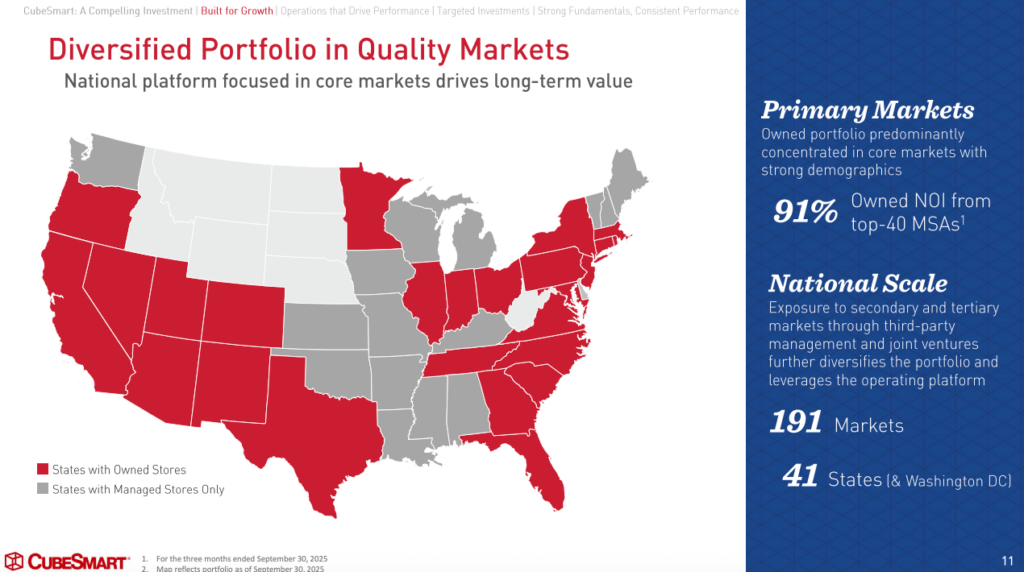
The self-storage sector was one of the most profitable REIT areas in the past, but the boom of the pandemic years triggered a veritable wave of new construction. The market environment is now returning to normal as high interest rates are slowing down many developers. CubeSmart (TWS ticker: CUBE, ISIN: US2296631094) is one of the leading providers in the USA, with a focus on urban locations on both coasts. The company is currently trading at around P/FFO 13.5x, well below its long-term average of around 20x, and the dividend yield is currently close to six percent. Self-storage REITs in particular could become the secret winners of the coming years, as artificial intelligence and automation will make a number of jobs redundant, leading to greater mobility and thus higher demand for storage space. At the same time, AI is giving rise to numerous new micro-enterprises that need low-cost storage options, and the marketing of space can also be made more efficient through data-driven price control.
Although demand is currently still weak because housing is prohibitively expensive in many regions and therefore fewer people are moving, this is likely to change with the planned interest rate cuts and potential government subsidy programs. CubeSmart has slightly raised its forecast for 2025 and speaks of a slow but steady stabilization. For patient investors, it is therefore interesting to enter the market now, as growth is likely to accelerate again in a few years' time. In the long term, I believe the share will return to a valuation level of around 20 times FFO, which would mean a price potential of around 50 %.
Healthcare REITs
Sila Realty Trust
Sila Realty Trust (TWS ticker: SILA, ISIN: US1462805086) is a little-known net lease REIT that has only been listed on the New York Stock Exchange since last year and focuses on healthcare facilities along the entire supply chain, from outpatient clinics to post-acute facilities and specialty hospitals. The management pursues a rather defensive strategy, focusing on long-term leases, almost exclusively with triple-net structures, in order to reduce operational volatility. The key figures show that this approach is working well. The occupancy rate was recently around 99 % and the Management Board is planning to drive growth further through targeted acquisitions, expansions and redevelopments. At the same time, the risks are manageable, as Sila works closely with its tenants in order to be able to take countermeasures at an early stage in the event of any vacancies and ensures a balanced financing structure. The liquidity reserve of over 476 million US dollars and the low Debt-equity ratio from just under net debt / EBITDA 3.6x provides additional scope for investments.
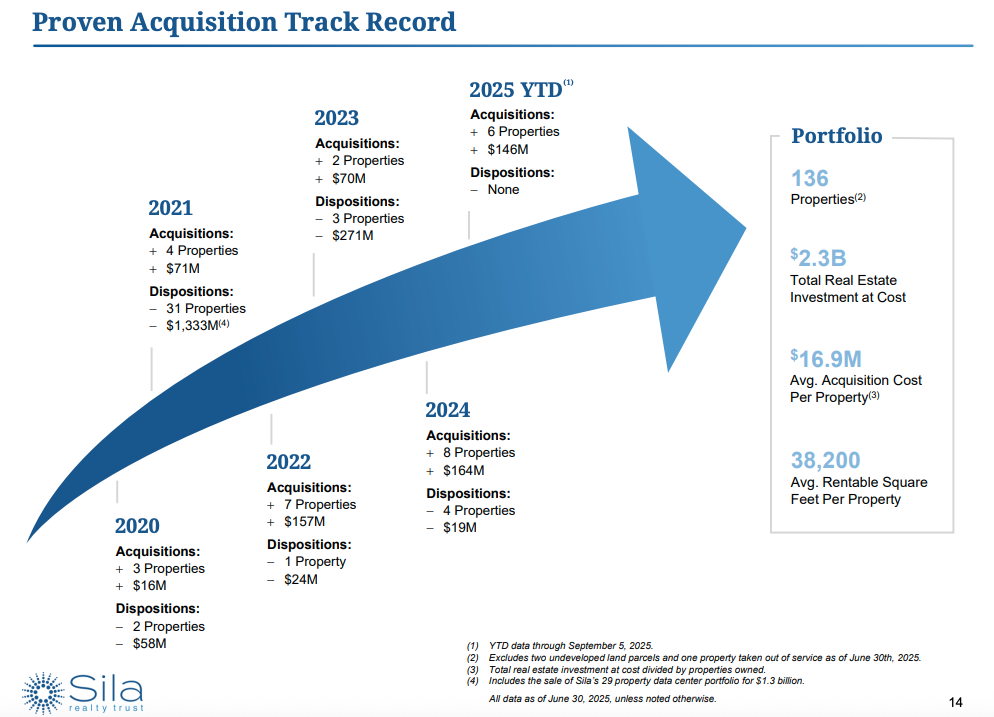
The year 2026 will be particularly interesting because Sila continues to see significant growth potential in its acquisition pipeline of around USD 43 million. In an environment where government healthcare spending continues to rise and the population is ageing, well-managed healthcare properties are increasingly in demand. SILA sweetens the wait until the undervaluation (P/FFO <11x) normalizes with a nice and well-covered dividend (dividend yield ~6.8%).
Residential REITs
Mid-American Apartments Communities
Mid-America Apartment Communities (TWS ticker: MAA, ISIN: US59522J1034) is one of the leading residential real estate REITs in the USA. The company owns over 104,000 apartment units in 16 states and focuses on the US Sunbelt. This growing region has seen particularly strong population growth in recent years, accounting for around 60 % of all domestic moves in the US. This demographic is a key driver for MAA's business. People are moving to where jobs are being created, and tenants appreciate modern, well-appointed apartment complexes. Nevertheless, a wave of new apartment projects since 2023 has put pressure on the market, particularly in the Sunbelt. Nevertheless, the REIT was largely able to maintain its FFO forecast and management expects FFO per share to average USD 8.74 for the current year. More importantly, however, the number of new projects is already declining and significantly fewer completions are expected for 2026.

Measured against the long-term valuation average, MAA is favorable. The current P/AFFO is just under 17.7x, while the ten-year average is around 19.4x. The dividend yield is a good 4.4 % and the REIT is continuously investing in smart home technology to increase the attractiveness of its apartments. I expect a slight recovery in rental momentum in 2026 as the new construction boom comes to an end and demand remains robust. Anyone looking for a solid residential REIT with a strong balance sheet and stable dividend could find what they are looking for in MAA, especially as the company has historically frequently revised its forecasts upwards.
Gaming REITs
VICI Properties
VICI Properties (TWS ticker: VICI, ISIN: US9256521090) owns one of the largest portfolios of casinos and entertainment properties in the USA. Unlike a casino operator, the REIT earns its money through long-term, mostly 40-year triple-net leases. This structure largely isolates the cash flow from the tenants' operating business. In 2025, however, the share price fell as weaker figures from the two largest operators Caesars and MGM caused uncertainty and the shares almost reached their pre-pandemic highs. However, the slump in visitor numbers in Las Vegas is more of a temporary nature and only indirectly affects VICI. Even during the pandemic, rental income has remained constant because the properties are essential for the operators. In addition, VICI is continuously diversifying its portfolio, most recently by acquiring the Stratosphere Casino and other properties at an attractive cap(italization) rate of 7.5 %.
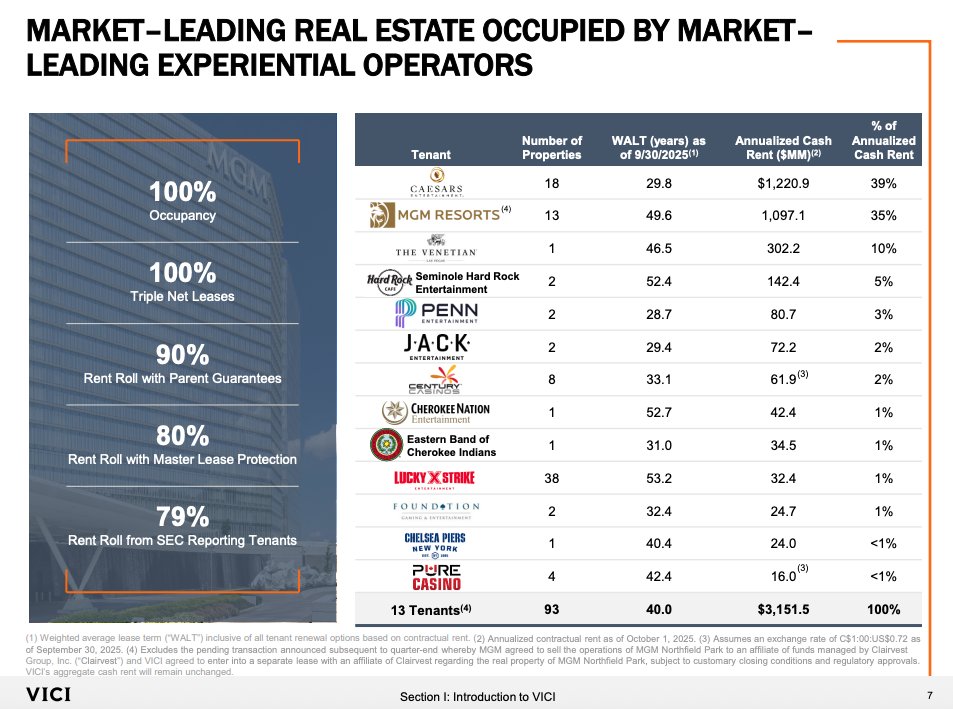
With a dividend yield of a good 6.34 % and a payout ratio of just 64 %, there is plenty of scope for further growth. With an expected AFFO multiple of around 12x, the valuation is well below the historical average and below the valuation of many peers. The main risks are a possible extension of the Las Vegas downturn and negotiations with Caesars over the regional master lease, but even in the worst case the dividend would be well protected. In the long term, experience will show that leisure and gaming properties will remain valuable thanks to their license protection and the expanding experience economy. As soon as the interest rate environment normalizes, the share could rise again towards a five percent dividend level, opening up a share price opportunity of 20 to 30 %.
Retail REITs
NNN REIT
At NNN (TWS ticker: NNN, ISIN: US6374171063), the name says it all. The REIT focuses on long-term triple-net leases with retailers in the USA. The portfolio is broadly diversified across 3,500 locations and around 350 tenants. The REIT has the longest uninterrupted dividend increase record in the net lease sector at 36 years. In Q3 2025, the company slightly exceeded its earnings expectations, AFFO per share increased by around 2.4 %, and the annual forecast was marginally raised. However, the reported portfolio turnover is high. NNN is selling and buying more properties than originally planned in order to optimize its portfolio. At the same time, there was a slight decline in the occupancy rate from over 99 % to 97.5 %, which is attributable to a number of distressed tenants. These have already been partially resolved through the sale of vacant properties. Despite this decline, the balance sheet remains solid. The average residual term of the debt is over ten years, net debt is around 5.6 x EBITDA and the investment grade rating ensures favorable refinancing.
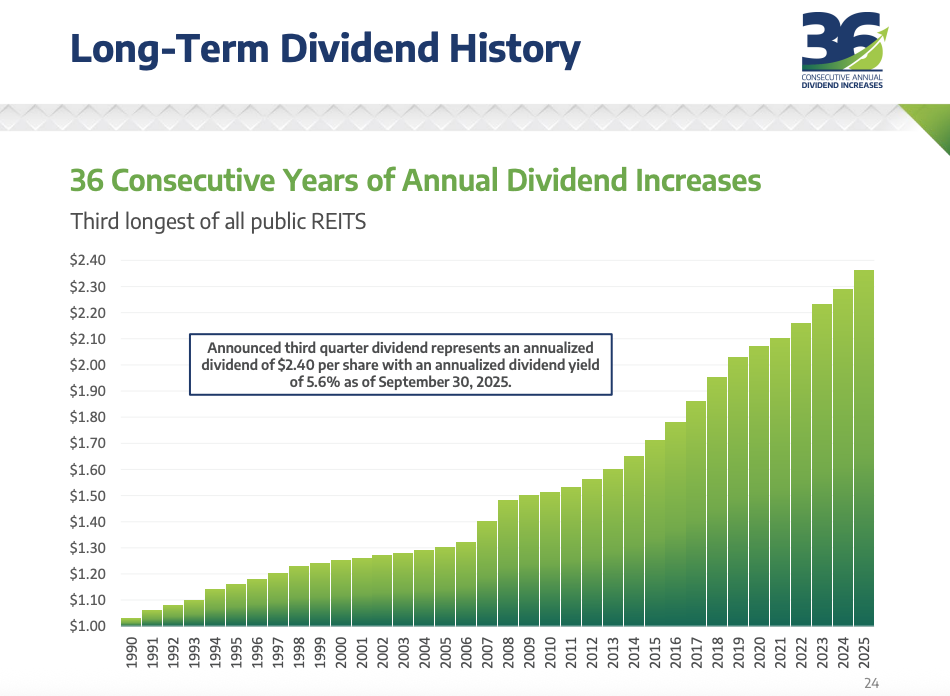
With a P/AFFO of less than 12x and a Dividend yield of around six percent, NNN continues to appear very attractive. Most leases have annually increasing rents, so even low growth expectations should ensure moderate earnings growth. If interest rates fall in 2026 as expected, Net LeaseREITs could benefit more than average. I therefore expect a price potential of around 25 % with limited risk, especially as the management is acting very conservatively.
Options trading
I myself also act actively Optionsbut almost exclusively as a so-called "writer". I am therefore naturally also interested in the REITs mentioned above, which are suitable for additional Cash flow or for a favorable entry by means of delivery. The Volatility (VIX) is currently at a rather low level again. Unfortunately, the spreads are too high for AHH, SILA.
CubeSmart: For CUBE there are Short Puts with a Strike from $35 in January '26 or longer continuously with Strike from $35 in August '26 (higher spread), which deliver a decent premium.
SBA Communications: For SBAC a Bull Put Spread mit Strikes of $190 for the short put and $180 for the long put in January '26 an.
Mid-American Apartment Communities: For MAA a Bull Put Spread mit Strikes of $135 for the short put and $125 for the long put in January '26 an.
VICI Properties: For VICI there are Short Puts with a Strike of $27.5 in January '26 or longer continuously with Strike of $27.5 in January '27 (higher spread), which deliver a decent premium.
NNN REIT: For NNN there are Short Puts with a Strike of $40 in January '26 or longer continuously with Strike of $40 in June '26 that deliver good premiums.
Conclusion
A closer look shows that there are still exciting investment opportunities in the REIT universe. The REITs presented here operate in different sectors, but they have one thing in common. In my view, they are attractively valued and offer an interesting combination of current income and upside potential. Armada Hoffler is repositioning itself and could rise sharply thanks to a high valuation discount. SBA Communications is benefiting from the global expansion of digital infrastructure. CubeSmart should benefit from the AI-driven mobility push following the consolidation of the self-storage market. Sila Realty Trust offers a defensive alternative in the healthcare sector with a growth spurt from future acquisitions. Mid-America Apartments is the quality leader in the Sunbelt apartment market, which will benefit from a slowing wave of new construction. VICI Properties offers a defensive entry into the experience economy with high dividends. And NNN REIT stands for security and predictable rental income with catch-up potential when interest rates fall. Of course, there are also risks. Debt, regulatory intervention and cyclical fluctuations remain constant companions. But those who are patient and invest in a broadly diversified manner should be able to make a good start to 2026 with these REITs.