The Q1 earnings season is in its final stages and so in today's blog post we take a look at the figures for a number of Real Estate Investment Trusts (REIT) an. In the article REIT Q1 Sector Overview - On the wrong track, I would like to discuss the net lease sub-sector as well as the rather exotic-looking timber sector. Basically, every REIT can be assigned to a sector quite easily, depending on the property type or purpose (with a few exceptions). The business model may often be the same, but within a sector there are specific challenges for the companies.
Net Lease REITs
The first sector I would like to discuss is not officially a sector in its own right, but rather a type of letting, namely (triple) net leases. Such REITs impose all kinds of burdens on their tenants that many other REITs take on themselves. This includes almost all costs that may arise, such as maintenance costs, any taxes or real estate insurance. Net lease REITs often have very long-term leases of up to 20 years, including various renewal options and annual rent increases as well as inflation clauses. All of this ensures lower expenses for the company on the one hand and a certain amount of organic growth on the other. As a result, net lease REITs usually have a lower valuation than REITs from other sectors or with the classic rental model. In addition, net lease REITs are dependent on acquisitions for inorganic growth.
Canadian Net REIT
Canadian Net REIT (TWS abbreviation: NET.UN, ISIN: CA13639A1093) is a classic small cap REIT with a market capitalization of only around CAD 110 million. In an earlier Blogpost I went into a little more detail at NET.UN.
Canadian Net delivered a strong comeback in the first quarter of 2025. After two years of stagnating cash flows, Fund From Operation (FFO) per share increased by an impressive % 8. The management promptly used this to increase the dividend - albeit "only" by 1.5 %. Symbolically, however, this step is important, as it signals a return to growth and strengthens investor confidence. Tailwinds are certainly coming from the Canadian central bank, which has now cut key interest rates seven times to 2.75 % - with further easing in sight. This opens up new scope for companies with higher debt, e.g. growth-oriented REITs such as NET.UN.
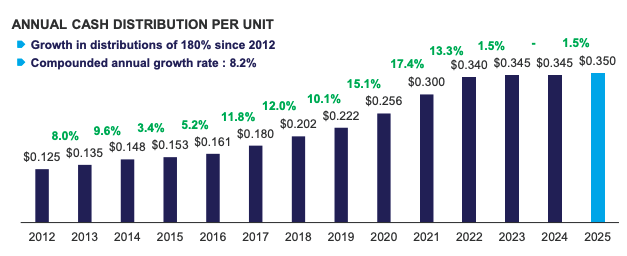
Distributions and dividend growth over time
(Source: Canadian Net REIT Management Discussion & Analysis Q1 2025)
Despite the progress made, the REIT is currently only valued at P/FFO of 8.5x, which is still a massive discount compared to US counterparts such as Essential Properties Realty Trust (TWS abbreviation: EPRT), which achieve over 18x FFO. At the same time, NET.UN is the only net lease REIT in Canada and operates there virtually without competition. The fragmented market allows for attractive acquisitions that are too small for large US players, but create real added value for NET.UN.
CEO Kevin Henley has also confirmed this in various interviews: The company is concentrating on sustainable, FFO-effective growth. No wild expansions for the sake of size, but disciplined portfolio management with a focus on shareholder value. The return on equity remains high, debt is gradually being reduced with the remaining cash flow and a monthly dividend payment (Dividend yield ~6.5 %). And that with a very low payout ratio of just over 50 %.
NetsREIT
NetSTREIT (TWS ticker: NTST, ISIN: US64119V3033) is a net lease representative that focuses primarily on retail real estate and currently operates a portfolio of 695 properties in 45 US states. The REIT has been working for some time to reduce tenant concentration and made further progress in Q1. The share of the five largest tenants has been reduced to 28.2 % of rental income, with Dollar General (TWS ticker: DG) in particular reduced to 8.1 % and is expected to fall below 5 % by year end. In the first three months of the year, around $91 million was invested in new properties, with an average initial yield of 7.7 %.
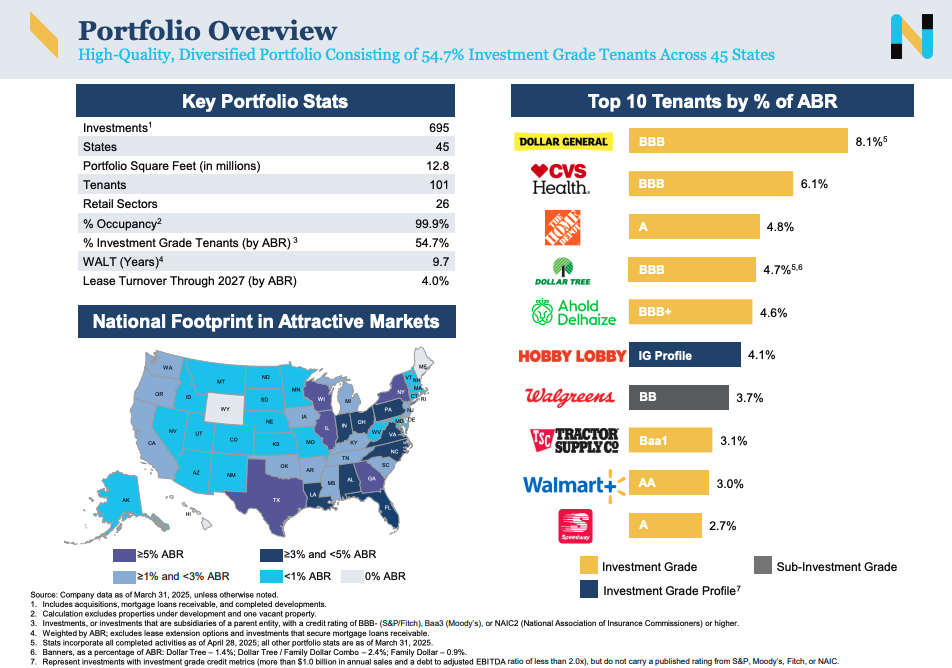
Tenant structure & portfolio overview (Source: NetSTREIT Investor Presentation April 2025)
At the same time, properties were sold for $40 million and the funds were reinvested quite sensibly in my opinion. The Adjusted Fund From Operations (AFFO) per share was $0.32, a slight increase on the previous year. The balance sheet remains solid with a leverage ratio of 4.7 times EBITDAre and over $500m in available liquidity. Even though the retail sector continues to struggle with uncertainties in the consumer environment, NetSTREIT is positioning itself increasingly robustly.
Timber REITs
Forestry land has long been regarded as a solid but less dynamic asset class. However, structural trends such as climate protection, the expansion of renewable energies and the growing demand for land that can be developed are giving timber REITs new relevance. Particularly exciting: the opportunity to benefit simultaneously from increases in value through land rezoning, CO₂ certificates and sustainable demand for raw materials - while at the same time enjoying stability through real assets. Many things are also changing within the industry: technological advances such as AI-supported management and the use of drones are increasing efficiency and sustainability. As a result, timber REITs are moving more into the focus of long-term investment strategies. With this in mind, I took a look at the latest quarterly figures from two leading companies in the sector.
Potlatchdeltic
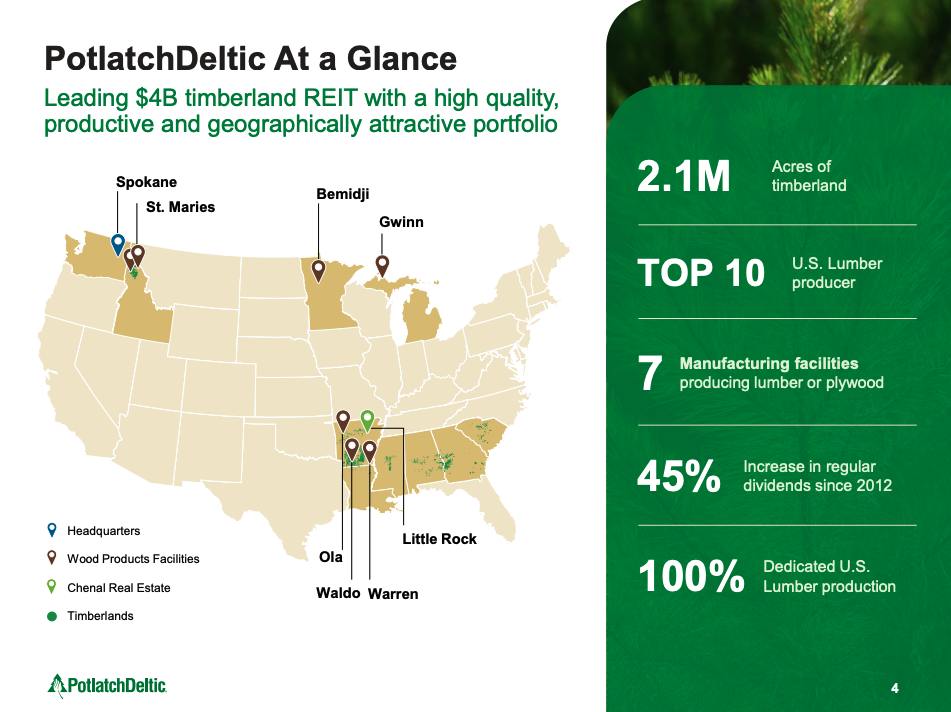
Potlatchdeltic (TWS ticker: PCH, ISIN: US7376301039) is a Timberland REIT with a vertically integrated structure, i.e. including its own timber processing operations, and owns around 2.1 million acres spread across regions such as Idaho, Arkansas and the south of the USA. The share is currently trading at around 0.65 times net asset value, which is already considered quite cheap from a historical perspective. There was little of note in the quarter itself, but valuation issues came into focus.
With options, some institutional investors were able to realize attractive entries below the long-term NAV. A look at the futures market has also shown that professional players are betting on a stabilization of timber prices. A certain degree of volatility on the timber market and increasing forest fire risks remain challenges - particularly in the western regions of the country, where there have already been major fires recently.
Rayonier
The more interesting Timber REIT in my view is Rayonier (TWS ticker: RYN, ISIN: US7549071030), which made a major strategic move in the first quarter of 2025. With the sale of its New Zealand portfolio, the REIT is now fully focused on the US market! The proceeds from this transaction add up to around $700 million and have significantly strengthened the balance sheet. Debt is now only 0.3 times EBITDA, with a very favorable and long-term fixed interest rate of 2.4 %. Furthermore, the management has announced the buyback of up to 8 % of its own shares in order to reduce the discount to the intrinsic value in a targeted manner. In addition, a special dividend of between $1.00 and $1.40 per share was announced.
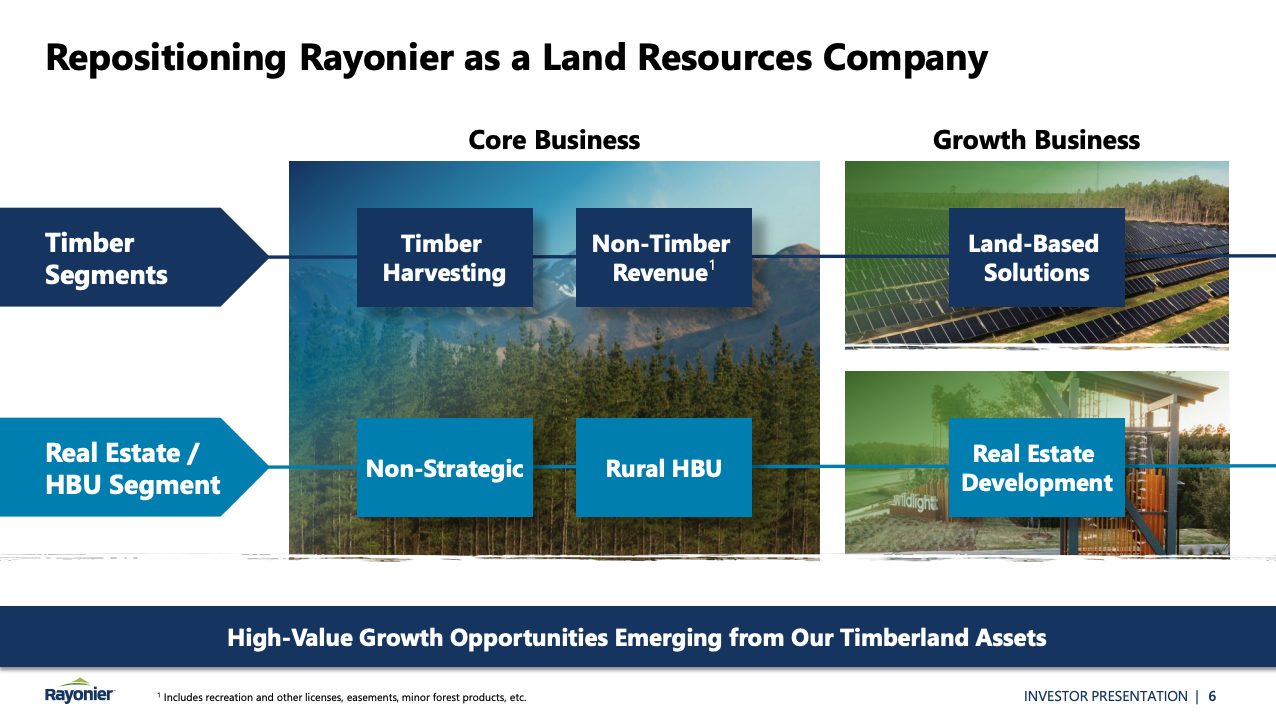
(Source: Rayonier Investor Presentation June 2025)
Rayonier owns around 2.5 million acres, mainly in the south of the USA, where not only sustainable timber utilization but also alternative uses such as solar leases and residential (space) development are becoming economically attractive. The demand for timber in the USA is likely to increase in the coming years, partly because many houses are in need of renovation and additional living space is required. Despite temporarily weaker cash flows due to restructuring, Rayonier remains well positioned operationally. The combination of real assets, low debt and targeted value creation from land use currently makes the REIT particularly attractive.
Options trading
I myself also act actively Optionsbut almost exclusively as a so-called "writer". I am therefore naturally also interested in the REITs mentioned above, which are suitable for additional Cash flow or for a favorable entry by means of delivery. The Volatility (VIX) has been falling again recently, but is now on the verge of a possible upward breakout due to the Israel-Iran conflict, which must and should always be taken into account when placing cash-secured puts. Perhaps a little patience will result in much more interesting setups. Unfortunately, there are no option chains available for Canadian Net REIT.
- NetSTREIT: For NTST there are Short Puts with a Strike from $15 in November '25 or longer continuously with in February '26 that offer reasonably decent premiums. However, the spreads are higher here.
- Potlatchdeltic: At a price of ~$35, the P/NAV is only 0.60x, which is why this is an interesting level, so Short Puts with a Strike of $35 in November '25 or February '26 a possibility.
- Rayonier: At RYN, the brand around $20 is quite interesting, therefore Short Puts with a Strike from $20 in November '25 an.
Conclusion
The article focused on two REITs from each of the net lease and timber sectors and highlighted the characteristics of the individual sectors and companies. The focus was again on the latest news that was communicated in the first quarter.