The earnings season is almost over again and almost all Real Estate Investment Trusts (REIT) have now reported quarterly figures. In the article REIT Q4 Sector Overview - New Opportunities in Uncertain Times, I would like to take a closer look at two sectors and two REITs each, namely Residential and Healthcare. Basically, every REIT can be assigned to a sector quite easily, depending on the property type or purpose (with a few exceptions). The business model may often be the same, but within a sector there are specific challenges for the companies.
Residential REITs
The residential sector has experienced quite a dynamic development in recent years. Rising rental demand, particularly in urban areas, and a limited supply of affordable housing have driven up rental prices. However, in some markets, particularly in the south of the USA, there has in turn been an increase in the supply of housing, which has led to a temporary oversupply. This oversupply has increased pressure on rental prices and impacted rental occupancy rates and must be absorbed by companies over time. BSR REIT and Sun Communities are two REITs that have to overcome different challenges.
BSR REIT
BSR REIT (TWS abbreviation: HOM.U, ISIN: CA05585D1033) is a genuine small cap REIT with a market capitalization of only around USD 670 million. However, it is a very interesting representative, as the share is listed on the TSX in Canada (in both USD and CAD), but the portfolio itself is located exclusively in the Sunbelt States in the USA and currently consists of "only" 31 properties. But more on that in a moment. The location of the assets is quite interesting in that there has been a migration to the South in the States in recent years.

Overview of properties sold (Source: BSR REIT $618.5 Million Transaction Presentation)
BSR REIT recently announced the sale of nine properties totaling 2,701 residential units to AvalonBay Communities (TWS ticker: AVB, ISIN: US0534841012) for USD 618.5 million. This strategic decision is aimed at further optimizing the portfolio and freeing up capital for future investments. The sale price corresponds to approximately USD 229,000 per residential unit, with an average monthly rent of USD 1,675. The sale is very positive in that the cap(italization) rate for the assets is 5.1%. This in turn confirms the net asset value (NAV), as the portfolio is valued at a cap rate of 5.2% and clearly shows that there is still a massive undervaluation here. The NAV per share is currently USD 16.75, the share price is around USD 12.30, which corresponds to a discount of around 37%. The sale will also generate a net profit of USD 111 million. The total proceeds are to be used in part to reduce debt and also to invest in new properties. Looking at other ratios, BSR REIT is currently valued at a P/AFFO of around 14x. Historically, the multiple has been closer to 17-18x. And as long as you wait, you also get a nice dividend (Dividend yield currently approx. 4.5%), which is also classified as return on capital (RoC).
Sun Communities
Another residential REIT with interesting news to report in Q4 is Sun Communities (TWS symbol: SUI, ISIN: US8666741041). The REIT also specializes in so-called manufactured housing, but also has RV parks and marinas in its portfolio. And the news revolves around the latter, as the management has agreed to sell the marina segment to the infrastructure division of Blackstone (TWS abbreviation: BX, ISIN: US09260D1072).
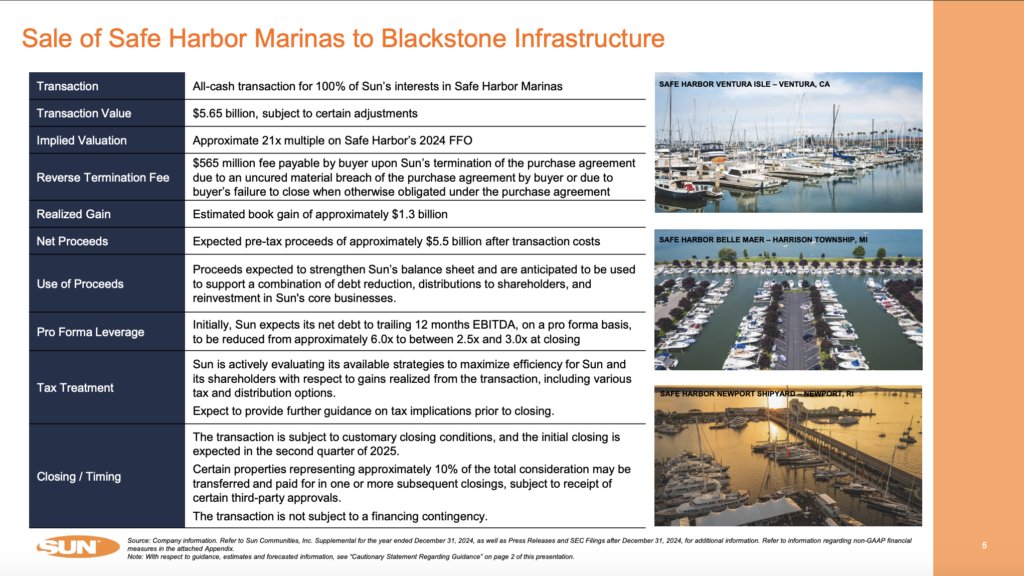
Summary of the Safe Harbor Marinas sale (Source: Sun Communities Investor Presentation - February 2025)
The deal is expected to close in Q2 2025 and would generate a total of USD 5.5 billion in net proceeds and a realized gain of USD 1.3 billion for SUI. With the funds, management plans to bring the increased leverage of Net Debt/EBITDA 6x into a range of 2.5x-3x. On the valuation side, SUI is slightly undervalued with a P/AFFO of around 22x, slightly below the historical value of 24x. The dividend yield is currently 2.9%, but it remains to be seen whether this will be adjusted after the Safe Harbor Marinas sale, as the current quarterly dividend is slightly higher than the funds from operations for the quarter.
Healthcare REITs
The healthcare sector is facing numerous challenges. Healthcare REITs play a crucial role in providing the necessary infrastructure and at the same time face the task of adapting their portfolios to the changing requirements of the market. This is because the US population is also getting older, which increases the need for modern facilities. However, financing is often a very political issue and as financing costs are still high, not enough new healthcare properties are being built. The tenants of the healthcare REITs are also facing problems (e.g. due to rising operating costs and unclear financing) and are themselves the REITs' liability if a corresponding financial imbalance arises. The following two healthcare REITs have to contend with all of the above challenges, with varying results.
Medical Properties Trust
Medical Properties Trust (TWS abbreviation: MPW, ISIN: US58463J3041) is a healthcare REIT representative that has exemplified the problems faced by companies in this sector in recent months and years. First and foremost were the tenants and the weighting in the portfolio. In the case of MPW and other healthcare REITs, this was primarily Steward Health Care, which is now going through Chapter 11 proceedings. The problems were exacerbated by MPW's various shareholdings in the tenants and the loans granted. All this also resulted in several short-seller reports. The management is now in the process of steering the REIT from stormy seas back into calmer waters. However, the road is and remains long.
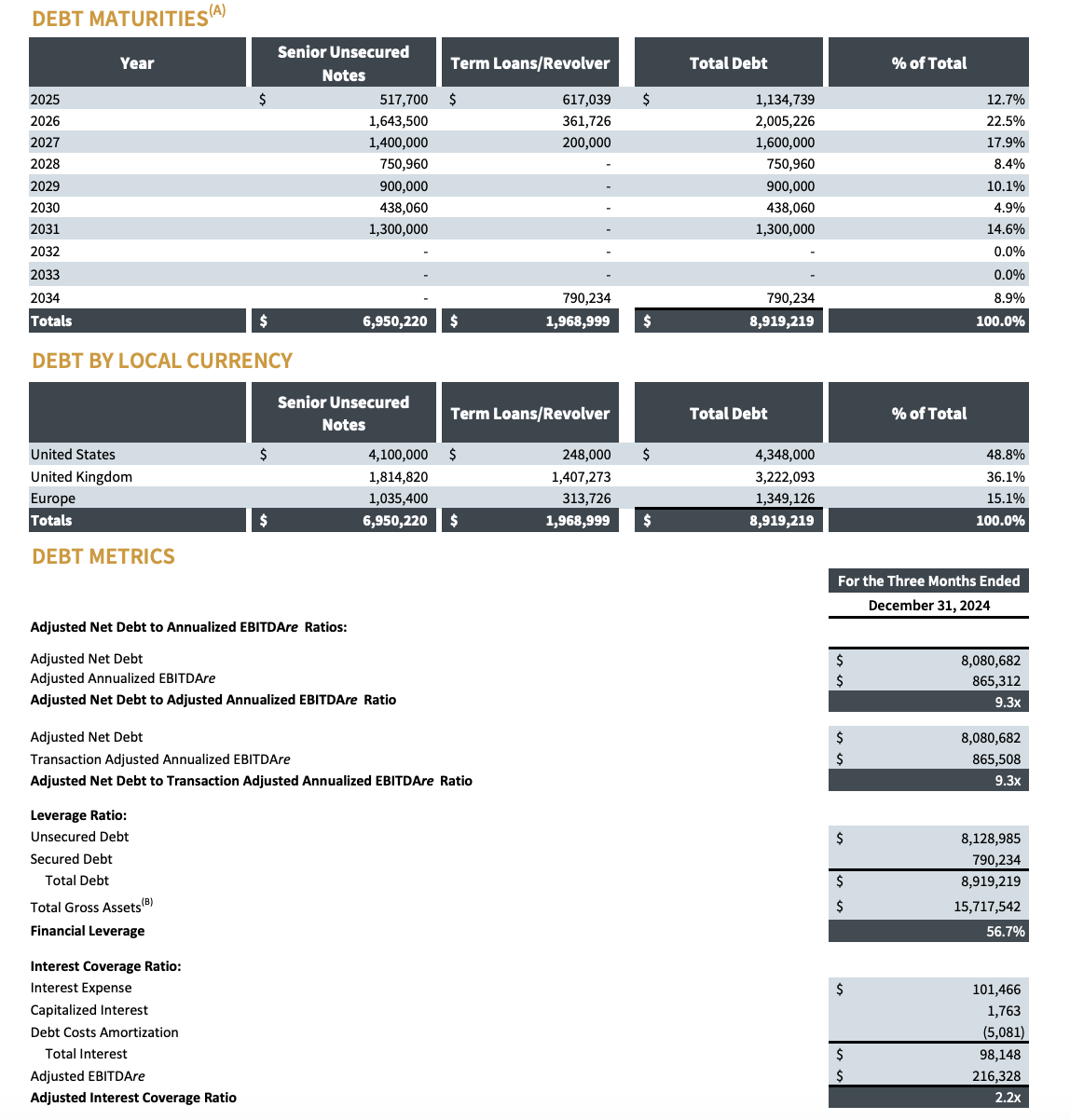
It must be acknowledged that Medical Properties Trust took important steps in 2024 to strengthen its financial stability and optimize its portfolio. A total of USD 5.5 billion worth of properties were sold to reduce debt. In February, USD 2.5 billion of secured debt was issued, albeit at a hefty interest rate of 7.885 %. The positive aspect of this is that many analysts thought it was impossible for the REIT to refinance itself in this way. For the time being, these measures cover all maturities until 2026. However, the net debt/EBITDA ratio of 9.3x remains very, very high. Refinancing at higher interest rates will increase interest expenses and could have a negative impact on FFO per share. In addition to Steward, Prospect Medical is another problem tenant that is now insolvent. However, an agreement was reached on the sale of the corresponding properties. In purely valuation terms, MPW is valued favorably compared to historical multiples, although interest costs are likely to exert considerable pressure here. It is and remains a turnaround story and this is rarely done quickly.
Sila Realty Trust
With a market capitalization of USD 1.4 billion, Sila Realty Trust is a smaller REIT in the healthcare sector (TWS abbreviation: SILA, ISIN: US1462805086). The company is still fresh on the stock market, as its IPO was only in June 2024. The focus is less on hospitals, but on outpatient medical and inpatient rehabilitation facilities, as well as those with a focus on surgery. SILA was also affected by the insolvencies of Steward Health Care (and GenesisCare), but to a much lesser extent than Medical Properties Trust. The corresponding assets have already been re-let or sold.
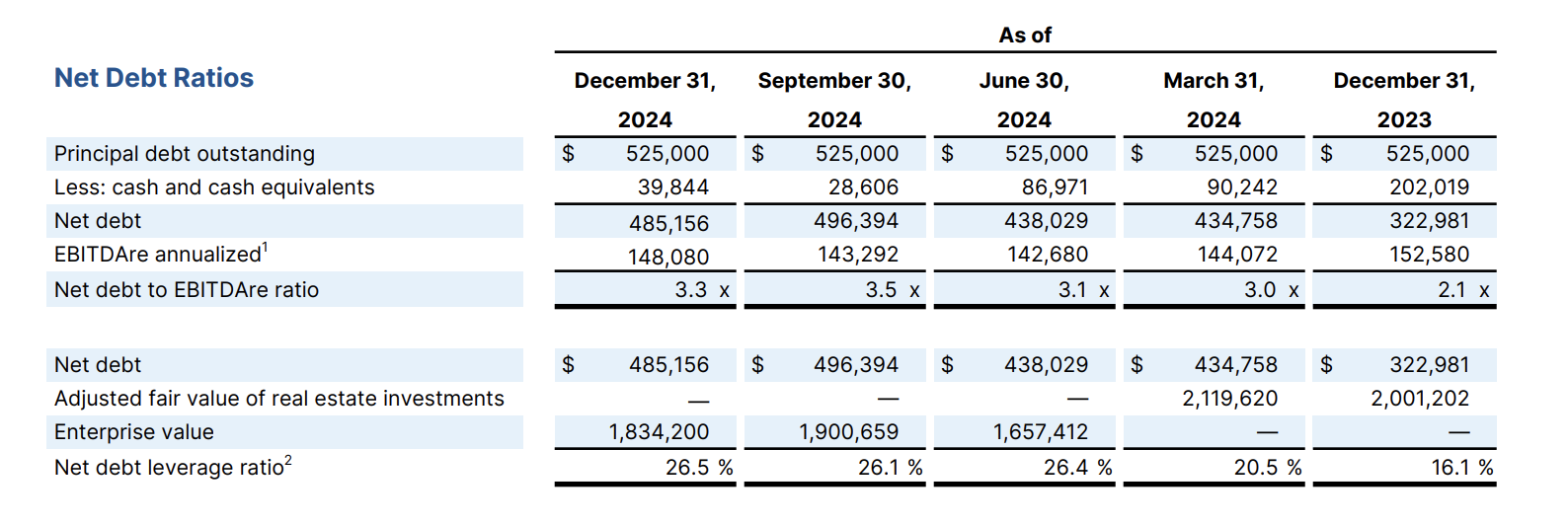
At Sila Realty Trust, you can also see quite clearly that the debt is significantly better with a net debt/EBITDA 3,3x. Furthermore, there are no significant maturities until 2028. The dividend, which was previously paid monthly, has been converted to a quarterly dividend and is well covered with a payout ratio of just under 70%. There are also funds left over to acquire new facilities. The dividend yield currently stands at 6.3%.
Options trading
I myself also act actively Optionsbut almost exclusively as a so-called "writer". I am therefore naturally also interested in REITs that are suitable for additional Cash flow or for a favorable entry by means of delivery. The Volatility (VIX) is currently significantly higher due to the punitive tariffs announced by the Trump administration and concerns about economic development, which on the one hand makes premiums more interesting, but on the other hand should also result in prudent action.
- Sun Communities: For SUI there are Short Puts with a Strike of $120 in April '25 or longer continuously with $115 in October '25 that offer decent premiums. However, the spreads are high.
- Medical Properties Trust: For MPW there are Short Puts with a Strike of $4.5 in May '25 or longer running (LEAP) with $4.5 in January '26 an.
Conclusion
Two REITs each from the residential and healthcare sectors were discussed in the article, highlighting the challenges they face and how the companies are responding to them. The focus was on the latest news that was communicated in the fourth quarter, particularly with regard to the current valuation and debt.