In my last blog post on BDCs and the so-called „Software Crash 2026“ I described how the price losses in the software sector are also spreading to other asset classes and why dividend cover and portfolio quality play a central role in credit-like investment vehicles. But now it's time for the traditional REIT Q4 sector overview. I would therefore like to take another look at the various real estate sectors.
The macro situation remains rather mixed. While Net Lease REITs are benefiting from the turnaround in interest rates (is it really coming?) and favourable or more favourable financing conditions, while the supply overhang in the retail and industrial sectors is slowly abating and demand appears to be stabilizing.
As usual, the following article summarizes the most important developments in some sectors and highlights 2-3 representative REITs each and classifies the latest Q4 and FY2025 results.
Net Lease REITs
Net lease REITs are something like the bonds of the real estate universe. Their long-term triple-net leases offer a high degree of predictability. At the same time, their valuations are heavily dependent on the interest rate markets, particularly interest rates at the long end. An environment of disinflation, falling capital market interest rates and solid economic growth is ideal for net lease REITs. This is because falling corporate bond yields reduce financing costs and at the same time increase the intrinsic value of future cash flows. As a result, net lease REITs clearly outperformed the broad real estate market in 2025 and also in 2026. The question is whether this will continue or whether the economic and geopolitical situation could lead to a renewed rise in inflation (the bullwhip effect), which could result in interest rate hikes instead of cuts.
NNN REIT
NNN REIT (TWS ticker: NNN, ISIN: US6374171063) sold around USD 100m of vacant properties in 2025 and bought USD 931m of new properties, increasing the occupancy rate to 98.3 %.
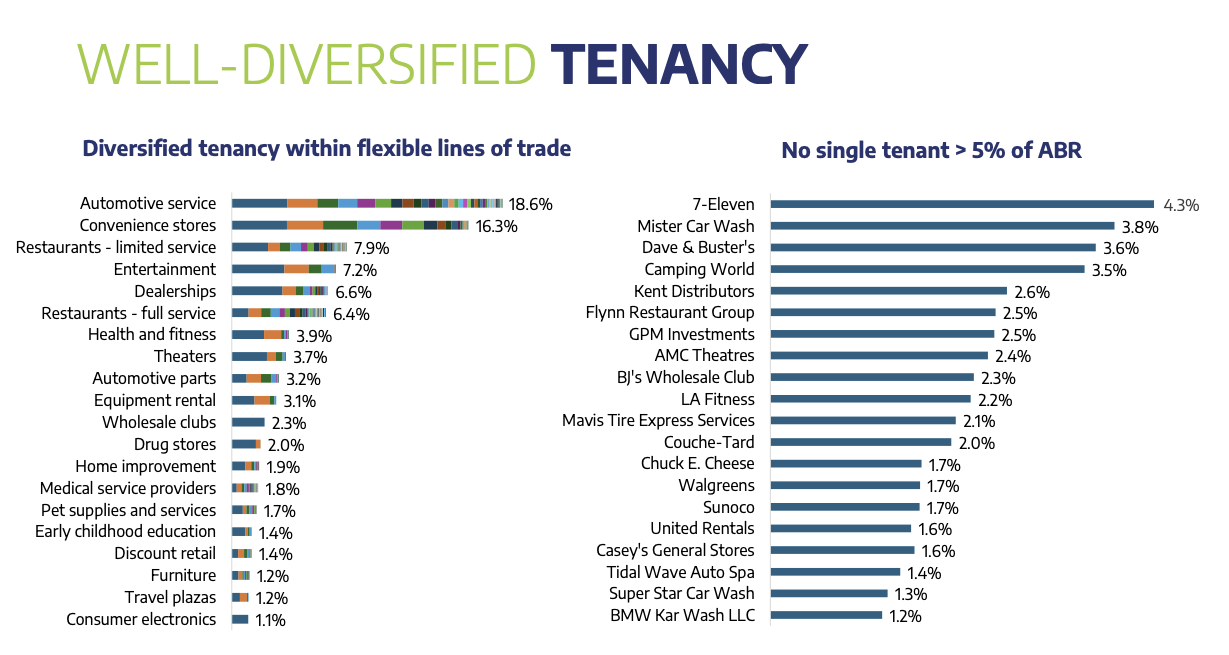
Tenant and sector diversification (source: NNN REIT Investor Update March 2026)
The average remaining term of the leases (10.2 years) is well aligned with the average term of the debt (10.8 years). AFFO per share have grown by 2.7 % and growth is expected to increase to 3.2 % in 2026.
With a dividend yield of 5.3 %, a moderate Debt-equity ratio (Net Debt/EBITDA 5.6×) and a price/AFFO multiple of only 12.6×, there is also a lot of upside possible in comparison with historical multiples. In return for the wait, the dividend has been rising for 36 years.
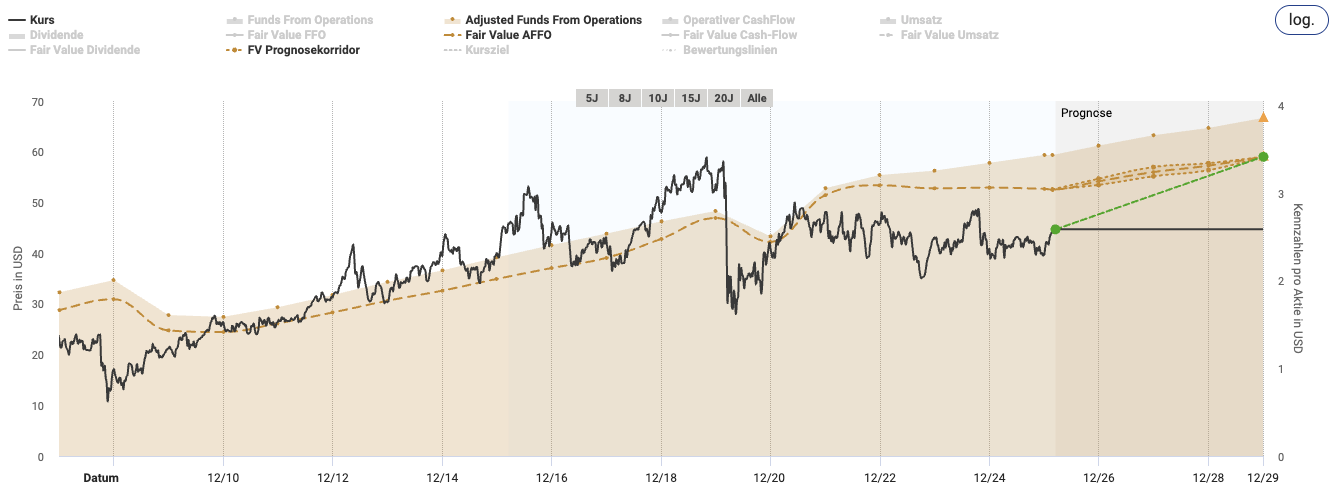
Fair value NNN REIT (source: aktienfinder.net)
W.P. Carey
W.P. Carey (TWS ticker: WPC, ISIN: US92936U1097) is one of the REITs that is much more globally positioned than some of its peers. Around 1/3 of the properties in the portfolio are in Europe. WPC was able to achieve AFFO growth of 5.7 % in 2025 and the Dividend by around 4 %. Due to the sale of a total of 63 self-storage properties and hotels, the non-net lease share has now shrunk to a few percent. The office segment of the portfolio had already been divested in 2023 and released into the open via the spin-off Net Lease Office Propertiers (TWS ticker: NLOP, ISIN: US64110Y1082). NLOP was (in retrospect) a very interesting asset play.
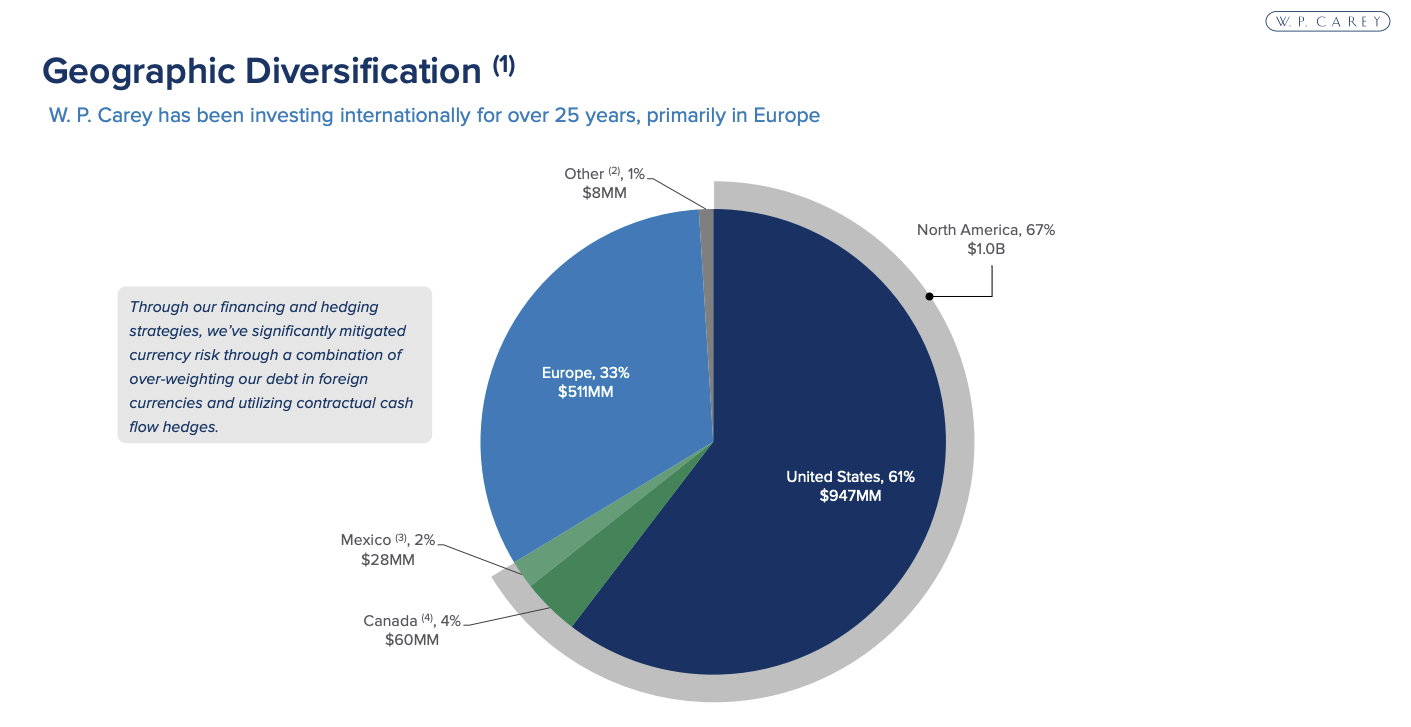
Geographical Diversification (Source: W. P. Carey Inc. investor presentation 4Q25)
For 2026, management expects around USD 1.5 billion in acquisitions and USD 500 million in further disposals. The portfolio turnover is therefore not over yet.
AFFO per share is expected to increase by 4.2 % in 2026. The dividend yield is around 5.2 %, i.e. still in the focus of income investors. With a P/AFFO multiple of 13.9×, there is still a discount compared to sector peers. The market does not yet seem to be fully rewarding the transformation into a pure net lease player.
VICI Properties
VICI Properties (TWS ticker: VICI, ISIN: US9256521090), the specialist for adventure and casino real estate, has reported AFFO growth of 5.1 % for the full year 2025. I already wrote about the very special net lease REIT and its challenges in the first article 2026 written in detail.
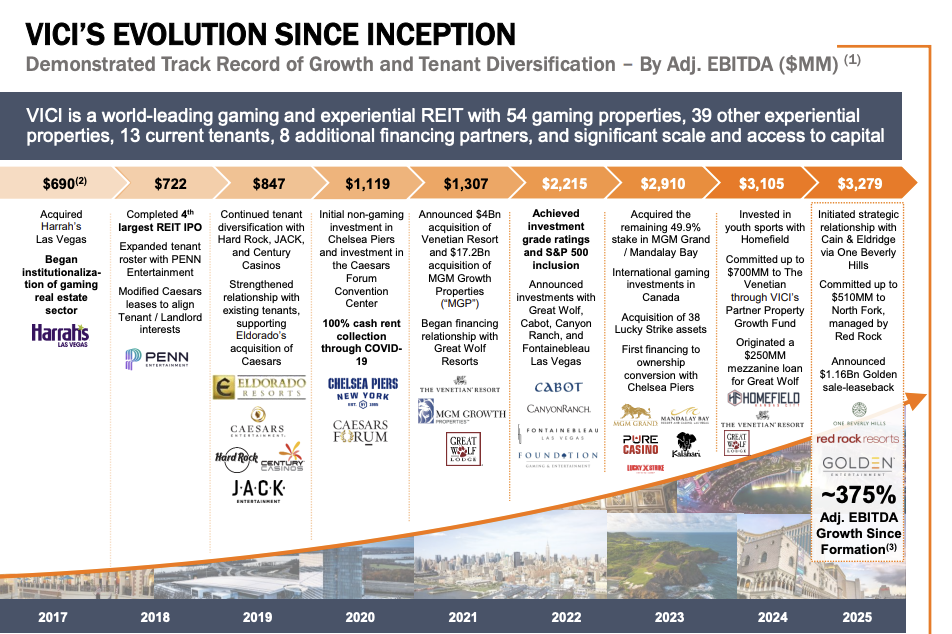
VICI growth story (Source: VICI Investor Presentation)
The main investments included a USD 1.16 billion portfolio of seven casinos (7.5 % initial yield) and structured financing. This year there is also a stronger focus on debt, as VICI has to refinance USD 1.75bn of bonds and redeem around USD 250m of preferred shares, which is why management is forecasting weaker AFFO growth of only 2-3 %.
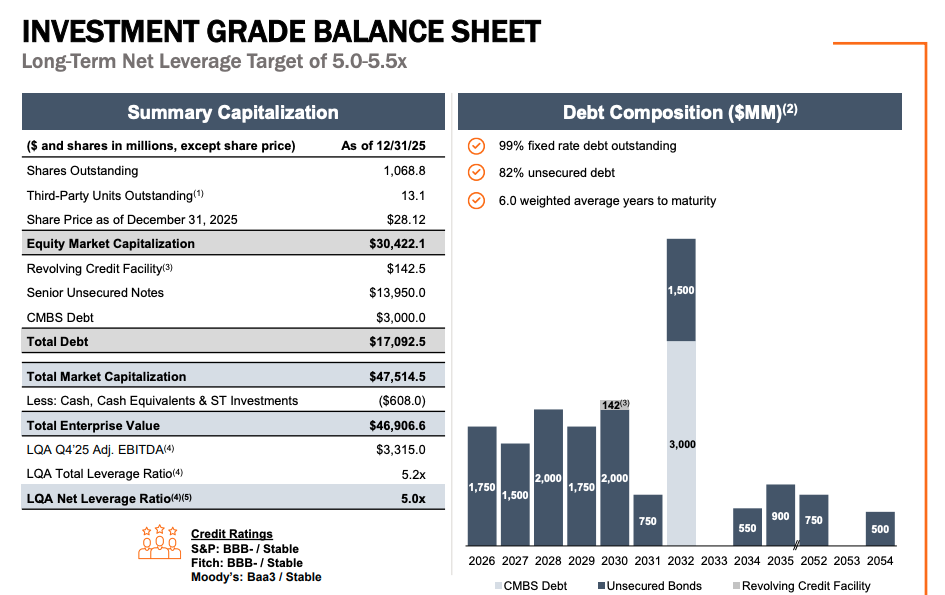
Balance sheet, debt and maturities (Source: VICI Investor Presentation)
The share is currently trading at 11.7× AFFO and a historically high Dividend yield of ~6.3 %, which should continue to grow at 2-5 % p.a.
Retail REITs
Brick-and-mortar retail has left the „retail apocalypse“ narrative behind. E-commerce and omni-channel remain important growth drivers, but supply is scarce due to the low level of construction activity in the retail segment. The world's largest commercial real estate services and investment firm CBRE Group expects the low supply to keep vacancy below 6 % for the foreseeable future and that rental growth of 2 to 2.5 % per year will lead to a new equilibrium in the retail market. After a slight decline in net absorption in 2025, CBRE expects net absorption to outpace low completions again in 2026. In short, demand is solid, but low construction activity is creating pricing power.
Whitestone REIT
Whitestone REIT (TWS ticker: WSR, ISIN: US9660842041) is a REIT with a smaller Market capitalization, which, however, has proven in the current year that a small-scale portfolio focused on the Sunbelt can generate high growth. Net operating income (NOI) increased by 4 % in 2025 and management expects a range of 3-4.75 % for 2026.
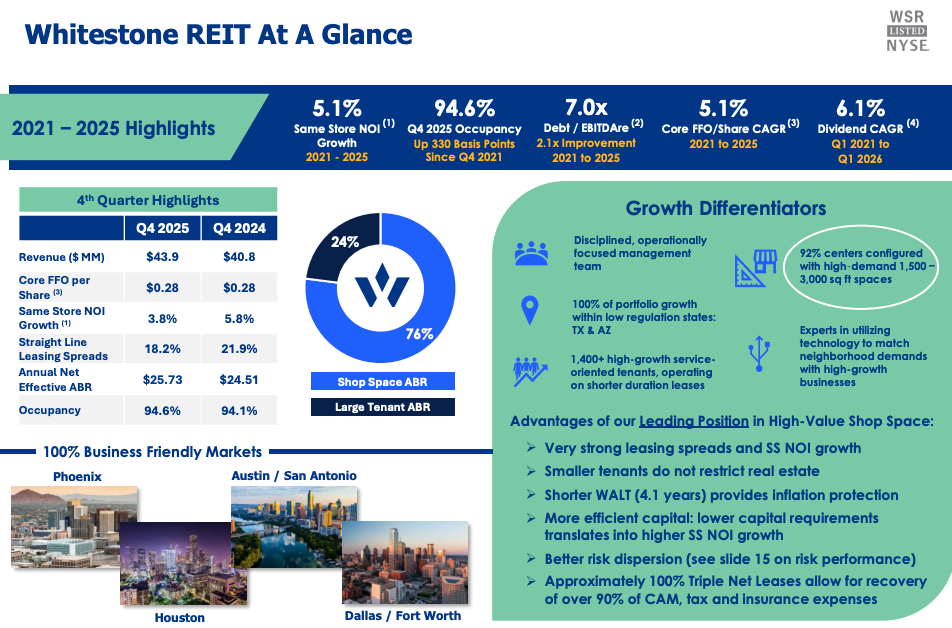
Whitestone REIT at a glance (Source: Whitestone REIT Q4 2025 Earnings Presentation)
At the same time, legal proceedings against the former CEO have been settled and the balance sheet has been strengthened through targeted sales.
FFO growth is expected to accelerate to 6.5-7 % in 2026, which is why the monthly dividend paid (dividend yield ~3.4 %) is well covered. At around 14.7× core FFO, there is certainly still some upside potential, especially as very concrete takeover rumors keep circulating. For example, two offers have already been rejected by MCB Real Estate.
Kite Realty Group Trust
Kite Realty Group (TWS ticker: KRG, ISIN: US49803T3005), which focuses primarily on grocery stores, recorded same-property NOI (SPNOI) growth of 2.9 % in 2025 and thus remained at the forefront of the industry and sector. Cash leasing spreads of over 20 % for new and renewal contracts have signaled strong rent increases. In Q4, growth fell slightly to 1.7 %, but was still well above the historical average.
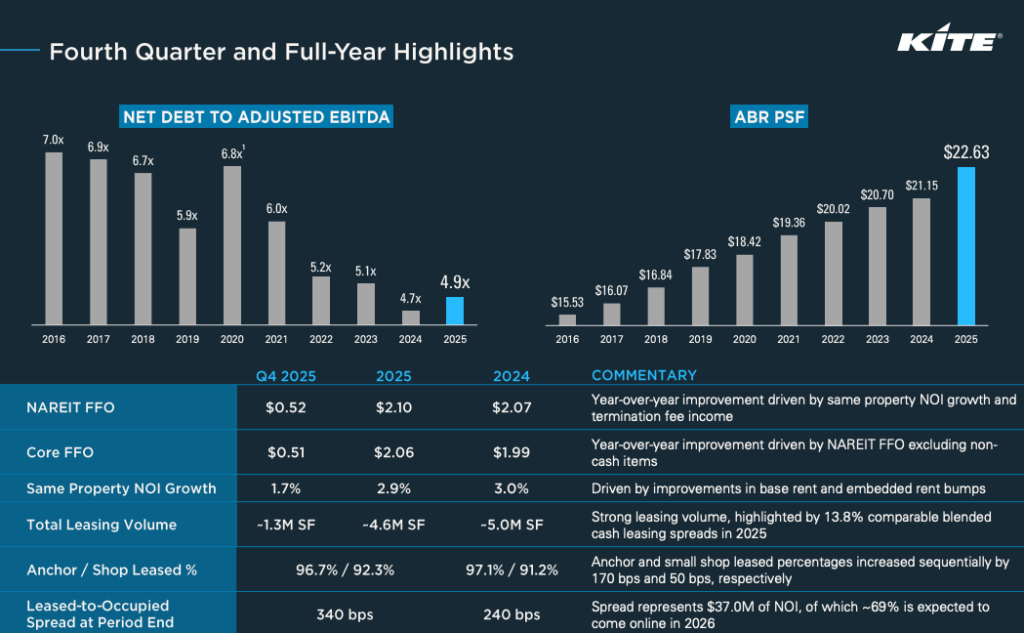
KRG Q4 and FY2025 highlights (Source: Kite Investor Update Q4 2025)
The balance sheet is rather conservative with a net debt/EBITDA of 4.9×, and KRG has used some of the capital surplus to buy back shares worth around USD 230m, at a return of just over 9 % on invested capital. Not bad!
For 2026, management expects a slight decline in SPNOI growth to 2.75 % and FFO growth of around 1.5 %, primarily due to refinancing. The share is trading at around 12.3× core FFO and a dividend yield of 4.5 %.
Kimco Realty
Kimco, with its national, also predominantly grocery-anchored portfolio, has reported SPNOI growth of 3 % and FFO growth of 6.7 % in 2025. The portfolio utilization is 96.4 %. The backlog of unutilized rental space has reached a record USD 73 million.
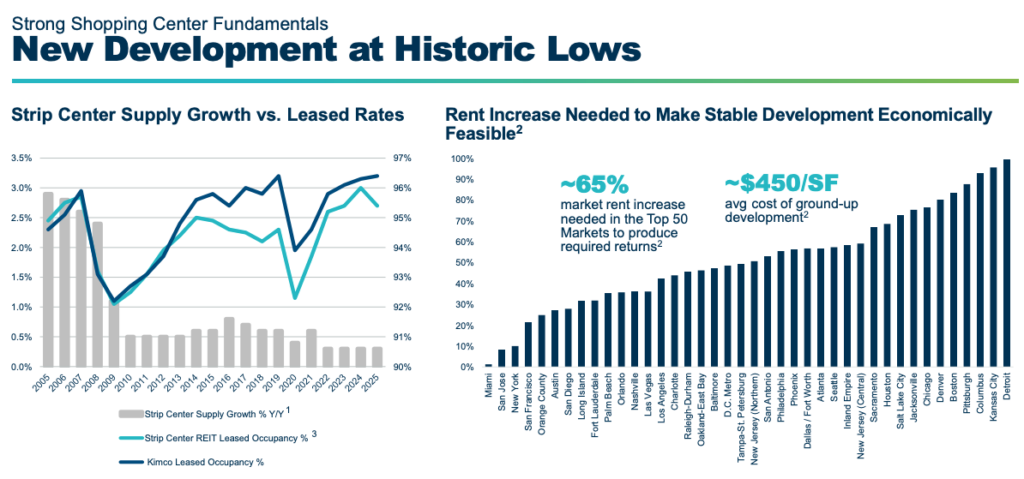
Growth with New developments in the sector (Source: KIM - Investor Presentation Fourth Quarter 2025)
KIM has used the low share prices to buy back around USD 121m of its own shares in 2025 and has also received a (further) rating upgrade. For 2026, management is targeting SPNOI growth of 3 % and FFO growth of 3.5 %.
In view of an FFO multiple of 12.8× and a dividend yield of 4.5 %, further potential is conceivable, especially as the valuation looks favorable by historical standards.
Industrial REITs
Following the pandemic boom, the industrial sector recorded the strongest wave of new builds of all real estate classes. Nevertheless, demand remains robust as e-commerce sales continue to rise and tenants' investment freeze of recent months and years is slowly dissipating. In 2025, overall leasing activity remained at the 2019 level, which is why the simultaneous increase in the construction of new warehouses ec. led to an increase in the vacancy rate. The pipeline is shrinking, as new buildings amounting to around 2 % of the existing stock are currently under development. This is the lowest figure for a decade! Avison Young expects a gradual recovery in 2026 as fewer speculative properties come onto the market and the additional demand stimulus from fiscal incentives (e.g. bonus depreciation for manufacturing plants) appears to be having an effect.
First Industrial Realty Trust
First Industrial Realty (TWS ticker: FR, ISIN: US32054K1034) increased FFO per share by 11.7 % and SPNOI by 7.1 % in 2025. In Q4, SPNOI growth declined to 3.7 %, while utilization fell from 96.2 % to 94.4 %, which is remarkably robust given the strong supply.
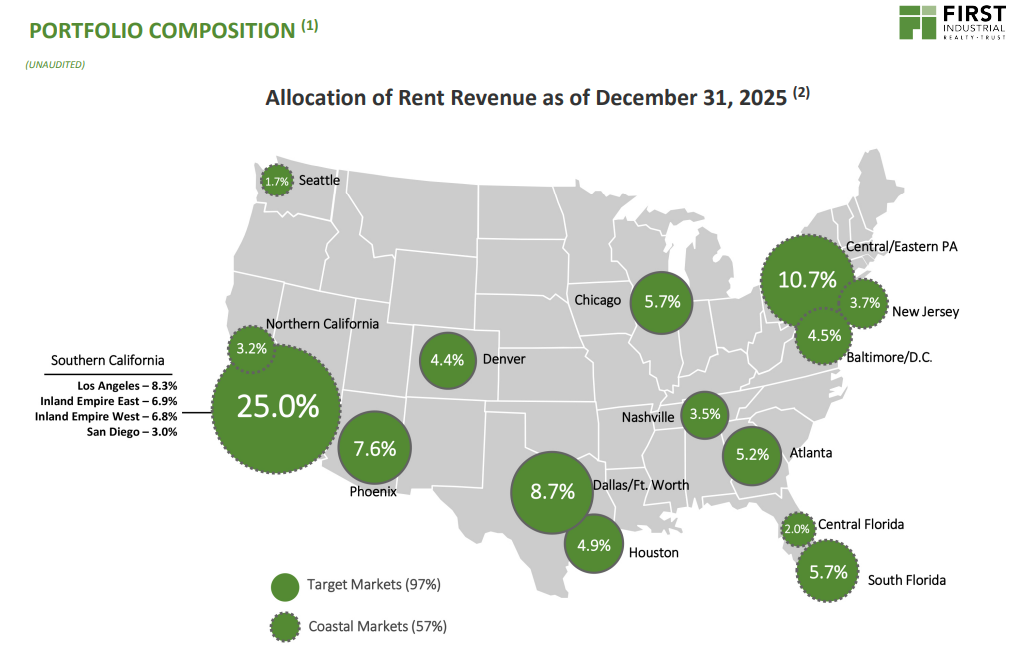
Portfolio FR (Source: First Industrial Realty Trust - Fourth Quarter 2025 Supplemental)
The management has increased the dividend by 12.4 % and secured more favorable credit terms by adjusting the spreads on variable loans. FFO and SPNOI to grow by 6 % each in 2026. Analysts expect a return to ~8 % in 2027.
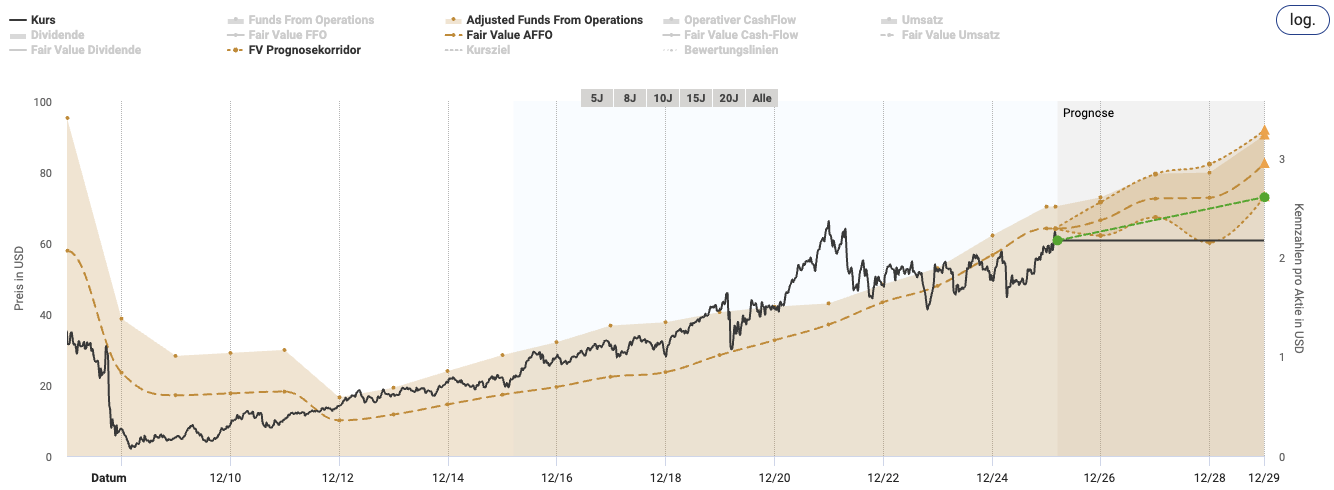
Fair value First Industrial Realty Trust (source: aktienfinder.net)
At 19.3× FFO and a dividend yield of 3.3 %, First Industrial Realty Trust still looks slightly undervalued.
Rexford Industrial
Rexford Industrial (TWS ticker: REXR, ISIN: US76169C1009), the logistics REIT with a pure focus on Southern California, disappointed in 2025 as core FFO only grew by 2.6 % and even declined slightly in the fourth quarter. Although SPNOI increased by 4.3 %, high sales for debt repayment and a low occupancy rate of 90 % (including redevelopment properties) weighed on the figures.
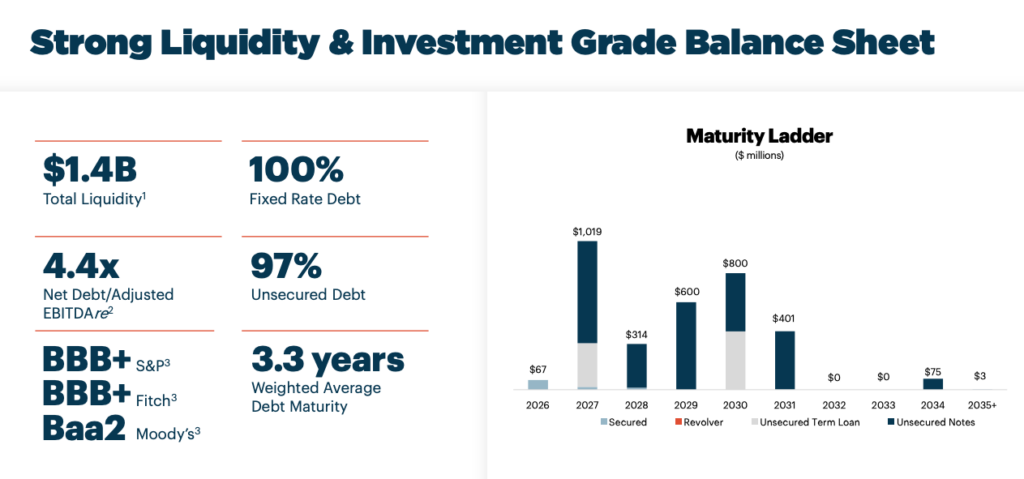
REXR Balance Sheet (Source: Rexford Industrial Realty Earnings Presentation 4Q 2026)
For 2026, management expects SPNOI to decline by 1-2 % and FFO to stagnate. Nevertheless, the structural advantage of the Southern California market with high barriers to entry and long-term e-commerce demand remains. Another advantage is REXR's strong balance sheet (net debt/EBITDA 4.4×) and ongoing share buyback programs.
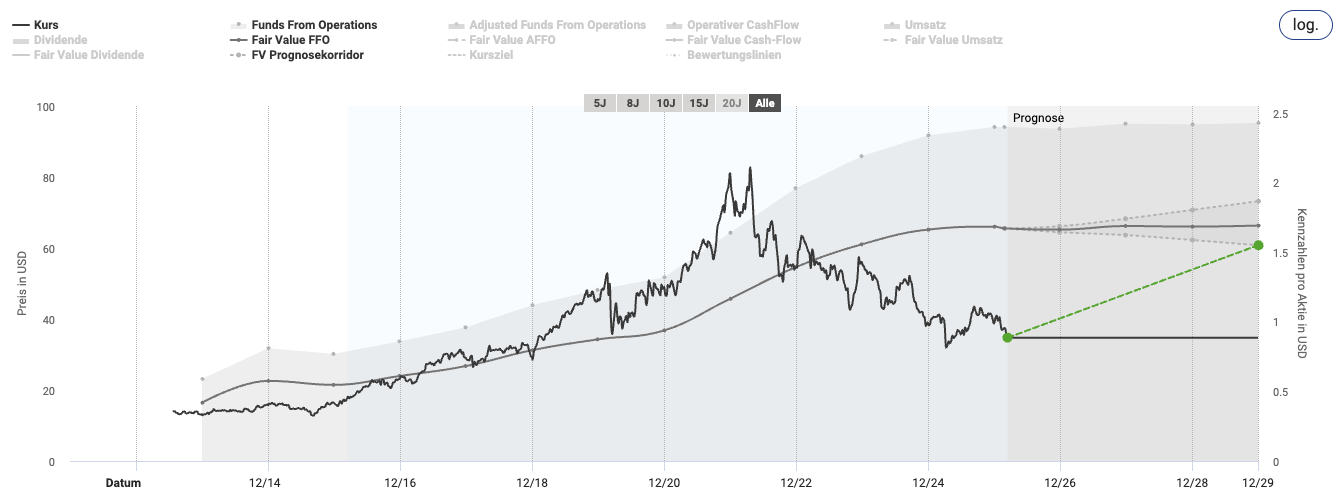
Fair value Rexford Industrial (source: aktienfinder.net)
As REXR is trading at around 14.7× FFO and there are signs of a recovery in 2027, the current valuation is quite attractive, also in view of the historically average multiples.
Options trading
I myself also act actively Optionsbut almost exclusively as a so-called "writer". I am therefore naturally also interested in the REITs mentioned above, which are suitable for additional Cash flow or for a favorable entry by means of delivery. The Volatility (VIX) is back at a level below the 20 mark after a spike. Unfortunately, the spreads at NTST are too high.
- Kimco Realty: For KIM there are at the money Short Puts longer running with Strike of $22.5 in December '26 which deliver a decent premium (slightly higher spread).
- W.P. Carey: In the case of WPC, short puts with a Strike from $65 in May '26 worth a look or longer running with Strike from $65 in January '27 (increased spread)
- VICI Properties: For VICI, ATM Short Puts offer a longer duration with Strike of $27.5 in January '27 that deliver a decent premium.
- NNN REIT: For NNN, short puts with a longer duration with Strike of $40 in September '26 that offer a reasonably interesting premium.
- Rexford Industrial: For REXR, short puts with longer maturities with Strike from $30 in December '26 that deliver a decent premium.
Conclusion
In the fourth quarter of 2025, the most important REIT sectors revealed different dynamics. Shopping centers (retail) remain robust thanks to scarce space and (still) stable consumer demand. Net-lease REITs are benefiting from falling interest rates (this could change) and offer attractive yields. The worst is probably over in the industrial sector. Those with patience could be rewarded over the next few years with REXR, for example.
Ultimately, it remains important to carefully examine the balance sheets (especially debt and maturities), valuation and growth prospects of all REITs. However, with a well-diversified selection from the REITs mentioned, both current income and long-term value appreciation can still be realized.