Welcome back to a new article about REITs and co! Those who drop by regularly know that real estate, and real estate investment trusts in particular, have a higher weighting in my portfolio. Recently, there have been blog posts on individual REITs like Mid-America Apartment Communitiesthe REIT Sector Overview and a quick deep dive into the niche topic Preferred shares.
Today, however, I would like to move up a level, so to speak, because you can not only make money with real estate by owning it directly or investing in it via REITs. Another option is so-called alternative asset managers, which manage institutional capital (and increasingly that of private investors) and thus finance real estate, infrastructure, private credit, and/or private equity, among other things.
Regarding real estate, this has been very interesting for some time now. As early as 2025, a wave of takeovers among publicly traded REITs began to emerge, which accelerated significantly once again in 2026. In Q1 alone, five acquisitions with a volume of approximately 26 billion USD were announced. By comparison, in 2025 there were 14 billion across five deals as well. As a rule, buyers paid high premiums over the stock market price while still getting a bargain.
Well-known names such as Brookfield, Blackstone, Ares, and Blue Owl keep appearing on the buyer side. And today we are taking a closer look at precisely some of these companies, including a small wildcard.
What What do alternative asset managers do?
An Equity REIT typically owns real estate and earns money from the rents generated thereby. The business model of an asset manager works a bit differently. Such companies raise capital from pension and sovereign wealth funds, insurance companies, high-net-worth private clients, or increasingly also from ordinary retail investors, and invest the raised capital in a wide variety of strategies.
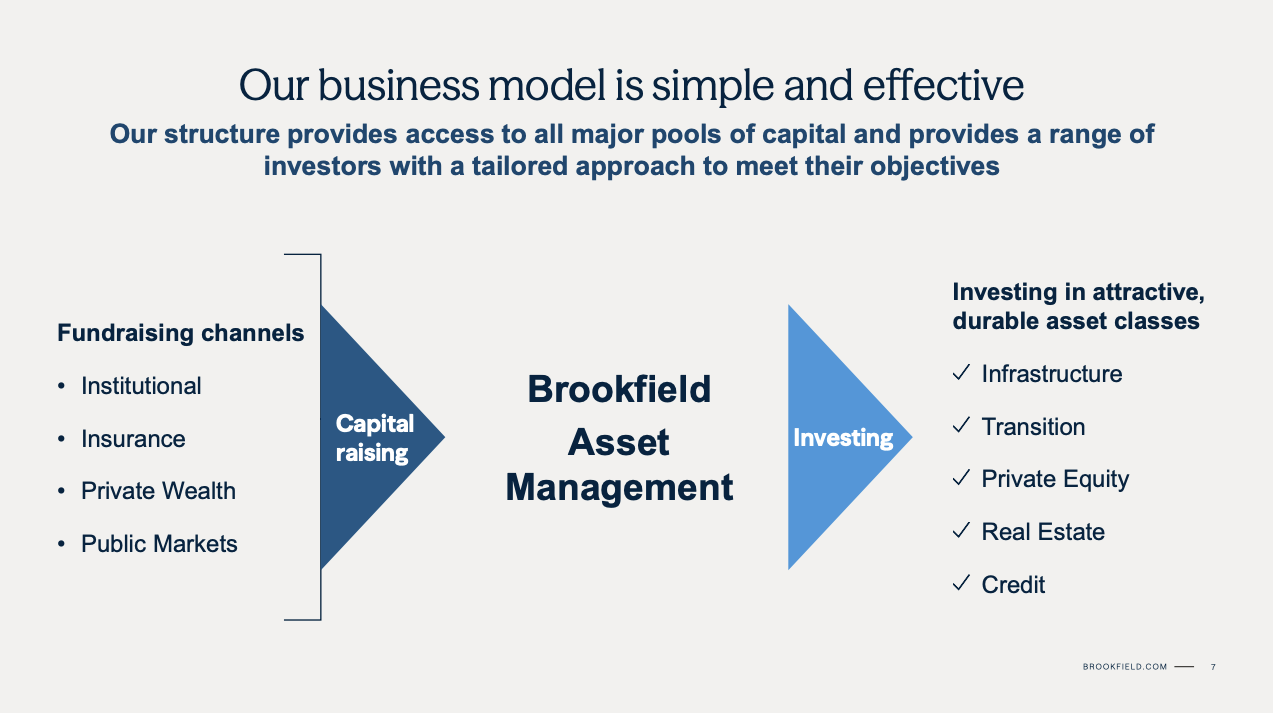
Business model of an alternative asset manager using Brookfield as an example
(Source: Brookfield Asset Management)
In return, the manager receives ongoing management fees, which can be supplemented by so-called performance fees or other types of fees for special successes or the achievement of milestones. The more capital is managed—referred to as AUM (assets under management)—the better the business model can be scaled.
I find one area particularly exciting, namely Permanent Capital. This refers to capital that, unlike a traditional fund, does not have to be repaid within a pre-defined time frame. Publicly traded REITs, as well as BDCs, etc., can provide an alternative asset manager with fees over very long periods of time. For this exact reason, Patria Investments, Blue Owl Capital Inc., Brookfield Asset Management, and Ares Management have invested a lot of money and time in building such structures over the past few years.
Incidentally, this also differentiates the key figures that one should look at with such companies. Instead of AFFO, the P/AFFO multiple, or Net Debt / EBITDA, primarily AUM and the portion of AUM that generates fees (fee-bearing AUM), fee-related earnings, and distributable earnings are of interest. The exact definition differs from company to company, so a direct comparison is only possible to a limited extent.
Patria Investments
I would like to start with probably the least known company, namely Patria Investments (NYSE ticker: PAX, ISIN: KYG694511059). PAX is originally a Latin American asset manager that focuses, among other things, on private equity, infrastructure, real estate, and credit. In the meantime, the company is also advancing in Europe and the USA and manages assets of more than 62 billion USD.
Especially in the real estate sector, Patria has repeatedly appeared on the scene for several years now. Through multiple acquisitions, the company has grown significantly and has built a rather interesting position, particularly in Brazil. For example, the acquisition of RBR Gestão added another roughly 1.3 billion USD in fee-earning AUM. Patria Investments has thus further expanded its position as the largest independent manager of publicly traded REITs (or Brazilian FIIs, so-called Fundos de Investimento Imobiliário). RBR had managed twelve funds, eleven of which were publicly traded real estate funds. Together with its existing platforms, Patria's real estate business has grown pro forma to approximately 8.5 billion USD in fee-earning AUM.
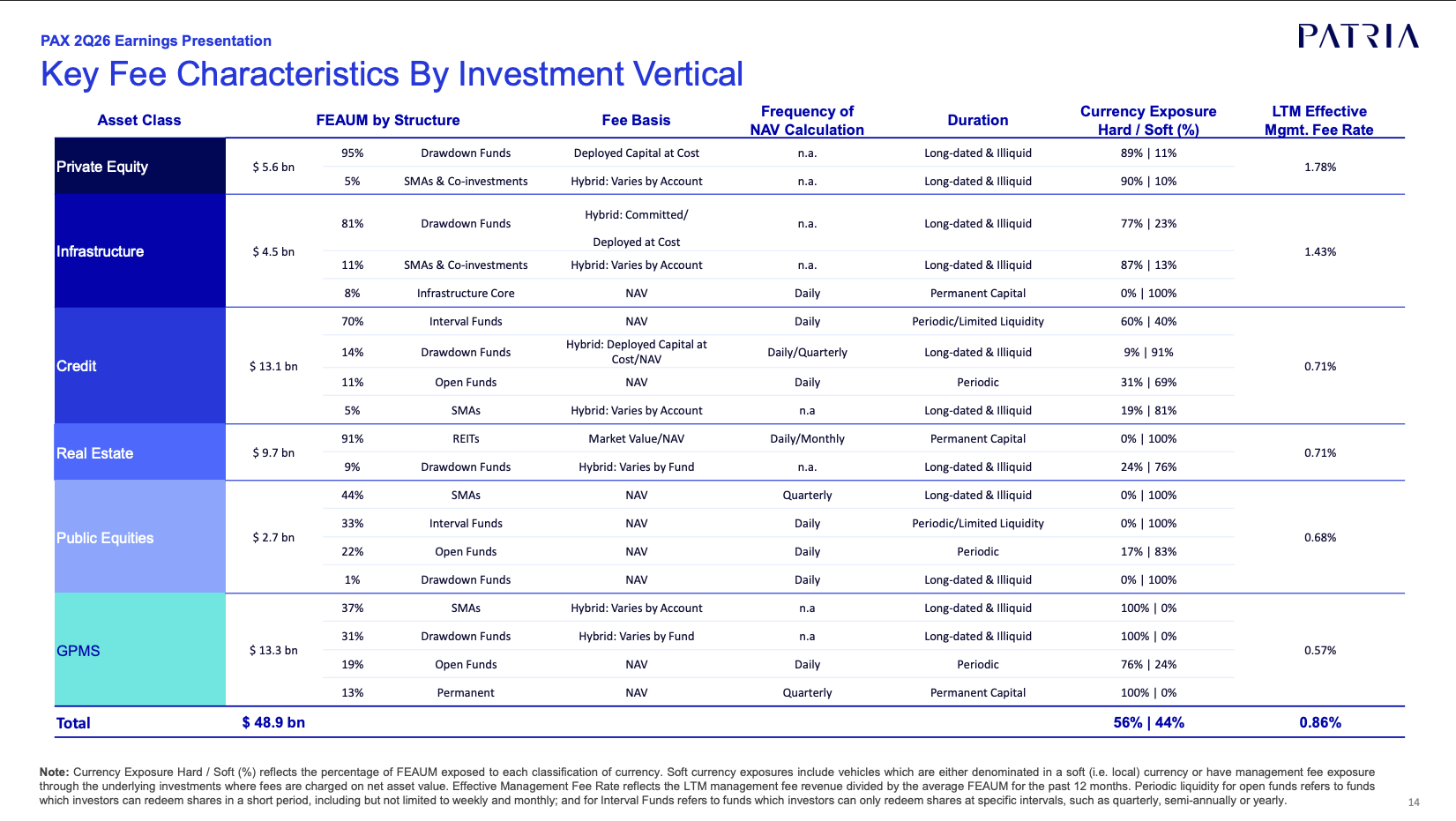
Overview of Asset Classes in the PAX Portfolio (Source: Patria Investments 2Q26 Earnings Presentation)
I like this especially because, at the time of the RBR acquisition, about 90 % of Patria’s real estate business consisted of Permanent Capital. So the corresponding management fees don’t just disappear because a fund is liquidated after a few years. This expansion of Permanent Capital is one of the reasons why I find Patria’s development particularly exciting.
Current developments at Patria
Operationally, things have also been going well recently. In Q2 2026, Patria raised $2.3 billion in new capital, bringing the total for the first half of the year to $4.5 billion. Fee-earning AUM rose by 32 % to USD 48.9 billion compared to the previous year. Approximately USD 11 billion, or 22 %, of this amount is now attributable to Permanent Capital.
Fee-related earnings rose by 24 % to 57.1 million USD in the second quarter, while distributable earnings per share increased by as much as 31 % to 0.32 USD. For the full year, management expects fee-related earnings to range between 225 and 245 million USD.
Patria is not only growing organically in the process. At the beginning of 2026, the majority acquisition of Solis was completed, adding approximately USD 3.5 billion in fee-earning AUM from the Brazilian private credit business. In addition, with WP Global Partners, a US platform with another approximately USD 1.8 billion in fee-earning AUM was acquired.
Of course, this growth does not come without additional risks. Patria is significantly more dependent on Latin America, and Brazil in particular, than the other three companies in this article. Added to this are currency risks and the task of properly integrating the many acquired platforms.
However, its valuation is significantly lower than that of its major U.S. peers. With a share price of around $11.50 and a most recent quarterly dividend of $0.1625, the annualized dividend yield stands at approximately 5.7%. For me, Patria is therefore the outlier in this comparison, but at the same time, it is also the company with the most direct connection to publicly traded real estate funds.
Blue Owl Capital Inc.
At Blue Owl Capital Inc. (TWS ticker OWL, ISIN: US09581B1035), not to be confused with the corp. of the same name (which is a BDC), things look a bit different. The company now manages 319 billion USD and divides its activities into Credit, Real Assets, and GP Strategic Capital. The Real Assets platform alone accounts for 89.4 billion USD. It houses more than 6,100 properties and over 870 tenant relationships or partnerships.
That naturally makes Blue Owl far more than just a real estate manager. Even so, real estate has evolved into one of the most important growth drivers. The net lease sector is of particular interest to me. For example, Blue Owl invests there in industrial properties, healthcare, essential retail, and data centers, which are typically leased long-term to individual companies.
We recently saw in Europe as well that this has now reached quite large dimensions. At the beginning of August, the first European Net Lease fund closed with capital commitments of over 1.6 billion euros. Originally, Blue Owl had only wanted to raise one billion euros. The fund is intended to invest in industry, logistics, healthcare, life science, data centers, and necessity-driven retail real estate, among other sectors.
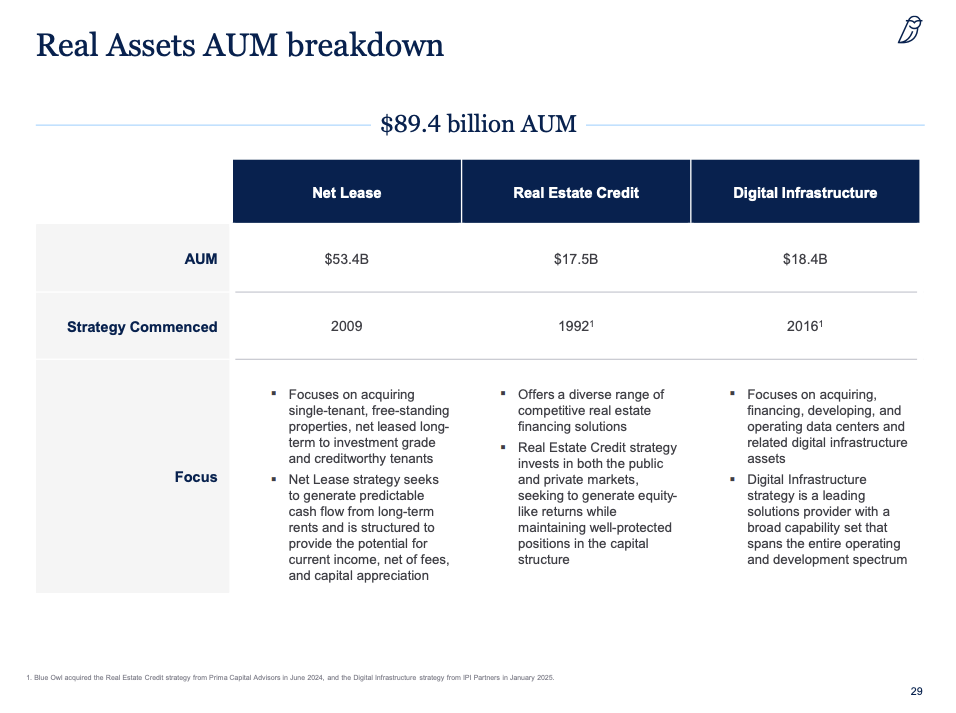
Overview OWL Real Assets AUM (Source: Blue Owl Capital Inc. Second Quarter 2026)
From STORE Capital to Sila Realty
Blue Owl is also attractive to REIT investors because the company frequently makes direct appearances in the publicly traded real estate market. In April, for example, Blue Owl announced the acquisition of Sila Realty Trust. The transaction valued Sila at approximately $2.4 billion and offered shareholders a premium of about 19 % over the previous closing price. The acquisition was completed in July.
This fits quite well with the current environment. Publicly traded REITs continue to be valued more attractively in some areas than comparable properties in the private market. For large asset managers, who have to invest billions in capital anyway, entire REIT portfolios can therefore be more attractive than the tedious acquisition of individual properties.
Another growth driver is data centers, in the construction and operation of which vast amounts of capital are currently known to be invested. This is precisely where I see a somewhat curious contrast to the discussion surrounding artificial intelligence. Blue Owl has temporarily come under significant pressure due to problems in the private credit sector and fears of potential loan defaults at technology companies. At the same time, through its real assets platform, the company is one of the major capital providers for the infrastructure that is needed in the first place for the further expansion of AI.
That does not mean, however, that I would completely ignore the concerns in private credit. The default rate in the US private credit market has recently risen, and there have been increased redemption requests for certain semi-liquid funds. Blue Owl products have also been affected by this. At the same time, however, the 319 billion USD in AUM is now significantly more diversified than it was a few years ago.

Dividend history of Blue Owl Capital Inc. since 2023 (Source: DivvyDiary)
With a share price most recently ranging between $11.50 and $12 and a quarterly dividend of $0.23, Blue Owl currently offers a dividend yield of around 8 %. This is by far the highest figure in this comparison and also shows just how much skepticism is currently priced in.
Brookfield Asset Management
From a relatively young market capitalization, we move to arguably one of the best-known names in the real assets sector. With Brookfield, one must first be careful which stock is actually being considered. Brookfield Corporation is listed under the TWS ticker BN (ISIN: CA11271J1075), while Brookfield Asset Management is traded under the TWS ticker BAM (ISIN: CA1130041058).
In this article, I am interested in BAM, because that's where the asset management business is housed. Brookfield itself describes BAM as an asset-light investment manager whose earnings are largely derived from recurring fees. In total, more than one trillion USD is now being managed!
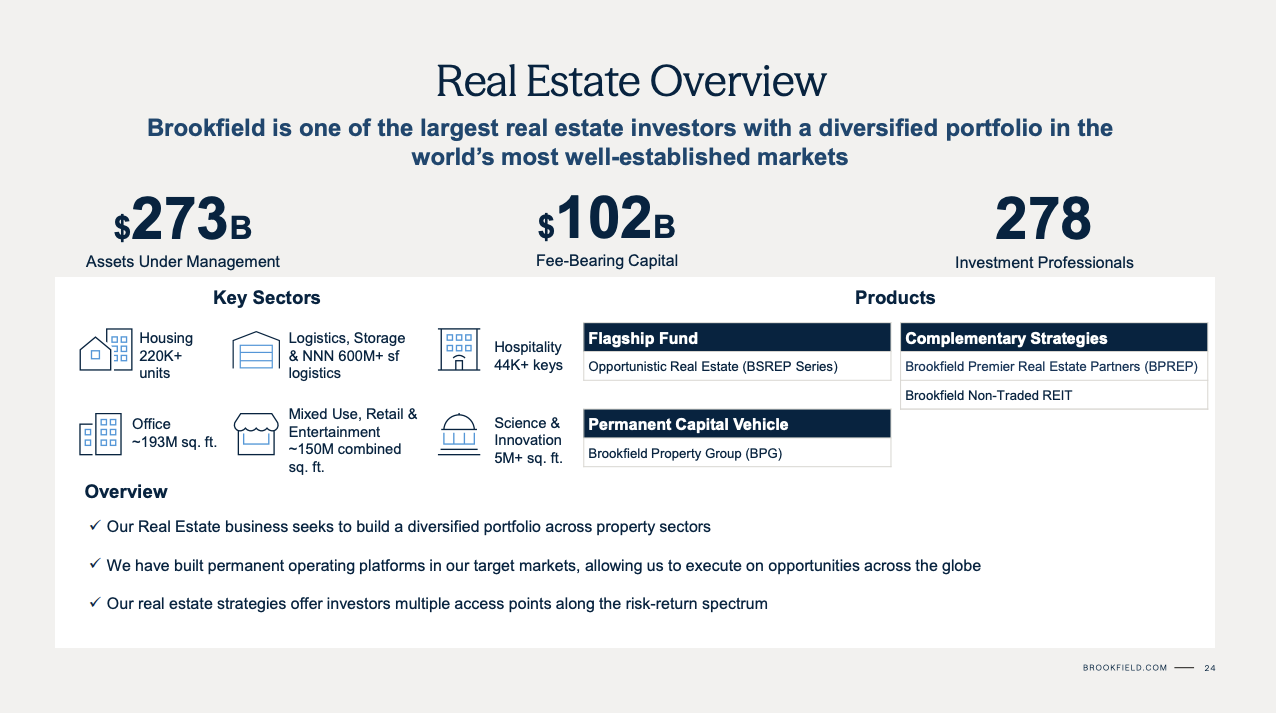
Overview of Brookfield's Real Estate Segment
(Source: Brookfield Asset Management Investor Presentation February 2026)
Brookfield is by no means a pure real estate manager. Infrastructure, renewable energy, private equity, and credit also play a major role. However, the group's roots lie firmly in real assets, and hardly any other asset manager has comparable operational experience in real estate and infrastructure.
Size creates opportunities
The second quarter of 2026 demonstrated quite impressively the economies of scale that have now been achieved. Brookfield raised a whopping $77 billion in new capital within three months, bringing the total for the first half of the year to $98 billion. Fee-bearing capital rose by 19 % year-over-year to $672 billion. Fee-related earnings increased by 20 % to $808 million, and distributable earnings rose by 15 % to $707 million.
In the real estate sector, too, Brookfield has become more aggressive again. In the second quarter, around USD 4.3 billion was raised and approximately USD 5.2 billion was invested. Among other things, Brookfield acquired a large US manufactured housing portfolio. In addition, there are several acquisitions of publicly listed real estate companies.
Peakstone Realty Trust is a good example of this. Brookfield acquired the industrial REIT in early 2026 for approximately $1.2 billion, paying a premium of about 34 % over the previous stock price. By the end of 2025, a consortium led by Brookfield and GIC had also acquired the Australian National Storage REIT adopted.
This clearly shows the advantages that scale brings. Brookfield can not only raise billions, but subsequently deploy them into transactions that would simply be too large for smaller asset managers.
The downside is the valuation. The market already treats BAM as a high-quality company, and it is therefore valued significantly higher than Patria Investment or, currently, Blue Owl Capital. The quarterly dividend is $0.5025, which translates to a dividend yield of just under 3.8% at a share price of around $53.
In my view, you get the broadest and qualitatively strongest business model of this selection in return. Anyone looking less for maximum dividend yield and more for long-term growth and economies of scale when it comes to an alternative asset manager will therefore likely find BAM to be the best fit.
Ares Management as an alternative
As a fourth value, I would also like to look at Ares Management (TWS ticker ARES, ISIN: US03990B1017). Ares, too, is significantly more than a real estate manager and is primarily known for its large private credit segment. Nevertheless, the real assets division is now considerable.
At the end of Q2, Ares had a total of 671.3 billion USD under management. Of that amount, approximately 151 billion USD was in the Real Assets segment. At the same time, total AUM grew by 17 % compared to the previous year.
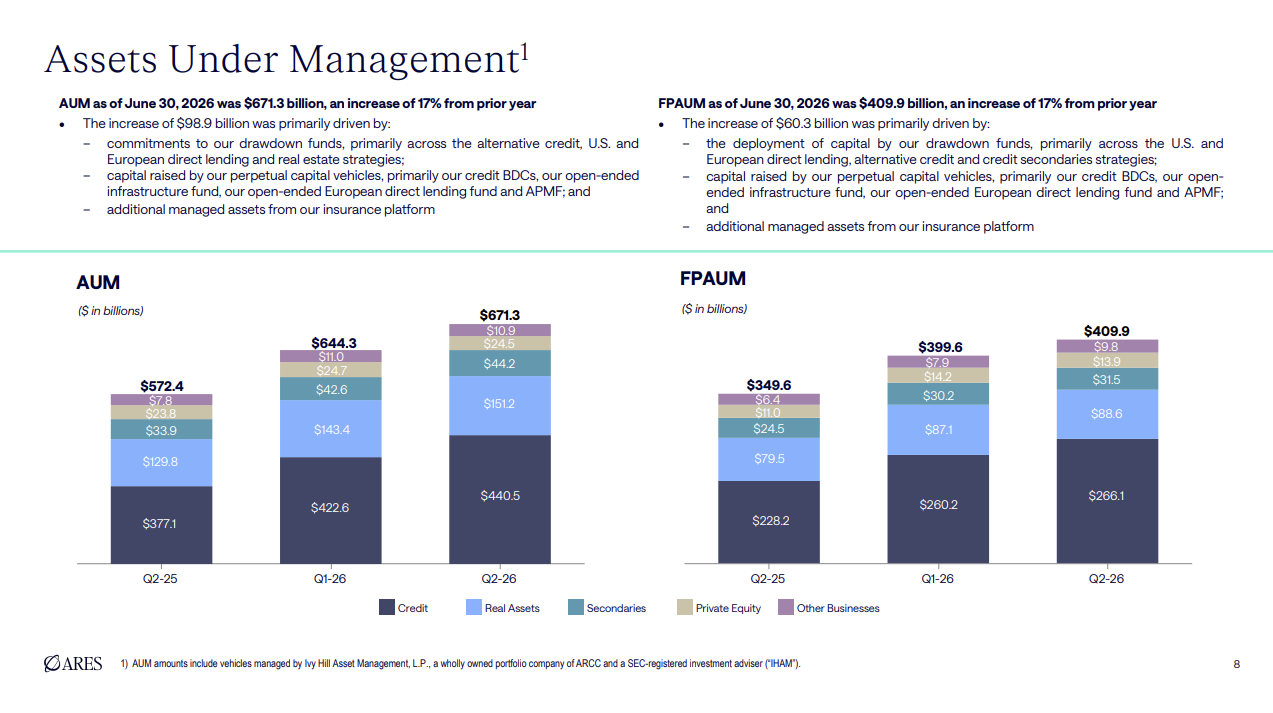
Ares Management - Assets Under Management
(Source: Ares Management Corporation Reports Second Quarter 2026 Results)
I find the current momentum in fundraising particularly noteworthy. In the second quarter, Ares raised more than 36 billion USD in new capital, setting a new record. Of that amount, 9.7 billion USD flowed into real assets strategies. Fee-related earnings, at $491 million, were also approximately 20 % above the previous year’s figure. At the same time, approximately $170 billion in uninvested capital was available.
For this article Ares is naturally suited especially because of Whitestone REIT. Ares hat the takeover of the shopping center REIT The transaction was completed in July, after a purchase price of approximately 1.7 billion USD had been agreed upon in April. Based on the unaffected stock price, the premium was approximately 26 %.
Here, too, a large asset manager has therefore acquired a publicly traded real estate portfolio after the stock market had valued it significantly lower for a longer period of time.
Ares's dividend was raised to $1.35 per quarter this year. At prices in the range of around $143, this also corresponds to a yield of just under 3.8 percent.
For me, Ares would be the alternative to Brookfield in this comparison. Although the company has a heavier weighting in private credit, it also now possesses an enormous real assets platform and has shown over the past few years that it can very successfully raise and scale capital.
Comparison
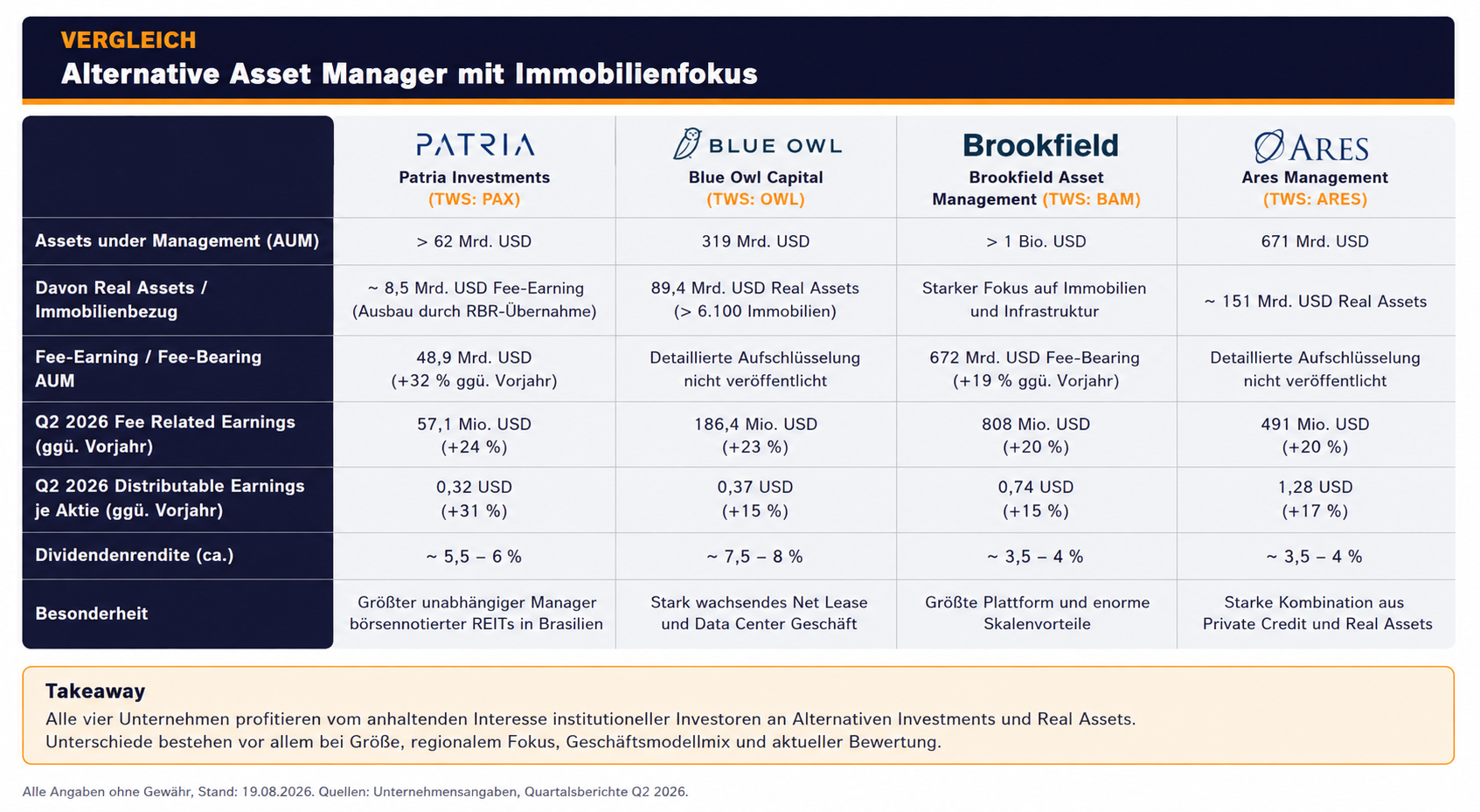
Comparison of the alternative asset managers discussed in the article
(Source: own illustration)
Options trading
I myself trade actively Options, but almost exclusively as a so-called "writer" (option seller). Therefore, I am naturally also interested in which of the above-mentioned securities are suitable for additional Cash flow or for a favorable entry by means of delivery. The Volatility (VIX) is currently at a low level of ~16, meaning the premiums are correspondingly small, and it must be noted that selling put options is not the best idea in this situation. Nevertheless, for the sake of completeness, I would like to point out a few interesting possibilities:
- Patria InvestmentsFor PAX, there are Short Puts mit Strike by $10 in January '27 that provide a decent bonus
- Blue Owl Capital Inc.At OWL, longer-term short puts offer Strike by $11 in October '26 or longer continuously with Strike by $10 in August '27 to
- Brookfield Asset ManagementAt BAM, longer-term short puts offer themselves with Strike by $50 in October '26 or longer continuously with Strike by $50 in January '28 to
- Ares ManagementFor ARES, long-term short puts are suitable with Strike by $130 in June '27 to
Conclusion
Alternative asset managers are not REITs, and I wouldn't consider them a replacement for traditional real estate stocks either. To me, however, they are a complementary element. Instead of collecting the rental income of individual properties yourself, you earn money here from the fees on ever-increasing amounts of capital, which in turn are invested in real estate, infrastructure, credit, and other alternative investments.
This year in particular shows quite well why this sector is interesting. While many publicly traded REITs continued to trade at discounts to their private real estate values, the major players began to exploit this exact difference and take one REIT after another off the market.
Patria Investments occupies a special position in this regard because the company has itself built a large platform of publicly traded Brazilian real estate funds and, with just over USD 60 billion in AUM, is still significantly smaller. Precisely this brings additional risks, but also opens up more growth potential.
I currently like Blue Owl Capital primarily due to the combination of a high dividend yield, the rapidly growing Real Assets segment, and the increasing importance of net lease and data centers. Brookfield Asset Management, on the other hand, would be my quality favorite if valuation and current distribution were less important or if that were the case. Ares Management is also a very interesting alternative that, with a Real Assets platform now exceeding 150 billion USD, should by no means be viewed merely as a private credit manager.
For REIT investors, taking a look one floor higher is certainly worthwhile. After all, sometimes it is not only interesting to know who owns the real estate, but also who manages the capital used to buy it!